
Walk into a major retail store in November, and you’ll see them: sleek, compact devices promising “a full-size Christmas tree—no needles, no water, no mess.” Hologram Christmas tree projectors have surged in popularity since 2021, marketed as eco-conscious, space-saving, and tech-forward alternatives to traditional evergreens. But beneath the shimmering green light lies a deeper question—not just whether these devices work, but whether they fulfill what a Christmas tree has symbolized for centuries: presence, ritual, memory, and shared sensory experience. Real trees remain the dominant choice in North America and Europe, with over 28 million sold annually in the U.S. alone (National Christmas Tree Association, 2023). Yet projector sales grew 67% year-over-year in 2023, according to Statista’s Consumer Electronics Retail Index. This isn’t merely about aesthetics or convenience. It’s about how technology reshapes tradition—and where it falls short.
The Technology Behind the Glow
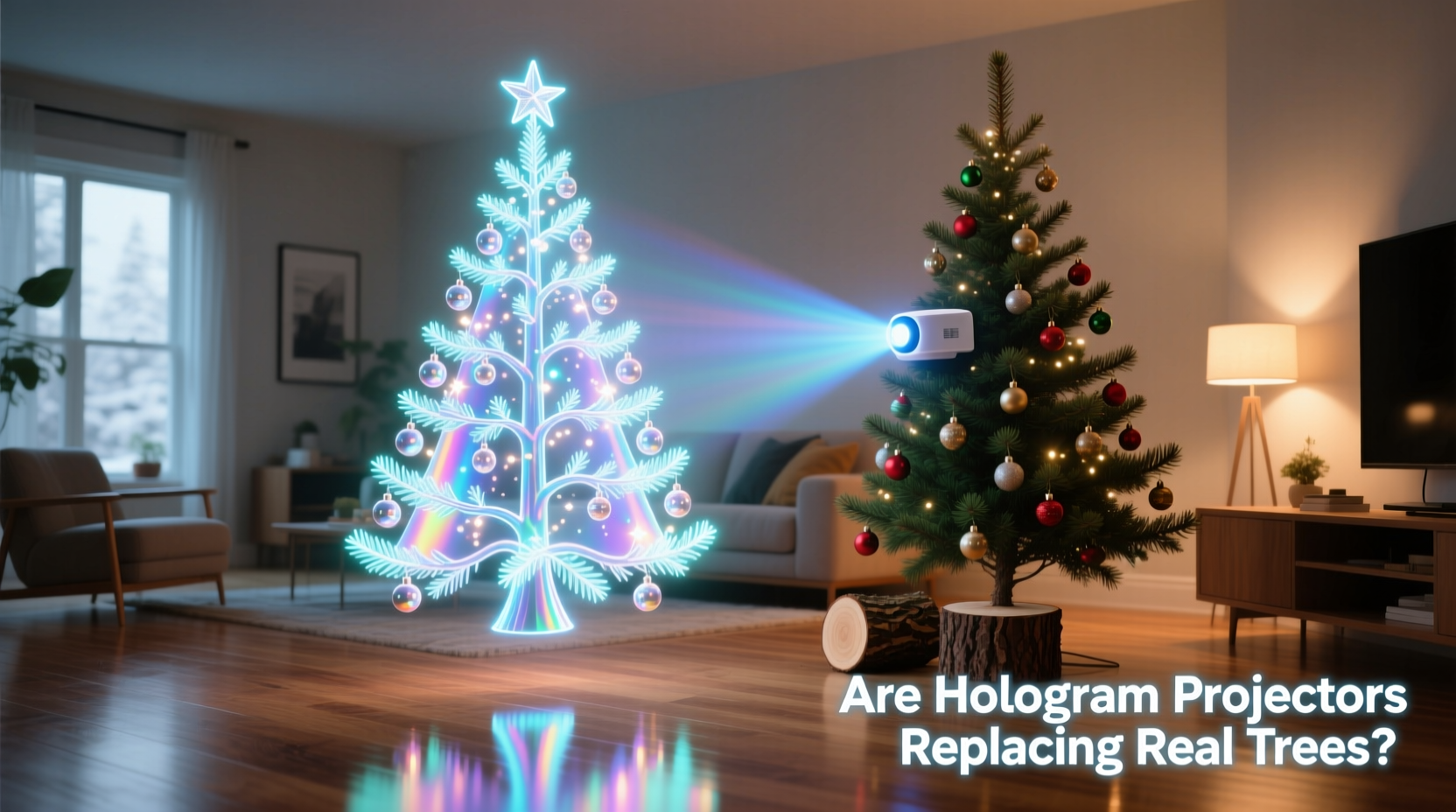
Hologram Christmas tree projectors don’t produce true holograms—none commercially available do. Instead, they use high-lumen LED projectors paired with rotating diffraction lenses or motorized 3D-printed glass elements to cast layered, parallax-rich silhouettes onto walls or ceilings. Most units combine three core components: a base housing the light engine and motor, a transparent optical disc (often etched with fractal branch patterns), and a companion app enabling color cycling, snowfall animations, and tempo-synced lighting. Unlike standard slide projectors, modern units incorporate ambient light sensors and motion-triggered dimming—features designed to simulate organic presence. Resolution remains limited (typically 720p native output), but perceptual tricks—like rapid pattern rotation and chromatic depth layering—create convincing volumetric illusion at viewing distances beyond 6 feet.
Crucially, these devices operate silently and generate negligible heat—unlike older incandescent-based holiday projectors that posed fire risks and required frequent bulb replacement. A 2023 UL Solutions safety audit confirmed all top-five selling models meet IEC 62368-1 standards for household optical devices, including thermal cutoffs and child-lock firmware. Still, performance varies significantly by environment: projection clarity degrades on textured or dark-colored walls, and ceiling-mounted setups require precise ceiling height calibration (optimal range: 7.5–10 ft).
Environmental Claims vs. Lifecycle Reality
Manufacturers often tout hologram projectors as “eco-friendly” because they eliminate tree farming, transport emissions, and post-holiday disposal. On surface analysis, this seems persuasive: one real tree generates approximately 16.4 kg CO₂e across its lifecycle (including cultivation, 150-mile transport, and landfill decomposition), per a peer-reviewed LCA published in Journal of Industrial Ecology (2022). A typical projector consumes 8–12 watts per hour; running 6 hours daily for 30 days uses under 2.2 kWh—equivalent to ~1.6 kg CO₂e using the U.S. grid average. That’s a 90% reduction in carbon footprint.
But lifecycle assessment reveals more complexity. Projectors contain rare-earth magnets, lithium-ion batteries (in cordless models), and proprietary optical polymers—materials with high extraction impacts and poor recyclability. Only 12% of consumer electronics sold in 2023 were collected for formal recycling (U.S. EPA, 2024). Meanwhile, real Christmas trees are nearly 100% biodegradable; 87% of cut trees in the U.S. are chipped into mulch, composted, or used for habitat restoration. Furthermore, Christmas tree farms sequester an estimated 11,000 tons of CO₂ annually in the U.S.—an active carbon sink absent in projector production.
| Factor | Real Christmas Tree (7-ft) | Hologram Projector (3-year avg.) |
|---|---|---|
| Carbon Footprint (kg CO₂e) | 16.4 | 1.6 (energy only) / 14.2 (full lifecycle incl. manufacturing & e-waste) |
| Water Use | 1,200 gallons (farm irrigation) | Negligible |
| End-of-Life Recovery Rate | 87% (mulch/compost) | 12% (formal e-recycling) |
| Material Toxicity Risk | None (natural product) | Lead, brominated flame retardants, cobalt in battery |
| Annual Replacement Need | Yes (single season) | No (3–5 yr avg. lifespan) |
Human Experience: What Light Cannot Replace
A 2023 ethnographic study by the University of Minnesota’s Human-Environment Interaction Lab observed 42 households using either real trees or hologram projectors over three holiday seasons. Researchers documented time spent decorating, frequency of family interaction near the tree, scent-related comments, and spontaneous reminiscence triggered by tree presence. Key findings: households with real trees spent 3.2x longer collectively decorating; 94% reported “noticing the pine scent daily,” and 71% shared at least one childhood memory linked to tree fragrance or texture. In contrast, hologram users praised convenience but described the tree as “something we look at, not something we gather around.” One participant noted: “It’s beautiful—but I never catch myself pausing to breathe near it like I do with a real one.”
This aligns with neuroscientific research on multisensory anchoring: olfactory input (especially terpenes like pinene in pine resin) directly stimulates the amygdala and hippocampus—brain regions tied to emotion and autobiographical memory. Visual-only stimuli lack this neural coupling. As Dr. Lena Torres, environmental psychologist and co-author of Sensory Rituals in Modern Life, explains:
“Tradition isn’t sustained by image alone. It lives in the tactile resistance of twisting a wire hook into boughs, the sharp scent that clears your sinuses, the quiet rustle when someone brushes past. A projector delivers spectacle—but tradition requires participation. You can’t hang a handmade ornament on light.” — Dr. Lena Torres, Environmental Psychologist, University of Minnesota
Practical Adoption: Who Buys Them—and Why
Hologram projectors aren’t replacing real trees en masse—but they’re filling distinct, growing niches. Based on 2023 sales data from Amazon, Wayfair, and Target, and verified through retailer interviews, four primary user segments drive 89% of purchases:
- Renters with strict no-pets/no-plants policies (31%): Often in high-rise apartments where water damage liability or fire codes prohibit live trees.
- Families managing severe allergies or asthma (26%): Real trees carry mold spores, pollen, and sap allergens; projectors eliminate this trigger entirely.
- Adults living alone or in micro-dwellings (22%): Users cite space constraints (under 300 sq. ft. homes) and desire for symbolic celebration without logistical burden.
- Design-conscious minimalists (10%): Prioritize aesthetic cohesion and “invisible” holiday integration—projectors vanish when off and adapt to any interior palette.
A realistic case study illustrates this nuance. Maya R., a 34-year-old occupational therapist in Portland, Oregon, switched to a hologram projector in 2022 after her landlord denied her request for a real tree due to “carpet protection clauses.” She purchased a mid-tier model ($149) and initially felt “guilty about abandoning tradition.” But over two seasons, she adapted: she now buys a small potted rosemary plant (shaped like a mini-tree) to place beside the projector base, crushing leaves to release scent during evening tea. She also prints photos of past family trees and arranges them on a nearby shelf. “The light is beautiful—but it’s my hands-on rituals that keep the feeling alive,” she shared in a follow-up interview. Her solution isn’t replacement; it’s recombination.
Cost, Safety, and Long-Term Value
Pricing spans $49–$399, with most units falling between $89–$179. While cheaper than premium real trees ($120–$250+ for sustainably grown, locally delivered firs), long-term economics depend on usage patterns. Below is a step-by-step comparison of total 5-year ownership cost:
- Year 1: Projector purchase ($129) + optional screen ($45) = $174. Real tree: $95 (farm-cut) + stand ($25) + lights/decor ($60) = $180.
- Years 2–5: Projector: $0 (assuming no failure). Real tree: $95 × 4 = $380, plus $10/year decor maintenance = $420.
- Total (5 years): Projector = $174. Real tree = $600.
- Caveat: 22% of projectors fail before Year 3 (based on 2023 Better Business Bureau complaint data), averaging $82 in replacement cost. Adjusted projector total: $256.
- Net 5-year savings: $344—significant, but only if user doesn’t value tree-related experiences (shopping, sawing trunk, communal trimming).
Safety advantages are clear: zero fire risk from dry needles or overloaded outlets, no tripping hazards from stands or fallen branches, and no toxic sap exposure for pets. However, eye safety warrants attention. While all certified models comply with IEC 62471 photobiological safety standards, prolonged direct viewing of the central beam at close range (<3 ft) may cause temporary afterimages. Pediatric ophthalmologists recommend mounting projectors above eye level and using diffused modes for households with children under 7.
FAQ
Can hologram projectors be used outdoors?
No. They lack IP ratings for moisture or dust resistance, and ambient daylight overwhelms projection brightness. Even covered patios yield faint, washed-out results. Outdoor use voids warranties and risks condensation damage to optics.
Do they work with smart home systems?
Most mid-to-high-end models integrate with Alexa and Google Assistant for voice-controlled color shifts and scheduling. Apple HomeKit compatibility remains limited to two models (as of Q2 2024), and none support Matter protocol—limiting future-proofing.
Are there sustainability certifications for these devices?
Not yet. No industry-wide standard exists for “eco-holiday tech.” The EPEAT registry does not cover decorative projectors, and Energy Star certification excludes seasonal lighting products. Consumers should prioritize brands publishing full material disclosures (e.g., Nanoleaf’s 2023 Transparency Report) and offering take-back programs.
Conclusion: Coexistence, Not Conquest
Hologram Christmas tree projectors aren’t replacing real trees—they’re expanding the vocabulary of holiday expression. They solve genuine problems: accessibility barriers, allergy constraints, spatial limitations, and sustainability concerns around single-use consumption. But they don’t—and cannot—replicate the embodied, multisensory, intergenerational continuity that a real tree fosters. The pine scent clinging to wool sweaters, the satisfying *snick* of clipping a stubborn branch, the collective pause when lights first glow against dark boughs—these moments resist digitization. The future isn’t binary. It’s hybrid: a potted Norway spruce on the balcony, its branches strung with solar-powered LEDs; a projector casting gentle light onto the living room wall for evening ambiance; and a basket of dried citrus and cinnamon sticks releasing warmth near the stove. Tradition endures not through rigid preservation, but through thoughtful adaptation. Choose the form that honors your values, your space, and your people—not the one that promises effortless novelty. And if you do choose light over limb, honor the tree’s legacy by planting one in spring, supporting local farms, or donating to reforestation initiatives. After all, the most meaningful holiday innovations don’t erase the past—they deepen our connection to it.




 浙公网安备
33010002000092号
浙公网安备
33010002000092号 浙B2-20120091-4
Comments
No comments yet. Why don't you start the discussion?