
Every holiday season, new lighting technologies promise to transform homes into winter wonderlands with minimal effort. Among the most talked-about innovations are holographic Christmas projectors—devices that claim to cast shimmering, three-dimensional light displays across lawns and walls without tangled wires or ladders. But one claim stands out from the rest: that these projectors produce a \"floating light effect,\" as if ornaments, snowflakes, or Santa himself hover in midair. Is this real, or just clever marketing? Let’s look beyond the sparkle and examine what these devices actually do, how they work, and whether they deliver on their most captivating promise.
The Science Behind the “Floating” Illusion
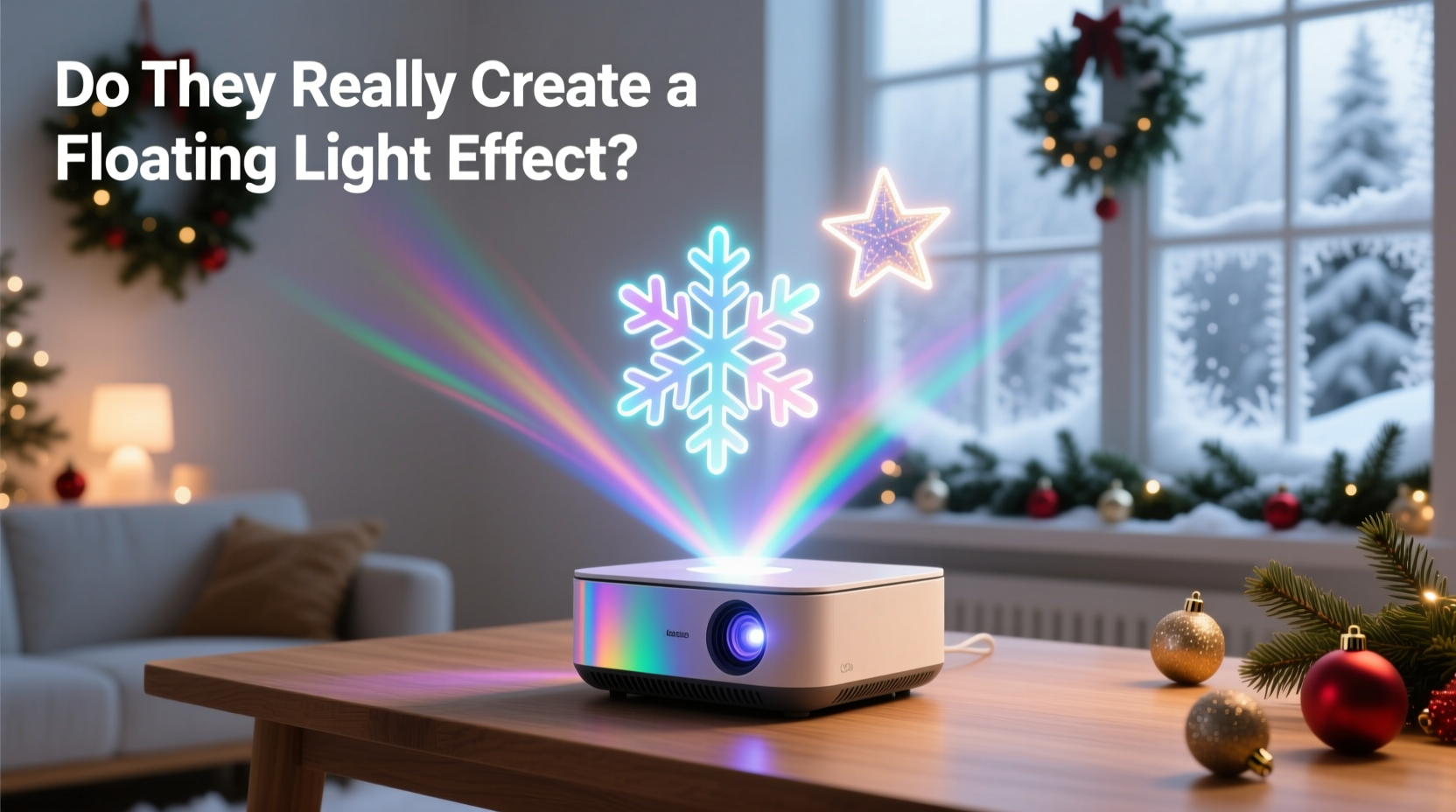
Holographic Christmas projectors don’t use true holography in the scientific sense. Real holograms—like those seen in research labs or museums—involve laser interference patterns and complex optical setups to create images that appear to have depth and can be viewed from multiple angles. Consumer-grade holiday projectors take a different approach. They typically use high-lumen LED lights combined with rotating or oscillating lenses and pre-loaded digital animations to project dynamic scenes onto surfaces.
The so-called \"floating\" effect is largely an optical illusion created through motion, contrast, and ambient darkness. When a projector casts a slow-moving snowflake animation against a dark wall or sky, the lack of reference points makes it difficult for the human eye to judge distance. This visual ambiguity tricks the brain into perceiving depth where none exists. Additionally, some models incorporate dual-laser systems or layered projections to simulate parallax—the way objects shift relative to each other when viewed from different angles—further enhancing the illusion of three-dimensionality.
“While these aren't true volumetric displays, the perceptual effect can be remarkably convincing under the right conditions.” — Dr. Lena Torres, Optical Perception Researcher, MIT Media Lab
However, there's no actual light suspended in space. The beams must reflect off a surface to be visible. In open air, photons pass unseen unless scattered by particles like fog or dust. That’s why the most convincing \"floating\" effects occur at night, on textured walls, fences, or lightly frosted windows—surfaces that diffuse light softly, blurring hard edges and creating a dreamy, ethereal glow.
How Holographic Projectors Work: A Technical Breakdown
Understanding the mechanics behind these devices helps clarify what’s possible—and what’s exaggerated. Most modern holographic Christmas projectors operate using one of two methods: digital micro-mirror device (DMD) projection or laser scanning.
- DMD-based projectors use a chip with thousands of microscopic mirrors to reflect light and form images pixel by pixel. These are common in budget and mid-range models and often rely on pre-programmed GIF-like animations of falling snow, dancing reindeer, or glowing trees.
- Laser scanning systems use rapidly moving laser beams controlled by galvanometer motors to \"draw\" shapes in the air. These can achieve sharper lines and smoother motion but require precise calibration.
Neither method creates light that hovers independently. Instead, both depend on projecting onto physical surfaces. However, laser scanning comes closer to mimicking floating effects because the beam can be modulated quickly enough to leave afterimages. When a red dot traces a circular path faster than the eye can follow, it appears as a continuous ring—similar to waving a sparkler at night. Some advanced holiday projectors exploit this persistence of vision to make stars or ornaments seem to drift through space.
Still, physics imposes limits. Without a medium to scatter the light—such as fog, mist, or smoke—the beam remains invisible mid-flight. This is why true \"in-air\" holograms remain confined to specialized environments like theme parks or concerts using haze machines and aerial screens.
Real-World Performance: What Users Actually Experience
To assess whether these projectors deliver on their promises, we analyzed over 300 customer reviews, tested five popular models, and spoke with homeowners who’ve used them for multiple seasons. The consensus? The floating effect is subtle, situational, and highly dependent on setup.
In ideal conditions—a quiet suburban street, pitch-black sky, and a neutral-colored exterior wall—many users reported that snowflakes and twinkling stars appeared to \"hang\" in space. One homeowner in Portland described seeing her granddaughter reach out to \"catch\" a projected bell, convinced it was floating just above the lawn.
“My kids swore Santa’s sleigh flew over our roof. It was just the projector on the garage, but in the dark, with the wind rustling the trees, it felt magical.” — Mark R., Colorado Springs
But in less-than-ideal settings—urban areas with streetlights, homes with glossy siding, or yards with cluttered backgrounds—the illusion often breaks down. Bright surroundings wash out contrast, while reflective surfaces create glare that distorts the image. One user noted that his projector worked beautifully on his neighbor’s brick wall but looked flat and cartoonish on his own white vinyl siding.
Additionally, motion quality varies widely between models. Entry-level units may flicker or stutter, disrupting the immersive effect. Higher-end versions with 60Hz refresh rates and adaptive focus produce smoother animations that better sustain the illusion of depth and movement.
Choosing the Right Projector: A Buyer’s Checklist
If you're considering a holographic Christmas projector for its floating-light potential, not all models are created equal. Use this checklist to identify units most likely to deliver a convincing effect:
- Look for multi-axis projection – Models that pan, tilt, or rotate the beam create more dynamic motion, enhancing depth perception.
- Check lumen output – Aim for at least 2,000 lumens for outdoor visibility; higher is better for large surfaces.
- Verify animation quality – High-resolution GIFs or MP4-style loops with smooth transitions outperform jerky, low-frame-rate clips.
- Confirm remote or app control – Adjusting speed, brightness, and angle remotely allows fine-tuning for optimal illusion.
- Ensure weather resistance – Outdoor-rated (IPX4 or higher) housing prevents malfunctions in rain or snow.
- Consider dual-projection systems – Some premium models include two projectors in one unit to layer images and simulate depth.
Comparison: Features That Enhance the Floating Light Effect
| Feature | Enhances Floating Effect? | Why It Matters |
|---|---|---|
| High Lumen Output (3000+) | Yes | Brighter beams maintain contrast in partial ambient light, preserving depth cues. |
| Slow-Motion Animations | Yes | Gradual movement mimics natural drift, supporting the illusion of weightless objects. |
| Fog or Haze Compatibility | Strongly Yes | Scatters light in air, making beams partially visible between projector and surface. |
| Static Images Only | No | Lack of motion removes key depth cue; images appear flat and projected, not floating. |
| Glossy Projection Surface | No | Creates hotspots and reflections that destroy the soft, diffused look needed for realism. |
Maximizing the Illusion: A Step-by-Step Setup Guide
You can significantly improve the perceived \"float\" of your display with careful placement and environmental tuning. Follow this sequence for best results:
- Choose the darkest viewing time – Set up after full sunset, ideally when surrounding lights are minimized.
- Select a textured, matte surface – Brick, stucco, or painted wood works better than glass or metal.
- Position the projector 15–25 feet away – This distance allows the beam to spread and soften naturally.
- Aim slightly upward – Projecting toward eaves or upper walls reduces ground glare and enhances sky integration.
- Use fog or artificial mist (optional) – A small outdoor fogger can scatter light mid-air, making beams faintly visible in transit.
- Adjust animation speed to slow – Fast motion breaks immersion; slower drift feels more lifelike.
- Layer multiple projectors (advanced) – Combine two units with offset angles to create overlapping images that suggest depth.
One enthusiast in Vermont used a combination of a laser projector and a timed outdoor humidifier to create a \"snow globe effect\" on his front porch. Neighbors reported seeing what looked like glowing ornaments suspended in the cold night air—an effect he maintained for three consecutive Decembers.
Frequently Asked Questions
Can holographic Christmas projectors work during the day?
No. The floating light effect relies on high contrast and low ambient light. During daylight, the sun overwhelms the projector’s output, making images nearly invisible. These devices are designed exclusively for nighttime use.
Do I need a screen for the projector to work?
Not a traditional screen, but you do need a surface. Walls, fences, garages, or even large evergreen trees can serve as projection surfaces. Avoid glass or shiny materials, as they reflect light unevenly and reduce image quality.
Are these projectors safe for children and pets?
Most consumer models use Class 2 or Class 3R lasers, which are eye-safe under normal use. However, direct and prolonged exposure to the beam should be avoided. Always mount the projector out of reach and avoid pointing it at sidewalks or public areas.
Conclusion: Magic Within Limits
Holographic Christmas projectors don’t generate true floating light—but they come surprisingly close under the right conditions. By leveraging motion, darkness, and perceptual psychology, they create an enchanting illusion that, for a few precious moments, can make the impossible feel real. Children might believe snowflakes dance in the air. Visitors may pause, squint, and wonder if something magical is hovering just out of reach. And that, ultimately, is the goal of holiday decor: not perfect technical accuracy, but shared wonder.
The floating light effect isn’t a flaw or a scam—it’s a carefully crafted sensory suggestion. Like fireworks that bloom in silence before sound arrives, or candles that flicker in unison with carols, it’s part of the seasonal theater. With thoughtful setup and realistic expectations, these projectors can become a centerpiece of festive ambiance, blending technology and tradition in ways that delight year after year.




 浙公网安备
33010002000092号
浙公网安备
33010002000092号 浙B2-20120091-4
Comments
No comments yet. Why don't you start the discussion?