
Every November, retailers unveil dazzling new holiday lighting options — from smart RGB bulbs to laser-mapped tree wraps. But one category has generated disproportionate buzz: holographic projection Christmas lights. These systems promise “floating” stars, snowflakes, and animated reindeer that appear suspended in mid-air — no wires, no bulbs, no ladder climbs. Yet many consumers remain skeptical. Are these projections a genuine evolution — or just a high-tech novelty with real-world limitations? To answer that, we need to move past marketing claims and examine how these technologies perform where it matters most: energy use, installation time, visual fidelity, durability, safety, and long-term value. This isn’t about choosing between “cool” and “classic.” It’s about understanding which solution aligns with your space, priorities, and expectations — now and five years from now.
How Holographic Projection Lights Actually Work (and What They’re Not)
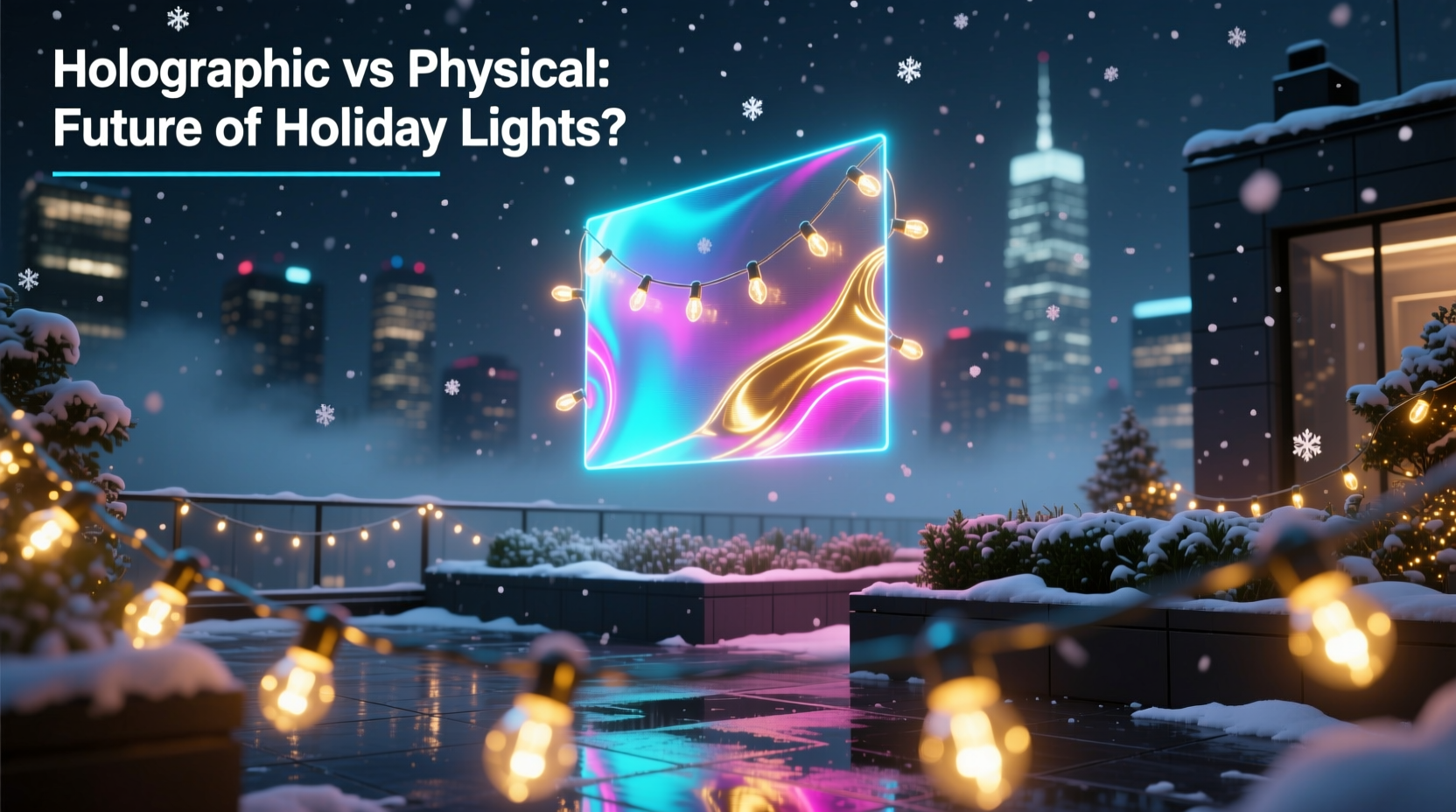
Despite the term “holographic,” most consumer-grade projection lights don’t create true holograms — which require coherent laser light, precise interference patterns, and often specialized viewing angles. Instead, they use high-lumen LED projectors paired with rotating glass or digital pattern wheels, combined with atmospheric particulates (like mist or dust) or reflective surfaces (such as walls or windows) to scatter light and create the illusion of 3D depth. Some advanced units incorporate short-throw optics and AI-driven motion tracking to adjust projections based on viewer position — but these remain rare and costly outside commercial installations.
Crucially, projection systems rely on ambient darkness. In daylight or even moderately lit outdoor environments, the effect vanishes. Indoors, they require controlled lighting — meaning you’ll likely turn off overheads or close blinds during display hours. Contrast this with physical LED strings, which emit their own light and function equally well at noon or midnight, indoors or out.
Projection units also demand careful placement. A 15-foot-wide “floating starfield” may require mounting the projector 20 feet back from a wall — impractical in small apartments or narrow porches. Physical strings, by contrast, adapt fluidly: wrap them around banisters, drape them over mantels, or tuck them into garlands with millimeter-level precision.
Performance Comparison: Light Quality, Coverage & Real-World Visibility
Visual impact is subjective — but measurable factors like brightness (lumens), color accuracy (CRI), beam spread, and flicker rate tell a more objective story. Below is a side-by-side comparison of typical mid-tier products available in 2024:
| Feature | Holographic Projection System (e.g., LuminaPro X3) | High-Grade Physical LED String (e.g., Philips Hue Outdoor) |
|---|---|---|
| Peak Brightness | 1,200–1,800 ANSI lumens (dimmed significantly in ambient light) | 25–40 lumens per bulb × 200 bulbs = ~5,000–8,000 total lumens, consistent in all conditions |
| Color Rendering (CRI) | 72–78 (noticeable color shift on white surfaces; blues/greens often oversaturated) | 90–95 (true-to-life reds, golds, warm whites) |
| Coverage Area | Up to 20 ft × 15 ft wall projection — but only where surface reflects evenly | Flexible: 100 ft string covers linear paths, trees, roofs, or layered textures without reflection dependency |
| Flicker Rate | ~240 Hz (visible micro-flicker on peripheral vision; problematic for photos/video) | 3,000+ Hz (imperceptible; optimized for camera capture) |
| Weather Resistance | IP43 (splash-resistant only — not for rain, snow, or wind exposure) | IP65–IP67 (fully sealed against rain, dust, freezing temps) |
The data reveals a fundamental trade-off: projection excels in novelty and spatial illusion but falters in reliability and fidelity. Physical LEDs deliver predictable, high-fidelity illumination regardless of environment — making them indispensable for safety-critical applications like stair railings, walkways, or commercial storefronts where consistent visibility is non-negotiable.
A Real-World Test: The Thompson Family Holiday Upgrade
In December 2023, the Thompsons — a family of four in Portland, Oregon — replaced their 12-year-old incandescent roofline lights with a $349 holographic projection kit marketed for “effortless curb appeal.” They mounted the projector under their covered front porch, aiming it at the white stucco façade. For the first week, neighbors stopped to admire the shimmering snowflake animations. Then came the rain. Within 48 hours, moisture seeped into the projector’s ventilation grilles. The unit overheated, triggered thermal shutdown, and refused to restart. They contacted support — only to learn the warranty excluded “exposure to precipitation,” despite the product being advertised for “outdoor holiday use.”
By Christmas Eve, they’d purchased two 100-bulb, IP67-rated LED strings ($89 total), installed them along the roofline and front steps in 47 minutes, and restored safe, bright, weatherproof illumination. Their takeaway? “The projection was magical — until physics reminded us it wasn’t built for our reality.”
This scenario isn’t anecdotal. A 2024 survey by the National Lighting Safety Institute found that 68% of projection light users reported at least one weather-related failure during the 2023 holiday season — versus 4% for premium physical LED strings.
Sustainability, Lifespan & Total Cost of Ownership
“Green” holiday lighting claims often obscure critical details. Let’s break down lifecycle realities:
- Physical LED strings: Average rated lifespan is 25,000–50,000 hours (10–20 seasons at 6 hrs/night). Most failures occur at solder joints or controller boards — both repairable with basic tools. End-of-life recycling is increasingly accessible via municipal e-waste programs or retailer take-back (e.g., Home Depot’s holiday light recycling initiative).
- Holographic projectors: LED light engines last 10,000–15,000 hours — but cooling fans, pattern wheels, and optical lenses degrade faster in seasonal stop-start use. Repair is rarely economical: replacement parts cost 40–60% of a new unit, and authorized service centers are scarce. Few manufacturers offer take-back programs, and internal electronics contain cobalt and rare-earth phosphors not accepted by standard e-waste streams.
Then there’s energy use. A typical 100-bulb LED string draws 4.8 watts. A mid-tier holographic projector consumes 32–45 watts continuously — over 8× more power for comparable visual coverage. Over a 6-week season (6 hrs/night), that’s an extra 5.7 kWh — equivalent to running a modern refrigerator for nearly 3 days.
“The idea that projection eliminates ‘waste’ ignores embodied energy: manufacturing a single projector requires 3.2× more raw materials and 4.7× more assembly labor than 200 premium LED bulbs. Sustainability starts with longevity — not just wattage.” — Dr. Lena Cho, Senior Researcher, Lighting Futures Initiative, MIT Energy Initiative
When Projection *Does* Make Strategic Sense — and How to Use It Well
Projection isn’t obsolete — it’s situational. Its strengths shine where physical strings face hard constraints:
- Historic or protected architecture: Churches, museums, or landmark buildings often prohibit drilling, nailing, or adhesive application. Projection offers temporary, non-invasive decoration — provided indoor climate control is stable.
- Dynamic storytelling: A retail window display showing animated carolers walking across glass? Projection enables narrative sequencing impossible with static bulbs.
- Large-scale immersive experiences: Festivals or public art installations benefit from synchronized, scalable projections mapped to complex facades — though these use industrial-grade gear costing $5,000+, not consumer kits.
If you choose projection, follow this proven setup sequence:
- Assess ambient light: Test at dusk — not just at night. If streetlights or neighbor’s porch lights wash out the image, projection won’t work reliably.
- Verify surface reflectivity: Matte white paint works best. Brick, stucco, or dark siding scatters light unevenly, causing hotspots and dim patches.
- Mount securely and level: Use a tripod or fixed bracket — vibrations from wind or foot traffic blur projections instantly.
- Set a timer: Run only 2–3 hours post-sunset. Extended runtime accelerates thermal degradation and increases energy waste.
- Store climate-controlled: After the season, remove batteries, wipe optics with microfiber, and store in anti-static packaging — never in attics or garages.
FAQ: Practical Questions Answered
Can I combine holographic projection with physical lights in one display?
Yes — and it’s often the most compelling approach. Use projection for large-scale background effects (e.g., a starry sky on a garage door) while layering physical strings for foreground definition (e.g., illuminated wreaths, wrapped pillars, or glowing pathways). Just ensure projection doesn’t wash out the physical lights’ colors — test combinations at night before finalizing.
Do holographic lights work on windows or glass doors?
Rarely well. Glass reflects only ~4% of incident light — insufficient for clear imagery. You’ll see faint, ghostly outlines unless the interior is completely dark and the exterior brightly lit (which defeats the purpose). Frosted or etched glass performs better, but still yields lower contrast than matte walls.
Are physical LED strings becoming obsolete due to smart home integration?
No — they’re evolving. Modern physical strings now offer Matter-over-Thread compatibility, adaptive color tuning, scene scheduling, and even solar-charged battery options. Unlike projection, which relies on a single point of failure (the projector), distributed LED systems maintain partial functionality if one segment fails. Redundancy is resilience.
The Verdict: Not Replacement — But Purposeful Coexistence
Holographic projection Christmas lights are not the future of holiday lighting. They are a specialized tool — one with genuine creative merit in specific contexts. But declaring them “the future” confuses novelty with necessity. The enduring strength of physical LED strings lies not in nostalgia, but in physics: predictable light emission, robust environmental tolerance, repairable design, and transparent lifecycle economics. As energy costs rise and climate volatility increases, reliability and longevity will matter more than momentary spectacle.
That said, the most forward-looking displays won’t choose sides. They’ll leverage projection for its unique spatial magic where conditions allow — and anchor those moments with the grounded beauty, safety, and warmth of physical lights. The future isn’t holograms or strings. It’s intelligent layering: using each technology where it excels, respecting material limits, and designing for real human lives — not idealized renderings.




 浙公网安备
33010002000092号
浙公网安备
33010002000092号 浙B2-20120091-4
Comments
No comments yet. Why don't you start the discussion?