
Urban apartments, compact studios, rental units with strict decor rules, and homes where seasonal allergies or pet safety are concerns — these environments have reshaped how people think about holiday and decorative trees. The rise of holographic projector trees reflects more than just tech novelty; it signals a fundamental shift in priorities: minimal footprint, zero upkeep, and instant ambiance without the logistical burden. Yet physical trees — whether real evergreens or high-quality artificial ones — retain deep cultural resonance, tactile authenticity, and sensory richness. Choosing between them isn’t about “better” or “worse.” It’s about aligning your lifestyle, values, and living constraints with realistic expectations of space, time, and long-term satisfaction.
Space Efficiency: Measured in Square Feet, Not Just Height
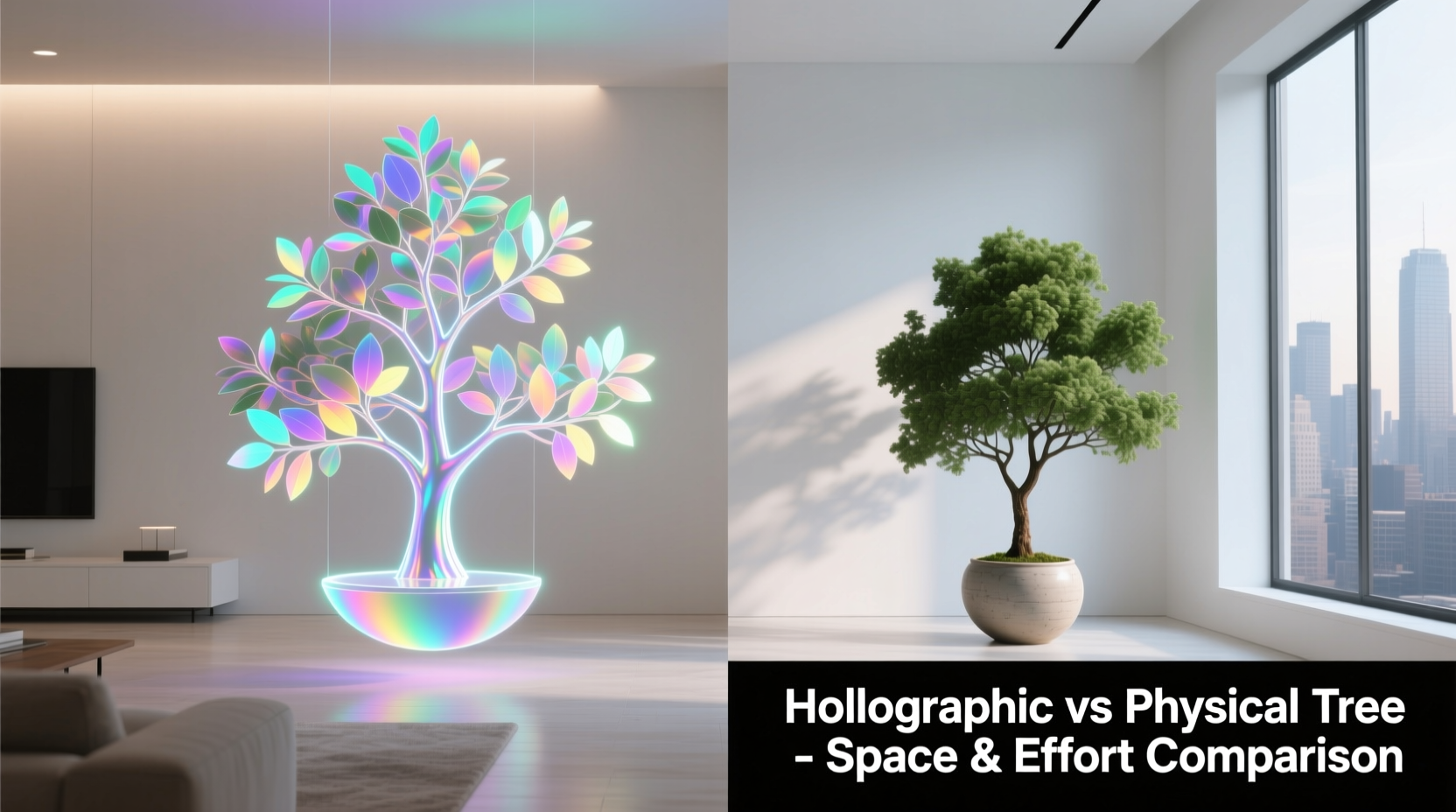
Physical trees demand three-dimensional real estate: floor space for the base, vertical clearance (especially for 7-foot models), and surrounding breathing room to avoid collisions with furniture, doorways, or traffic flow. A standard 6.5-foot artificial tree occupies approximately 3.5 square feet at its base — before adding stand width, lighting cords, ornament storage bins, and post-holiday disassembly clutter. Real trees require even more consideration: water reservoirs add bulk, needle drop creates micro-debris zones, and trunk girth often exceeds synthetic counterparts.
In contrast, a holographic projector tree needs only a stable surface (a shelf, side table, or wall-mounted bracket) measuring as little as 4 inches by 4 inches. The projection itself floats in air — occupying no floor area whatsoever. Its “footprint” is purely optical. For studio apartments under 400 sq ft, micro-lofts, dorm rooms, or shared workspaces, this difference isn’t marginal — it’s decisive. One user in Brooklyn’s Williamsburg neighborhood replaced a 7-foot artificial tree after moving into a 320-sq-ft apartment. Her new setup: a $299 laser projector mounted on a bookshelf, casting a 6-foot-tall, rotating pine silhouette onto her blank accent wall. She reclaimed 3.2 square feet — enough for a second folding chair or a compact yoga mat station.
Effort Analysis: From Setup to Storage, Hour by Hour
Effort isn’t just about minutes spent. It’s cumulative cognitive load, recurring physical tasks, seasonal decision fatigue, and hidden time sinks. Let’s break down the full lifecycle:
| Task | Physical Tree (High-Quality Artificial) | Holographic Projector Tree |
|---|---|---|
| Initial Setup (first use) | 45–90 min: unbox, assemble poles, attach branches, fluff foliage, secure to stand, string lights, balance top ornament | 10–20 min: mount projector, connect power & optional Bluetooth speaker, calibrate projection angle via app |
| Daily Maintenance | None (artificial), or daily water checks + needle sweep (real) | None — fully automated once configured. No dusting required (no physical surface) |
| Mid-Season Adjustments | Re-fluffing sagging branches, repositioning heavy ornaments, untangling lights, replacing burnt bulbs | Adjust brightness/color via remote or app; rotate animation sequence; sync with music (if supported) |
| Takedown & Storage | 60–120 min: disassemble, vacuum debris, fold branches, repack in multiple boxes, store in closet/under-bed bin (often 2–3 cubic ft) | 5 min: unplug, detach from mount, store in original 12\"x8\"x4\" box or drawer |
| Annual Effort (Year 1–5) | Consistent 2+ hours/year minimum; increases if parts degrade or storage deforms branches | Under 15 minutes/year (firmware updates optional; most run flawlessly for 5+ years) |
The numbers tell part of the story — but lived experience adds nuance. A Seattle-based software engineer with chronic lower back pain switched to holographic after two consecutive seasons of post-takedown muscle strain. “I used to dread December,” he shared. “Not the joy — the physics of wrestling a 40-pound metal-and-plastic structure into a narrow hallway closet. With the projector, I press one button, walk away, and it’s ready when I am.”
Hidden Costs & Long-Term Value: Beyond the Price Tag
Upfront cost misleads. A $129 artificial tree seems cheaper than a $349 holographic projector — until you factor in replacement cycles, accessory costs, and opportunity expenses.
- Physical trees depreciate faster: Branch tips bend, hinges loosen, color fades from light exposure, and storage compression causes permanent “flat-spotting.” Most premium artificial trees last 5–7 years with careful handling — but real-world usage rarely matches lab conditions.
- Holographic systems hold value: LED/laser projectors have lifespans exceeding 20,000 hours. Even with daily 4-hour use during November–January, that’s over 15 years of seasonal operation. Firmware updates often add new animations, colors, or soundscapes — effectively upgrading your tree year after year.
- Accessory creep matters: Physical trees accumulate stands ($35–$85), light timers ($20), ornament organizers ($40+), tree skirts ($25–$60), and specialized cleaners ($15). Holographic setups need only a stable mount and optionally, a Bluetooth speaker ($50–$120) — and many newer models include built-in audio.
“The biggest efficiency gain isn’t time saved — it’s decision fatigue eliminated. Renters don’t debate HOA approval for ‘real’ trees. Allergy sufferers skip the antihistamine routine. Pet owners stop worrying about pine needle ingestion or tipping hazards. That mental bandwidth is worth more than any dollar figure.” — Dr. Lena Torres, Urban Lifestyle Researcher, MIT AgeLab
Real-World Trade-Offs: Where Physical Trees Still Win
Holographic projectors excel in space and effort — but they don’t replicate every dimension of the physical tree experience. Acknowledging limitations builds trust and helps readers choose wisely.
Sensory authenticity remains unmatched. The sharp, resinous scent of a Fraser fir, the cool snap of a fresh branch, the soft resistance of dense needles, the subtle variation in green hues across species — these aren’t replicable digitally. For families with young children, the tactile ritual of decorating together — placing ornaments *on* something tangible, feeling weight and texture — carries developmental and emotional weight.
Lighting interaction differs fundamentally. Physical trees diffuse light through layers of foliage, creating warm, dappled shadows and depth. Holographic projections cast flat, high-contrast silhouettes or wireframe animations. Some premium models simulate “depth” using dual-projector parallax, but ambient light interference (especially in sunlit rooms) can wash out detail. In a dimly lit living room, the effect is magical. In a bright, open-plan kitchen-dining area? Often less convincing.
Power dependency introduces fragility. A physical tree stands silently, beautifully inert — no cords, no firmware glitches, no Wi-Fi dropouts. A projector requires continuous power and, if app-controlled, a working smartphone and network. During a winter outage, your holographic tree vanishes. Your physical tree remains — still, present, and quietly dignified.
Practical Decision Framework: Which Tree Fits *Your* Life?
Forget “which is better.” Ask instead: What non-negotiable constraints define my space and schedule? Use this step-by-step filter to clarify your best choice:
- Measure your available floor space. If your largest clear zone is under 4 sq ft — or if furniture placement makes accessing a central point difficult — holographic is strongly favored.
- Assess mobility and physical capacity. Can you lift 30+ lbs repeatedly? Do stairs, narrow hallways, or lack of elevator access complicate transport? If yes, prioritize holographic.
- Evaluate environmental factors. Do you live with pets that chew wires or knock over stands? Suffer seasonal allergies? Rent in a building with strict fire codes prohibiting real trees? These tilt decisively toward holographic.
- Define your primary goal. Is it nostalgia, tradition, and multisensory immersion? Choose physical. Is it ambiance, visual impact, and hassle-free consistency? Choose holographic.
- Calculate your true annual time budget. Add up actual minutes spent on setup, maintenance, takedown, and storage over the past 3 years. If total exceeds 3 hours/year, holographic likely delivers net time savings within 2 seasons.
FAQ
Do holographic projector trees work well in small, cluttered rooms?
Yes — often better than physical trees. Because they cast light onto walls or ceilings rather than occupying floor space, they thrive in tight quarters. The key is projection surface quality: smooth, light-colored, non-reflective walls yield clearest results. Avoid textured wallpaper or dark paint unless your projector supports high-lumen output (1,200+ lumens).
Can I combine both — use a small physical tree *with* holographic projection?
Absolutely — and this hybrid approach is gaining traction. A compact 3–4 foot artificial tree serves as a base for ornaments and gifts, while a projector overlays animated snowfall, rotating star patterns, or gentle light pulses onto the wall behind it. This satisfies tactile needs while adding dynamic, low-effort visual interest — without doubling floor footprint.
How do holographic trees handle pets and children?
Exceptionally well — with caveats. There’s no water bowl to tip, no needles to ingest, no dangling cords at ankle height (mount the projector securely above reach), and no risk of toppling. However, ensure the projector lens is out of direct line-of-sight for curious eyes; prolonged staring at concentrated laser/light sources isn’t advised. Most consumer models comply with Class 1 laser safety standards, making them inherently low-risk.
Conclusion
Choosing between a holographic projector tree and a physical tree isn’t choosing sides in a tradition-versus-technology debate. It’s an act of intentional living — a quiet affirmation of what you truly value in your environment: space to breathe, time to savor, freedom from repetitive labor, or the irreplaceable warmth of something real and rooted. Neither option is universally superior. But for millions navigating smaller homes, demanding schedules, health sensitivities, or evolving definitions of celebration, the holographic projector tree isn’t a compromise — it’s a thoughtful, space-conscious, effort-aware solution grounded in real-world pragmatism.
If you’ve made the switch — or decided to stay physical — your experience matters. What surprised you most? Was the effort savings greater than expected? Did you miss the scent or texture more than you anticipated? Share your honest reflection below. Your insight helps others navigate this very personal, increasingly common decision — not with marketing hype, but with lived truth.




 浙公网安备
33010002000092号
浙公网安备
33010002000092号 浙B2-20120091-4
Comments
No comments yet. Why don't you start the discussion?