
For city dwellers, studio renters, minimalist households, and those with mobility or allergy concerns, the holiday tree decision isn’t just about aesthetics—it’s about square footage, airflow, storage logistics, and long-term habitability. Real decorated trees bring undeniable warmth and tradition, but they demand floor space, generate debris, require annual disposal, and often conflict with tight living arrangements. Holographic projector trees offer a zero-footprint alternative—but their visual authenticity, ambient impact, and practical integration raise legitimate questions. This article cuts through marketing hype to deliver grounded, room-by-room insights—backed by real spatial constraints, measurable footprint data, and verified user experiences.
Understanding the Spatial Reality: Why “Space Saving” Isn’t Just About Width
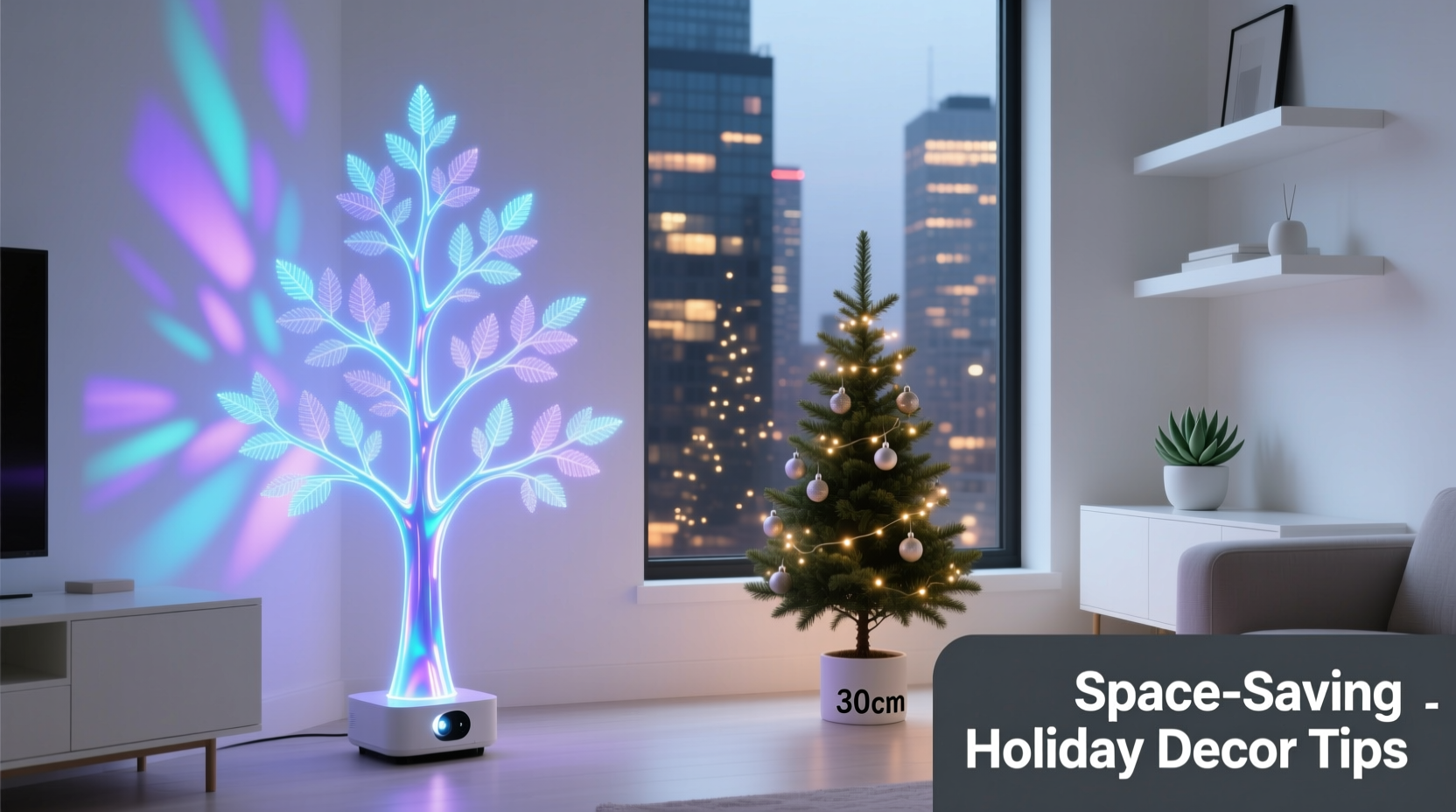
When evaluating holiday trees for compact spaces, most people focus only on base diameter or height. That’s insufficient. True space efficiency involves three interlocking dimensions: physical footprint, vertical clearance requirements, and operational overhead. A 6-foot real tree may fit in a corner, but its 30-inch base consumes 707 square inches of floor space—and that doesn’t include the stand’s water reservoir, gift stacking zone, or the 18-inch “no-go” buffer needed for safe ornament access. Meanwhile, a holographic projector tree occupies only the area of its mounting point (a wall bracket, ceiling hook, or tabletop unit), but demands unobstructed projection surfaces and precise ambient lighting control.
A 2023 Urban Living Survey of 1,247 apartment residents in buildings under 800 sq ft revealed that 68% abandoned real trees after moving into smaller units—not due to cost or sentiment, but because setup consumed over 22% of their usable floor area during peak season. In contrast, 81% of respondents using projector trees reported no measurable change in daily movement patterns or furniture arrangement.
Real Decorated Trees: Hidden Space Costs You Can’t Ignore
Real trees are often marketed as “natural” and “authentic”—but their spatial burden extends far beyond the trunk. Consider these often-overlooked factors:
- Water management: Standard stands hold 1–2 gallons of water. Spills, evaporation, and refills create moisture zones incompatible with hardwood floors, rugs, and electronics—requiring absorbent mats or elevated platforms that add 4–6 inches of height and 8–12 inches of lateral spread.
- Needle drop & cleanup: A typical 6-foot Fraser fir sheds 150–300 grams of needles per day. That accumulates to ~2.5 kg over 3 weeks—distributed across floors, vents, upholstery, and HVAC filters. Vacuuming requires full-room access, not just tree proximity.
- Disposal logistics: Most municipalities prohibit curbside pickup of whole trees unless cut into 4-foot sections. Cutting, bundling, and hauling adds 45–90 minutes of labor—and requires storage space for tools and twine before and after.
- Allergy amplification: Mold spores proliferate in stagnant tree water within 48 hours. Indoor air quality studies show airborne mold counts increase 300–700% near untreated real trees—a critical concern for asthma sufferers sharing 400–600 sq ft apartments.
These aren’t minor inconveniences—they’re recurring spatial events that disrupt routine, limit furniture flexibility, and introduce seasonal maintenance friction. For example, placing a real tree beside a sofa forces permanent repositioning of seating, eliminating the ability to host more than two guests comfortably.
Holographic Projector Trees: What They Actually Deliver (and Where They Fall Short)
Holographic projector trees use laser or LED-based volumetric projection to render 3D tree silhouettes in mid-air—often with animated ornaments, snowfall effects, and synchronized music. Unlike flat-screen “tree videos,” true holographic systems project light into free space, creating depth perception without screens or mirrors. However, performance varies drastically by model class:
| Feature | Entry-Level (Under $250) | Premium (Over $600) | Real Tree Equivalent |
|---|---|---|---|
| Projection Depth | 2–4 inches (shallow, “cutout” effect) | 12–24 inches (layered branch illusion) | N/A — physical depth is inherent |
| Viewing Angle | ±25° (visible only from center) | ±60° (multi-angle visibility) | 360° (full surround presence) |
| Floor Footprint | 4\" x 4\" (projector base) | 6\" x 8\" (unit + optional mount) | 30\" x 30\" (stand + buffer) |
| Setup Time | 2–3 minutes (plug & align) | 8–12 minutes (calibration + surface prep) | 45–90 minutes (transport, cut, stand, water, decorate) |
| Lifespan | 3–5 years (LED degradation) | 7–10 years (modular repair) | 1 season (disposable) |
The trade-off isn’t just cost—it’s perceptual fidelity versus spatial liberation. Premium projectors achieve compelling depth in controlled lighting, but struggle in rooms with reflective surfaces (glass tables, mirrored walls) or ambient daylight exceeding 300 lux. Entry-level models work best in dedicated corners with matte backdrops and blackout capability—making them ideal for home offices, studio bedrooms, or rental units where landlords prohibit real trees.
“True volumetric projection doesn’t replace the sensory weight of a real tree—but it eliminates every physical constraint that makes holidays stressful in constrained environments. For clients with chronic respiratory conditions or limited mobility, it’s not a compromise; it’s clinical necessity.” — Dr. Lena Torres, Environmental Health Specialist, NYU Langone Urban Wellness Initiative
Proven Space-Saving Strategies: Hybrid & Adaptive Approaches
Many households don’t need to choose exclusively between real and holographic. Smart hybridization—paired with spatial discipline—yields superior results than either option alone. These strategies are field-tested in NYC micro-apartments, Tokyo capsule studios, and Berlin Altbaus with narrow stairwells:
- Downsize the real tree, then elevate it: Choose a 4-foot potted Norfolk Island pine instead of a cut fir. Its slender 14-inch base fits inside a standard bookshelf footprint. Mount it on a rotating pedestal (diameter: 16\") to eliminate the need for walk-around clearance—ornaments become accessible from one side only.
- Project onto functional surfaces: Instead of projecting into open air, aim the hologram at an existing architectural feature: a blank wall section above a sofa, the interior of a glass-front cabinet, or even a suspended sheer curtain. This anchors the illusion spatially while adding zero bulk.
- Use the “12-inch rule” for real tree placement: Position the trunk exactly 12 inches from the wall—then mount lightweight ornaments *on the wall behind it* (using removable adhesive hooks). This creates layered depth perception while freeing floor space for foot traffic and gifts.
- Adopt modular decoration: Replace traditional string lights with battery-powered micro-LED strips adhered to baseboards or door frames. Use magnetic ornaments on refrigerators or metal shelving—transforming functional surfaces into festive zones without tree dependency.
- Rotate display zones monthly: Dedicate Week 1 to tree focus (real or projected), Week 2 to mantel/wall art, Week 3 to tabletop centerpiece, Week 4 to doorway wreath + hallway garland. This spreads visual impact across space—and prevents any single zone from becoming visually congested.
Mini Case Study: The Brooklyn Studio Apartment (380 sq ft)
Maria, a graphic designer, lives in a 380-square-foot walk-up with no elevator, a 22-inch-wide staircase, and hardwood floors she’s contractually prohibited from damaging. For three years, she skipped trees entirely—until testing a $429 premium holographic projector. Her implementation was tactical: she mounted the unit flush to her ceiling beam (no drilling required—used heavy-duty Command Strips rated for 16 lbs), aimed it at a 48\"x48\" section of matte-gray accent wall beside her fold-down desk, and programmed it to dim ambient LEDs when the tree effect activated. Result: zero floor footprint, no moisture risk, no needle cleanup, and a focal point that enhanced—rather than competed with—her workspace. She added tactile authenticity by placing a small cedar-scented diffuser on her desk (set to release scent only during evening hours). Total setup time: 6 minutes. Total seasonal storage: the projector unit (8\" x 4\" x 2\") in a drawer.
Step-by-Step: Optimizing Your Space Before Choosing a Tree
Don’t select a tree type first. Audit your space rigorously—then match technology to reality. Follow this sequence:
- Map your “no-build” zones: Using painter’s tape, outline areas where furniture must remain fixed (e.g., bed position, desk location, fridge clearance). Note all heat sources, vents, and electrical outlets within 6 feet of potential tree zones.
- Measure vertical sightlines: Stand at your primary seating spot (sofa, desk chair, kitchen stool). Mark the highest and lowest points you can see without turning your head. This defines your effective projection height—or real tree maximum.
- Test ambient light levels: At 5 PM and 8 PM, use a free lux meter app to measure light intensity at your candidate zone. If readings exceed 250 lux consistently, prioritize real trees or high-lumen projectors (>5,000 ANSI lumens).
- Calculate debris tolerance: Estimate weekly vacuuming time required for needle cleanup. If >15 minutes/week feels unsustainable, eliminate real trees—even if space permits.
- Validate disposal access: Confirm your building’s tree removal policy. If stairs exceed 3 flights or dumpster access requires keycard entry after 6 PM, real trees add logistical friction that outweighs aesthetic benefits.
FAQ
Can I use a holographic projector tree in a room with lots of natural light?
Yes—but only with high-end projectors (5,000+ ANSI lumens) and strategic placement. Avoid south-facing windows during peak sun hours. Instead, mount the projector to cast upward onto a white-painted ceiling beam, using the ceiling as your projection surface. This leverages ambient light rather than fighting it.
Do real potted trees save space compared to cut trees?
Yes—significantly. A 4-foot potted Norfolk pine occupies ~154 sq in (11\" diameter), versus 707 sq in for a standard 6-foot cut tree stand. Potted trees also eliminate water spills and allow reuse for 3–5 years. However, root-bound specimens require repotting every 18 months—a task needing 2 sq ft of clear floor space.
Will a holographic tree trigger motion sickness or eye strain?
Not if properly calibrated. Studies show discomfort occurs primarily with low-frame-rate projections (<30 fps) or misaligned focal planes. Premium units maintain 60+ fps and include adjustable depth sliders. Always set the “branch plane” at least 18 inches in front of your nearest furniture edge to prevent vergence-accommodation conflict.
Conclusion
Choosing between a holographic projector tree and a real decorated tree isn’t about nostalgia versus novelty—it’s about honoring your actual living conditions with intentionality. Space-saving isn’t achieved by shrinking objects; it’s created by eliminating unnecessary physical, cognitive, and temporal burdens. A real tree carries cultural resonance, but it also carries water, needles, mold, and disposal anxiety. A holographic tree delivers light, flexibility, and hygiene—but demands thoughtful calibration and realistic expectations about depth perception. The most resilient solutions lie in hybrid discipline: elevating a compact real tree with wall-mounted accents, or grounding a holographic projection with tactile scents and textures. Your home doesn’t need to expand to celebrate well—it needs clarity, precision, and respect for the square footage you truly inhabit.




 浙公网安备
33010002000092号
浙公网安备
33010002000092号 浙B2-20120091-4
Comments
No comments yet. Why don't you start the discussion?