
When Honor released the P30 Lite in 2019, it was positioned as a modern mid-range contender with sleek design and improved photography features. But for users still holding onto the Honor View 10—launched just a year earlier—the question remains: does the P30 Lite offer enough meaningful improvements to justify an upgrade? While both phones share similarities in branding and price positioning, they represent different generations of smartphone evolution. A closer look at their hardware, software, and user experience reveals where the P30 Lite excels—and where the older View 10 still holds its ground.
Design and Build: Modern Aesthetics vs Functional Simplicity
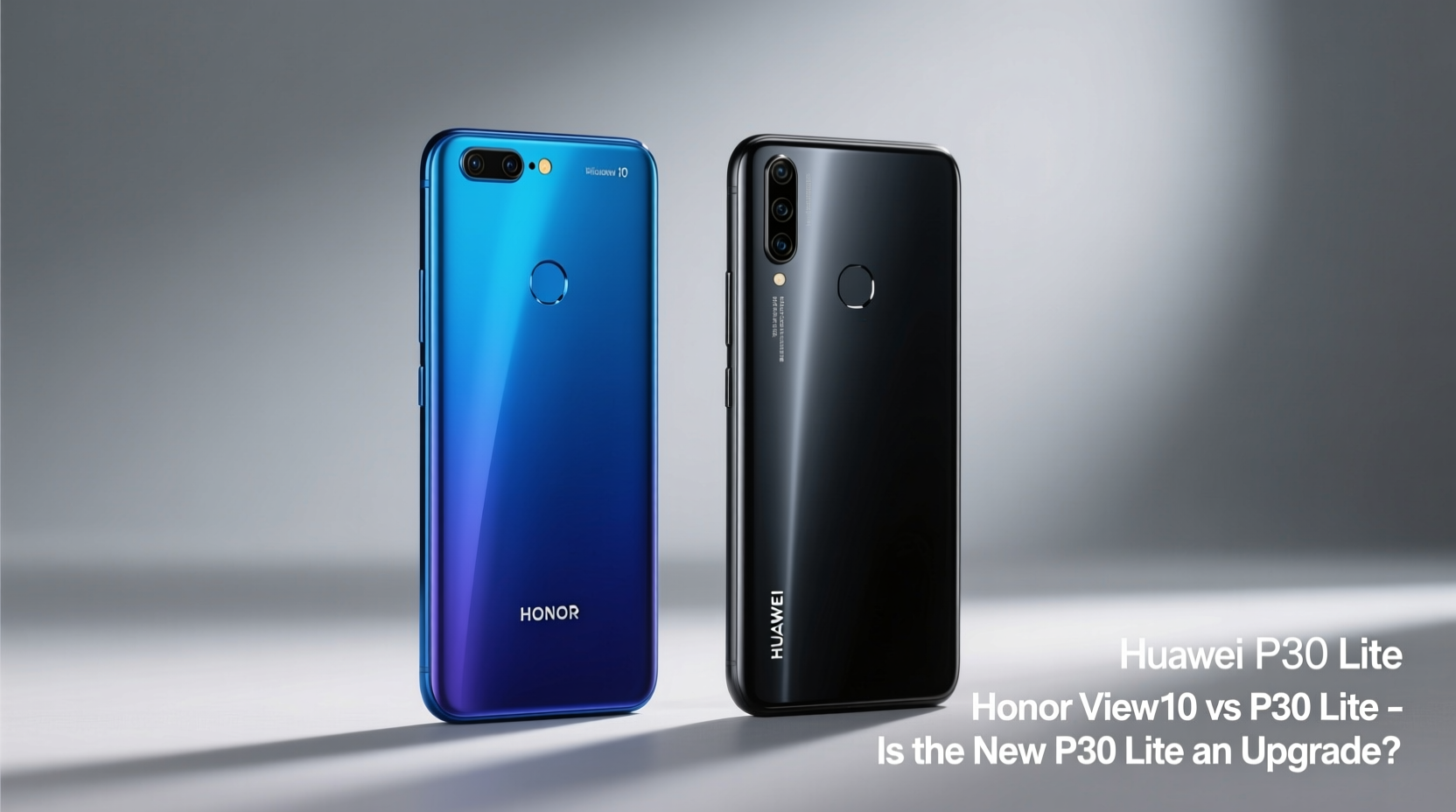
The most immediate difference between the two devices lies in their design language. The Honor View 10, released in late 2017, featured a premium metal-and-glass build with a horizontal dual-camera layout on the upper left—a design that was cutting-edge at the time but now feels dated. Its 5.99-inch LCD panel has thick bezels by today’s standards, particularly at the top and bottom.
In contrast, the P30 Lite embraces the 2019 trend of minimal bezels and notch displays. It sports a 6.15-inch Dewdrop OLED screen with a significantly slimmer top bezel and a small front-facing camera cutout. This gives it a more immersive viewing experience and a sleeker profile overall. The back features a gradient glass finish available in colors like Pearl White and Midnight Black, which not only looks modern but also reflects light attractively.
Display Quality and Usability
The display technology marks another key shift. The View 10 uses an IPS LCD panel with a resolution of 2160x1080, offering decent color accuracy and brightness. However, the P30 Lite steps up with an OLED display of similar resolution (2340x1080), delivering deeper blacks, higher contrast ratios, and better power efficiency—especially when viewing dark-themed content or using dark mode apps.
While both screens are sharp and usable for daily tasks, the P30 Lite’s taller aspect ratio (19.5:9 vs 18:9) makes it slightly better suited for video streaming and gaming. Additionally, the newer device supports adaptive brightness more effectively, adjusting smoothly under varying lighting conditions.
Camera Comparison: Triple Lens vs Dual Sensor
One of the most significant upgrades comes in the camera department. The Honor View 10 launched with a competent dual-camera setup: a 16MP main sensor and a 20MP monochrome lens, both co-developed with Leica. While this combo delivered strong detail and low-light performance for its time, it lacked advanced AI processing and ultra-wide capabilities.
The P30 Lite, however, introduces a triple-lens system: a 48MP main sensor (using pixel-binning to output 12MP images), an 8MP ultra-wide lens, and a 2MP depth sensor. This allows users to capture wider landscapes, group shots, and bokeh-enhanced portraits with greater flexibility. The front-facing 32MP selfie camera is also a major leap forward, especially for social media enthusiasts who prioritize high-resolution selfies.
“Multi-lens systems have redefined what mid-range phones can do. The inclusion of an ultra-wide lens on the P30 Lite opens up creative possibilities the View 10 simply couldn’t match.” — Lin Zhao, Mobile Imaging Analyst at TechPulse Asia
In practical use, the P30 Lite handles dynamic range better and applies AI scene recognition to optimize settings automatically. However, some long-term View 10 users note that while the P30 Lite captures more data, the image processing can sometimes oversharpen or over-saturate photos compared to the View 10’s more natural tone.
Performance and Software: Incremental Gains Over Generations
Under the hood, the differences are less dramatic. The Honor View 10 runs on Huawei’s Kirin 970 chipset—still a capable octa-core processor with dedicated AI processing via the NPU. Paired with 6GB of RAM, it handled multitasking and gaming well even years after release.
The P30 Lite uses the Kirin 710F, a mid-tier chip introduced in 2018. While it improves power efficiency, it doesn’t outperform the Kirin 970 in raw processing power. Benchmarks show the View 10 scoring higher in CPU-intensive tasks like app rendering and file compression. However, the P30 Lite benefits from being shipped with EMUI 9.1 (upgradable to EMUI 10 and beyond), offering smoother animations, gesture navigation, and better battery management.
| Feature | Honor View 10 | P30 Lite |
|---|---|---|
| Release Year | 2017 | 2019 |
| Display | 5.99\" IPS LCD | 6.15\" OLED (Dewdrop) |
| Processor | Kirin 970 | Kirin 710F |
| Rear Cameras | 16MP + 20MP (Dual) | 48MP + 8MP + 2MP (Triple) |
| Front Camera | 13MP | 32MP |
| Battery | 3750 mAh | 3340 mAh |
| Software (Launch) | Android 8.0 + EMUI 8 | Android 9 + EMUI 9.1 |
Note the smaller battery in the P30 Lite despite newer power-efficient components. In real-world usage, the View 10 often lasts longer on a single charge, especially with lighter app loads. The P30 Lite compensates with faster charging support (10W vs 5V/2A standard on View 10).
User Experience and Real-World Longevity
To understand how these differences play out daily, consider Maria, a university student who upgraded from the View 10 to the P30 Lite in 2020. She appreciated the larger, brighter screen for online lectures and the superior selfie camera for virtual presentations. However, she noticed her phone heated up during extended Zoom calls—something rare on her cooler-running View 10. She also missed the physical navigation buttons and found the on-screen gestures occasionally unresponsive.
After six months, she concluded that while the P30 Lite felt “newer,” it wasn’t necessarily “better” across all metrics. For her, the trade-offs in battery life and thermal performance offset some of the gains in camera quality and screen tech.
Checklist: Should You Upgrade?
- ✅ Prioritize camera versatility (ultra-wide, high-res selfies)? → P30 Lite wins
- ✅ Want a modern, edge-to-edge display with OLED clarity? → Choose P30 Lite
- ✅ Need longer battery life and proven stability? → View 10 may still suffice
- ✅ Value raw performance for gaming or heavy apps? → View 10 has the edge
- ✅ Prefer updated software with longer support cycle? → P30 Lite is safer
Frequently Asked Questions
Is the P30 Lite faster than the View 10?
No, not in all aspects. While the P30 Lite has newer software optimizations, the View 10’s Kirin 970 processor outperforms the Kirin 710F in CPU-heavy tasks. Everyday operations like browsing and messaging feel similarly smooth on both, but intensive applications run better on the View 10.
Does the P30 Lite support Google services?
Yes, unlike later Huawei and Honor models affected by U.S. sanctions, the P30 Lite was released before the restrictions took full effect. It includes full Google Play Services, making it compatible with Gmail, YouTube, Maps, and other essential apps.
Can the Honor View 10 still be used in 2024?
Absolutely. Many users continue relying on the View 10 for basic functions. While official software updates ended years ago, the phone remains secure enough for casual use if kept off suspicious networks and apps. Performance degrades slightly with very new apps, but core functionality holds up well.
Final Verdict: An Upgrade, But Not Universally Better
The Honor P30 Lite is undeniably a more modern smartphone. Its design, display, and camera system reflect advancements made in the two years since the View 10’s debut. For users seeking better selfies, wider-angle shots, and a fresher aesthetic, the P30 Lite delivers tangible benefits.
However, calling it a “better” phone overall would overlook important trade-offs. The View 10 still boasts superior processing power, a larger battery, and a more balanced thermal profile. It was built during a peak period for Huawei’s flagship-grade chipsets trickling down into mid-range models.
If you’re upgrading purely for future-proofing and camera diversity, the P30 Lite is the logical choice. But if your current View 10 meets your needs, there’s no urgent reason to replace it—especially given its enduring reliability.




 浙公网安备
33010002000092号
浙公网安备
33010002000092号 浙B2-20120091-4
Comments
No comments yet. Why don't you start the discussion?