
When it comes to accessorizing with scarves, the pattern you choose does more than just express your style—it sends subtle signals about taste, confidence, and perceived value. Among the most debated prints in fashion today are houndstooth and leopard. Both have strong identities, but only one consistently aligns with the visual language of quiet luxury. The question isn’t just about preference; it’s about perception. Which of these two iconic patterns—houndstooth or leopard—makes you look more expensive?
The answer lies not in trend cycles or celebrity endorsements, but in how each pattern functions within the broader context of elegance, restraint, and sartorial intelligence.
The Psychology of Pattern and Perceived Value
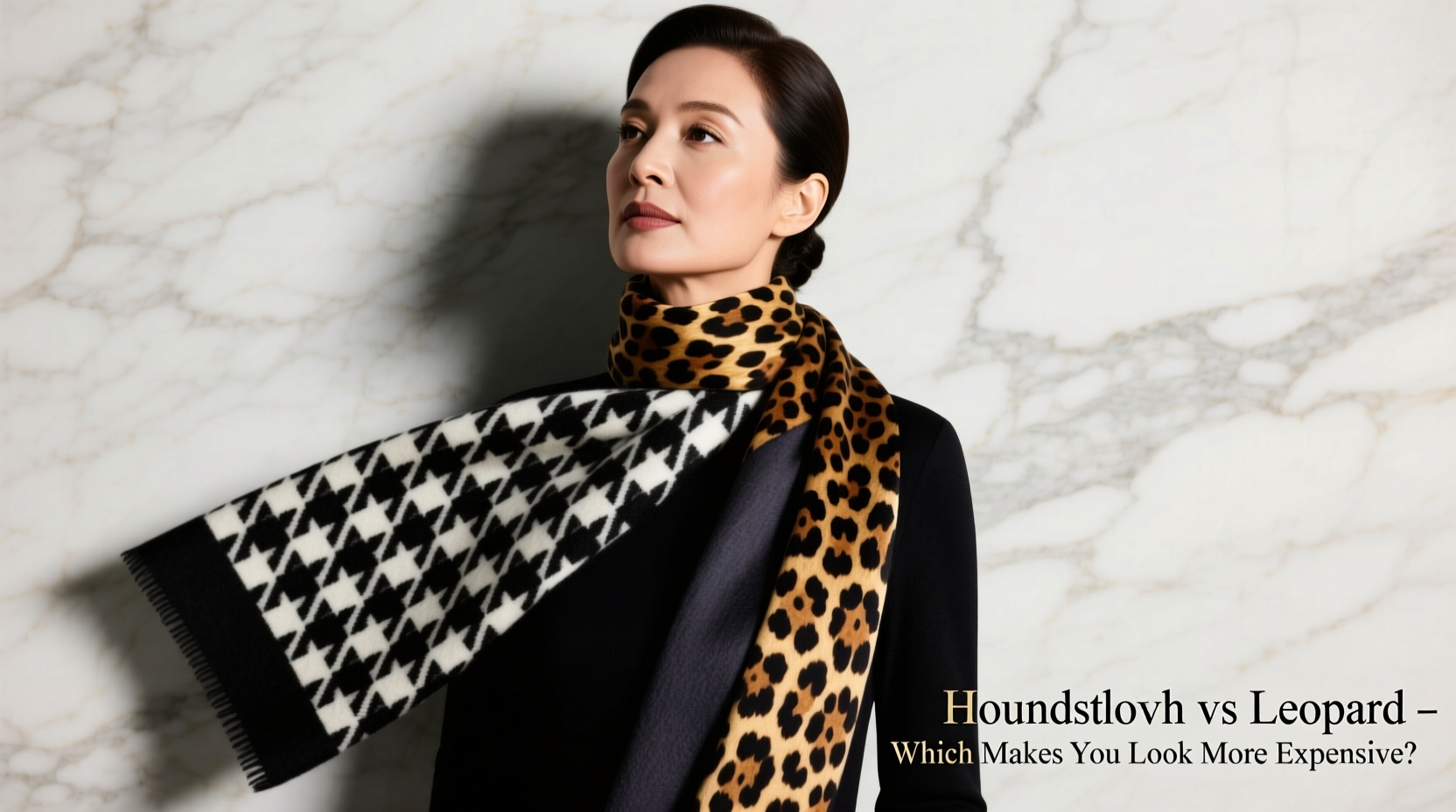
Patterns influence how others perceive us before a word is spoken. Research in behavioral fashion psychology suggests that structured, geometric designs like houndstooth are subconsciously associated with order, precision, and professionalism. In contrast, animal prints like leopard trigger associations with boldness, sensuality, and risk-taking.
This distinction matters when evaluating \"expensive\" aesthetics. True luxury today isn’t defined by logos or loud statements, but by subtlety, craftsmanship, and timelessness. Think of brands like The Row, Loro Piana, or Totême—minimalist silhouettes, neutral palettes, and refined textures dominate their collections. Within this framework, patterns must earn their place by enhancing sophistication, not distracting from it.
Houndstooth, with its origins in 19th-century Scottish woolens, carries historical weight. It became a symbol of British tailoring and later, American boardroom authority through designers like Christian Dior and Yves Saint Laurent. Leopard, while equally historic (seen in 1930s Hollywood and 1980s power dressing), has always straddled the line between glamour and kitsch.
Houndstooth: The Quiet Signal of Refinement
Houndstooth’s defining trait is structure. Its broken check design—alternating light and dark blocks forming jagged checks—creates rhythm without chaos. This visual balance appeals to the same principles found in high-end menswear and minimalist womenswear.
Worn as a scarf, houndstooth works best in classic color pairings: black-and-white, charcoal-and-cream, or navy-and-tan. These combinations read as deliberate, especially when paired with tailored coats, cashmere sweaters, or structured handbags. The pattern doesn’t shout; it whispers authority.
Fashion historian Dr. Clara Montague notes:
“Houndstooth survived decades because it adapts without losing its identity. It’s equally at home on Savile Row and in Parisian ateliers. That kind of versatility signals cultural fluency—a hallmark of true luxury.”
In modern styling, a houndstooth scarf layered over a camel trench or draped neatly around a silk blouse elevates the entire ensemble. It reads as curated, not costumed.
Leopard: Boldness with a Risk-Reward Balance
Leopard print is undeniably magnetic. Its wild, organic spots disrupt symmetry and draw immediate attention. When executed well—in rich browns, caramel undertones, or monochrome grayscale—it can project confidence and flair.
However, the margin for error is narrow. Poor-quality fabrics, overly bright colors, or mismatched proportions can make leopard appear costume-like or dated. Unlike houndstooth, which benefits from neutrality, leopard demands careful contextual support. A cheap polyester scarf with neon undertones will undermine even the most expensive outfit.
Styling leopard effectively requires restraint. Designers like Phoebe Philo and Bottega Veneta’s Daniel Lee have reimagined the print in muted tones, using it sparingly—as a trim, a single accessory, or in abstracted forms. In these cases, leopard becomes a whisper of rebellion rather than a roar.
As stylist Marcus Tran explains:
“Leopard can look expensive, but only when it’s treated like a secret. One piece. Luxe fabric. Neutral backdrop. Break those rules, and it reads as trying too hard.”
Comparison: Houndstooth vs Leopard Scarf in Real Contexts
| Criterium | Houndstooth Scarf | Leopard Scarf |
|---|---|---|
| Perceived Sophistication | High – associated with tradition and tailoring | Moderate – depends heavily on execution |
| Versatility | High – pairs easily with neutrals and structured wear | Low to Moderate – requires careful coordination |
| Luxury Association | Strong – linked to heritage brands and bespoke clothing | Conditional – only with premium materials and tone |
| Timelessness | Proven across decades | Cyclical – resurges every 10–15 years |
| Risk of Looking Costumey | Very Low | High if poorly styled or low-quality |
How to Wear Each Pattern for Maximum Luxury Impact
Both patterns can contribute to a polished appearance, but success depends on material, proportion, and context.
For Houndstooth:
- Choose wool, cashmere, or silk blends—never synthetic.
- Opt for smaller-scale patterns; large houndstooth can overwhelm.
- Pair with solid neutrals: gray, beige, black, or navy.
- Drape loosely around the neck or fold neatly under a coat collar.
For Leopard:
- Select scarves in matte finishes with warm, earthy tones.
- Avoid shiny polyester or cartoonish contrasts.
- Limit leopard to one element in the outfit—no matching bags or shoes.
- Style with monochrome outfits to let the print breathe.
Mini Case Study: Two Women, Two Scarves, One First Impression
Sophie and Lena, both mid-level professionals, attended the same networking event in London. Sophie wore a camel wool coat with a black-and-white houndstooth silk scarf neatly folded at the neck. Her look was completed with dark jeans, ankle boots, and a structured tote.
Lena wore a similar coat but accessorized with a large, vivid leopard-print polyester scarf, loosely knotted. Her boots were trendy but scuffed, and her bag had visible branding.
Post-event feedback revealed a telling difference. Multiple attendees described Sophie as “put-together,” “executive,” and “someone I’d trust with a client meeting.” Lena was called “eye-catching” and “fun,” but no one associated her with seniority or authority.
The scarves weren’t the only factor, but they shaped initial perception. Houndstooth reinforced competence; leopard emphasized personality—valuable traits, but not synonymous with looking expensive.
Action Checklist: Choosing the Right Scarf for a High-Value Look
- Assess your primary goal: Do you want to project authority (choose houndstooth) or bold individuality (leopard may work)?
- Evaluate fabric quality—natural fibers only for luxury appeal.
- Check color harmony: neutral bases enhance expense cues.
- Limit competing patterns in the outfit.
- Ensure the scarf complements, not dominates, your silhouette.
- Test the look in natural light—does it read as elegant or flashy?
- Ask a trusted friend: “Does this look expensive? Why or why not?”
FAQ
Can a leopard scarf ever look truly expensive?
Yes—but only under strict conditions. It must be in a high-quality material (silk, fine wool), feature a realistic or tonal color palette, and be worn with minimal other statement pieces. Think of it as a strategic accent, not a centerpiece.
Is houndstooth outdated?
No. Houndstooth remains a staple in luxury collections precisely because of its adaptability. Modern iterations use softer scales, tonal contrasts, or unexpected colors like burgundy or slate, keeping it fresh without sacrificing gravitas.
Which pattern lasts longer in a wardrobe?
Houndstooth wins for longevity. Its association with classic style means it rarely falls out of favor. Leopard is more trend-dependent and may feel dated faster unless carefully selected.
Final Verdict: Which Makes You Look More Expensive?
If the goal is to appear quietly luxurious, effortlessly composed, and subtly authoritative, houndstooth is the superior choice. It aligns with the current ethos of “stealth wealth”—where value is implied, not declared. It works across seasons, ages, and occasions with remarkable consistency.
Leopard, while powerful, is a calculated risk. It can elevate an outfit when used with precision, but more often, it draws attention for attention’s sake—a trait at odds with the understated confidence of true luxury.
In the end, looking expensive isn’t about price tags. It’s about control: control over color, cut, contrast, and context. Houndstooth offers that control. Leopard demands surrender to its wilder nature.




 浙公网安备
33010002000092号
浙公网安备
33010002000092号 浙B2-20120091-4
Comments
No comments yet. Why don't you start the discussion?