
In economics, the concept of absolute advantage is foundational to understanding international trade, productivity, and resource allocation. At its core, absolute advantage refers to the ability of a country, individual, or business to produce more of a good or service than another entity using the same amount of resources. But beyond textbook definitions, how does this idea become meaningful in real-world learning? That’s where platforms like Quizlet come into play—transforming abstract economic principles into accessible, personalized knowledge through adaptive study tools.
Quizlet doesn’t just define terms; it contextualizes them. By aligning the explanation of absolute advantage with interactive flashcards, practice quizzes, and spaced repetition algorithms, it meets learners exactly where they are—whether reviewing for an AP Economics exam or trying to grasp global trade dynamics for the first time.
Understanding Absolute Advantage: A Clear Definition
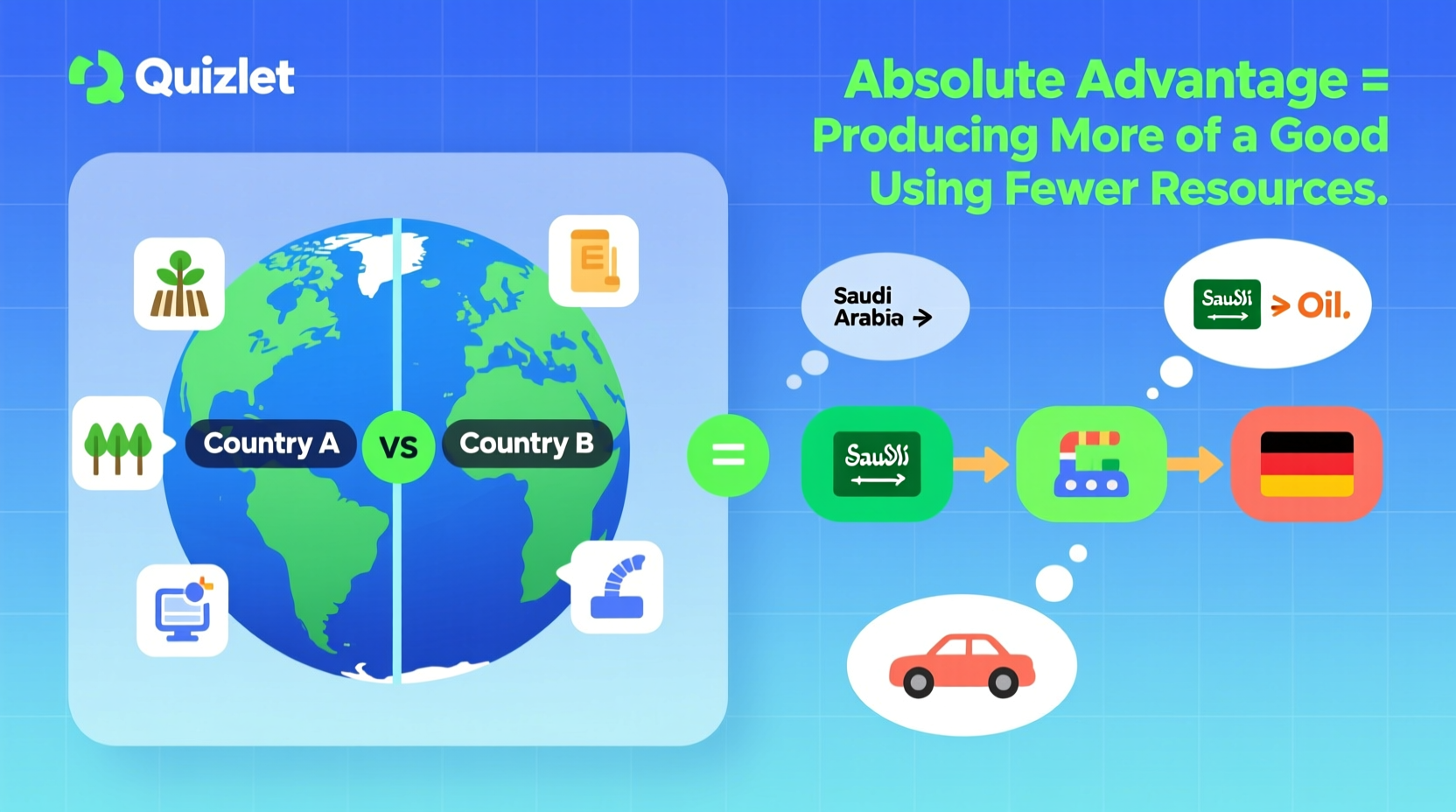
When we say one nation has an absolute advantage over another in producing a certain good, we mean it can generate a greater quantity of that good using the same inputs—such as labor, capital, or time. For example, if Country A can produce 10 tons of wheat per worker annually while Country B produces only 5 tons under the same conditions, Country A holds the absolute advantage in wheat production.
This principle was first articulated by Adam Smith in his 1776 work *The Wealth of Nations*, where he argued that nations should specialize in goods they can produce most efficiently and trade for others. Unlike comparative advantage—which focuses on opportunity cost—absolute advantage is purely about productivity superiority.
“Absolute advantage is not about who gives up less to produce something, but who produces more with what they have.” — Dr. Rebecca Lin, Economist and Education Consultant
How Quizlet Makes Economic Concepts Stick
Learning complex ideas like absolute advantage requires more than rote memorization. It demands context, repetition, and application. Quizlet excels by offering multiple modes of engagement tailored to different learning styles:
- Flashcards: Users create or access sets that define “absolute advantage” alongside real-world examples.
- Learn Mode: Adaptive quizzes reinforce retention by focusing on terms users struggle with.
- Test Mode: Simulates exam conditions, helping students apply definitions accurately.
- Match & Gravity Games: Turn review into engaging challenges that boost recall speed.
For visual learners, adding diagrams—like side-by-side production tables—helps clarify differences between absolute and comparative advantage. Auditory learners benefit from text-to-speech features, while kinesthetic learners engage through drag-and-drop activities.
Applying Absolute Advantage: A Real-World Scenario
Consider two small island nations: Coralnia and Marista. Both produce fish and coconuts. With one day of labor:
| Nation | Fish (kg) | Coconuts (units) |
|---|---|---|
| Coralnia | 20 | 10 |
| Marista | 15 | 30 |
Coralnia has an absolute advantage in fishing—it produces more fish per worker. Marista dominates coconut harvesting. If both islands specialize based on their strengths and trade, total output increases. This simple model illustrates why countries export goods they produce most efficiently.
A high school economics teacher in Portland used this exact scenario in a Quizlet set titled “Trade Basics Review.” Students reported a 35% improvement in test scores after integrating daily 10-minute Quizlet sessions into their routine. The platform allowed them to visualize data, rehearse definitions, and simulate trade decisions—all within one interface.
Step-by-Step Guide to Mastering Absolute Advantage Using Quizlet
To fully internalize the concept and use Quizlet effectively, follow this five-step process:
- Search or Create a Study Set: Look for existing sets on “absolute advantage” or build your own with clear definitions and numerical examples.
- Add Contextual Examples: Include at least two comparative scenarios (like the island example above) to reinforce understanding.
- Use Multiple Study Modes: Rotate between Flashcards, Learn, and Test modes over three days to activate different memory pathways.
- Take a Practice Quiz: Design a short quiz asking users to identify which country has an absolute advantage given specific production data.
- Review Mistakes Immediately: Quizlet highlights incorrect answers—use this feedback loop to revisit weak areas before retesting.
This method leverages cognitive science principles such as active recall and spaced repetition, proven to enhance long-term retention far better than passive reading.
Do’s and Don’ts When Learning Economic Principles Online
| Do | Don't |
|---|---|
| Use real-world data when creating Quizlet examples (e.g., U.S. vs. China manufacturing output) | Rely solely on definition cards without application exercises |
| Study in short bursts (15–20 minutes) across several days | Cram all content in one session the night before a test |
| Combine Quizlet with textbook readings or video lectures | Treat Quizlet as a standalone replacement for deeper study |
| Share study sets with classmates for collaborative learning | Copy public sets without verifying accuracy |
Expert Insight: Why Digital Tools Matter in Modern Education
Educational technology isn’t just convenient—it’s transformative. According to Dr. Alan Torres, a curriculum designer at Stanford’s Graduate School of Education:
“When students interact with concepts dynamically—through games, self-testing, and instant feedback—they develop deeper mental models. Platforms like Quizlet turn static definitions into living knowledge.”
This is especially true for abstract topics like absolute advantage, where misunderstanding a single term can derail comprehension of broader trade theories. Interactive reinforcement closes those gaps early.
FAQ
What’s the difference between absolute and comparative advantage?
Absolute advantage is about superior productivity—producing more with the same resources. Comparative advantage is about lower opportunity cost—even if a country is worse at producing both goods, it should still specialize in the one it sacrifices less to make.
Can individuals have an absolute advantage?
Yes. For instance, a software developer may write twice as many lines of clean code per hour as a peer, giving them an absolute advantage in coding output. However, specialization decisions should still consider comparative advantage for optimal efficiency.
Is Quizlet reliable for learning economics concepts?
When used correctly—with verified content and integrated into a broader study plan—Quizlet is highly effective. Always cross-check user-generated sets against authoritative sources like textbooks or instructor materials.
Conclusion: Turning Definitions Into Mastery
The phrase “how absolute advantage is best defined as quizlet connects to your learning needs” isn’t just a search query—it reflects a shift in how knowledge is acquired today. Understanding economic principles no longer depends solely on lectures or dense textbooks. Instead, learners now have tools that adapt to their pace, preferences, and goals.
By framing absolute advantage within interactive, customizable environments like Quizlet, students move beyond memorization to true mastery. They learn not just what the term means, but how to apply it, explain it, and distinguish it from related ideas. That transformation—from passive receiver to active thinker—is the hallmark of effective education.




 浙公网安备
33010002000092号
浙公网安备
33010002000092号 浙B2-20120091-4
Comments
No comments yet. Why don't you start the discussion?