
The word \"why\" is one of the most frequently used interrogative words in the English language. Despite its simplicity, confusion sometimes arises—not because of complexity, but due to mishearing, autocorrect errors, or uncertainty in writing. Whether you're drafting an email, completing homework, or double-checking a message, knowing how to spell \"why\" correctly—and understanding its role—is essential for clear communication.
At first glance, the question “how do you spell why” may seem trivial. But for learners, non-native speakers, or even native users typing quickly, such small words can become points of hesitation. This article clarifies the correct spelling, explains the meaning and grammatical function of \"why,\" explores common misconceptions, and offers practical tools to ensure you use it confidently and accurately.
Understanding the Word: Spelling and Pronunciation
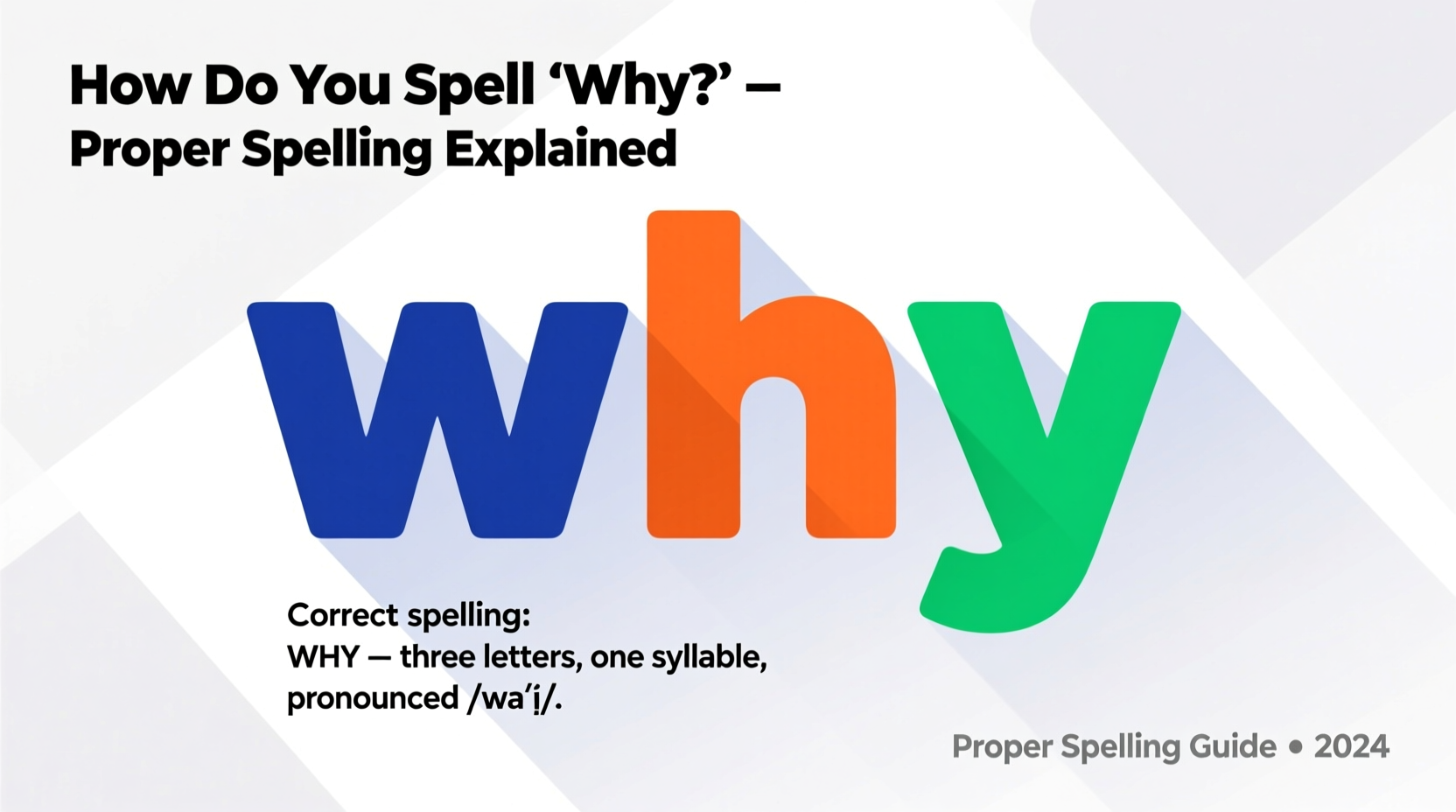
The correct spelling is W-H-Y. No variations, no silent letters—just three simple letters forming a powerful question word. It is pronounced /waɪ/ (rhymes with “sky”), with a long “i” sound at the end.
This pronunciation sometimes leads to misspellings. For example, people may incorrectly write “wye” (which is actually a homophone used in formal or technical contexts) or “wi” (a phonetic misinterpretation). However, in standard modern English, \"why\" is always spelled W-H-Y when used as an interrogative or relative adverb.
What Does \"Why\" Mean? Core Uses and Functions
\"Why\" primarily functions as an interrogative adverb used to ask for reasons or explanations. It seeks to uncover motivation, cause, or purpose behind actions, events, or decisions.
Examples of correct usage include:
- “Why did you leave early?” — asking for a reason.
- “I know why she was upset.” — introducing a subordinate clause explaining cause.
- “Why not try again?” — suggesting possibility through rhetorical questioning.
Beyond direct questions, \"why\" also appears in indirect speech and explanatory statements:
“She explained why the project failed.” — Here, “why” introduces the explanation.
It's important to note that \"why\" differs from other question words like \"what,\" \"where,\" or \"when,\" as it focuses exclusively on causality rather than identity, location, or time.
Common Misspellings and Why They Happen
Despite being short, \"why\" is occasionally misspelled due to phonetic assumptions or keyboard slips. Below are frequent errors and their likely causes:
| Incorrect Spelling | Likely Cause | Correct Form |
|---|---|---|
| wi | Phonetic simplification; assuming “why” sounds like “we” | why |
| wye | Confusion with archaic or dialectal spelling; sometimes used in names or logos | why |
| whi | Typo or incomplete keystroke (missing 'y') | why |
| y | Over-reliance on texting shortcuts or slang abbreviations | why |
These errors often occur in informal digital communication, where speed overrides accuracy. While autocorrect may catch some, others slip through—especially in professional or academic writing, where precision matters.
“Even small spelling errors like ‘wi’ instead of ‘why’ can undermine credibility in formal writing. Accuracy builds trust.” — Dr. Laura Simmons, Linguistics Professor at Boston University
Step-by-Step Guide to Using \"Why\" Correctly
To ensure you're using \"why\" properly in both spoken and written English, follow this simple five-step process:
- Identify the need for explanation: Ask yourself if you’re seeking a reason or cause. If yes, “why” is likely the right word.
- Spell it W-H-Y: Always double-check the spelling before sending messages or submitting work.
- Use proper capitalization: Begin sentences with a capital “Why,” and capitalize it in titles according to style rules (e.g., “Why You Should Care”).
- Avoid redundancy: Don’t combine “why” with phrases like “the reason is because.” Instead, say “The reason is that…” or simply “Why did you…?”
- Edit for tone: In rhetorical questions (“Why bother?”), ensure context makes intent clear to avoid sounding dismissive.
Real Example: A Student’s Writing Improvement
Jessica, a high school sophomore, consistently lost points on essays for minor spelling errors. One recurring mistake was writing “wi” instead of “why,” especially in rushed drafts. Her teacher highlighted the error multiple times, noting that while the meaning was clear, repeated misspellings weakened her overall score.
After installing a grammar-check extension and practicing dictation exercises, Jessica began reviewing each paragraph specifically for question words. She created a personal checklist (see below) and reduced spelling errors by over 80% within two months. Her final essay on climate change included precise usage: “Why have global policies failed to reduce emissions?”—spelled correctly and used effectively to frame her argument.
Checklist: Mastering the Use of \"Why\"
Use this quick-reference checklist whenever writing or editing:
- ✅ Is the word spelled W-H-Y?
- ✅ Am I asking for a reason or explaining a cause?
- ✅ Did I capitalize it at the beginning of a sentence?
- ✅ Have I avoided redundant constructions like “reason why is…”?
- ✅ Would rephrasing improve clarity or tone?
This tool helps reinforce accuracy and promotes mindful writing habits, especially under time pressure.
Frequently Asked Questions
Is “wye” ever the correct spelling of “why”?
“Wye” is a legitimate word, but it refers to the letter Y or a triangular junction in roads or pipes. It is not used as a standard spelling for the interrogative “why” in modern English. While “wye” appears in historical texts or poetic forms, contemporary usage requires “why.”
Can “why” be used at the end of a sentence?
Yes, though less common. In conversational English, fragments like “That’s what I want to know—why!” are acceptable. However, in formal writing, structure typically places “why” at the beginning of a clause or question.
Does “why” always require a question mark?
No. When used in indirect questions or subordinate clauses, no question mark is needed. For example: “She asked why he left.” Only direct questions require punctuation: “Why did he leave?”
Final Thoughts: Confidence Starts with Clarity
Mastering the spelling and usage of “why” might seem minor, but it reflects broader attention to detail in communication. Whether you're a student, professional, or casual writer, getting the basics right strengthens your voice and enhances credibility. There’s no magic trick—just consistent practice, awareness of common pitfalls, and a willingness to proofread.
Every well-spelled word is a step toward clearer thinking and more effective expression. Now that you know how to spell “why” and understand its meaning, apply this knowledge deliberately. Revisit your recent messages or documents. Spot any old mistakes? Correct them. Share this insight with someone who might benefit. Because asking “why” isn’t just about spelling—it’s about caring enough to get it right.




 浙公网安备
33010002000092号
浙公网安备
33010002000092号 浙B2-20120091-4
Comments
No comments yet. Why don't you start the discussion?