
Estimating travel time is more than just checking a map app—it’s about understanding variables that can turn a 30-minute drive into an hour-long ordeal. Whether you're commuting, road-tripping, or catching a flight, inaccurate time estimates lead to stress, missed appointments, and unnecessary expenses. The difference between a smooth journey and a chaotic one often comes down to preparation and awareness of real-world conditions.
Modern navigation tools provide instant answers, but they don’t always account for last-minute changes like weather, traffic spikes during school drop-offs, or unexpected construction. To truly know how long it will take to reach your destination, you need a layered approach: combine technology with personal experience and proactive planning.
Understanding the Basics of Travel Time Estimation
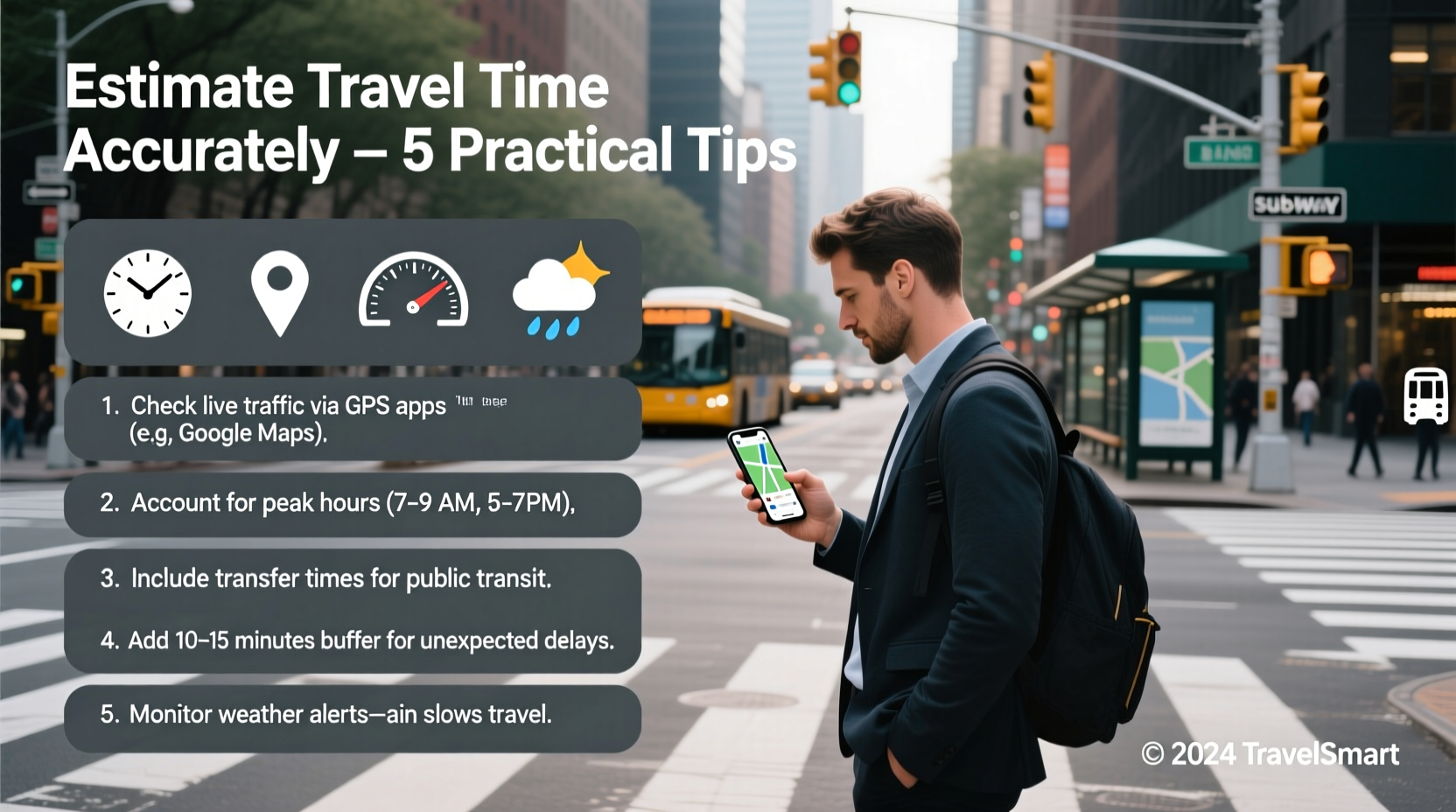
At its core, travel time is calculated using distance divided by average speed. But in practice, this formula rarely tells the whole story. Urban commutes, rural routes, public transit schedules, and even pedestrian pathways introduce variables that skew predictions.
For example, a 15-mile route may appear to take 20 minutes on paper at 45 mph, but signal delays, merging lanes, and school zones can easily stretch that to 35 minutes. Similarly, walking 1 mile might be listed as a 20-minute walk, but uphill terrain or crowded sidewalks slow actual pace.
The key is recognizing that estimated time en route (ETR) is not static. It shifts based on:
- Time of day: Rush hours dramatically increase congestion.
- Day of the week: Fridays often see heavier outbound traffic; Mondays bring return surges.
- Weather conditions: Rain, snow, or fog reduce speeds and increase accident risks.
- Special events: Concerts, sports games, or parades reroute traffic unpredictably.
- Mode of transport: Driving, biking, walking, and public transit each have unique delay factors.
How to Accurately Predict Your Arrival Time
Accurate travel time estimation requires both data and judgment. Here’s how to refine your predictions beyond what GPS apps tell you.
Use Real-Time Traffic Apps Strategically
Google Maps, Waze, and Apple Maps offer dynamic routing based on live traffic. However, their default settings assume ideal conditions unless manually adjusted. For better accuracy:
- Check the route at the same time you plan to travel—morning estimates won’t reflect afternoon gridlock.
- Enable “departure time” or “arrival time” options to simulate real scenarios.
- Compare multiple apps: Waze excels in crowd-sourced alerts, while Google Maps integrates public transit seamlessly.
Factor in Stops and Transitions
Many travelers forget non-driving time. A 90-minute drive might include:
- Parking search (5–15 minutes in dense areas)
- Tunnel or bridge tolls (potential queues)
- Restroom breaks or fuel stops
- Walking from parking to final destination
“People underestimate transition time by up to 30%. That five-minute walk from the train station adds up when repeated daily.” — Dr. Lena Torres, Urban Mobility Researcher, MIT Transit Lab
Step-by-Step Guide to Planning Your Travel Time
Follow this timeline-based method to build reliable estimates:
- Define start and end points precisely – Include building entrances, parking lots, or terminal gates.
- Choose your mode of transport – Compare driving, transit, biking, or rideshare using time and cost.
- Run simulations in mapping apps – Input your planned departure time and review alternate routes.
- Add contingency time – 15% for routine trips; 30–50% for critical ones (flights, interviews).
- Check external factors – Look up weather forecasts, event calendars, and roadwork notices.
- Test the route ahead of time – If possible, do a trial run during similar conditions.
- Review and adjust post-trip – Note discrepancies between prediction and reality for future accuracy.
Common Pitfalls and How to Avoid Them
Even experienced travelers fall into timing traps. Below are frequent mistakes and how to counter them.
| Mistake | Why It Happens | How to Fix It |
|---|---|---|
| Relying solely on GPS best-case estimates | Apps often show optimistic times without traffic history | Cross-check with historical data or past experience |
| Ignoring seasonal patterns | Summer weekends bring tourist traffic; holidays alter flows | Research seasonal trends for your route |
| Overlooking parking logistics | City centers may require circling blocks or paid garages | Pre-book parking or use apps like SpotHero |
| Underestimating public transit delays | Buses get stuck in traffic; trains face mechanical issues | Add 20+ minutes buffer; check agency alerts |
| Forgetting security or boarding time | Airports, stadiums, and conferences require screening | Verify entry requirements and arrive early |
Real-World Example: Commuting Across a Major Metro Area
Sarah lives in Silver Spring, Maryland, and works in downtown Washington, D.C. Her office is a 12-mile drive that Google Maps says takes 28 minutes. Yet she consistently arrives late when leaving at 8:02 a.m.
After tracking her commute for two weeks, she discovered:
- From 7:45–8:15 a.m., I-495 experiences heavy merging traffic near the Capital Beltway.
- Her building’s garage often has a 5–7 minute wait during peak entry.
- The final quarter-mile walk through the federal zone includes a security checkpoint.
By adjusting her departure to 7:30 a.m. and using the Metro during extreme congestion days, Sarah reduced her average arrival variance from 18 minutes late to within 5 minutes of target. She now uses a checklist to decide each morning whether to drive or take transit based on real-time alerts.
Essential Checklist for Reliable Travel Planning
Before every trip—short or long—run through this checklist to ensure accurate time estimates:
- ✅ Confirm exact starting point and final destination (e.g., “third-floor conference room,” not just “office building”)
- ✅ Check live traffic and weather via multiple sources
- ✅ Account for known delays (construction, events, holidays)
- ✅ Add buffer time: 15% for regular trips, 30%+ for high-stakes ones
- ✅ Pre-book parking or verify public transit schedules
- ✅ Share your itinerary and estimated arrival with someone if traveling alone
- ✅ Review previous trips on the same route for pattern insights
Frequently Asked Questions
How accurate are GPS travel time estimates?
GPS apps are generally accurate under normal conditions, especially with real-time traffic enabled. However, they often fail to predict sudden incidents like accidents or flash flooding. Use them as a baseline, not a guarantee.
Should I trust “estimated time of arrival” notifications from ride-share apps?
Ride-share ETAs are useful but subject to driver behavior, detours, and pickup coordination. They typically don’t include time for you to walk to the pickup spot or delays caused by double-parked vehicles. Add 10–15 minutes for reliability.
What’s the best way to estimate walking time in a new city?
While most apps assume a 3 mph walking speed, urban environments slow you down. Factor in crosswalk signals, crowded sidewalks, and navigation confusion. A better rule: allow 20 minutes per mile in dense cities instead of the standard 20 minutes for 3 miles.
Final Thoughts: Turn Guesswork Into Precision
Knowing how long it takes to get to your destination isn’t about finding a single number—it’s about building a process that adapts to changing conditions. The most effective travelers don’t just follow maps; they interpret them, challenge assumptions, and prepare for the unexpected.
By combining technology with personal insight, factoring in overlooked transitions, and learning from past trips, you gain control over your schedule rather than being ruled by delays. Whether you’re heading to work, catching a flight, or visiting family across state lines, precise time estimation reduces stress and increases reliability.




 浙公网安备
33010002000092号
浙公网安备
33010002000092号 浙B2-20120091-4
Comments
No comments yet. Why don't you start the discussion?