
When a recipe calls for fresh onions but you only have onion powder in your spice cabinet, the question arises: how much onion powder equals one fresh onion? This is more than a simple substitution—it’s about preserving flavor balance, texture, and depth in your cooking. Understanding the conversion ratio between fresh onions and their dehydrated counterpart is essential for consistent results, whether you're making soups, stews, marinades, or dry rubs. Unlike raw onions, onion powder lacks moisture and crunch but delivers concentrated allium flavor in a compact, shelf-stable form. Knowing when and how to use it ensures your dishes remain flavorful and well-balanced, even without fresh produce on hand.
Definition & Overview
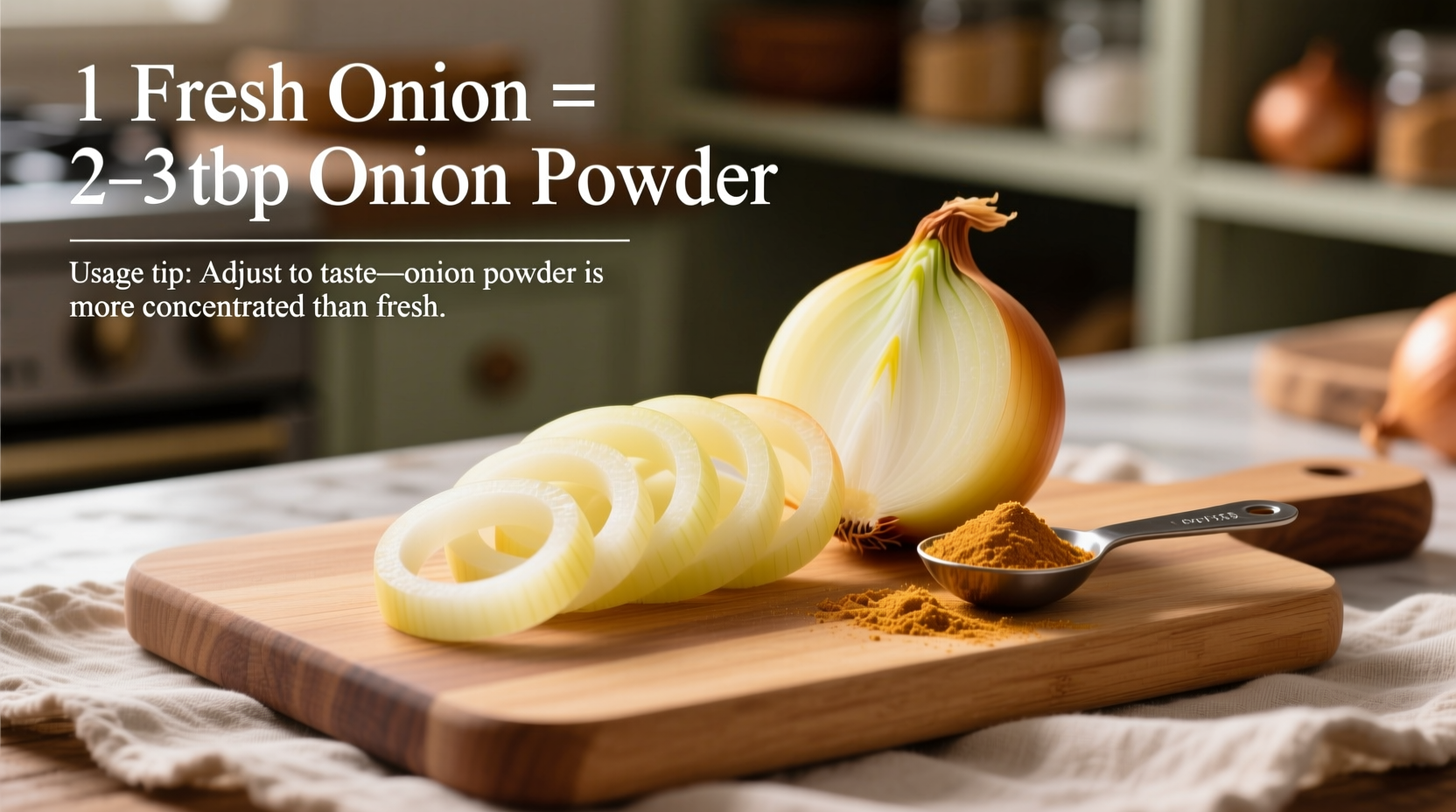
Onion powder is a finely ground seasoning made from dehydrated onions, typically white, yellow, or red varieties. The onions are peeled, sliced, dried, and then milled into a fine powder. This process removes approximately 85–90% of the water content, leaving behind a potent concentration of onion flavor and aroma. As a result, onion powder functions as a convenient, long-lasting alternative to fresh onions in many culinary applications.
It belongs to the broader category of dried allium seasonings and is commonly used in spice blends, dry rubs, soups, sauces, and processed foods. Its origin traces back to early food preservation techniques, where drying vegetables extended shelf life without refrigeration. Today, onion powder is a staple in both home kitchens and commercial food production due to its consistency, ease of use, and ability to dissolve evenly in liquids.
The flavor profile of onion powder is savory, slightly sweet, and mildly pungent—retaining the essential character of raw onions but without the sharp bite or textural bulk. Because it dissolves quickly and integrates smoothly into mixtures, it’s ideal for recipes where uniform distribution of flavor is critical.
Key Characteristics
| Characteristic | Description |
|---|---|
| Flavor | Savory, mildly sweet, with a clean onion essence; less sharp than raw onion |
| Aroma | Potent, earthy, immediately recognizable as onion when opened |
| Form & Color | Fine yellow-to-tan powder; may have slight granules depending on brand |
| Heat Level | Non-spicy; contributes umami and depth, not heat |
| Culinary Function | Flavor enhancer, base seasoning, thickener in dry mixes |
| Shelf Life | 2–3 years when stored properly in a cool, dark, dry place |
| Solubility | Dissolves readily in liquids; does not rehydrate like flakes |
Practical Usage: How to Substitute Onion Powder for Fresh Onions
The standard conversion accepted by most culinary professionals and food scientists is:
1 tablespoon of onion powder ≈ 1 medium fresh onion (about 1 cup chopped)
This ratio accounts for the removal of water during dehydration while maintaining equivalent flavor compounds. However, this is a guideline—not an absolute rule—and adjustments may be necessary based on the dish type, desired intensity, and personal taste preferences.
For example, if a recipe calls for one medium chopped yellow onion (approximately 150 grams), you can substitute it with one tablespoon of onion powder. When using onion powder in liquid-based dishes such as soups, stews, gravies, or sauces, add it early in the cooking process to allow full dissolution and flavor integration.
Step-by-Step Substitution Guide
- Assess the recipe type: Determine whether the dish relies on the texture of fresh onion (e.g., salsas, salads) or primarily uses onion for flavor (e.g., casseroles, meatloaf).
- Measure accurately: Use measuring spoons for precision. One level tablespoon of sifted onion powder is standard.
- Adjust for moisture loss: Since onion powder adds no moisture, consider increasing liquid slightly in dry mixtures (e.g., batters or doughs) if replacing large quantities.
- Taste and refine: Add half the intended amount first, cook briefly, then adjust. Onion powder can become overpowering if overused.
- Combine with other aromatics: In absence of fresh onion, enhance complexity by pairing onion powder with garlic powder, shallot powder, or a pinch of celery seed.
Pro Tip: For layered flavor in sautéed dishes, add onion powder along with oil at the beginning of cooking to \"bloom\" its flavor, mimicking the effect of sweating fresh onions. This technique enhances depth in curries, stir-fries, and braises.
Common Applications
- Dry Rubs: Ideal for seasoning meats before grilling or smoking. Combine with paprika, salt, pepper, and brown sugar for barbecue blends.
- Marinades: Dissolves easily in acidic or oily liquids, ensuring even flavor penetration.
- Baking: Used in savory breads, biscuits, and cheese straws for subtle onion notes without altering texture.
- Instant Foods: Found in instant noodles, soup mixes, and boxed sides for quick flavor delivery.
- Vegetarian/Vegan Cooking: Provides umami richness in plant-based dishes where caramelized onion might otherwise be used.
Variants & Types of Dried Onion Products
While onion powder is the most concentrated form, several related dried onion products exist, each with distinct uses and conversion rates:
| Type | Texture | Flavor Intensity | Conversion Ratio (per 1 fresh onion) | Best Uses |
|---|---|---|---|---|
| Onion Powder | Fine, flour-like | High – most concentrated | 1 tbsp = 1 onion | Liquids, dry rubs, baking |
| Onion Flakes | Dehydrated slices, flaky | Moderate – rehydrates partially | 3 tbsp = 1 onion | Stews, casseroles, dips |
| Granulated Onion | Slightly coarser than powder | Moderate-high | 1.5 tbsp = 1 onion | Dry mixes, rubs, pickling |
| Freeze-Dried Minced Onion | Light, brittle pieces | Moderate – closer to fresh | ¼ cup = 1 onion | Rehydration needed; soups, sauces |
Among these, onion powder remains the most versatile for precise measurement and seamless integration. Flakes and granules offer textural interest but require longer cooking times to soften. Freeze-dried versions best mimic fresh onion but are less common in household pantries.
Comparison with Similar Ingredients
Onion powder is often confused with other dried allium products. Understanding the differences ensures proper usage and prevents flavor imbalances.
- Garlic Powder: While similar in form and function, garlic powder has a sharper, more pungent flavor. It cannot substitute for onion powder 1:1 due to stronger potency. Use garlic powder when garlic flavor is intended, not as a general aromatic replacement.
- Onion Salt: A blend of onion powder and table salt (typically 3:1 ratio). Using onion salt in place of pure onion powder will increase sodium levels significantly. To substitute, reduce added salt in the recipe by ½ tsp for every tablespoon of onion salt used.
- Chives or Shallots (dried): These have more delicate, nuanced flavors. Dried chives lack the sulfurous punch of onion and are better suited for garnishes. Shallot powder is finer and sweeter, ideal for vinaigrettes or French-inspired dishes.
- Leek Powder: Milder and grassier than onion powder, derived from dehydrated leeks. Not interchangeable in recipes requiring strong onion flavor.
Quick Reference: Never swap onion powder directly for garlic powder or onion salt without adjusting salt and flavor expectations. Always check labels to confirm ingredient composition.
Practical Tips & FAQs
Can I use onion powder in raw applications like salads or salsas?
No, onion powder is unsuitable for raw preparations. Without moisture to dissolve it, the powder remains gritty and overly intense. Fresh minced onion, scallions, or pickled onions are better choices for cold dishes.
Does onion powder lose potency over time?
Yes. While shelf-stable for up to three years, onion powder gradually loses volatile oils and aroma. Store in an airtight container away from heat and light. To test freshness, smell the jar—if the scent is faint or musty, replace it.
Is onion powder gluten-free and allergen-safe?
Pure onion powder is naturally gluten-free and free of major allergens. However, some commercial blends may include anti-caking agents or be processed in facilities with allergens. Always read labels if dietary restrictions apply.
How do I make homemade onion powder?
Preheat oven to 175°F (80°C). Slice 2–3 large onions thinly, spread on a parchment-lined tray, and bake for 6–8 hours until completely crisp. Cool, then grind in a spice grinder until powdery. Sift to remove coarse bits. Store in a glass jar. Yield: ~3 tablespoons per large onion.
Why does my dish taste too strong after using onion powder?
Overuse is the most common cause. Onion powder is highly concentrated—one teaspoon can equal a quarter of a fresh onion. Start with half the recommended amount, especially in delicate dishes like creamy sauces or grain pilafs.
Can I rehydrate onion powder to mimic fresh onion?
Not effectively. Unlike onion flakes, onion powder dissolves rather than rehydrates. Adding water creates a paste that lacks the fibrous texture of real onion and may alter dish consistency.
What dishes benefit most from onion powder?
Onion powder excels in:
- Meatloaf and meatballs (even flavor without excess moisture)
- Homemade spice blends (e.g., Cajun, Italian seasoning)
- Gravies and pan sauces (no need to sauté onions separately)
- Roasted vegetable coatings (adheres well to oil-coated surfaces)
- Plant-based dairy alternatives (adds savory depth to vegan cheeses)
Expert Insight: When Fresh Can’t Be Beaten
\"There’s no perfect substitute for the complexity of a slowly caramelized onion—the Maillard reaction develops hundreds of flavor compounds that powder simply can’t replicate. Use onion powder for convenience and base seasoning, but reserve fresh onions for dishes where transformation through heat is key.\" — Chef Elena Torres, Culinary Instructor, National Institute of Gastronomy
This underscores a vital principle: onion powder is a tool, not a universal replacement. It fills a specific niche in modern cooking—efficiency, consistency, and solubility—but cannot replicate the textural evolution or nuanced sweetness achieved by cooking fresh onions over time.
Storage & Shelf Life Best Practices
To maximize longevity and flavor retention:
- Store in airtight glass or metal containers—plastic may absorb odors and degrade over time.
- Keep in a cool, dark cupboard away from the stove, dishwasher, or sunlight.
- Label with purchase date; aim to use within 24 months for peak potency.
- Do not store in the refrigerator—moisture causes clumping and spoilage.
- Never dip a wet spoon into the container; always use dry utensils.
If clumping occurs, break up gently with a fork. Small lumps indicate moisture exposure but don’t necessarily mean spoilage—smell and taste before discarding.
Summary & Key Takeaways
Understanding the relationship between onion powder and fresh onions empowers better decision-making in the kitchen. Here are the core principles to remember:
- Standard Conversion: 1 tablespoon of onion powder equals one medium fresh onion (approx. 1 cup chopped).
- Best Applications: Use in cooked dishes where texture isn’t critical—soups, stews, rubs, sauces, baked goods.
- Avoid in Raw Dishes: Does not perform well in salsas, salads, or garnishes due to grittiness and excessive potency.
- Don’t Confuse with Onion Salt: Adjust salt levels accordingly when substituting.
- Start Low, Taste Often: Onion powder builds quickly; under-season first, then correct.
- Store Properly: Airtight, cool, dark conditions preserve flavor for up to three years.
- Complement, Don’t Replace: Use alongside fresh aromatics when possible for layered depth.
Final Thought: Onion powder is a pantry powerhouse—compact, reliable, and flavor-efficient. Master its use, and you’ll never be stranded without onions again. But remember: while it solves convenience challenges, it doesn’t eliminate the value of fresh ingredients. Keep both on hand, and let your recipe guide the choice.




 浙公网安备
33010002000092号
浙公网安备
33010002000092号 浙B2-20120091-4
Comments
No comments yet. Why don't you start the discussion?