
Understanding your true annual income is more than just checking your paycheck—it’s the foundation of smart budgeting, tax planning, and long-term financial growth. Many people assume their annual income is simply 12 times their monthly salary, but that oversimplification can lead to inaccurate financial decisions. Whether you're salaried, hourly, self-employed, or have multiple income streams, an accurate calculation requires attention to detail and awareness of all revenue sources and adjustments.
This guide breaks down the process into clear, actionable steps so you can determine your real annual income with confidence. From base pay to bonuses, side gigs to deductions, we’ll walk through every component that matters.
Step 1: Identify All Sources of Income
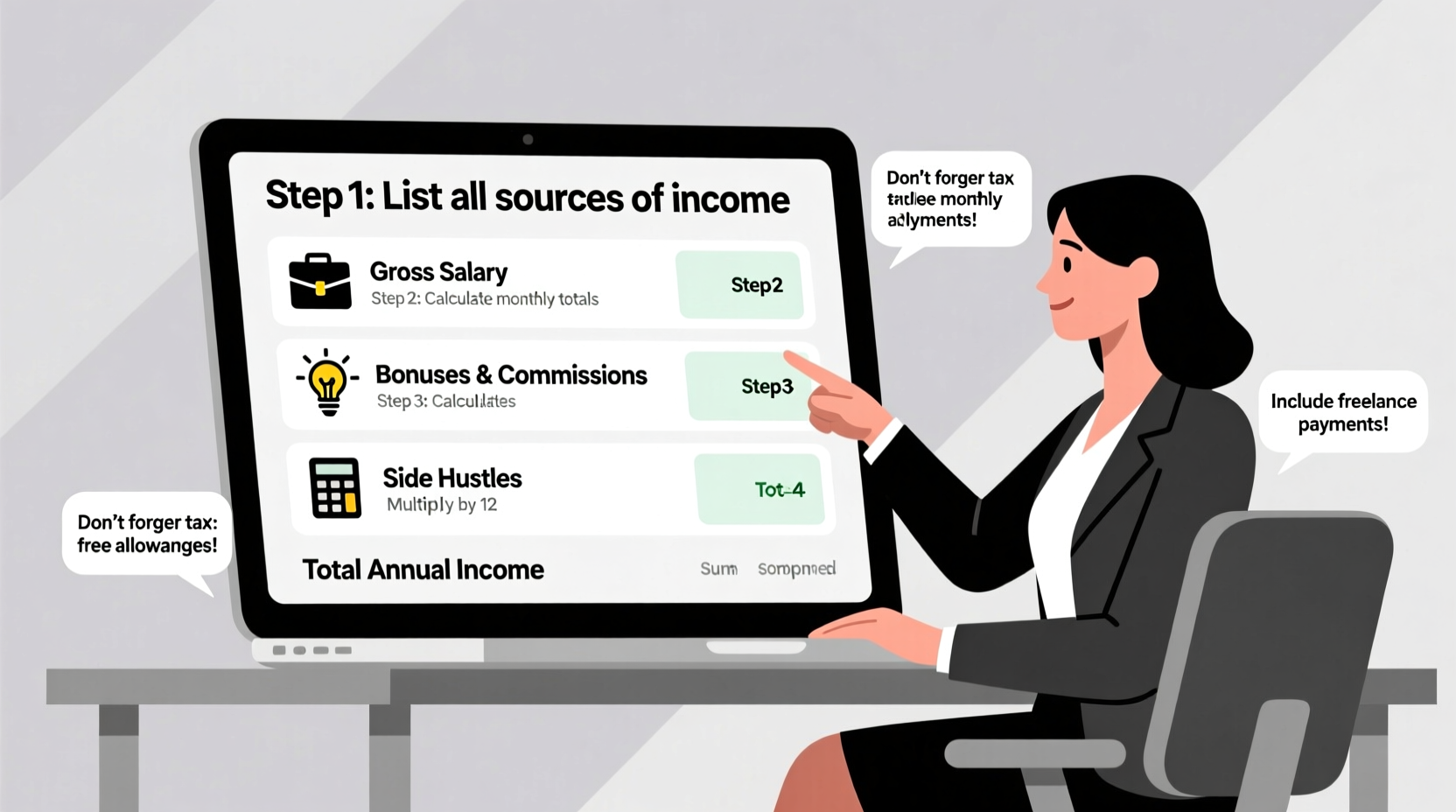
The first step in calculating your annual income is gathering a complete picture of where your money comes from. Do not limit yourself to your primary job. Consider every stream that contributes to your financial inflow.
- Wages or salary from full-time employment
- Hourly earnings from part-time work
- Overtime pay (if consistent)
- Bonuses, commissions, or profit-sharing
- Freelance or gig economy earnings (e.g., Uber, Fiverr, Upwork)
- Rental income
- Dividends or interest from investments
- Social Security, disability, or pension payments
- Side businesses or online sales
For each source, estimate the average monthly amount you receive. Then multiply by 12 to get the annual figure. If income fluctuates—like freelance work—use a 6- to 12-month average for greater accuracy.
Step 2: Distinguish Between Gross and Net Income
It's crucial to understand the difference between gross and net income, as they serve different purposes in financial planning.
| Income Type | Definition | Best Used For |
|---|---|---|
| Gross Annual Income | Total earnings before taxes and deductions | Loan applications, tax filing, budgeting baseline |
| Net Annual Income | Take-home pay after taxes, insurance, retirement, etc. | Monthly budgeting, expense planning |
For example, if you earn $60,000 per year before deductions, that’s your gross income. After federal and state taxes, Social Security, Medicare, health insurance, and retirement contributions, you might take home only $45,000. That $45,000 is your net income—the amount actually available for spending and saving.
“Knowing your net income is essential for creating a realistic budget. Too many people base their lifestyle on gross income and end up living paycheck to paycheck.” — Lisa Tran, Certified Financial Planner
Step 3: Calculate Income Based on Employment Type
Your method of calculation depends on how you’re paid. Here are common scenarios:
Salaried Employees
If you’re paid a fixed annual salary, the calculation is straightforward:
Annual Income = Annual Salary
Example: $5,000/month × 12 = $60,000/year.
Hourly Workers
Multiply your hourly rate by average weekly hours, then by 52 weeks:
Annual Income = Hourly Rate × Hours/Week × 52
Example: $20/hour × 35 hours/week × 52 weeks = $36,400/year.
If overtime is regular, include it. Otherwise, treat it as supplemental income.
Freelancers and Self-Employed
Use historical data. Add up total income from the past 12 months and divide by 12 to find the average monthly income, then multiply by 12 again for the projected annual total.
Annual Income = (Total Earnings Last Year) or (Average Monthly Earnings × 12)
Also factor in expected business expenses when determining taxable and usable income.
Multiple Jobs or Side Hustles
Add the annualized income from each role. Be honest about consistency—don’t count one-time windfalls unless they’re truly recurring.
Step 4: Adjust for Irregular or Variable Income
If your income varies month to month—common among freelancers, commission-based workers, or seasonal employees—use a rolling average. Look at the last 6 to 12 months of deposits and calculate the mean.
Example:
- Jan: $3,000
- Feb: $2,800
- Mar: $3,500
- Apr: $2,700
- May: $3,200
- Jun: $3,800
Average Monthly Income = ($3,000 + $2,800 + $3,500 + $2,700 + $3,200 + $3,800) ÷ 6 = $3,166.67
Estimated Annual Income = $3,166.67 × 12 = $38,000
To build stability, some variable-income earners use the “lowest three-month average” method to ensure they can survive lean periods.
Mini Case Study: Maria, Freelance Graphic Designer
Maria works independently and earns income from client projects, stock design sales, and occasional teaching gigs. Her monthly income ranges from $2,200 to $5,000. Over the past year, she earned a total of $48,600.
She calculates her annual income as $48,600, but for budgeting, she uses a conservative monthly baseline of $3,500 ($42,000/year). This allows her to save during high-earning months and cover expenses during slower ones.
By tracking her income meticulously, Maria avoids overspending and plans for taxes effectively.
Step 5: Factor in Deductions and Pre-Tax Contributions
Your gross income isn't what ends up in your bank account. To understand your actual financial position, subtract key deductions:
- Federal and state income taxes
- Social Security and Medicare (FICA)
- Health, dental, and vision insurance premiums
- Retirement contributions (401(k), IRA, etc.)
- Flexible Spending Account (FSA) or Health Savings Account (HSA) contributions
- Union dues or wage garnishments
Many of these are pre-tax, meaning they reduce your taxable income. For example, contributing $6,000 to a traditional 401(k) lowers your taxable income from $60,000 to $54,000, even though you still had access to that $6,000—it was just redirected to savings.
When lenders assess your eligibility, they often look at adjusted gross income (AGI), which includes most deductions except personal exemptions. You can find your AGI on line 11 of Form 1040.
Checklist: How to Accurately Calculate Your Annual Income
- List all income sources (jobs, side gigs, investments, etc.)
- Determine frequency and average amount for each source
- Calculate annual totals using multiplication or averaging
- Distinguish between gross and net income
- Adjust for irregular income using 6- to 12-month averages
- Subtract pre-tax deductions to find taxable and net income
- Verify with tax returns, pay stubs, or bank statements
- Update calculations quarterly or whenever income changes
FAQ
Does annual income include bonuses and commissions?
Yes, if they are reasonably predictable and received regularly. One-time bonuses should be excluded unless you expect them annually. Commission-based income should be averaged over several months for accuracy.
Should I include investment income when calculating annual income?
Yes, especially if it’s a consistent part of your cash flow—such as dividends, rental income, or interest. However, avoid including volatile or speculative gains unless they are part of a long-term trend.
How often should I recalculate my annual income?
At minimum, once a year—ideally at the start of the calendar year or tax season. If you have variable income, review it quarterly. Major life changes (new job, promotion, side business launch) also warrant an immediate update.
Conclusion
Accurately calculating your annual income is not a one-size-fits-all task, but it’s one of the most empowering financial skills you can develop. Whether you’re applying for a mortgage, planning a budget, or setting savings goals, knowing your real income—gross, net, and everything in between—gives you control over your financial future.
Take the time to gather your records, analyze your cash flow, and apply the steps outlined here. Don’t guess. Don’t estimate loosely. Precision today leads to prosperity tomorrow.




 浙公网安备
33010002000092号
浙公网安备
33010002000092号 浙B2-20120091-4
Comments
No comments yet. Why don't you start the discussion?