
Many watch owners assume their timepiece can handle water because it says “water resistant” on the case. But that label alone doesn’t guarantee safety in wet conditions. Mechanical watches are intricate instruments, and even minor exposure to moisture can lead to fogged crystals, corroded movements, or irreversible damage. Understanding whether your watch is truly waterproof—especially under real-world conditions—is essential for preserving both function and value.
The truth is, no mechanical watch is 100% waterproof in the literal sense. Instead, manufacturers use the term “water resistant” to indicate a level of protection against moisture under specific conditions. The key lies in interpreting those specifications correctly and knowing when to trust them—and when to remove your watch before getting near water.
Understanding Water Resistance Ratings
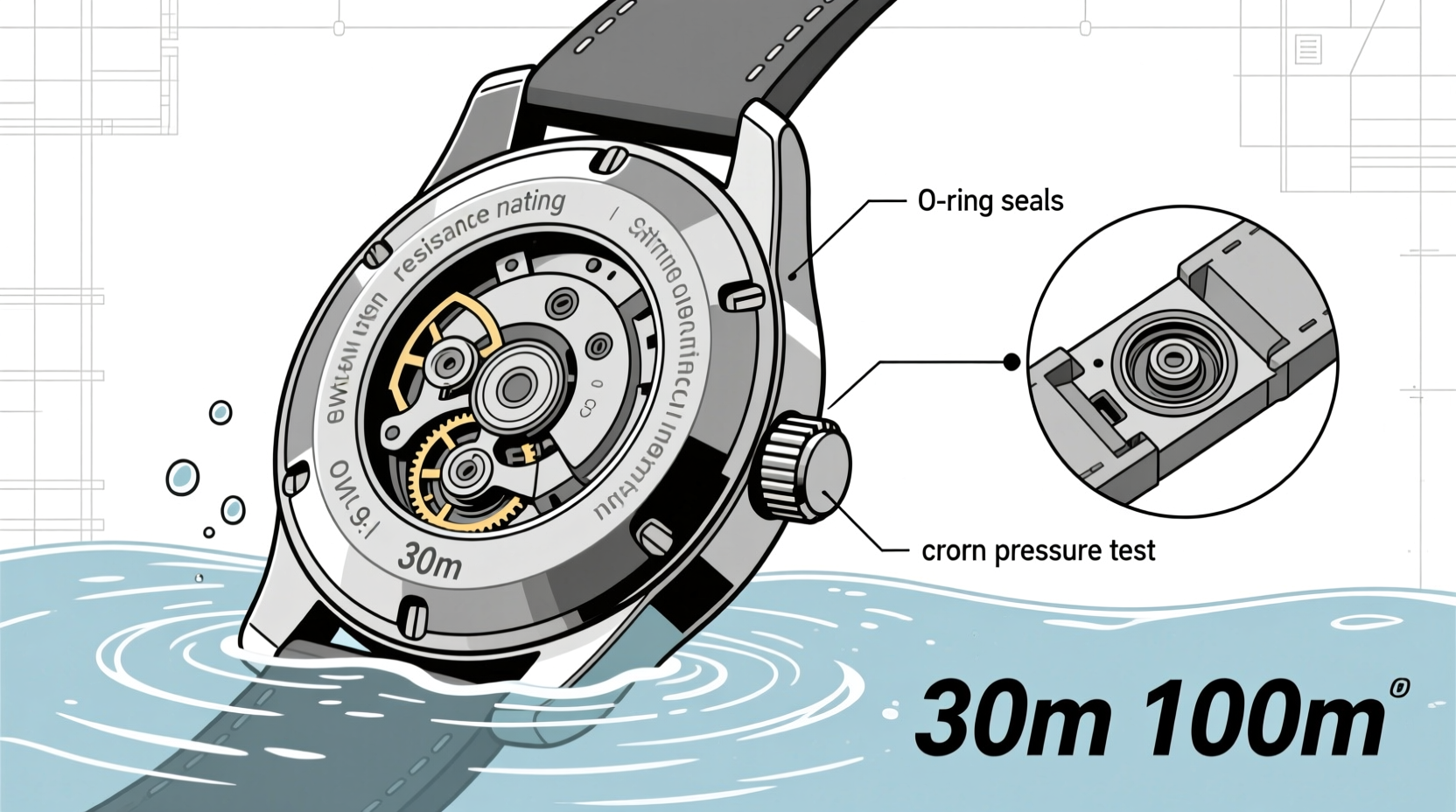
Water resistance is measured in atmospheres (ATM), meters (m), or feet (ft). These numbers reflect laboratory-tested pressure tolerances, not actual diving depths. A watch rated at 50 meters does not mean it’s safe to dive that deep—it means it can withstand pressure equivalent to that depth under controlled conditions.
| Rating (ATM) | Meters | Feet | Recommended Use |
|---|---|---|---|
| 3 ATM | 30 m | 100 ft | Resists splashes and rain. Not suitable for swimming. |
| 5 ATM | 50 m | 165 ft | Suitable for showering and shallow swimming. Avoid hot water. |
| 10 ATM | 100 m | 330 ft | Safe for snorkeling and recreational diving. |
| 20 ATM+ | 200+ m | 660+ ft | Designed for professional scuba diving. |
It's important to note that these ratings degrade over time. Gaskets dry out, cases warp from impacts, and crowns loosen. Even a well-maintained 100-meter-rated watch may not perform as expected after five years without servicing.
How to Test Your Watch’s Water Resistance
While professional pressure testing is the only definitive method, there are observational checks you can perform at home to detect early signs of failure.
- Condensation Check: Look under the crystal. If you see fogging or droplets inside, moisture has already entered.
- Date Change Test: Rapidly change the date through the crown. If the window fogs up during this process, the seal around the stem may be compromised.
- Crown Inspection: Ensure the crown screws down tightly (if applicable) and shows no wobbling or resistance issues.
- Bezel Movement: On divers’ watches, check that the rotating bezel turns smoothly but isn't loose—a sign of potential casing weakness.
For accurate results, take your watch to an authorized service center annually for a pressure test. This non-invasive procedure uses a machine that simulates underwater pressure and detects leaks by measuring case deformation.
“Water resistance isn’t permanent. It’s performance-based and time-sensitive. A vintage Rolex Submariner might look pristine, but its seals are likely degraded—making it vulnerable even in light rain.” — Daniel Reeves, Master Watchmaker & Horology Conservator
Real-World Example: The Poolside Misjudgment
Mark, an avid swimmer, owned a vintage Omega Seamaster rated at 200 meters. Confident in its heritage, he wore it daily—even during lap sessions. After six months, the dial developed slight discoloration. He ignored it until one morning he noticed fine droplets beneath the crystal. A service inspection revealed failed gaskets and salt residue in the movement. Despite the original rating, years of chlorine exposure and lack of maintenance had eroded the seals. The repair cost exceeded $400—far more than routine annual servicing would have been.
This scenario illustrates a common misconception: high initial rating does not equal ongoing protection. Environmental factors like chlorine, sweat, and temperature swings accelerate wear on seals and metal components.
Step-by-Step Guide to Maintaining Water Resistance
To ensure your mechanical watch remains protected against water damage, follow this proactive maintenance sequence:
- Check the Rating Monthly: Know your watch’s limit. If it’s 30 meters or less, treat it as splash-proof only.
- Inspect Seals Visually: Look for cracked or discolored gaskets around the crown and case back (visible under magnification).
- Avoid Thermal Shock: Don’t go from hot showers to cold pools. Rapid temperature changes create vacuum effects that pull moisture inside.
- Rinse After Saltwater Exposure: If used near the ocean, rinse gently with fresh water and dry thoroughly.
- Schedule Annual Pressure Testing: Have a certified technician perform a dry-pressure test every 12–18 months.
- Service Every 3–5 Years: During full servicing, all gaskets should be replaced, and the case cleaned and resealed.
Common Myths About Waterproof Watches
- Myth: “If it survived the pool last summer, it’s fine.”
Reality: One successful exposure doesn’t prove long-term integrity. Damage can be internal and cumulative. - Myth: “Screw-down crown = always waterproof.”
Reality: A screw-down crown helps, but only if properly sealed and undamaged. - Myth: “Water resistance lasts forever.”
Reality: Gaskets degrade within 1–3 years depending on usage and environment.
Frequently Asked Questions
Can I wear my mechanical watch in the shower?
Generally, no. Hot water and steam can penetrate seals more easily than liquid water. Even watches rated for 100 meters should avoid prolonged exposure to hot showers, as thermal expansion compromises gasket integrity.
What should I do if water gets inside my watch?
Remove it immediately, stop using it, and take it to a professional. Leaving moisture inside accelerates corrosion. Do not attempt to dry it with rice or heat sources—this can worsen damage.
Is a higher ATM rating always better?
Not necessarily. A 300-meter diver’s watch offers no advantage in everyday wear over a 50-meter dress watch if neither is exposed to water. Excessive bulk, weight, and maintenance complexity may outweigh benefits unless you’re diving regularly.
Essential Checklist Before Water Exposure
- ✅ Confirm current water resistance rating (not just original spec)
- ✅ Verify crown is fully screwed down (if applicable)
- ✅ Check for visible cracks or damage to crystal or case
- ✅ Ensure no recent impacts or drops occurred
- ✅ Confirm last pressure test was within 12 months
- ✅ Avoid sudden temperature changes before immersion
Conclusion
Determining whether your mechanical watch is truly waterproof requires more than reading the case back—it demands awareness, regular maintenance, and respect for engineering limits. A watch may leave the factory capable of withstanding deep pressure, but daily wear, environmental exposure, and aging components inevitably reduce that capability. By understanding ratings, recognizing warning signs, and committing to professional care, you protect not just the accuracy of your timepiece, but its legacy.
Your mechanical watch is more than an accessory—it’s a precision instrument shaped by craftsmanship and history. Treat it with informed caution around water, and it will serve you reliably for decades.




 浙公网安备
33010002000092号
浙公网安备
33010002000092号 浙B2-20120091-4
Comments
No comments yet. Why don't you start the discussion?