
Understanding power consumption in electrical systems is essential for safety, efficiency, and cost management. Watts, the unit of power, indicate how much energy a device uses or produces at any given moment. Whether you're troubleshooting a circuit, sizing a generator, or optimizing energy use, knowing how to measure watts accurately is a foundational skill. This guide provides clear, actionable methods to determine wattage using real-world tools and principles—without relying on guesswork.
Understanding Watts: The Basics of Electrical Power
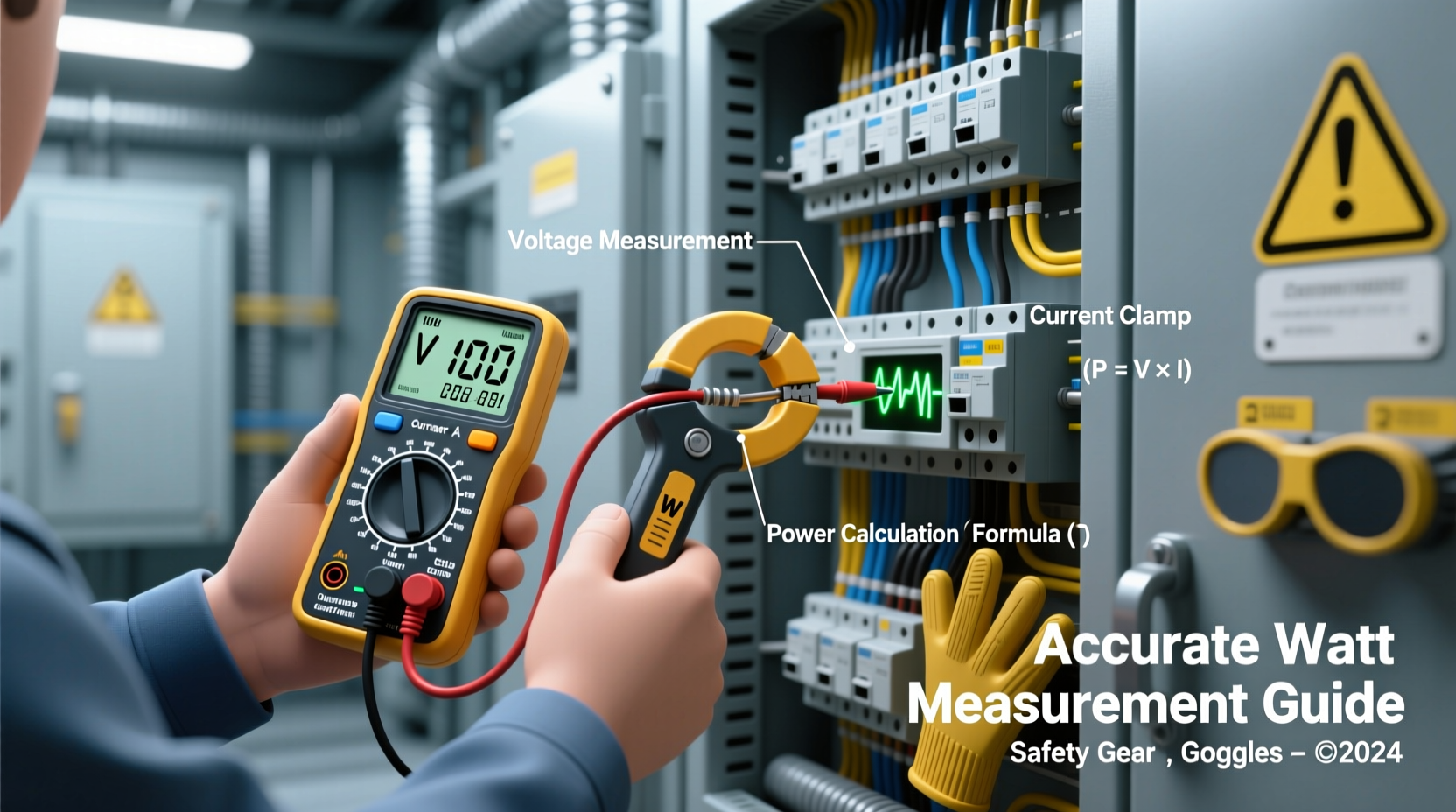
Watts (W) represent the rate at which electrical energy is used or generated. One watt equals one joule per second. In practical terms, it tells you how much work an electrical device can perform over time. For example, a 60-watt light bulb consumes 60 joules of energy every second it’s turned on.
Power in watts is derived from two primary electrical values: voltage (V) and current (I). The fundamental formula is:
Watts = Volts × Amps
This relationship, known as the power equation, applies to direct current (DC) circuits. For alternating current (AC) systems—common in homes and businesses—a third factor, power factor (PF), must be considered:
Watts = Volts × Amps × Power Factor
Power factor accounts for inefficiencies caused by phase differences between voltage and current in inductive or capacitive loads like motors or transformers. It ranges from 0 to 1, with 1 being ideal efficiency.
Essential Tools for Measuring Watts
To determine watts accurately, you need reliable tools capable of measuring voltage, current, and, ideally, real-time power. Here are the most common instruments:
- Digital Multimeter (DMM): Measures voltage and current separately. You must calculate watts manually using the power formula.
- Clamp Meter: Measures current without breaking the circuit. Many modern clamp meters also display voltage and calculate watts directly.
- Plug-in Power Meter: A simple device that plugs into a wall outlet; appliances plug into it. It displays real-time watts, voltage, current, and cumulative energy use (kWh).
- Power Quality Analyzer: Professional-grade tool for detailed AC power analysis, including harmonics, power factor, and true RMS readings.
For most homeowners and technicians, a clamp meter with watt measurement capability or a plug-in power meter offers the best balance of accuracy and usability.
Step-by-Step Guide to Measuring Watts
Follow this sequence to obtain accurate wattage readings in different scenarios:
- Identify the Circuit or Device: Determine whether you’re measuring a single appliance, a branch circuit, or an entire system.
- Select the Right Tool: Use a plug-in meter for individual devices; use a clamp meter for hardwired circuits.
- Check Safety Ratings: Ensure your tool is rated for the voltage and current levels involved. Never exceed instrument limits.
- Measure Voltage: Using a multimeter or clamp meter, measure the voltage across the live and neutral conductors. Record the value.
- Measure Current: Clamp around a single conductor (not the whole cable) to read current in amps. For DC systems, ensure correct polarity.
- Determine Power Factor (for AC): If not provided by the meter, estimate based on load type. Resistive loads (heaters) have PF ≈ 1.0; motors may range from 0.75 to 0.9.
- Calculate or Read Watts: Multiply volts × amps × PF (if applicable). If using a smart meter, read the displayed wattage directly.
- Verify Under Load: Take measurements while the device is operating under normal conditions, as idle and full-load power differ significantly.
Common Measurement Scenarios and Practical Examples
Different situations require tailored approaches. Below are three realistic cases illustrating how to apply watt measurement techniques.
Mini Case Study: Calculating Server Rack Power Usage
A small business operates a server rack with five devices: two network switches (120V, 0.8A each), a NAS (120V, 1.5A), and two redundant PSUs (120V, 2.0A combined). All are resistive loads with PF ≈ 0.95.
Calculations:
- Switches: 120V × 0.8A × 0.95 = 91.2W each → 182.4W total
- NAS: 120V × 1.5A × 0.95 = 171W
- PSUs: 120V × 2.0A × 0.95 = 228W
Total estimated load: 182.4 + 171 + 228 = 581.4 watts. The IT manager uses this figure to confirm the UPS can handle peak demand and avoid overloading.
Mini Case Study: Home Energy Audit with Plug-In Meter
A homeowner suspects high electricity bills are due to inefficient appliances. Using a plug-in power meter, they test a refrigerator labeled “120V, 5A.” The meter shows 520W during compressor startup and averages 120W during normal operation.
The discrepancy arises because the label lists maximum current, not running wattage. The actual daily consumption is calculated as:
120W × 8 hours (average runtime) = 960 Wh/day or 0.96 kWh/day. Over a month: ~28.8 kWh.
This data helps the homeowner compare efficiency against newer models and decide whether replacement is cost-effective.
Do’s and Don’ts of Watt Measurement
| Do’s | Don’ts |
|---|---|
| Use true RMS meters for non-linear loads (electronics, LEDs) | Assume all devices operate at rated wattage continuously |
| Measure under typical operating conditions | Clamp around both conductors—this cancels out the magnetic field |
| Account for power factor in AC motor-driven equipment | Ignore startup surges (inrush current) when sizing breakers or inverters |
| Double-check probe placement and meter settings | Use damaged leads or uncalibrated instruments |
| Record measurements for trend analysis | Estimate wattage based solely on nameplate ratings |
“Accurate watt measurement starts with understanding what you’re measuring and why. Nameplate data is a starting point—not a final answer.” — Carlos Mendez, Certified Electrical Engineer and Energy Auditor
Frequently Asked Questions
Can I measure watts without a specialized meter?
Yes, if you have a multimeter that reads voltage and current. Measure both simultaneously and multiply them. For AC circuits, include an estimated power factor. However, this method lacks precision compared to a dedicated wattmeter.
Why does my device show lower watts than its label states?
Nameplate ratings indicate maximum possible draw, not continuous usage. Most devices consume less under normal operation. For example, a microwave labeled 1200W may only draw 800W while cooking, depending on duty cycle and efficiency.
Is it safe to measure watts in high-voltage circuits?
Only trained personnel should measure high-voltage systems (above 50V AC or 120V DC). Always follow lockout/tagout procedures, wear appropriate PPE, and use tools rated for the voltage class. When in doubt, consult a licensed electrician.
Checklist: How to Accurately Determine Watts
- ☐ Identify the type of load (resistive, inductive, or electronic)
- ☐ Select the correct measuring tool (plug-in meter, clamp meter, or multimeter)
- ☐ Verify instrument safety ratings match the circuit
- ☐ Measure voltage under load conditions
- ☐ Measure current using proper clamp technique
- ☐ Apply power factor correction for AC inductive loads
- ☐ Calculate or read real power in watts
- ☐ Repeat measurements at different times to capture variability
- ☐ Document results for future reference or comparison
Conclusion: Take Control of Your Electrical Measurements
Accurately determining watts isn't just for engineers—it's a practical skill that empowers homeowners, technicians, and energy managers alike. With the right tools and understanding, you can make informed decisions about energy use, prevent circuit overloads, and reduce waste. Precision comes from attention to detail: measuring under real conditions, respecting power factor, and using properly calibrated instruments.




 浙公网安备
33010002000092号
浙公网安备
33010002000092号 浙B2-20120091-4
Comments
No comments yet. Why don't you start the discussion?