
The Myers-Briggs Type Indicator (MBTI) remains one of the most widely used frameworks for understanding personality differences. While many encounter it through quick online quizzes, truly discovering your accurate type requires more than just answering 20 questions in five minutes. Misidentification is common—up to 50% of people receive different results when retested weeks apart, according to research from the Center for Applications of Psychological Type. The key isn’t speed; it’s depth, reflection, and consistency across real-life behavior. This guide walks you through a structured, thoughtful process to identify your true MBTI type with confidence.
Understanding the MBTI Framework
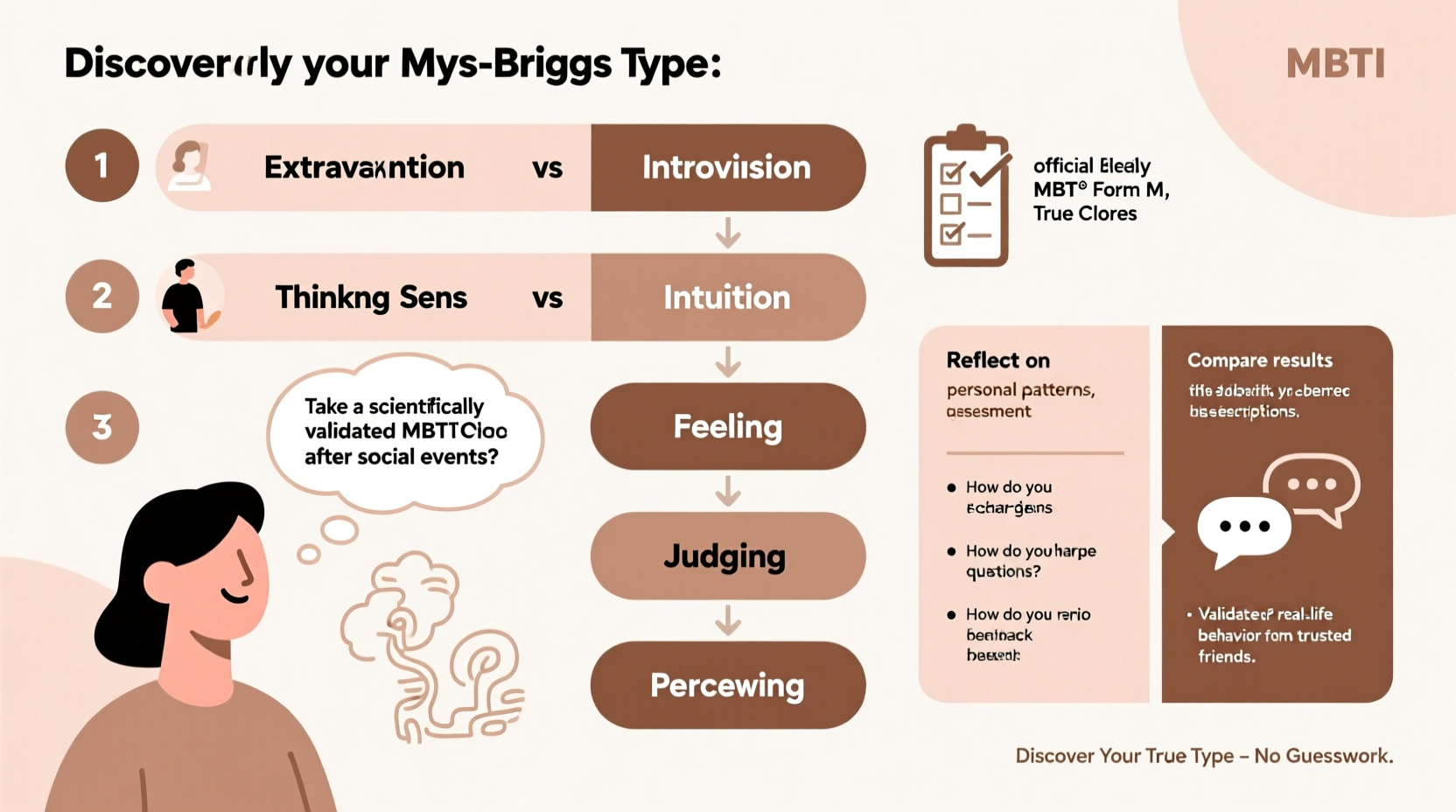
The MBTI categorizes personality into 16 types based on four core dichotomies:
- Extraversion (E) vs. Introversion (I): Where you draw energy—from the outer world or your inner world.
- Sensing (S) vs. Intuition (N): How you gather information—through concrete details or abstract patterns.
- Thinking (T) vs. Feeling (F): How you make decisions—via logic and objectivity or values and harmony.
- Judging (J) vs. Perceiving (P): How you approach the outside world—with structure and planning or flexibility and spontaneity.
Each person ends up with a four-letter type, such as INFJ or ESTP. But these letters represent cognitive functions—mental processes like Introverted Intuition (Ni) or Extraverted Thinking (Te)—that operate in a specific hierarchy. Accurate typing means identifying not just preferences, but your dominant and auxiliary functions.
“Type is not about labels—it’s about recognizing consistent patterns in how you perceive, decide, and interact.” — Isabel Briggs Myers, co-creator of the MBTI
Step-by-Step Guide to Discovering Your True Type
Follow this six-phase process to move beyond superficial quiz results and uncover your authentic MBTI type.
Phase 1: Take Multiple Reputable Assessments
Start with standardized tools. Avoid free, unvalidated quizzes on random websites. Instead, use:
- The official MBTI® assessment (available via certified practitioners)
- Truity’s TypeFinder (scientifically reviewed)
- 16Personalities (with caveats—use as a starting point, not final verdict)
Take each assessment at least twice, spaced several days apart, under different conditions (e.g., morning vs. evening). Note any inconsistencies—these highlight areas needing deeper exploration.
Phase 2: Study All 16 Types Deeply
After initial results, resist the urge to accept your suggested type immediately. Read detailed descriptions of all 16 types—not just your top matches. Pay attention to:
- Cognitive function stacks (e.g., INFP = Fi-Ne-Si-Te)
- Behavioral patterns in stress and growth
- Lifestyle preferences and communication styles
You may resonate with aspects of multiple types. That’s normal. The goal is to find the type whose underlying motivations and internal processes align most consistently with your experience.
Phase 3: Reflect on Lifelong Patterns
Ask yourself reflective questions:
- As a child, did I prefer structured activities or open-ended exploration?
- When solving problems, do I naturally seek data (S) or possibilities (N)?
- In conflicts, do I prioritize fairness (T) or emotional impact (F)?
- Do I feel stressed by disorganization (J) or rigid plans (P)?
Patterns evident since adolescence are stronger indicators than recent behaviors shaped by job demands or life stages.
Phase 4: Analyze Cognitive Functions
This is where most self-typing fails. People confuse behaviors with functions. For example, being organized doesn’t automatically mean you’re a Judging (J) type—it might just mean you have a demanding job.
Identify your dominant function—the one you use most naturally and confidently:
| Dominant Function | Indicators |
|---|---|
| Introverted Thinking (Ti) | You deconstruct ideas internally, value precision, and enjoy logical models. |
| Extraverted Feeling (Fe) | You tune into group emotions, adjust behavior to maintain harmony, and express care outwardly. |
| Introverted Intuition (Ni) | You foresee long-term implications, synthesize insights, and “just know” things. |
| Extraverted Sensing (Se) | You live in the moment, respond quickly to surroundings, and enjoy physical experiences. |
Your dominant function determines your type. Once identified, the rest follow logically.
Phase 5: Seek External Feedback
Ask three close friends or family members: “Based on how I typically behave, what do you think my MBTI type is?” Share no hints. Compare their observations with your self-assessment. Outsiders often notice blind spots—like an introvert who socializes frequently but drains quickly afterward.
Phase 6: Test Over Time
Treat your provisional type as a hypothesis. For two weeks, read content specific to that type. Notice moments when the description fits—and when it doesn’t. Journal your observations. Does the type explain your reactions under pressure? Your ideal work environment? Your relationships?
If contradictions pile up, revisit earlier phases. Typing is iterative, not instant.
Common Mistakes to Avoid
Missteps derail accurate identification. Watch out for these:
- Confusing role with preference: A manager using logic at work may appear like a Thinker, but privately rely on Feeling.
- Overvaluing interests: Loving art doesn’t make you intuitive; loving routines doesn’t make you sensing.
- Relying solely on quizzes: Most free tests don’t measure cognitive functions and mislead users.
- Choosing aspirational types: Wanting to be an ENTP doesn’t make you one. Type reflects reality, not desire.
Mini Case Study: From INFP to INTJ – A Journey of Clarity
Sarah, a 32-year-old writer, initially typed herself as an INFP. She valued authenticity, disliked routine, and expressed deep empathy—hallmarks of Fi users. But something felt off. She didn’t relate to Ne (Extraverted Intuition) as her secondary function. Instead, she found herself constantly synthesizing complex ideas into singular visions—a Ni trait.
After studying cognitive functions, she realized her decision-making was rooted in internal logic (Ti), not personal values. Her empathy stemmed from developed Fe, not dominant Fi. She thrived on long-term strategy, not open-ended exploration. The fit? INTJ.
Once she embraced this, her career choices, relationship dynamics, and stress responses made far more sense. The shift wasn’t about changing who she was—it was about naming it accurately.
Checklist: Confirming Your MBTI Type
Use this checklist before finalizing your type:
- ✅ I’ve taken at least two validated assessments and received consistent results.
- ✅ I understand the cognitive function stack of my proposed type.
- ✅ My dominant function aligns with my most natural, effortless mental process.
- ✅ I’ve compared my behavior in childhood, stress, and growth to type descriptions.
- ✅ Trusted others’ perceptions support my self-assessment.
- ✅ I can explain why other similar types (e.g., INFJ vs. INTJ) don’t fit as well.
- ✅ I’ve tested the type over several weeks and found strong consistency.
FAQ
Can my MBTI type change over time?
No. Your core preferences remain stable. However, you develop greater access to your tertiary and inferior functions with age and experience, which may make you appear different on the surface.
I keep getting different results on quizzes. What should I do?
Different quizzes measure different things. Many conflate behavior with cognitive function. Focus less on quiz outcomes and more on functional analysis and lifelong patterns.
Is the MBTI scientifically valid?
The MBTI has moderate reliability and is widely used in organizational and coaching settings. While not as rigorously validated as the Big Five, decades of research from the Center for Applications of Psychological Type support its utility for self-awareness and team dynamics—when used correctly.
Conclusion: Own Your Type, Not Just a Label
Discovering your true MBTI type isn’t about fitting into a box—it’s about finding a map that reflects your inner landscape. Accuracy comes not from a single test, but from patient observation, honest reflection, and functional understanding. When you finally land on the right type, it won’t just sound plausible; it will feel like recognition. You’ll say, “So that’s why I do that,” or “Now I understand my frustrations.” That clarity is worth the effort.




 浙公网安备
33010002000092号
浙公网安备
33010002000092号 浙B2-20120091-4
Comments
No comments yet. Why don't you start the discussion?