
Selecting the perfect OT (Open Time) bracelet and ring set isn't just about aesthetics—it's about fit, comfort, and long-term wearability. Many buyers overlook sizing, only to discover that their stylish new set slips off, pinches, or fails to complement their hand shape. Accurate measurement ensures your jewelry enhances your look without causing discomfort. Whether you're shopping for yourself or gifting someone special, understanding how to measure and select the correct size is essential.
Why Sizing Matters for OT Bracelets and Rings
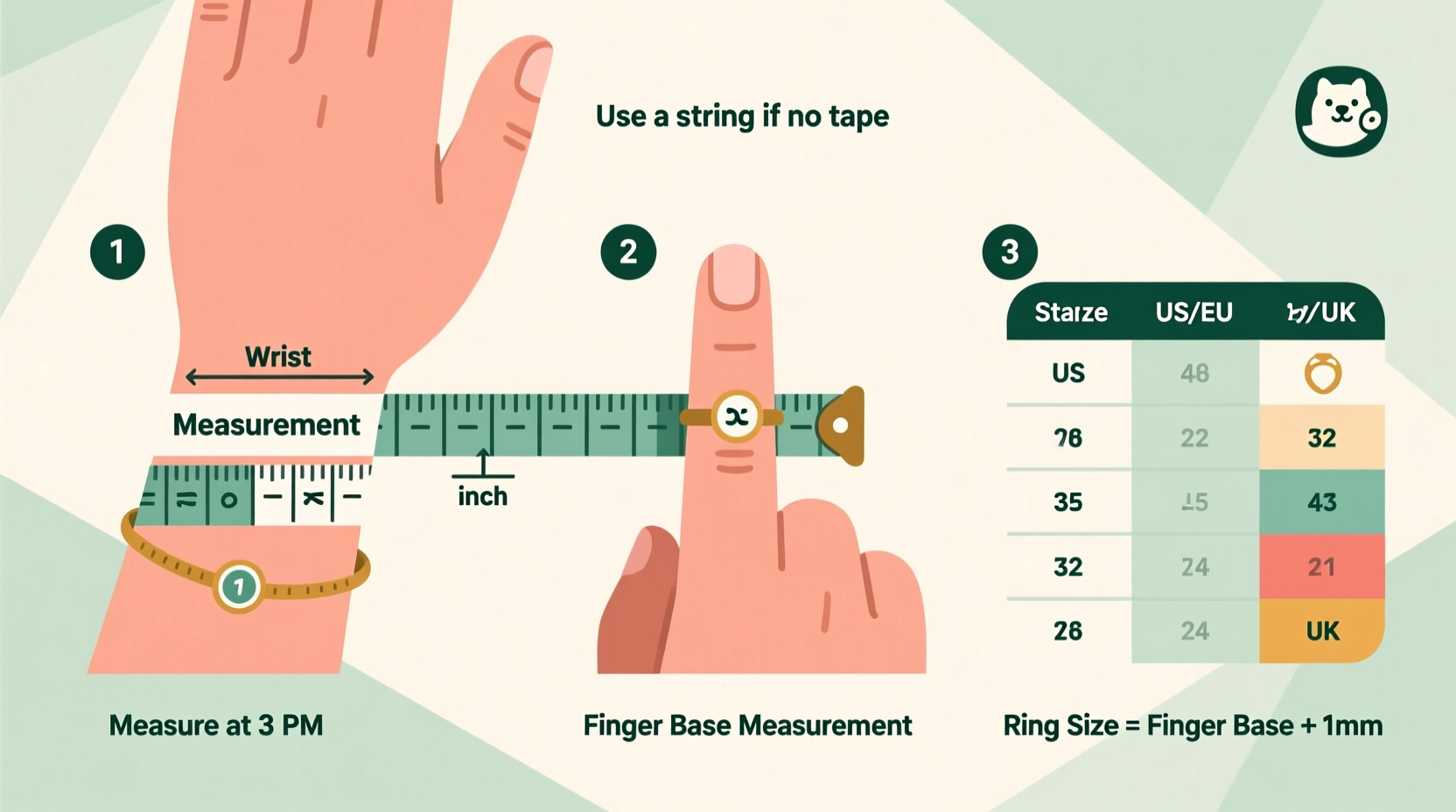
OT jewelry sets are designed with a modern, minimalist aesthetic—often featuring open-ended bracelets and sleek stacking rings. Because they lack clasps or adjustable bands, precise sizing is crucial. A bracelet that’s too loose may rotate awkwardly or slip off during daily activities. One that’s too tight can restrict circulation or leave marks on the skin. Similarly, ill-fitting rings can cause discomfort, swelling, or even get lost easily.
Finger and wrist sizes vary significantly between individuals—and even fluctuate throughout the day due to temperature, hydration, and activity level. Relying on guesswork or standard “one size fits most” claims often leads to disappointment. Taking accurate measurements eliminates uncertainty and ensures your OT set looks as good as it feels.
Step-by-Step Guide to Measuring Your Wrist for an OT Bracelet
Unlike traditional bangles or cuff bracelets, OT bracelets are semi-open and rely on snug but flexible fit around the wrist. Follow these steps for accuracy:
- Gather tools: Use a flexible measuring tape or a non-stretch string and ruler.
- Position correctly: Wrap the tape around the narrowest part of your wrist, just below the wrist bone. Don’t pull too tight—allow enough space to slide a finger underneath.
- Record circumference: Note the measurement in millimeters or inches.
- Add allowance: For comfort, add 5–10mm (about 0.2–0.4 inches) to your actual wrist size, depending on preferred fit (snug vs. relaxed).
- Compare to brand sizing: Check the manufacturer’s size chart. Some OT bracelets are sized by internal diameter rather than circumference.
For example, if your wrist measures 150mm and you prefer a comfortable fit, aim for a bracelet with an inner circumference of 160mm. This accounts for both comfort and ease of slipping over the hand.
Common Mistakes When Measuring Wrist Size
- Measuring too tightly, resulting in a bracelet that feels restrictive.
- Using a rigid ruler instead of a soft tape, leading to inaccurate curves.
- Ignoring hand width—some OT bracelets must slide over the knuckles, which are wider than the wrist.
How to Measure Ring Size Accurately
Rings in an OT set are typically delicate and meant for stacking, making precise sizing even more critical. A ring that spins excessively or sticks midway down the finger disrupts the intended design flow.
Method 1: Using a Ring You Already Own
If you have a ring that fits well on the intended finger:
- Measure the inner diameter of the ring in millimeters using a ruler or caliper.
- Cross-reference the measurement with an international ring size chart.
- Confirm the fit across multiple fingers if the set includes multiple rings.
Method 2: String or Paper Strip Method
- Cut a thin strip of paper or use a thread.
- Wrap it snugly around the base of your finger—the same spot where you’d wear the ring.
- Mark where the ends overlap.
- Lay the strip flat and measure the length in millimeters.
- Divide the circumference by 3.14 (π) to find the diameter, then match it to a ring size chart.
| Ring Size (US) | Diameter (mm) | Circumference (mm) |
|---|---|---|
| 5 | 15.7 | 49.3 |
| 6 | 16.5 | 51.9 |
| 7 | 17.3 | 54.4 |
| 8 | 18.1 | 56.9 |
| 9 | 18.9 | 59.5 |
Expert Insight: What Jewelers Recommend
“Most returns in online jewelry sales come from incorrect sizing. We always advise customers to double-check their measurements and consider seasonal changes. Cold weather shrinks fingers; heat expands them.” — Lena Torres, Master Jeweler & Founder of Aura Fine Jewelry
Torres emphasizes that metal expands and contracts with temperature, so a ring that fits perfectly in winter might feel tight in summer. If you live in a climate with extreme seasonal shifts, consider opting for a slightly looser fit or choosing adjustable designs when available.
Checklist: How to Choose the Right OT Set Size
- ✅ Measure wrist circumference at the end of the day.
- ✅ Account for knuckle width when selecting bracelet size.
- ✅ Use a known-fitting ring to determine correct ring size.
- ✅ Consult the brand’s specific sizing chart—don’t assume universal standards.
- ✅ Consider material flexibility—sterling silver bends slightly; titanium does not.
- ✅ Order a half-size up if between sizes, especially for rings.
- ✅ Verify return policy in case adjustments are needed post-purchase.
Mini Case Study: Sarah’s Online Purchase Success
Sarah ordered an OT bracelet and ring set online as a birthday gift for her sister. Instead of guessing the size, she borrowed a ring her sister wore daily and used the diameter method. She measured the inner span at 17.3mm—matching a US size 7. For the bracelet, she wrapped a string around her own wrist (similar build) and added 8mm for comfort, landing on a 165mm circumference.
The set arrived and fit perfectly. Her sister praised how the bracelet hugged her wrist without sliding and how the rings stacked seamlessly. Sarah avoided the common pitfall of assuming sizes were interchangeable across brands—a decision backed by careful measurement.
FAQ: Common Questions About OT Jewelry Sizing
Can I resize an OT bracelet after purchase?
Most OT bracelets are not resizable due to their open-ended, tension-based design. Unlike closed bangles, they rely on precise curvature. Some jewelers offer exchange programs for different sizes, but bending at home risks breaking the metal.
Do ring sizes differ between fingers?
Yes. The ring finger is typically smaller than the middle finger but larger than the pinky. Always measure each finger individually if the set includes multiple rings for different digits.
Are international ring sizes the same?
No. The US, UK, EU, and Japan all use different numbering systems. Always confirm which standard the seller uses. For example, a US size 7 is approximately a UK size N½ and an EU size 54.
Final Tips for Confident Sizing
When buying an OT bracelet and ring set, treat sizing like tailoring—precision elevates the experience. Avoid last-minute guesses. Take time to measure properly, consult charts, and understand the design limitations of open-style jewelry. If gifting, discreetly borrow a piece of the recipient’s existing jewelry or enlist a friend to help gather measurements.
Remember, well-fitted jewelry doesn’t fight the body—it flows with it. An OT set that fits correctly becomes an extension of personal style, not a distraction.




 浙公网安备
33010002000092号
浙公网安备
33010002000092号 浙B2-20120091-4
Comments
No comments yet. Why don't you start the discussion?