
Fountain pens are more than writing instruments—they’re personal tools that reflect taste, precision, and craftsmanship. Whether you collect them, use them daily, or travel with them, protecting your pen in a properly fitting case is essential. A poorly sized case can lead to scratches, loose movement, or even damage to delicate components like nibs and caps. Yet, many pen owners overlook one critical step: accurate measurement. Getting the dimensions right ensures your pen stays secure, organized, and ready to write.
Why Precise Measurement Matters
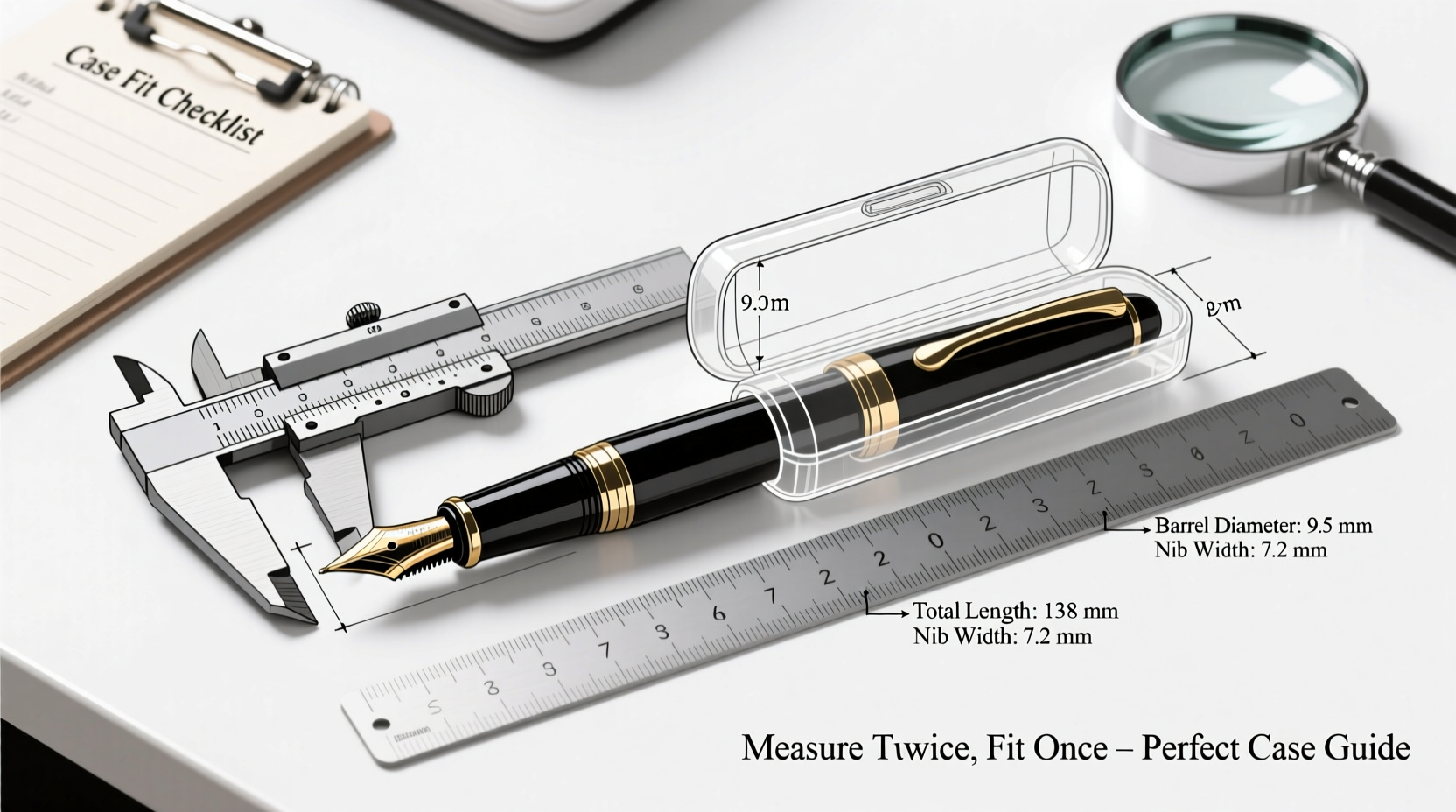
A well-fitted case doesn’t just look neat—it protects your investment. Fountain pens vary widely in size and shape. From compact demonstrators to long, capped eyedroppers, no two pens are exactly alike. Off-the-shelf cases often assume standard dimensions, but real-world variations mean those assumptions can fall short.
When a pen rattles inside a case, micro-abrasions occur over time. Caps may loosen, barrels can scuff, and clips might bend. Conversely, forcing a pen into a too-small compartment risks cracking resin, warping metal, or damaging threads. Measuring your pen before selecting or customizing a case eliminates guesswork and preserves both function and finish.
“Most pen damage in storage comes not from impact, but from improper fit—either too tight or too loose.” — Daniel Reeves, Pen Conservator & Archivist at The Writing Instrument Society
Step-by-Step Guide to Measuring Your Fountain Pen
To ensure a perfect fit, follow this systematic approach using simple tools you likely already have.
- Gather your tools: Use a digital caliper for best accuracy (available for under $20), or a ruler with millimeter markings. A soft measuring tape works for circumference.
- Measure length capped: Place the pen tip-to-cap end on a flat surface. Record the total length in millimeters. This is the most important dimension for case selection.
- Measure length uncapped: Remove the cap and measure the barrel alone. This helps determine if the case allows for posting or requires separate compartments.
- Measure maximum diameter: Use calipers to find the widest point—often at the grip section, piston knob, or center band. Rotate the pen slightly to ensure consistency.
- Check cap diameter separately: Some caps taper or flare. Measure both the top and base of the cap, especially if it has a prominent clip.
- Note protrusions: Identify any extensions—like large clips, finials, or converter knobs—that add effective width or depth.
- Record all values: Write down each measurement clearly. Include whether the pen was posted during measurement.
Understanding Case Sizing Standards
Pen cases come in standardized sizes—small, medium, large—but these labels are inconsistent across brands. One company’s “large” may only accommodate pens up to 145mm, while another extends to 160mm. Relying on vague categories risks incompatibility.
Instead, compare your measurements directly to the manufacturer’s internal compartment specs. Look for:
– Internal sleeve length (not exterior case size)
– Maximum inner diameter
– Clearance for clips or finials
– Depth of individual slots
Some premium cases, like those from Kaweco or Pelikan, publish exact interior dimensions. Third-party organizers, such as Penhabit or JetPens’ leather rolls, often include fit guides based on popular models.
Common Fountain Pen Dimensions (Capped Length)
| Pen Model | Length (mm) | Max Diameter (mm) | Notes |
|---|---|---|---|
| Pilot Metropolitan | 137 | 14 | Narrow grip, small clip |
| Lamy Safari | 139 | 15 | Bulbous grip, medium clip |
| Pelikan M800 | 150 | 16 | Large clip, wide piston knob |
| Sailor 1911 Standard | 142 | 15.5 | Heavy brass cap, tapered barrel |
| Kaweco Sport | 102 | 12 | Compact; fits smallest sleeves |
Use this table as a reference, but never substitute it for measuring your own pen. Even within the same model line, slight production variances exist—especially in handmade or limited editions.
Real-World Example: The Lamy 2000 Dilemma
Mark, an architect and avid pen user, purchased a high-end leather roll advertised to fit “most full-size fountain pens.” Confident his Lamy 2000 would fit, he stored it without measuring. After a week of daily carry, he noticed a faint scratch near the piston knob. Upon inspection, he realized the slot was just 1mm too narrow. The pen fit when inserted carefully, but the friction caused abrasion against the brushed polycarbonate body.
He measured the pen: 141mm long, 14.8mm max diameter—but the piston knob flared to 15.3mm. The case listed a max diameter of 15mm. That 0.3mm difference caused cumulative wear. After switching to a wider slot, the issue stopped immediately.
This example underscores a key principle: manufacturers often list average diameters, not peak widths. Always account for the bulkiest part of your pen.
Do’s and Don’ts When Measuring for Cases
| Do | Don't |
|---|---|
| Use calipers for precise diameter readings | Rely solely on advertised pen specs |
| Include clip height in vertical clearance checks | Assume all pens of the same model are identical |
| Measure with converter or cartridge installed | Ignore posted length if you store pens that way |
| Add 1–2mm tolerance to each dimension for ease of insertion | Force a pen into a tight sleeve |
Checklist: Preparing Your Pen for Case Selection
- ☐ Measure total length with cap on (in mm)
- ☐ Measure barrel length without cap
- ☐ Find maximum diameter using calipers
- ☐ Note clip height and finial protrusion
- ☐ Check if you plan to post the cap
- ☐ Compare measurements to case interior specs
- ☐ Allow 1–2mm extra space per dimension for smooth access
- ☐ Verify case material flexibility (e.g., elastic vs. rigid tubes)
Frequently Asked Questions
Can I use a ballpoint or rollerball case for my fountain pen?
Sometimes—but not always. Many ballpoint cases are shorter and narrower. Fountain pens, especially high-end models, tend to be longer and thicker. Always verify internal dimensions before repurposing a case.
What if my pen has an oversized grip or converter?
Focus on the widest point. Even if the rest of the pen is slim, the case must accommodate the largest diameter. Consider open trays or padded pouches instead of tight sleeves.
Should I measure my pen with ink inside?
Yes. Ink adds negligible bulk, but the presence of a converter or piston mechanism can affect balance and fit—especially if the knob extends beyond the barrel. Measure in normal writing condition.
Final Thoughts: Precision Protects Performance
A fountain pen deserves more than guesswork when it comes to protection. Accurate measurement is a five-minute task that pays off in preserved finishes, reliable mechanics, and peace of mind. Whether you're choosing a zippered roll for travel or a wooden box for display, knowing your pen’s true dimensions transforms storage from a chore into a seamless part of your routine.




 浙公网安备
33010002000092号
浙公网安备
33010002000092号 浙B2-20120091-4
Comments
No comments yet. Why don't you start the discussion?