
Transforming your holiday decor into a multisensory experience starts with subtle enhancements—none more impactful than hidden audio. A hollow artificial Christmas tree offers a unique opportunity to embed sound directly into the centerpiece of your living space. By installing Bluetooth speakers inside the trunk, you can achieve rich, ambient music that appears to emanate from within the tree itself. This method preserves aesthetic integrity while delivering high-quality audio, ideal for entertaining guests or creating a cozy atmosphere during festive gatherings.
The key challenge lies in concealing technology without compromising performance. Done correctly, no wires, speaker grilles, or charging ports should be visible from the outside. This guide walks through the technical, structural, and design considerations involved in embedding wireless audio seamlessly into your tree’s core.
Assessing Your Tree’s Compatibility
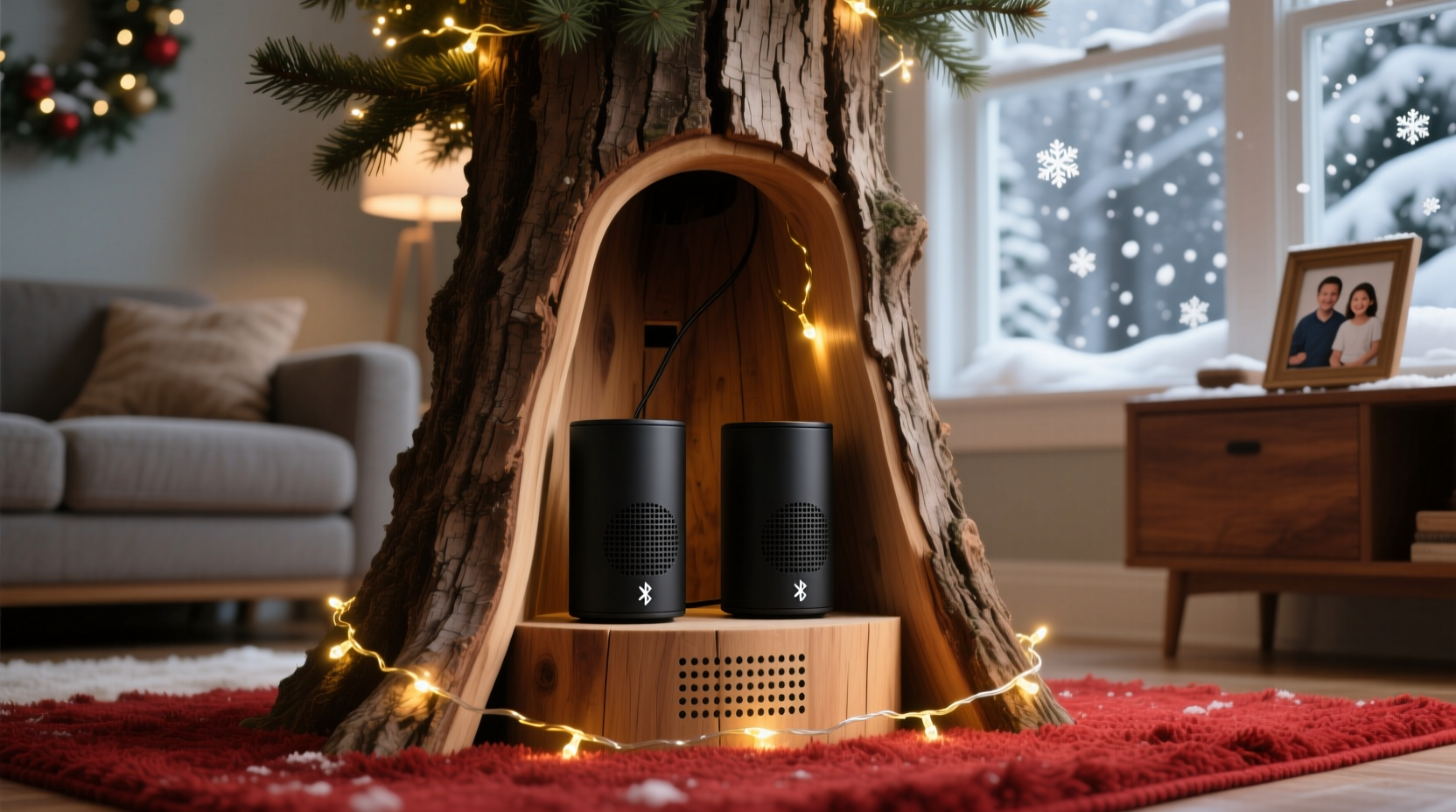
Not all artificial trees are suitable for internal speaker installation. Before purchasing equipment or beginning modifications, evaluate your tree’s structure carefully.
Hollow-trunk trees are common among mid-to-high-end pre-lit models, especially those marketed as “easy assembly” or “space-saving.” These typically feature a central pole made of plastic or lightweight metal, segmented into sections that stack vertically. The interior cavity must be wide enough to accommodate at least one full-range speaker driver (minimum 3 inches in diameter) and allow for airflow to prevent sound muffling.
Measure the internal diameter of each trunk section using a flexible measuring tape or caliper. Most standard poles range between 1.5 to 3 inches across—only the larger end supports compact active speakers. If the opening is too narrow, consider passive drivers powered externally, which require only thin wiring rather than bulky enclosures.
Also inspect access points. Many trees have removable caps or bases; others may need slight modification such as drilling an entry hole near the bottom connector. Prioritize models where disassembly doesn’t compromise stability or light wiring.
Choosing the Right Audio Equipment
Selecting appropriate speakers is critical—not just for sound quality, but for physical integration. Compact Bluetooth-enabled units vary widely in power output, battery life, and enclosure design. For this application, prioritize low-profile, omnidirectional models with strong midrange clarity.
Passive vs. active systems present a fundamental choice:
- Active (powered) speakers: Include built-in amplifiers and Bluetooth receivers. Easier to set up wirelessly but require internal battery access or concealed charging solutions.
- Passive speakers: Require external amplifier and power source. More complex to install but offer greater flexibility in placement and sound tuning.
For most homeowners, a single active bookshelf-style speaker (e.g., Anker SoundCore Mini 3 or Bose SoundLink Flex) fits well in lower trunk segments. Alternatively, multiple smaller drivers (like 2-inch full-range units) can be wired together and distributed across levels for stereo dispersion.
“Sound should complement decor, not compete with it. Directional control matters less than tonal balance when hiding sources.” — Marcus Lin, Audio Integration Specialist at HomeHarmony Systems
Equipment Comparison Table
| Speaker Type | Size Fit (Trunk Diameter) | Power Source | Pros | Cons |
|---|---|---|---|---|
| Mini Active Bluetooth | 2–3 inches | Battery (rechargeable) | Wireless, simple setup | Limited bass, needs recharging |
| Puck-Style Passive | 1.5–2.5 inches | External amp | Customizable volume, no batteries | Requires hidden wiring |
| Cylindrical Outdoor Rock Speaker | 3+ inches | AC adapter or solar | Durable, weather-resistant | Larger footprint |
| DIY Driver + Amp Kit | Adjustable | Wall-powered | Full control over output | Advanced skill required |
Avoid over-amplified subwoofers—they generate vibrations that may loosen tree sections or rattle ornaments. Focus instead on clear vocal and instrumental reproduction, which enhances carols and background playlists effectively.
Step-by-Step Installation Process
Follow this sequence to integrate audio cleanly and safely into your tree’s framework.
- Disassemble the tree: Remove all branches and stack trunk sections in order. Label each segment if necessary to ensure correct reassembly.
- Test internal clearance: Insert your chosen speaker or mock-up form to confirm fit. Note any obstructions like support rods or light wire conduits.
- Create access (if needed): Drill a small hole (¼ inch) at the base of the lowest section for charging cables or speaker wire. Use a rubber grommet to protect insulation.
- Mount the speaker: For active units, use non-damaging adhesive putty (e.g., museum wax) or Velcro strips to secure the device vertically inside the trunk. Avoid glue that could damage plastic.
- Route wiring (for passive setups): Feed thin-gauge speaker wire down the center channel, exiting through the base hole. Connect to an amplifier hidden nearby (e.g., entertainment console).
- Reassemble the tree: Stack trunk sections carefully, ensuring wires aren’t pinched. Reattach branches starting from the bottom, working upward.
- Pair and test: Activate Bluetooth mode and connect from your phone or tablet. Play music at moderate volume to check clarity and resonance.
- Final concealment: Place the tree in its stand. Route any external cables under rugs or along baseboards. Use cable clips painted to match flooring for discretion.
If using a rechargeable model, schedule charging during off-season storage. Mark your calendar annually to maintain longevity.
Real-World Example: The Silent Snowfall Setup
In suburban Connecticut, homeowner Diane Reyes transformed her 7.5-foot Evergreen Pro II into a sensory centerpiece by integrating two modified JBL Clip 4 speakers inside the lower trunk. Her tree had a 2.75-inch internal cavity and a removable base plate—ideal conditions.
She used double-sided silicone pads to affix one speaker facing upward and another angled diagonally toward the front. Both were paired simultaneously via multipoint Bluetooth to a single playlist of soft jazz and classic carols. Cables exited through a drilled port beneath the stand, connecting to a USB hub behind her sofa.
During holiday parties, guests consistently remarked that “the music feels like it’s coming from everywhere,” unaware of the hidden tech. Over three seasons, the system required only biweekly charging and minor repositioning after storage.
Her success stemmed from careful planning: she tested five speaker candidates in-store, brought home foam tube prototypes, and dry-fitted everything before permanent placement.
Optimization and Maintenance Tips
Once installed, fine-tune performance and ensure long-term reliability.
- Equalize for enclosure effects: Hollow tubes amplify certain frequencies (often mid-bass). Use EQ settings on your playback device to reduce boost around 150–250 Hz if sound seems boomy.
- Prevent overheating: Ensure at least ½ inch of air gap around active components. Never seal speakers in airtight compartments.
- Use seasonal playlists: Automate playback with smart home routines. Start playing “Holiday Magic” playlist at sunset on December 1st.
- Inspect annually: During setup, verify connections, clean speaker grilles gently with a soft brush, and check for wear on adhesives.
“The best installations go unnoticed until someone says, ‘Where’s that beautiful music coming from?’ That’s the win.” — Lena Tran, Smart Home Designer, LuxAura Interiors
Do’s and Don’ts Checklist
- Choose speakers narrower than your trunk’s inner width
- Use removable mounting methods
- Test sound at normal room volume before finalizing
- Label wires and store instructions with off-season decor
- Force oversized equipment into tight spaces
- Block ventilation holes on active speakers
- Run wires across walkways without protection
- Forget about future battery replacement or charging
Frequently Asked Questions
Can I use regular outdoor speakers instead?
Yes, but only if they fit physically and aren’t prone to overheating. Outdoor-rated models often have better durability and moisture resistance, useful if your tree is near a humidifier or drafty window. However, many are too large for standard trunks. Check dimensions carefully.
Will the sound be muffled inside the trunk?
Somewhat—but this can be an advantage. Enclosed spaces naturally enhance warmth in vocals and instruments. To counter excessive dampening, angle the speaker forward or slightly upward, and avoid surrounding it with dense branch clusters at the base. Some users add a short fabric baffle (rolled scarf) just above the speaker to reflect sound outward.
What if my tree isn’t pre-lit or has a solid pole?
You can still achieve a similar effect. Install small wireless speakers behind the tree skirt, aiming upward into the trunk cavity. Use dark-colored units and tuck them beneath layered fabric. While not fully internal, this mimics the illusion of embedded sound and works well for solid-core trees.
Conclusion: Elevate Your Holiday Ambiance Thoughtfully
Integrating Bluetooth speakers into a hollow Christmas tree trunk blends technology and tradition in a way that feels both innovative and timeless. When executed with attention to detail, the result is more than convenience—it’s immersion. Guests won’t see gadgets; they’ll feel the spirit of the season amplified through seamless sound.
This project rewards patience and precision. Take time to assess compatibility, choose the right gear, and plan every step before making modifications. Whether you opt for a simple single-speaker setup or a multi-driver system tuned for stereo depth, the goal remains the same: enchantment without exposure.




 浙公网安备
33010002000092号
浙公网安备
33010002000092号 浙B2-20120091-4
Comments
No comments yet. Why don't you start the discussion?