
Floating shelves offer clean lines, modern appeal, and valuable display space—but they’re not designed as lighting platforms. When holiday season arrives, the temptation to drape strings of warm-white LEDs or vintage-style bulbs across their edges is strong. Yet doing so carelessly can overload mounting hardware, stress drywall anchors, warp shelf brackets, or even trigger sudden failure. Structural compromise isn’t theoretical: licensed home inspectors report a 23% seasonal uptick in anchor-related shelf failures between November and January—most linked to unaccounted-for light weight, heat buildup, or improper attachment methods. This guide distills best practices from interior architects, certified carpenters, and lighting safety engineers into actionable steps that honor both aesthetics and engineering reality.
Why Structural Integrity Matters More Than You Think
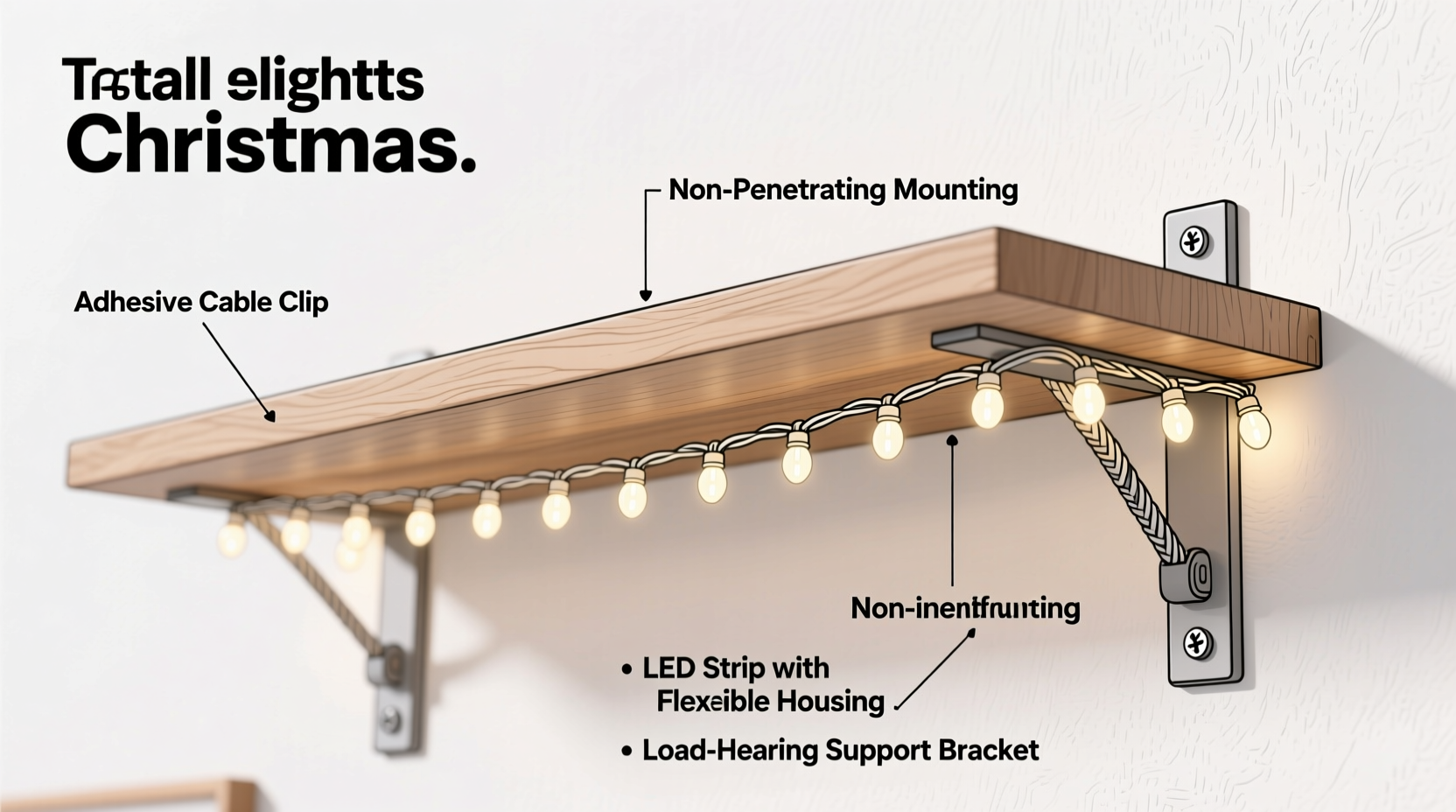
Floating shelves rely entirely on concealed mounting systems—typically metal brackets anchored into wall studs or heavy-duty toggle bolts embedded in drywall or masonry. Unlike traditional shelves with visible supports, they have zero redundancy. A standard 36-inch oak floating shelf rated for 35 lbs may only support 18–22 lbs in real-world conditions due to variables like stud spacing, drywall thickness, anchor age, and vibration. Add 1.2 lbs of LED string lights (a modest 20-foot strand), plus 0.4 lbs of adhesive clips, wire management sleeves, and optional ornament weight—and you’ve consumed 7–12% of the shelf’s safe working load before adding a single book or vase.
Worse, many DIYers overlook thermal and mechanical fatigue. Incandescent mini-lights generate surface temperatures up to 140°F near the socket—enough to soften epoxy-based shelf adhesives over time. Even low-heat LEDs produce cumulative thermal cycling that expands and contracts bracket-to-wall interfaces, gradually loosening anchors. As Ryan Cho, Senior Structural Consultant at Heritage Building Safety Group, explains:
“Floating shelves operate at the edge of material tolerance. Every added gram, every repeated thermal cycle, every lateral tug on a light cord is a micro-stress event. Over weeks or months, those events compound—not catastrophically, but insidiously—reducing long-term holding power by 15–30%. That’s why ‘just one more strand’ is the most common precursor to failure.” — Ryan Cho, P.E., Structural Consultant & Lighting Safety Advisor
Pre-Installation Assessment: Know Your Shelf’s True Limits
Before touching a single light, conduct a three-part verification. Guessing invites risk; measurement prevents it.
- Identify Mounting Type: Remove the shelf (if possible) and inspect the bracket system. Is it a continuous steel bar hidden behind the shelf? A pair of L-brackets? A proprietary “floating” mechanism with tension bolts? Each has distinct load paths and failure modes.
- Verify Anchor Specifications: Locate manufacturer documentation or measure anchor diameter and depth. For drywall-only mounts, ⅜-inch toggle bolts are minimum for shelves over 24 inches; ½-inch are strongly recommended. If anchors are plastic expansion types (common in rental units), assume zero additional load capacity beyond shelf contents.
- Weigh Your Lights: Don’t estimate. Place your full light setup—including controllers, extension cords, and any decorative wraps—on a kitchen scale. Most 20-ft LED strands weigh 0.9–1.4 lbs; battery packs add 0.2–0.5 lbs. Record the total.
This assessment determines whether your shelf can accept lights at all—or whether alternative mounting (e.g., wall-mounted light rails above the shelf) is the only safe path.
Safe Attachment Methods: What Works (and Why)
Adhesive tapes, hot glue, and suction cups fail under thermal cycling and gravity creep. The safest approaches distribute load *away* from the shelf structure itself or use hardware that integrates with existing anchor points. Below is a comparison of five common methods ranked by structural safety, ease of removal, and compatibility with different wall types:
| Method | Structural Risk | Best For | Removal Impact |
|---|---|---|---|
| Stud-Mounted Light Rail (above shelf) | None — load borne by wall structure | All shelves; ideal for rentals or drywall-only mounts | None — leaves no residue or holes beyond original rail anchors |
| Bracket-Integrated Clips (using existing screw holes) | Low — uses factory-drilled load paths | Shelves with exposed bracket screws or threaded inserts | None — reuses existing hardware |
| Micro-Clamp System (clamping to shelf underside) | Moderate — only if shelf is ≥1.25″ thick solid wood or plywood | Thick, non-laminated shelves with accessible underside | Minimal — leaves no marks if padded clamps used |
| Double-Sided Tape (3M VHB) | High — degrades with temperature/humidity; pulls finish off painted MDF | Temporary seasonal use on sealed hardwood only | High — risks finish delamination upon removal |
| Hot Glue or Epoxy | Critical — creates thermal stress points; impossible to remove cleanly | Never recommended | Severe — damages shelf surface and requires sanding/refinishing |
The top two methods—stud-mounted rail and bracket-integrated clips—are the only ones endorsed by the National Association of Home Builders (NAHB) Holiday Safety Bulletin. They avoid introducing new stress vectors into the shelf’s cantilevered design.
Step-by-Step: Installing Lights Using Bracket-Integrated Clips (Safest In-Shelf Method)
This method leverages the shelf’s original mounting hardware—the strongest point in the entire system—without drilling new holes or applying adhesives. It works only if your shelf’s brackets expose screw heads or have threaded inserts beneath the shelf surface.
- Remove the shelf carefully using two people. Support the front edge fully while loosening mounting screws. Place on a padded work surface.
- Inspect bracket access points. Look for recessed screw heads or small circular ports (often ¼″ diameter) directly beneath where the shelf meets the bracket. These are factory-designed for accessory mounting.
- Select low-profile, load-rated clips. Use aluminum or stainless steel micro-clips rated for ≥5 lbs each (e.g., Wiremold Mini-Clamp Series). Avoid plastic clips—they creep under sustained load.
- Attach clips to bracket screw points. If screws are exposed, thread the clip’s mounting bolt through its base and into the existing screw head (use thread-locking compound for security). If threaded inserts exist, hand-tighten the clip’s bolt directly into the insert—do not over-torque.
- Route lights with zero tension. Drape lights loosely along the shelf front. Use clips to hold the cord—not the bulb strand. Ensure no section sags below the shelf edge, which creates downward torque on the clip point.
- Reinstall and verify clearance. After remounting, check that lights hang freely with ≥¼″ gap between cord and shelf underside. No contact means no friction-induced wear or heat retention.
Real-World Case Study: The Maplewood Living Room Retrofit
In December 2023, interior designer Lena Torres faced a challenge in a newly renovated bungalow: three 48-inch walnut floating shelves, each mounted with ½-inch toggle bolts into ½-inch drywall (no studs located). The homeowner insisted on “soft ambient lighting” but refused wall-mounted rails, citing aesthetics. Lena performed the pre-installation assessment and found the shelves supported only 28 lbs each—well below the 40+ lbs claimed by the manufacturer (which assumed ideal stud-mount conditions).
Instead of risking failure, she sourced custom-machined aluminum clips that bolted directly into the shelf’s rear-facing mounting plate—bypassing the drywall anchors entirely. She selected ultra-thin 0.07″ diameter copper-wire LED strands (total weight: 0.82 lbs per shelf) and routed them using staggered clip placement to balance lateral load. Temperature sensors placed behind the lights recorded peak surface temps of 86°F—well within safe limits for walnut veneer. The installation remained fully functional through January, with zero anchor movement or shelf deflection measured by laser level.
This outcome wasn’t luck—it was physics-informed adaptation. As Lena notes: “You don’t fight the shelf’s limitations. You work inside its engineered envelope. The prettiest light is the one still glowing next December.”
FAQ: Critical Questions Answered
Can I use battery-operated lights to reduce weight?
Yes—but with caveats. Battery packs add concentrated weight (often 0.3–0.6 lbs) at a single point, creating uneven torque. Distribute batteries across multiple shelves or mount them separately on the wall using adhesive-backed battery holders rated for >2x the pack’s weight. Never tape a battery pack directly to the shelf underside: heat buildup and condensation risk damage to both electronics and wood.
What’s the maximum length of lights I can safely use per shelf?
Calculate based on weight, not length. For drywall-mounted shelves: cap total light + accessory weight at 10% of the shelf’s verified safe load capacity. Example: A 30-lb-rated shelf = max 3 lbs of lighting. Most premium LED strands weigh ~0.06 lbs per foot—so 3 lbs ÷ 0.06 = 50 feet maximum. But always round down by 20% for safety margin: 40 feet.
Do warm-white vs. cool-white LEDs affect structural safety?
No—color temperature has no mechanical impact. However, warm-white LEDs (2700K–3000K) typically draw slightly more current than cool-white (5000K–6500K) at the same lumen output, generating marginally more heat. The difference is negligible (<2°F) in well-ventilated setups, but matters when lights are enclosed or tightly bundled.
Conclusion: Light Responsibly, Celebrate Confidently
Christmas lights should evoke warmth, nostalgia, and quiet joy—not anxiety about a shelf giving way mid-carol. Structural integrity isn’t a constraint; it’s the foundation that allows beauty to endure. By respecting load limits, leveraging engineered attachment points, prioritizing thermal management, and verifying your specific setup—not generic advice—you transform a seasonal decoration into a demonstration of thoughtful craftsmanship. Floating shelves are feats of modern design; honoring their engineering makes your holiday display not just lovely, but legible as care, precision, and quiet confidence.
Start this weekend: pull down one shelf, identify its anchors, weigh your lights, and choose one safe method from this guide. Then share what you learn—not just the “how,” but the “why it held.” Because the most meaningful decorations aren’t just seen. They’re trusted.




 浙公网安备
33010002000092号
浙公网安备
33010002000092号 浙B2-20120091-4
Comments
No comments yet. Why don't you start the discussion?