
There’s a quiet magic that happens when a Christmas tree stops being just a decorated evergreen and becomes a portal—a threshold between the ordinary living room and an enchanted forest clearing, a gingerbread cottage courtyard, or a snow-dusted village square straight from a 19th-century storybook. That transformation rarely begins at the treetop. It starts at the ground: the often-overlooked expanse beneath the lowest boughs—the tree base. This is where narrative takes root. And few elements anchor that narrative more evocatively than thoughtfully placed mini figurines: tiny cottages, sleeping hedgehogs, brass lanterns, porcelain elves, carved wooden deer, or even a single silver-scaled dragon curled beside a mossy stone. These aren’t mere ornaments; they’re silent storytellers, inviting guests to pause, kneel, and imagine.
Yet many people hesitate—worried about clutter, scale mismatch, or kitsch. Others invest in beautiful pieces only to see them gather dust under tangled lights or get buried by oversized gift wrap. The truth is, fairy tale charm at the tree base isn’t about abundance—it’s about intentionality, harmony, and layered meaning. It’s a design discipline rooted in theatrical staging, botanical arrangement, and literary world-building. When done well, it transforms the entire holiday aesthetic—not just visually, but emotionally. Below is a comprehensive, practitioner-tested guide to cultivating that charm, grounded in real interior styling experience, conservation principles for delicate collectibles, and decades of seasonal display wisdom.
Why Mini Figurines Elevate the Tree Base (Beyond Aesthetics)
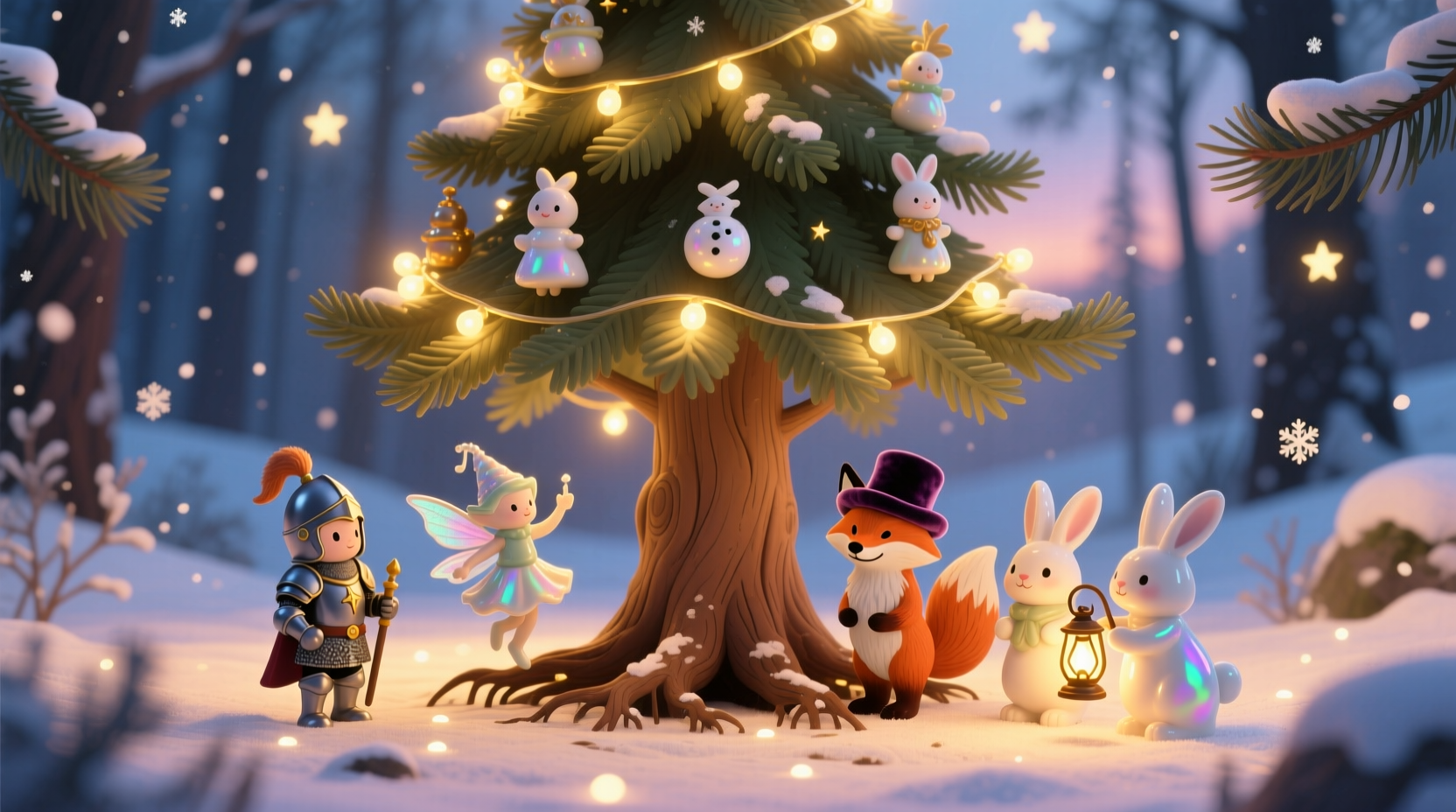
The tree base functions as both visual anchor and psychological threshold. In interior design, this zone is known as the “ground plane”—the horizontal surface that stabilizes vertical elements and invites human interaction. Unlike ornaments suspended in air, figurines inhabit shared space with us. They occupy the same plane as our feet, our pets, our children’s curious hands. This proximity creates intimacy. A hand-painted mushroom house isn’t admired from afar; it’s discovered mid-crouch, its tiny window catching candlelight, its roof dusted with faux snow we added ourselves.
Psychologically, miniature scenes trigger what psychologists call “affordance-rich environments”—spaces that invite tactile engagement, narrative projection, and gentle play. Studies in environmental psychology show that carefully scaled, story-infused vignettes reduce perceived stress and increase dwell time in domestic spaces during high-sensory periods like the holidays. In practical terms: guests linger longer. Children return repeatedly. Adults find themselves smiling without knowing why.
Crucially, fairy tale figurines also solve a common design problem: visual weight imbalance. A tall, full tree can dominate a room, leaving the floor feeling empty or disconnected. Figurines—especially when grouped with natural textures like birch logs, dried lavender, or preserved eucalyptus—add grounded warmth and dimensional contrast. They bridge the gap between artificial foliage and organic life, making the whole display feel intentional rather than assembled.
Selecting Figurines with Narrative Integrity
Not all miniatures belong together—even if they’re all “Christmas-themed.” Fairy tale charm collapses when you mix a hyper-realistic ceramic fox with a cartoonish plastic reindeer or a glitter-drenched Santa next to a hand-carved Nordic troll. Cohesion comes from shared visual language: consistent scale, compatible materials, and aligned storytelling tone.
Begin by choosing a *narrative anchor*—a single figurine or small group that defines your scene’s emotional core. Is it a weathered stone cottage with smoking chimney (cozy hearth energy)? A pair of porcelain swans gliding across mirrored “ice” (elegant winter stillness)? A moss-covered gnome reading under a toadstool (whimsical woodland mystery)? Once anchored, build outward—not upward—with supporting pieces that obey three rules:
- Scale Consistency: All figures should share the same proportional logic. A 2-inch cottage demands 1–1.5-inch animals and 0.75-inch accessories. Mixing 1:12 scale (dollhouse) with 1:24 (miniature railway) breaks immersion.
- Material Harmony: Group ceramics with ceramics, wood with wood, metal with metal—or intentionally juxtapose *texturally* (e.g., smooth porcelain mushrooms beside rough-hewn bark). Avoid glossy plastic unless it’s part of a deliberate retro-fairy-tale aesthetic (think 1950s Danish design).
- Tonal Alignment: A “dark forest” theme (moss, blackened twigs, matte charcoal figurines) shouldn’t include candy-striped candy canes. A “vintage storybook” theme (cream-glazed ceramics, sepia-toned paper labels, muted greens) rejects neon accents.
Step-by-Step: Building Your Fairy Tale Base (From Foundation to Finishing Touch)
Building a compelling figurine base isn’t linear—it’s iterative and responsive to your space. Follow this sequence, pausing after each step to assess balance and mood:
- Clear & Define the Zone: Remove all existing decor. Measure the diameter of your tree skirt or desired coverage area (typically 36–48 inches for standard trees). Mark the outer edge with painter’s tape if needed.
- Lay the Textural Foundation: Start with a neutral, tactile layer: undyed burlap, raw linen, unbleached muslin, or natural jute. Avoid shiny fabrics—they reflect light chaotically. For depth, layer underneath with preserved moss (sheet or loose), dried wheat stalks, or shredded kraft paper dyed with tea for antique warmth.
- Anchor with Architecture: Place your largest piece first—the cottage, gazebo, or miniature castle. Position it slightly off-center (rule of thirds), angled toward the main viewing angle. Ensure its base sits flush; use tiny cork shims if uneven flooring causes wobble.
- Add Living Elements: Introduce organic life: preserved eucalyptus sprigs (silver-green), cinnamon sticks, dried orange slices, or white pine cones. Nestle them *around*, not under, figurines—letting stems emerge naturally from the foundation layer.
- Place Characters with Purpose: Add animals and figures last. Place larger ones (deer, bears) near the architecture’s “doorway”; smaller ones (mice, hedgehogs, fairies) along paths or nestled in moss. Leave intentional negative space—empty patches of moss or fabric suggest hidden pathways or unseen magic.
- Final Light & Texture: Tuck battery-operated micro-LED string lights (warm white, 2700K) beneath moss or behind cottages for soft glow. Sprinkle sparingly with biodegradable “snow” (ground cornstarch or crushed eggshells) only on elevated surfaces—not directly on delicate porcelain.
Do’s and Don’ts: Preserving Charm and Preventing Disappointment
Mistakes at the tree base are rarely catastrophic—but they erode charm quickly. Here’s what seasoned stylists observe year after year:
| Action | Do | Don’t |
|---|---|---|
| Storage | Keep figurines in individual acid-free tissue inside rigid boxes, labeled with scene name and year. | Stack delicate pieces or store in plastic bags (traps moisture, yellows glue). |
| Cleaning | Dust gently with a soft makeup brush or low-suction vacuum attachment once per season. | Wipe ceramics with damp cloths—moisture seeps into porous glazes and weakens paint adhesion over time. |
| Placement | Use museum putty (repositionable, non-residue) to secure pieces on slippery surfaces like glass or polished wood. | Rely on gravity alone—especially near foot traffic or pet zones. One accidental nudge ruins months of curation. |
| Lighting | Choose LEDs with built-in timers (6h on/18h off) to prevent battery drain and overheating near flammable materials. | Use incandescent mini-lights—they generate heat that warps thin metal bases and fades hand-painted details. |
| Seasonal Rotation | Rotate figurines annually—swap a woodland scene for a coastal fairy tale (seashell cottages, ceramic crabs) to keep tradition fresh. | Repeat the exact same layout every year without editing—charm fades when novelty disappears. |
A Real Example: How the Ellisons Transformed Their Urban Apartment Tree Base
In a compact Chicago apartment with hardwood floors and minimal storage, the Ellisons struggled for years with their tree base. “It always looked like a dumping ground,” says Maya Ellison, a graphic designer. “We’d pile gifts there, then shove in a cheap plastic village because ‘it was Christmas.’ It felt fake.”
After researching miniature gardening techniques, they committed to a single theme: *The Forgotten Library Garden*. Inspired by illustrated editions of E. Nesbit’s *The Phoenix and the Carpet*, they sourced: a 3-inch ceramic bookshelf with tiny leather-bound “books,” two 1.25-inch porcelain owls perched on its top shelf, a 1.5-inch brass reading lamp with a silk shade, and preserved boxwood clipped into miniature hedges. They laid undyed linen, tucked in dried lavender (for scent and purple contrast), and used museum putty to secure everything.
The result? A vignette that felt deeply personal—not generic. Guests didn’t say “cute.” They said, “I want to open that bookshelf.” Their toddler named the owls and brought them stuffed animals. Crucially, the setup took 22 minutes to assemble and disassemble, and every piece fit into one 10-inch cube for storage. As Maya notes: “It stopped being decoration. It became part of our family’s December language.”
“Miniature scenes succeed when they honor silence as much as detail. The most powerful fairy tale moments happen in the spaces between objects—not the objects themselves.” — Lena Varga, Curator of Miniature Arts, Museum of Craft & Design
FAQ: Practical Questions from Real Homes
How do I keep pets or toddlers from disturbing the scene?
Strategically place low-profile barriers: a ring of smooth river stones (3–4 inches tall), a shallow wooden tray with raised edges, or a vintage brass candle ring. Avoid anything sharp or breakable. More effective than physical barriers: train curiosity through ritual—designate “viewing time” with a magnifying glass, turning discovery into shared reverence rather than disruption.
Can I mix vintage and new figurines safely?
Yes—if you prioritize patina harmony over era. A 1920s German bisque mushroom is compatible with a 2023 ceramic fox if both share matte finishes, earthy tones, and hand-painted texture. Avoid pairing glossy modern resin with fragile antique porcelain—their material languages conflict. Always test weight distribution: heavier vintage pieces may need cork pads to prevent scratching floors.
What’s the best way to store delicate porcelain or hand-painted pieces long-term?
Never stack. Wrap each piece individually in unbleached cotton cloth (not paper towels—they shed lint), then place upright in compartmentalized archival boxes. Store in climate-controlled areas (avoid attics or garages). Include silica gel packets to absorb ambient moisture. Check annually for signs of blooming (white haze on glaze), which indicates humidity damage.
Conclusion: Your Story Begins at Ground Level
Fairy tale charm isn’t inherited—it’s cultivated. It grows from noticing how light catches the curve of a ceramic roof at dusk, from remembering which figurine your child pointed to first last year, from the quiet satisfaction of placing a single perfect acorn beside a sleeping mouse and knowing the composition feels complete. The tree base is where holiday magic becomes tangible—not in grand gestures, but in the careful alignment of scale, texture, and silence.
You don’t need rare antiques or a decorator’s budget. You need observation, patience, and permission to tell a small, true story with your hands. Start with one piece that moves you. Build around its quiet voice. Edit ruthlessly. Protect what matters. And when December arrives, don’t rush the assembly—kneel. Breathe. Let the miniature world you’ve made remind you that wonder isn’t reserved for mountaintops or palaces. It waits, patiently, right where your feet meet the floor.




 浙公网安备
33010002000092号
浙公网安备
33010002000092号 浙B2-20120091-4
Comments
No comments yet. Why don't you start the discussion?