
There’s a quiet alchemy that happens when miniature figures—no taller than a pinecone—nestle among the boughs of a Christmas tree. A porcelain snow queen beside a frosted branch. A brass fox curled beneath a cluster of silver berries. A hand-painted wooden cottage nestled in the lower third, smoke rising from its chimney in faint grey enamel. These aren’t ornaments in the traditional sense; they’re narrative anchors—tiny portals into wonder, memory, and myth. Fairy tale magic on the tree isn’t about excess or spectacle. It’s about intentionality: choosing figures that resonate emotionally, placing them with reverence, and allowing story—not symmetry—to guide the design.
This approach transforms the tree from a seasonal decoration into a living vignette—a three-dimensional storybook where every twig holds possibility. It appeals especially to those who value heirloom quality over trend-driven flash, and who understand that magic isn’t conjured with glitter alone, but with meaning, scale, and quiet detail.
Why Tiny Figurines Elevate Holiday Tradition
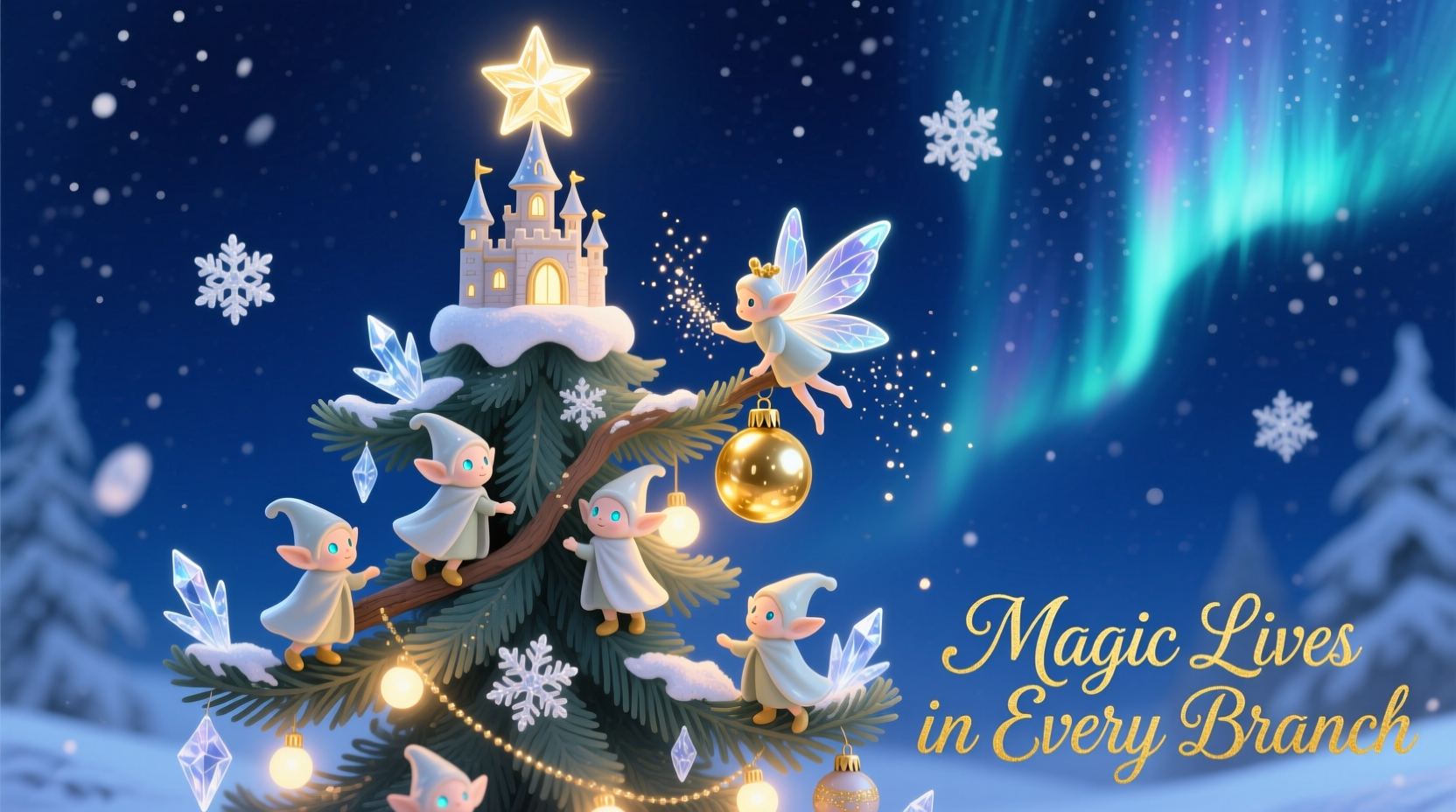
Fairy tale figurines differ fundamentally from standard ornaments. While baubles reflect light, figurines invite contemplation. Their small scale—typically 1 to 3 inches tall—encourages slow looking. You lean in. You notice the hand-stitched cloak on a felted Little Red Riding Hood, the subtle patina on a cast-iron dwarf, the way a resin unicorn catches candlelight at just the right angle. This intimacy fosters emotional connection, particularly for families passing down pieces across generations.
Psychologists studying ritual and nostalgia note that tactile, story-rich objects strengthen intergenerational bonds during holidays. Dr. Lena Torres, cultural anthropologist at the University of Vermont, observes:
“When children help place a Sleeping Beauty figurine near a cluster of white roses, they’re not just decorating—they’re co-authoring family mythology. The object becomes a vessel for shared language, values, and unspoken hopes.”
Unlike mass-produced decorations, many high-quality fairy tale figurines are crafted by artisans using techniques unchanged for centuries: lost-wax bronze casting, hand-blown glass, hand-carved wood, or porcelain slip-casting. Their material integrity matters—not only for longevity, but for authenticity of feeling. A cold brass wolf feels ancient and watchful; a warm beeswax-coated wooden bear radiates gentleness. These subtleties shape atmosphere far more than color schemes ever could.
Selecting Your Enchanted Cast: Materials, Themes & Meaning
Building a cohesive fairy tale tree begins not with placement—but curation. Resist the urge to collect “all the characters.” Instead, choose a unifying theme or emotional tone. Common resonant themes include:
- The Enchanted Forest: Foxes, owls, badgers, moss-covered mushrooms, tiny deer, and woodland sprites—emphasizing earthy textures and muted greens, browns, and greys.
- Winter Kingdoms: Ice queens, frost sprites, silver wolves, crystal carousels, and snow-draped cottages—leaning into cool tones, metallic finishes, and translucent materials like frosted glass or acrylic.
- Storybook Archetypes: Figures representing universal motifs—The Guardian (a stone golem), The Guide (a lantern-bearer), The Threshold (a tiny arched gate), The Dreamer (a sleeping child under a star). Less literal, more symbolic.
- Family Lore: Custom pieces reflecting personal milestones—e.g., a figurine of a child’s first pet as a forest companion, or a tiny bookshelf representing beloved bedtime stories read aloud each December.
Material choice affects both aesthetics and care. Consider this comparative guide:
| Material | Atmospheric Effect | Care Notes | Ideal Placement Zone |
|---|---|---|---|
| Hand-painted porcelain | Ethereal, delicate, luminous | Dust gently with soft brush; avoid moisture or direct heat | Middle to upper branches—where light catches fine detail |
| Cast bronze or brass | Timeless, grounded, regal | Wipe with dry microfiber; occasional light wax polish preserves patina | Lower third—near trunk or base for visual weight |
| Carved walnut or cherry wood | Warm, organic, inviting | Store in breathable cotton bags; avoid humidity swings | Mid-level branches—especially near natural elements like pinecones or dried citrus |
| Frosted glass or resin | Sparkling, dreamlike, refractive | Handle by base only; clean with lint-free cloth dampened slightly with distilled water | Outer tips of branches—maximizes light refraction |
| Felted wool or hand-stitched fabric | Soft, cozy, tactile | Vacuum gently with upholstery attachment; store flat between acid-free tissue | Interior clusters—nestled among full foliage for texture contrast |
A Step-by-Step Arrangement Ritual (Not Just Hanging)
Treating placement as ritual—not task—deepens the experience and ensures lasting visual harmony. Follow this intentional sequence:
- Clear & Assess: Remove all existing ornaments. Step back and observe your tree’s natural architecture—where branches diverge, where density varies, where light pools. Note “quiet zones” (areas of sparse foliage) and “anchor points” (sturdy horizontal limbs).
- Group by Narrative Proximity: Sort figurines into thematic trios—e.g., “The Watchers” (owl, fox, raven), “The Hearth Keepers” (woodcutter, kettle, sleeping cat), “The Starlit Travelers” (elf, reindeer, comet). Each trio tells a micro-story.
- Anchor the Base First: Place 2–3 substantial pieces at the lowest visible tier—often near the trunk. A bronze badger guarding a tiny acorn, or a porcelain cottage with a glowing window. This establishes grounding and invites upward exploration.
- Create Vertical Pathways: Choose 3–5 primary branches that spiral upward. Along each, place one figure from a different trio—spacing them 8–12 inches apart. This guides the eye organically, mimicking how fairy tales unfold: beginning, turning point, revelation.
- Embrace Asymmetry & Negative Space: Leave at least 30% of the tree visibly unadorned. Let bare twigs, clusters of pinecones, or draped ivy breathe. Magic needs silence to be heard.
- Add Final Whispers: Tuck 1–2 ultra-tiny pieces (a glass snowflake no bigger than a fingernail, a seed-pod fairy) into unexpected places—behind a larger ornament, nestled in a knot-hole of a rustic branch, or half-hidden beneath a velvet bow. These discoveries reward close attention.
Real Example: The Evergreen Family’s “Thistlewood Tree”
In Portland, Oregon, the Evergreen family has cultivated a fairy tale tree tradition for 17 years. When their daughter Elara was diagnosed with chronic illness at age six, her parents sought ways to make holiday rituals feel less overwhelming—and more restorative. They began collecting small, tactile figurines during local craft fairs: a smooth river-stone frog, a copper dragonfly with wing veins etched by hand, a walnut mouse holding a thimble of holly berries.
They established simple rules: no plastic, nothing battery-operated, and every piece must have been touched by human hands—not machines. Each December, Elara (now 23 and a pediatric occupational therapist) leads the “Tree Whispering” evening: lights dimmed, instrumental folk music playing, and each family member placing one figure while sharing a hope or memory it evokes. Their tree doesn’t dazzle—it hums. Visitors often stand quietly for minutes, tracing the path of a ceramic snail climbing a ribbon-wrapped branch, or noticing how morning light turns a glass snow queen’s crown into a prism.
What began as gentle accommodation evolved into profound tradition. “It taught us that magic isn’t about perfection,” Elara reflects. “It’s about presence. And presence is always available—even in the smallest things.”
Preserving the Spell: Storage, Cleaning & Longevity
Fairy tale figurines are investments in atmosphere—not disposable decor. Proper stewardship ensures they retain their narrative power for decades. Unlike ornaments designed for annual wear, these pieces benefit from mindful handling year-round.
After the holidays, follow this preservation checklist:
- ✔ Gently dust each piece with a soft-bristled artist’s brush (never compressed air or cloths that snag).
- ✔ Photograph each figurine individually against a neutral background—note maker, year acquired, and associated memory (e.g., “2019, from Blackberry Hollow Pottery, placed first on Elara’s tree after remission”).
- ✔ Wrap individually in unbleached, acid-free tissue paper—never newspaper or colored tissue (inks can migrate).
- ✔ Store upright in rigid, compartmentalized boxes lined with wool felt or cork. Avoid stacking unless pieces are fully supported.
- ✔ Keep storage location cool (under 68°F/20°C), dry (35–50% RH), and dark—away from attics, basements, or garages with temperature swings.
“The most magical trees I’ve styled weren’t the fullest—but the most thoughtfully tended. A single, well-placed figurine can hold more resonance than fifty baubles. Its power multiplies when handled with reverence—not just once a year, but across time.” — Silas Thorne, award-winning holiday stylist and author of *The Quiet Tree*
One often-overlooked factor is scent integration. Fairy tales are deeply olfactory—think gingerbread, pine resin, cold stone, old books. Introduce subtle, natural fragrance *around* (not on) figurines: tuck dried lavender sachets into storage boxes, or place a single drop of fir needle essential oil on a cotton ball inside the storage container (never directly on metal or wood). Scent becomes an invisible thread connecting seasons.
FAQ: Practical Questions from Real Tree-Tenders
Can I mix figurines from different eras or styles—like vintage German chalkware with modern ceramic?
Absolutely—and often beautifully. Contrast creates depth. A matte, rough-hewn troll beside a glossy porcelain princess highlights texture and time. The key is shared intention: if both pieces evoke wonder, protection, or quiet courage, they belong together. Avoid pairing items whose sole purpose is irony or kitsch—their energy disrupts narrative cohesion.
My tree is artificial. Will tiny figurines still feel authentic?
Yes—if you honor material honesty. Artificial trees excel at structure and consistency, freeing you to focus entirely on figurine placement and storytelling. Enhance authenticity by adding natural accents: real pinecones, dried orange slices wired to branches, bundles of cinnamon sticks, or foraged birch twigs. The figurines become the soul; the natural elements, the breath.
How do I explain the significance of these pieces to young children without oversimplifying?
Invite curiosity instead of explanation. Ask open questions: “What do you think this little fox is waiting for?” or “If this cottage had a door, where do you think it leads?” Children intuit symbolism long before they name it. Their answers—“to Grandma’s kitchen,” “inside a cloud,” “where dreams get folded”—are often wiser than any adult interpretation.
Conclusion: Your Tree Awaits Its First Chapter
Fairy tale magic isn’t summoned—it’s invited. With patience, selectivity, and tenderness, your Christmas tree can become more than a centerpiece. It can become a sanctuary of small wonders, a testament to continuity, and a quiet rebellion against the hurried and the generic. Each figurine you choose carries a whisper of resilience, kindness, transformation, or quiet courage—qualities we need most in winter’s deep hours.
You don’t need rare antiques or artisan commissions to begin. Start with one meaningful piece—a thrift-store ceramic rabbit, a child’s clay sculpture from preschool, a hand-carved spoon gifted by a neighbor. Place it with attention. Tell its story aloud. Watch how the light changes around it at dusk. Notice how your own breath slows when you pause before it.
That is where the magic begins—not in grand gestures, but in the deliberate, loving placement of something small, true, and full of possibility.




 浙公网安备
33010002000092号
浙公网安备
33010002000092号 浙B2-20120091-4
Comments
No comments yet. Why don't you start the discussion?