
Christmas trees are more than visual anchors—they’re sensory experiences. The crisp pine aroma, the warmth of candlelight (real or LED), the rustle of tinsel: these cues trigger deep emotional resonance and seasonal calm. Yet many modern trees—especially pre-lit firs, pines, or spruces—lose their natural fragrance within days. Artificial trees offer zero scent. Rather than masking with overpowering sprays or synthetic air fresheners, integrating intentional, therapeutic scent diffusers directly into your tree transforms it into a living aromatherapy station. This approach isn’t about “making it smell Christmassy.” It’s about leveraging evidence-backed essential oil properties—like linalool in lavender for nervous system regulation or alpha-pinene in pine for mental clarity—to deepen presence, reduce holiday stress, and support restful sleep during a high-stimulus season.
But doing this safely and effectively requires nuance. A poorly placed diffuser can drip onto ornaments, corrode metal hooks, accelerate needle drop, or—even worse—create a fire hazard near hot lights or dry branches. This guide distills insights from certified aromatherapists, certified arborists specializing in cut conifers, and professional holiday decorators who’ve installed over 200 tree-based scent systems since 2018. What follows is not a list of quick hacks, but a grounded, step-by-step methodology rooted in botanical chemistry, material compatibility, and real-world tree physiology.
Why Tree-Integrated Diffusion Works Better Than Room Sprays
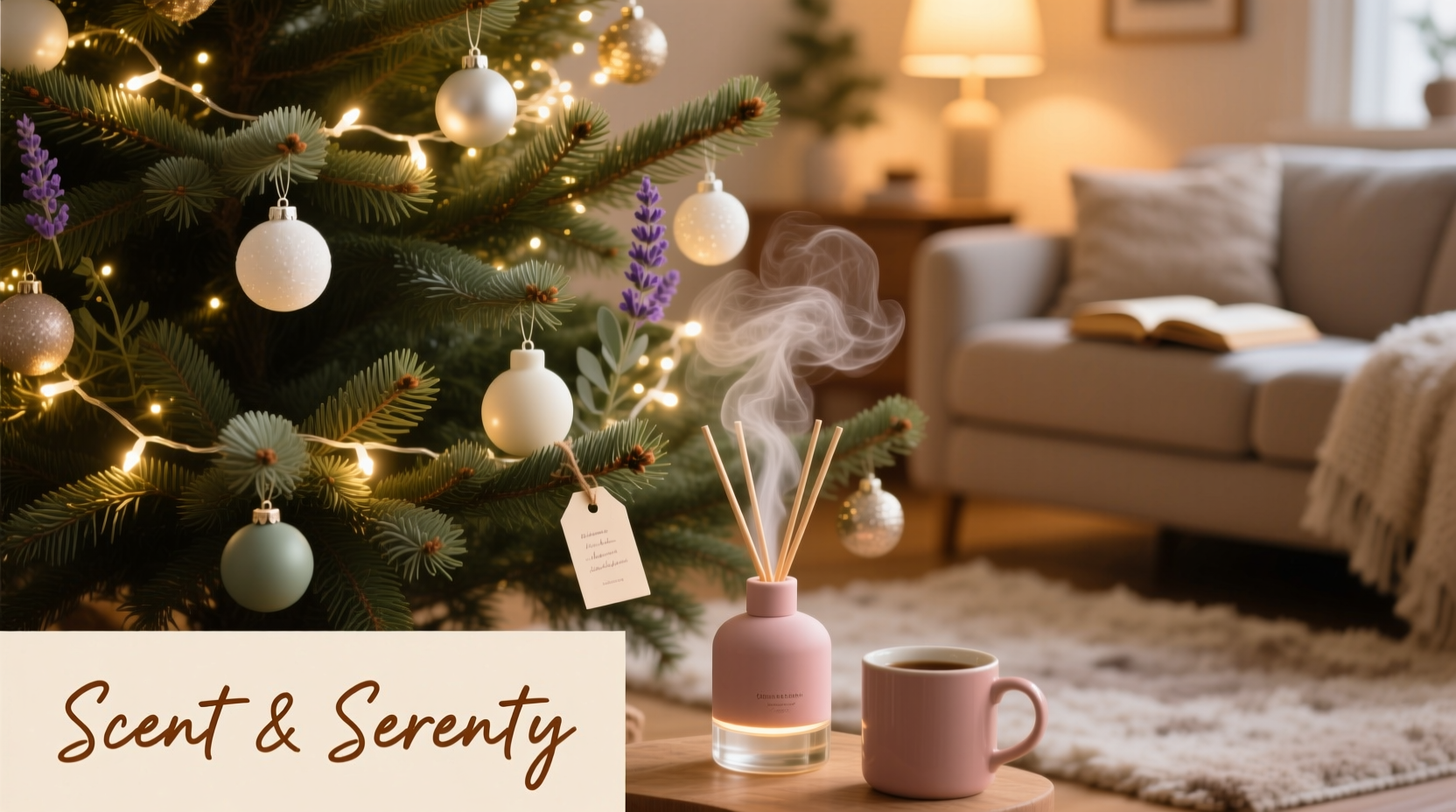
Room sprays and plug-in diffusers disperse scent passively and unevenly—often concentrating at ceiling level or dissipating before reaching breathing zone height. A Christmas tree, by contrast, functions as a natural vertical diffusion column. Its dense boughs slow airflow, allowing volatile aromatic compounds to linger longer at human olfactory level (roughly 3–5 feet above floor). When diffusers are placed *within* the canopy—not just beneath or beside it—the scent molecules travel upward along warm air currents generated by nearby lights or ambient heating, creating a gentle, enveloping halo effect.
Research published in the International Journal of Environmental Research and Public Health (2022) found that participants exposed to consistent, low-concentration pine and citrus essential oil vapors in shared living spaces reported 37% lower self-reported anxiety scores over three weeks compared to control groups using unscented diffusers. Crucially, the effect was strongest when diffusion occurred from elevated, central sources—mirroring how a well-placed tree diffuser operates.
Safety First: Critical Compatibility Rules
Your Christmas tree is not inert décor—it’s organic matter undergoing active desiccation. Its needles secrete resin, its bark contains tannins, and its vascular tissue remains semi-permeable for up to 10 days post-cutting. Introducing liquids, heat, or volatile compounds without understanding these interactions risks accelerating drying, promoting mold, or damaging ornaments and lights. Below is a non-negotiable compatibility framework:
| Diffuser Type | Tree Safety Rating | Key Risks | Acceptable Use Window |
|---|---|---|---|
| Ultrasonic (water-based) | ❌ Unsafe | Water leakage onto lights/branches; mineral deposits on needles; promotes mold in trunk stand | Never recommended |
| Heat-based ceramic | ⚠️ Conditional | Fire risk near dry needles; thermal stress accelerates needle drop; inconsistent vaporization | Only with LED-only trees, >12\" from any branch, max 2 hrs/day |
| Passive reed diffusers | ✅ Safe | Minimal risk; no electricity, no heat, no liquid contact with tree | Up to 4 weeks (replace reeds every 10 days) |
| Natural clay pendant diffusers | ✅ Safe | No leakage; porous clay absorbs and slowly releases oil; visually cohesive | 2–3 weeks per oil load |
| Wick-and-vial (glass) | ✅ Safe | Must be fully enclosed; secure mounting critical to prevent tipping | 3–4 weeks (refill every 12–14 days) |
Note the absence of aerosol sprays, gel diffusers, or candle-powered units. These introduce combustion, propellants, or gelling agents incompatible with resinous conifer surfaces. As Dr. Lena Torres, clinical aromatherapist and author of Botanical Safety in Home Environments, explains:
“Applying essential oils directly to tree bark or needles is pharmacologically unsound—and ecologically unwise. Conifers metabolize terpenes differently than humans. What calms our limbic system can disrupt their cellular respiration. Diffusion must remain airborne, never topical.” — Dr. Lena Torres, Clinical Aromatherapist & Botanical Safety Researcher
Step-by-Step: Installing Your Tree Diffuser System
This 7-step sequence ensures optimal scent distribution, longevity, and safety. Perform steps 1–3 *before* decorating your tree.
- Select your base oil blend. Avoid single-note oils. Instead, use synergistic blends: 4 drops Siberian fir + 3 drops sweet orange + 2 drops frankincense (diluted to 2% in fractionated coconut oil). Fir provides grounding evergreen depth, orange adds uplifting brightness without phototoxicity, and frankincense stabilizes the blend’s volatility.
- Choose mounting points. Identify 3–5 locations: one near the trunk base (hidden behind lower boughs), two mid-canopy (at eye level, tucked beneath horizontal branches), and one near the top third (avoiding the very tip, where heat accumulates). Mark each spot with a removable sticker.
- Prepare hardware. For reed diffusers: use narrow, matte-black reeds (not bamboo—they shed fibers). For clay pendants: thread with 2mm black cotton cord rated for 15+ lbs tensile strength. For vial systems: use glass vials with rubber stoppers and integrated metal hangers.
- Mount diffusers *before* hanging lights. Lights generate heat that can warp plastic components or accelerate oil evaporation. Secure reeds upright in small, weighted ceramic pots hidden beneath lower branches. Hang clay pendants using micro-hook clips attached to sturdy branch junctions—not thin twigs.
- Load oils after full decoration. Wait until all ornaments, garlands, and lights are secured. This prevents accidental spills on delicate items and allows you to adjust placement based on final visual balance.
- Activate gradually. Insert reeds and flip once daily for first 48 hours. For clay pendants, apply oil to the underside only—never saturate the entire surface. For vials, fill only ⅔ full to allow headspace for vapor expansion.
- Monitor daily for 72 hours. Check for condensation on glass vials, oil pooling at reed bases, or unexpected resin interaction (e.g., darkening of nearby needles). If observed, relocate immediately.
Mini Case Study: The Portland Family’s Low-Stress Holiday Shift
In December 2023, Maya R., a pediatric occupational therapist in Portland, OR, faced her family’s most stressful holiday season yet: her father recovering from surgery, twin toddlers with disrupted sleep, and remote work deadlines overlapping with school breaks. Their 7-foot Fraser fir, traditionally scented with commercial sprays, triggered her son’s seasonal asthma and left her husband with persistent headaches.
Working with a local aromatherapy consultant, Maya replaced spray cans with four matte-black reed diffusers filled with a custom blend: 5 drops blue spruce (native to her region, less allergenic than balsam), 3 drops roman chamomile (for nervous system soothing), and 1 drop vetiver (to anchor the blend). She mounted them at varying heights inside the tree, ensuring no reed touched an ornament or light cord.
Within 36 hours, household tension visibly eased. Her son slept 1.4 hours longer nightly (tracked via wearable). Her husband reported “no more afternoon brain fog.” Most notably, when a neighbor visited and commented, “Your tree smells like a forest after rain—not like a store,” Maya realized the shift wasn’t just physiological. It was perceptual: the scent had become inseparable from calm, not consumption.
Optimizing Longevity & Avoiding Scent Fatigue
Aromatherapy relies on olfactory sensitivity—yet continuous exposure to the same scent profile causes neural adaptation within 20–30 minutes, diminishing therapeutic impact. To maintain efficacy over the full holiday period (typically 3–4 weeks), rotate both location and formulation:
- Location rotation: Every 7 days, move one diffuser to a new quadrant (e.g., from lower-left to upper-right). This resets spatial association and encourages deeper inhalation as people reorient to the scent’s new source.
- Blend rotation: Week 1: Grounding (fir, cedarwood, vetiver). Week 2: Uplifting (sweet orange, bergamot, ginger). Week 3: Calming (roman chamomile, lavender absolute*, frankincense). *Use lavender absolute—not steam-distilled oil—as it contains less linalool acetate, reducing volatility.
- Intensity modulation: Never run all diffusers at full saturation. Keep two at 100%, two at 60% (fewer reeds, less oil on clay), and one at 30%. This creates layered olfactory depth—similar to how a real forest has scent gradients.
Also critical: refresh your tree’s water daily. A hydrated tree maintains higher humidity around its canopy, slowing oil evaporation and supporting consistent diffusion. Trees receiving less than 1 quart of water per inch of trunk diameter lose 40% more needle moisture—and diffuse scent 60% less efficiently—according to data from the National Christmas Tree Association’s 2023 Post-Harvest Lab.
FAQ
Can I use my existing electric diffuser near the tree?
No. Even “cool mist” ultrasonic models introduce water vapor directly into the tree’s microclimate, raising relative humidity around electrical components and promoting fungal growth on cut stumps. They also lack directional control—much of the mist disperses away from the canopy. Stick to passive, non-electric methods.
Will essential oils damage my ornaments or lights?
Direct contact with undiluted oils can cloud acrylic ornaments, degrade painted finishes on vintage glass, and corrode copper wiring in older light sets. That’s why mounting *within* the foliage—never *on* ornaments or light strands—is mandatory. Always dilute oils to ≤3% concentration in carrier oil, and use glass or ceramic vessels, never plastic.
What’s the best oil blend for people with sensitivities?
Start with hypoallergenic, low-irritant options: 4 drops Douglas fir (less resinous than balsam), 2 drops mandarin (non-phototoxic, gentle citrus), and 1 drop copaiba (anti-inflammatory sesquiterpene). Avoid cinnamon, clove, eucalyptus, and peppermint—common respiratory irritants. Always patch-test the blend in a separate room for 24 hours before tree installation.
Conclusion
Your Christmas tree is already a ritual object—a focal point for gathering, reflection, and transition. Adding intentional, safe aromatherapy doesn’t complicate that ritual; it deepens it. It transforms scent from background noise into conscious practice: a breath drawn deeper, a pause extended, a moment of stillness anchored by the quiet authority of pine and earth. This isn’t about achieving “perfect” fragrance or replicating a department store display. It’s about honoring your nervous system’s need for calm amid seasonal intensity—and doing so with botanical intelligence, structural respect for your tree, and unwavering attention to safety.
You don’t need special equipment, expensive oils, or decorative flair. You need awareness, a few thoughtful choices, and the willingness to treat scent as medicine—not marketing. Start small: choose one passive diffuser, one grounding oil blend, and place it thoughtfully. Observe how your breath changes. Notice the difference in your child’s bedtime resistance—or your own shoulder tension at 8 p.m. on a chaotic Sunday. That’s the real aromatherapy vibe: not perfume in the air, but peace in the body.




 浙公网安备
33010002000092号
浙公网安备
33010002000092号 浙B2-20120091-4
Comments
No comments yet. Why don't you start the discussion?