
Nothing evokes the spirit of the season quite like the crisp, resinous aroma of a fresh-cut Christmas tree. Yet many traditional scenting methods—candles nestled in branches, aerosol sprays misted directly onto needles, or simmer pots placed too close to dry foliage—introduce serious fire risks. According to the National Fire Protection Association (NFPA), December is the peak month for home decoration–related fires, with Christmas trees accounting for an average of 160 reported structure fires annually in the U.S. alone. Most occur when ignition sources contact dry, untreated trees—or when well-intentioned scenting efforts compromise fire safety.
This isn’t about sacrificing atmosphere for safety. It’s about rethinking fragrance as an intentional, layered experience—one that honors tradition while respecting modern fire science. The safest, most enduring scents come not from volatile chemicals or heat-dependent delivery, but from passive diffusion, botanical integrity, and thoughtful placement. Below, you’ll find field-tested strategies developed in consultation with certified fire safety educators, arborists, and professional holiday stylists—methods proven to deliver rich, nostalgic fragrance without increasing ignition risk.
Why Traditional Scenting Methods Pose Real Fire Risks
Understanding *why* certain practices are dangerous helps inform smarter alternatives. A live Christmas tree’s fire hazard increases exponentially as it dries. Within just 7–10 days of cutting—even with daily watering—needles lose moisture, becoming highly combustible. At that point, ignition can occur at temperatures as low as 350°F (177°C). That’s well below the surface temperature of a lit candle flame (1,400–1,800°F) or the localized heat generated by an overheating string of incandescent lights.
Certain popular scenting tactics compound this danger:
- Aerosol “Christmas scent” sprays often contain alcohol, propane, or butane propellants—highly flammable under pressure and prone to flash ignition near heat sources.
- Candles or tea lights in tree stands or on lower branches create direct flame contact with dry needles and pine resin, which ignites readily and burns intensely.
- Simmer pots placed on or near the tree stand may seem safe, but steam condensation wets electrical cords, and accidental tipping introduces water into outlets—both contributing to electrical faults, a leading cause of holiday fires.
- Fresh citrus peels or cinnamon sticks pinned directly into bark may look charming, but they dehydrate quickly, become brittle, and can fall into warm light sockets or tangled wiring.
Fire safety begins not with reaction—but with design. That means choosing scent delivery systems that require no heat, no electricity near the tree base, no pressurized containers, and no physical attachment to the tree itself.
Safe, Passive Scenting Methods That Actually Work
The most reliable fire-safe scenting relies on passive diffusion: letting natural volatiles evaporate slowly at room temperature, carried by ambient air currents—not forced by heat or propellant. These methods preserve the tree’s integrity while delivering layered, evolving fragrance over time.
Natural Botanical Sachets (The Gold Standard)
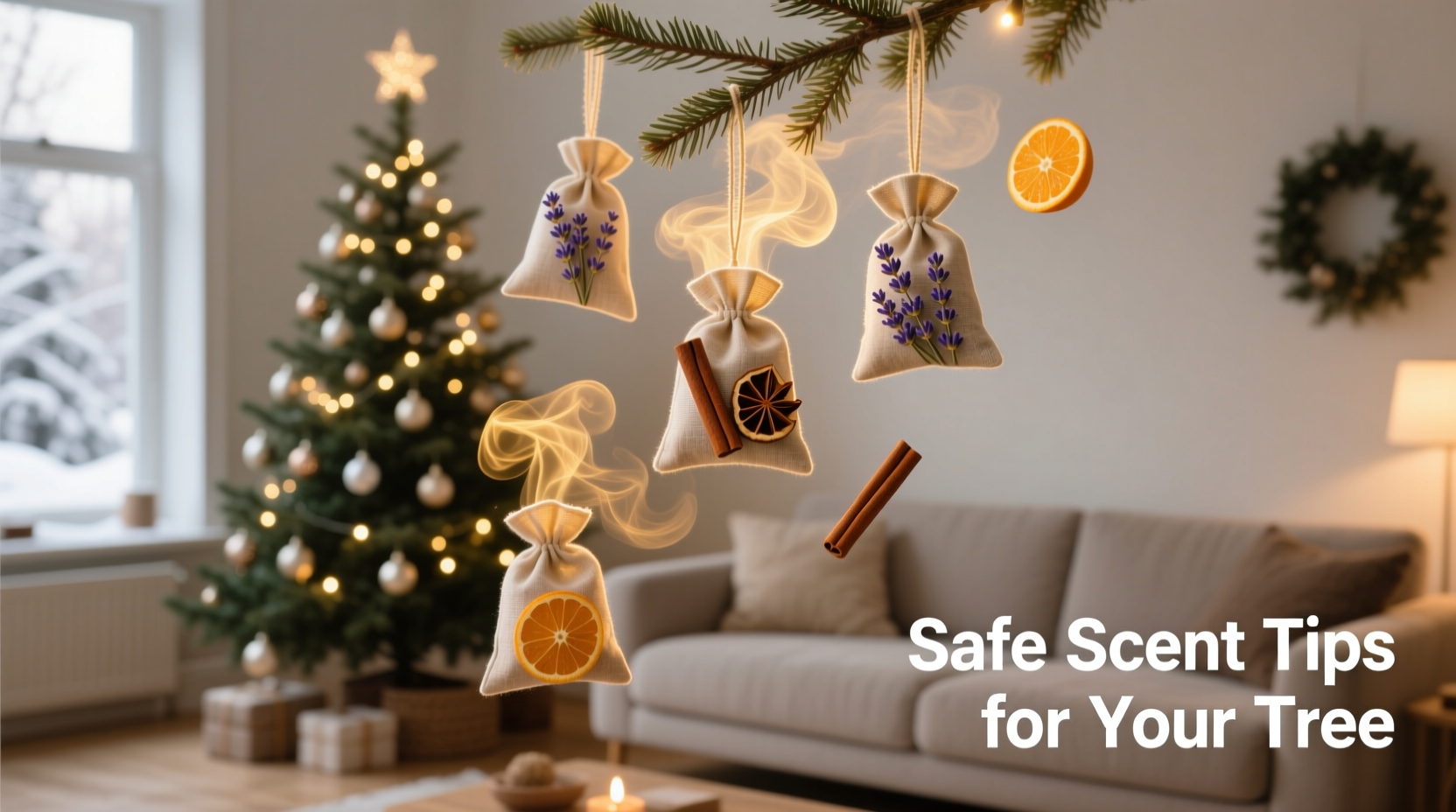
Small, breathable muslin or cotton bags filled with dried conifer clippings, whole spices, and citrus zest release scent gradually and safely. Unlike oils or sprays, they contain zero flammables—and unlike fresh items, they won’t mold, drip, or attract pests.
Effective combinations include:
- Pine needles + crushed star anise + dried orange peel (zest only—no pith)
- Balsam fir clippings + whole cloves + cardamom pods
- Spruce tips + dried rosemary + black peppercorns
Hang 3–5 sachets from sturdy upper branches using natural jute twine—never wire or metal hooks that could puncture bark or conduct electricity. Position them where airflow is strongest (e.g., near ceiling vents or open doorways), not tucked deep into dense foliage where scent becomes trapped.
Essential Oil Diffusers — With Critical Safety Modifications
Ultrasonic diffusers are safe *only if* placed at least 6 feet from the tree—on a stable, non-flammable surface like stone, ceramic, or sealed hardwood. Never place one on the tree stand, mantle above the tree, or within reach of dangling lights.
Use only pure, undiluted essential oils known for their stability and low volatility: Siberian fir needle, Douglas fir, white spruce, and frankincense. Avoid pine, cypress, or eucalyptus oils—they oxidize rapidly, becoming sensitizing and potentially irritating to mucous membranes.
Run diffusers for no more than 30 minutes on, 60 minutes off—preventing oversaturation and maintaining air quality. Refill daily with fresh water and oil; stagnant water encourages bacterial growth and musty odors.
What to Avoid: A Fire-Safety Checklist
Before decorating, review this checklist. If any item applies, remove or replace it immediately.
🛑 Fire-Risk Scenting Checklist
- ☐ Candles, flameless candles with exposed heating elements, or LED tea lights placed in or under the tree
- ☐ Aerosol sprays used directly on tree branches, lights, or ornaments
- ☐ Simmer pots, crockpots, or stovetop infusions placed on or adjacent to the tree stand
- ☐ Fresh citrus slices, whole apples, or unpeeled oranges attached to branches with pins or wire
- ☐ Essential oil “tree spray” blends containing alcohol, witch hazel, or synthetic solvents
- ☐ Dried botanicals stored in plastic bags or sealed containers near the tree (traps moisture and heat)
- ☐ Any scenting method requiring extension cords routed under rugs or furniture near the tree base
Real-World Example: How the Miller Family Reduced Risk While Deepening Tradition
In 2022, the Miller family of Portland, Oregon, lost their vintage glass ornament collection—and nearly their home—when a candle placed beneath their Fraser fir ignited dry lower branches. The fire started at 8:17 p.m.; firefighters arrived in under four minutes, but smoke damage was extensive. In the months that followed, they consulted with local fire marshal Diane Ruiz and horticulturist Dr. Lena Cho to rebuild their holiday ritual around safety-first scenting.
They now prepare five linen sachets each November: two filled with dried noble fir tips and whole allspice berries, two with balsam clippings and dried lemon zest, and one “quiet blend” of cedarwood chips and lavender buds for their bedroom. All are sewn by hand using undyed, GOTS-certified linen. They hang them from the top third of the tree using biodegradable hemp cord tied to interior branch forks—not outer limbs. A single ultrasonic diffuser runs on a side table across the room, programmed via smart plug to cycle during evening hours only.
“We expected compromise,” says Sarah Miller. “Instead, we got something richer: the scent evolves. You smell sharp citrus first, then warm spice, then deep evergreen—like walking through different forest layers. And knowing our kids can safely sit beside the tree without us holding our breath? That’s the real gift.”
Expert Guidance: What Fire Safety Professionals and Arborists Recommend
Fire prevention isn’t just about avoiding ignition—it’s about preserving the tree’s natural moisture barrier and minimizing environmental stressors. Certified Fire Protection Specialist Marcus Bell, who trains municipal fire departments nationwide, emphasizes proactive hydration and scent separation:
“The biggest misconception is that ‘fire-safe scenting’ means using less fragrance. It actually means using better delivery. Heat, propellants, and moisture all accelerate needle desiccation—and dry needles ignite faster than paper. Keep scent away from the tree’s physical structure entirely. Let the room carry it—not the branches.” — Marcus Bell, NFPA-Certified Fire Protection Specialist
Dr. Elena Torres, urban forester and conifer specialist at Oregon State University, adds botanical context:
“Fresh-cut trees continue limited transpiration for up to 21 days—if kept in clean water with a fresh cut and cool room temps. Introducing foreign substances—especially oils or acidic fruit residues—disrupts capillary action in the xylem. That’s why passive, external scenting doesn’t just prevent fire—it supports the tree’s own longevity.” — Dr. Elena Torres, Urban Forestry Extension, OSU
Comparison Table: Scent Method Efficacy vs. Fire Risk
| Scent Method | Fragrance Duration | Ignition Risk Level | Key Safety Requirement |
|---|---|---|---|
| Dried botanical sachets (muslin) | 3–6 weeks (with gentle shaking) | Very Low | Must be fully air-dried; hung with natural fiber cord |
| Ultrasonic diffuser (6+ ft away) | Continuous while running (max 30-min cycles) | Low | Never placed on or near tree stand; uses only stable conifer oils |
| Simmer pot on stove (not near tree) | 2–4 hours per session | Moderate | Must be monitored constantly; never left unattended or placed in same room as tree |
| Candle-based scent (e.g., pine-scented pillar) | 4–6 hours per burn | High | Not recommended near any live or artificial tree |
| Aerosol “Christmas mist” sprays | Minutes to 1 hour | Very High | Avoid entirely—propellants are Class 1 flammables |
Step-by-Step: Building Your Fire-Safe Scent System (Under 20 Minutes)
- Gather materials: 5–7 inches of dried conifer tips (balsam, fir, or spruce), 2 tbsp whole allspice, 1 tbsp dried orange zest (no pith), 5 small muslin bags (4\"x6\"), natural jute twine, sharp scissors.
- Prepare sachets: Fill each bag ¾ full. Tie securely with twine—leave 2 inches of tail for hanging. Gently crush contents once sealed to release initial oils.
- Hydrate your tree: Make a fresh ½-inch cut straight across the trunk base. Place immediately in a stand holding at least one gallon of plain, cool water. Keep water level above the cut at all times.
- Position diffuser: Place ultrasonic diffuser on a non-flammable surface at least 6 feet from the tree, away from foot traffic and cords. Fill with distilled water and 4–6 drops of Siberian fir essential oil.
- Hang sachets: Starting at the top third of the tree, tie sachets to sturdy interior branch forks—not outer tips. Space evenly (approx. 12–18 inches apart) to encourage airflow.
- Set schedule: Run diffuser 7–9 p.m. daily. Shake sachets gently every 3 days to refresh scent. Top off tree water every morning before coffee.
Frequently Asked Questions
Can I use glycerin-based “preservative” sprays on my tree to extend freshness and scent?
No. Glycerin sprays marketed for tree preservation have not been evaluated for fire safety by the NFPA or UL. Many contain propylene glycol or ethanol carriers, which increase flammability and leave sticky residues that attract dust and impede water uptake. Stick to plain water and a fresh cut—the only methods proven to extend needle retention.
Are battery-operated “scent diffuser” ornaments safe to hang on the tree?
Not unless explicitly certified by Underwriters Laboratories (UL) for use on live trees. Most lack thermal cutoffs and can overheat inside enclosed ornament shells. Even low-voltage units pose entanglement and short-circuit risks when wired among lights. Reserve battery-powered scenting for wall-mounted or tabletop units only.
How do I know if my tree is drying out faster than normal?
Check daily: healthy needles should bend without snapping. If they crumble, drop easily with light touch, or the trunk cut looks dull and gray (not pale green/white), the tree is dehydrating. Immediately increase room humidity (use a humidifier set to 40–50%), reduce heat sources nearby, and verify water level stays above the cut. Do not add sugar, aspirin, or commercial additives—plain water remains the gold standard.
Conclusion: Scent Is Memory—Safety Is Non-Negotiable
The scent of Christmas isn’t merely background ambiance—it’s neural architecture. Studies in environmental psychology confirm that olfactory cues from conifers and warm spices activate the hippocampus and amygdala more powerfully than visual or auditory stimuli, anchoring memories with emotional precision. That’s why we go to such lengths to recreate it. But memory shouldn’t come at the cost of safety—or peace of mind.
You don’t need flame, fog, or force to fill your home with the essence of the season. You need intention. A few minutes spent preparing botanical sachets. A conscious choice to place your diffuser across the room—not beside the stand. The discipline to check water levels before checking email. These aren’t compromises. They’re acts of care—extended to your family, your home, and the living tree standing quietly at your center.
This year, let your scenting practice reflect your values: grounded in science, respectful of nature, and unwavering in its commitment to safety. Hang your sachets. Fill your diffuser. Breathe deeply. And know—with certainty—that the warmth you feel comes not from risk deferred, but from wisdom applied.




 浙公网安备
33010002000092号
浙公网安备
33010002000092号 浙B2-20120091-4
Comments
No comments yet. Why don't you start the discussion?