
Christmas trees are cultural anchors—symbols of warmth, continuity, and quiet reverence. When anime fandom enters that sacred space, it’s not about plastering logos or flooding branches with neon characters. It’s about resonance: honoring both the seasonal ritual and the emotional significance of the stories that shaped you. The most compelling hybrid trees don’t shout “I love anime!”—they whisper it through texture, color harmony, narrative nuance, and thoughtful restraint. This isn’t cosplay for pine boughs; it’s curatorial layering. Done well, the result feels organic—not like a crossover event, but like a natural extension of your personal aesthetic language.
Why subtlety matters—and what “overboard” really looks like
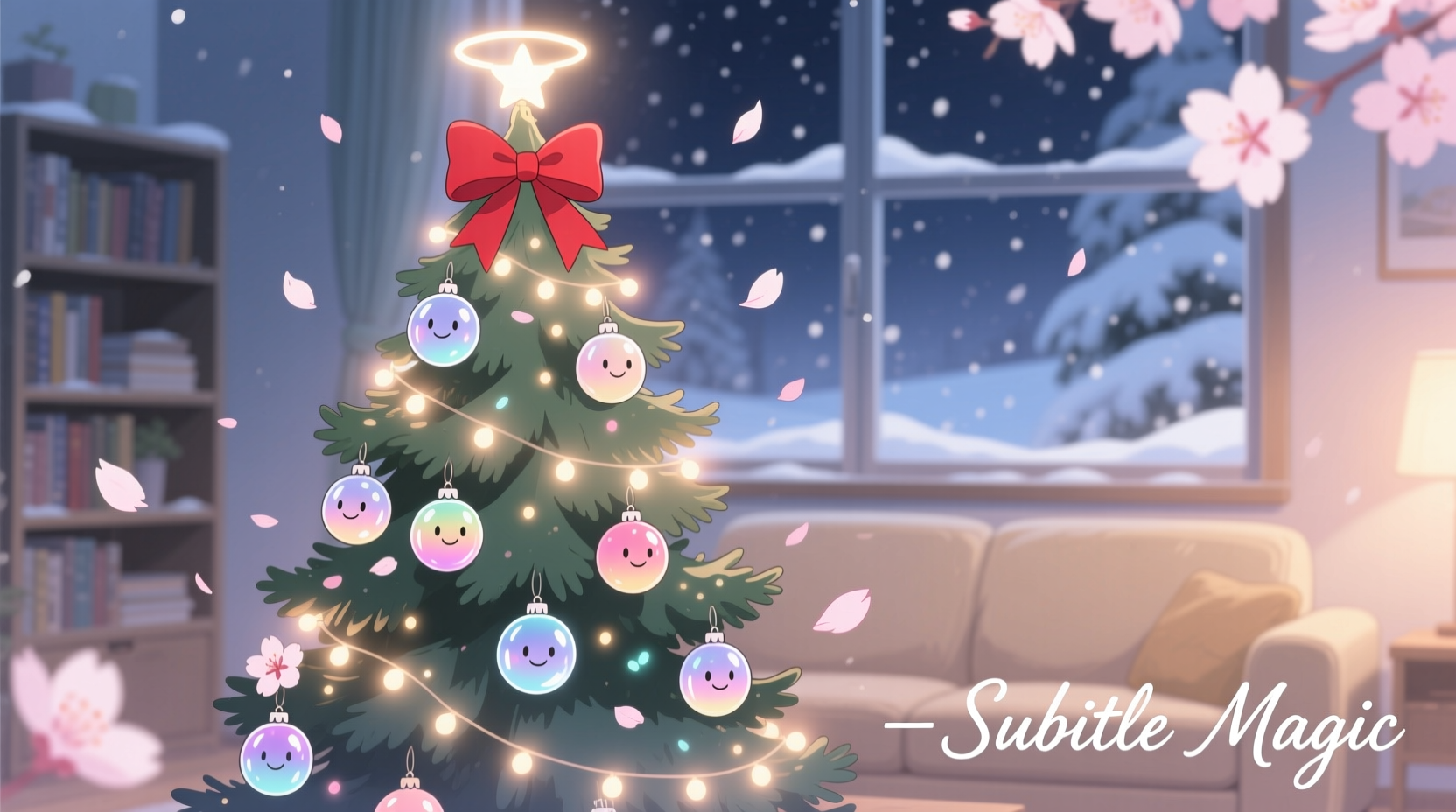
“Overboard” isn’t defined by quantity alone. It’s signaled by dissonance: when an element disrupts visual rhythm, contradicts seasonal tonality, or prioritizes fandom reference over cohesive mood. A single oversized Naruto head ornament amid delicate glass baubles jars the eye—not because it’s anime, but because its scale, material, and iconography refuse to converse with its surroundings. Conversely, a hand-painted ceramic ornament featuring Studio Ghibli’s iconic soot sprites in matte charcoal gray, hung beside antique mercury-glass balls and dried eucalyptus, reads as intentional, grounded, and quietly evocative.
Subtlety works because it respects two truths: first, that Christmas decor carries deep sensory and emotional weight for many people; second, that meaningful fandom expression thrives on specificity—not generic branding. As interior stylist and cultural curator Lena Park observes:
“Fandom becomes design language when it’s translated—not transplanted. The difference between ‘anime-themed’ and ‘anime-informed’ is measured in intention, not inventory.” — Lena Park, Founder of *Hearth & Frame*, interior studio specializing in narrative-driven seasonal styling
This distinction is foundational. You’re not decorating *with* anime—you’re decorating *through* its visual grammar: its reverence for quiet moments, its love of soft light and weathered textures, its recurring motifs of resilience, memory, and gentle magic.
Five principles for tasteful integration
These aren’t rules to follow rigidly—but guardrails to guide instinct. Each principle addresses a common point of tension between festive tradition and anime sensibility.
- Color fidelity over literalness: Instead of using official character palettes (e.g., Sailor Moon’s bold reds and blues), borrow the temperature and saturation of anime’s most atmospheric scenes—think the hushed lavender-gray of a Kyoto winter morning in K-On!, or the warm ochre-and-cream tones of the bakery in Shirobako.
- Texture before iconography: Prioritize tactile qualities associated with beloved anime worlds—hand-stitched felt, brushed brass, frosted glass, raw linen ribbons—before reaching for character silhouettes.
- Narrative echo, not logo placement: Choose ornaments that evoke themes rather than trademarks: a tiny origami crane for hope and transformation (My Neighbor Totoro), a miniature steampunk gear wrapped in twine for curiosity and craft (Fullmetal Alchemist).
- Scale discipline: No ornament should dominate more than 10% of the visual field it occupies. If it draws attention away from the branch structure or neighboring elements, it’s too large—or too loud.
- Light logic: Anime lighting is rarely harsh or uniform. Mimic its depth: use warm-white fairy lights (not cool white), cluster them loosely along inner branches, and avoid outlining the tree’s perimeter—a technique that reads as commercial, not cinematic.
A curated selection: 7 understated anime-inspired ornaments (and how to place them)
These aren’t mass-produced items you’ll find in bulk at convention booths—they’re either handmade, artisan-crafted, or thoughtfully repurposed objects that carry anime resonance without explicit branding. Placement strategy is key: each serves a specific role in the tree’s layered composition.
| Ornament | Material & Craft | Anime Resonance | Placement Strategy |
|---|---|---|---|
| Hand-thrown ceramic “spirit lantern” | Matte-glazed stoneware, unglazed base, hollow interior for tea light | Echoes the paper lanterns of Princess Mononoke and Spirited Away; embodies quiet reverence and liminal space | Hang low on inner branches near trunk—creates soft, upward-facing glow; never in direct line of sight from entryway |
| Felted wool “soot sprite” | Hand-felted black merino wool, subtle charcoal stitching, no facial features | Abstracts Totoro’s soot sprites into pure form—symbolizing innocence, quiet presence, and unseen helpers | Nestle three to five among mid-level branches, partially obscured by pine needles; they should feel discovered, not displayed |
| Brass “train token” | Brushed brass disc (1.5cm), etched with minimalist mountain silhouette and single cherry blossom | References the iconic train scene in 5 Centimeters Per Second—a motif of distance, memory, and gentle longing | Thread onto thin copper wire and tuck into outer foliage near top third; catch light only when viewer moves |
| Linen-wrapped “book charm” | Vintage-style book shape cut from reclaimed wood, wrapped in undyed linen, stamped with faint ink “Chapter 3” | Evokes the tactile love of stories in Honey and Clover and Bakuman—celebrating narrative as object, not just plot | Hang vertically on lower branches, nestled beside real pinecones; suggests a story resting among nature |
| Smoked-glass “mirror orb” | Small spherical orb with subtle silver mirroring on one hemisphere, matte black on the other | Reflects duality in Death Note and Neon Genesis Evangelion—but abstracted into light-play, not thematic confrontation | Place where light hits at an angle; let it catch reflections of other ornaments, not faces or walls |
| Dried persimmon slice “kaki charm” | Naturally dehydrated persimmon, sealed with food-safe beeswax, strung with silk thread | Rooted in Japanese winter tradition and featured in Chihayafuru and March Comes in Like a Lion as symbol of patience and seasonal change | Cluster three to four on a single branch tip—creates organic, edible-texture punctuation |
| Embroidered “wind chime” | Tiny brass ring with three hand-embroidered silk threads (indigo, moss, parchment), each ending in a single seed bead | Translates the soundscapes of Your Name and The Girl Who Leapt Through Time into silent, kinetic suggestion | Hang high, near tree apex, where air currents move naturally—designed to sway imperceptibly |
Step-by-step: Building your tree in three intentional phases
Resist the urge to hang everything at once. A layered approach ensures balance, prevents visual fatigue, and honors the meditative quality central to both holiday tradition and anime storytelling.
- Phase 1: Anchor & Atmosphere (Day 1)
Start with structural elements only. String warm-white fairy lights first—working from the trunk outward, weaving them deep into the interior branches. Then add your largest textural elements: dried eucalyptus garlands, bundles of cinnamon sticks tied with jute, and the ceramic spirit lanterns. Let these sit overnight. Observe how light pools and shadows fall. Adjust spacing—not for symmetry, but for rhythm. - Phase 2: Narrative Layering (Day 2)
Add ornaments that carry thematic weight: the soot sprites, train tokens, and book charms. Place them with intention—not evenly spaced, but clustered where meaning accumulates (e.g., three soot sprites near the lantern; two train tokens flanking a bare branch suggesting a rail line). Step back every 5–7 placements. Ask: Does this group tell a micro-story? Does it invite pause? - Phase 3: Whisper Details (Day 3)
Introduce the smallest, most delicate elements: persimmon slices, mirror orbs, wind chimes. These are punctuation marks—not sentences. Hang them singly or in pairs where the eye naturally rests after scanning larger forms. Avoid placing any within 12 inches of another “whisper detail.” Their power lies in scarcity and surprise.
Real-world example: Maya’s Kyoto-inspired tree in Portland, OR
Maya Tanaka, a Japanese-American educator and longtime Mushishi fan, faced skepticism from her traditionalist mother when she proposed incorporating anime elements into their family tree. Rather than arguing, Maya built a prototype on a 3-foot tabletop tree using only materials found at local craft and botanical shops: hand-dyed indigo cotton ribbon, foraged cedar sprigs, smoked-glass beads, and ceramic mushrooms glazed in forest-floor greens.
She presented it not as “anime decor,” but as “a tree that feels like walking through the mountains near Koyasan in late December—the stillness, the mist, the sense that something ancient and kind is watching.” Her mother paused, then said, “It smells like home. And it feels… respectful.” That tree became the foundation for their full-height living room tree, now adorned with subtle references to Mushishi’s core themes: interconnectedness, quiet observation, and the sacredness of ordinary moments. No character art appears—only textures, temperatures, and silences that resonate with the series’ soul.
What to avoid: A concise Do/Don’t checklist
- Use matte, natural, or aged finishes—not glossy plastic or metallic foil
- Limit character-based ornaments to zero or one, placed discreetly on lower branches
- Match ornament weight to branch thickness (heavy ceramics only on sturdy lower limbs)
- Test color harmony by photographing a small grouping against green paper in natural light
- Let 30% of your tree remain ornament-free—negative space is where subtlety breathes
- Use licensed merchandise unless it’s vintage, worn, or materially transformed (e.g., repainted, rewrapped)
- Cluster all anime elements on one side—balance is non-negotiable
- Choose ornaments with speech bubbles, action poses, or exaggerated expressions
- Hang anything with LED screens, moving parts, or battery compartments
- Force a theme—let resonance emerge organically from your existing aesthetic preferences
FAQ: Addressing common concerns
Can I incorporate anime without knowing Japanese aesthetics?
Absolutely—and you shouldn’t try to replicate them. Focus instead on universal qualities present across beloved anime: reverence for small details, comfort in quietude, celebration of handmade imperfection, and deep respect for seasonal shifts. Your personal connection to a show’s emotional core matters far more than technical accuracy.
What if my family finds it “too niche” or “inappropriate”?
Reframe the conversation. Instead of presenting it as “anime decor,” describe the feelings you want the tree to evoke: “I want it to feel like the calm before snowfall,” or “I want it to hold the same warmth as sharing hot cocoa after coming in from the cold”—both common anime moods. Invite collaboration: “Which of these textures feels most like home to you?” Shared sensory language builds bridges faster than fandom labels.
Are there anime studios whose visual language adapts especially well to Christmas?
Studio Ghibli (especially My Neighbor Totoro, Howl’s Moving Castle, and The Tale of the Princess Kaguya) offers rich winter palettes and nature-infused symbolism. Makoto Shinkai’s films (Your Name, Weathering With You) provide masterclasses in light diffusion and atmospheric color grading. Even older works like Grave of the Fireflies offer profound, restrained beauty in their depiction of domestic warmth during hardship—resonant with Christmas’s deeper themes of hope and resilience.
Conclusion: Where fandom meets reverence
Your Christmas tree doesn’t need to be a museum exhibit of your favorite shows. It needs to be a reflection of how those stories live in your hands, your heart, and your home—not as spectacle, but as sensibility. Subtlety isn’t compromise; it’s distillation. It’s choosing the weight of a felted soot sprite over the flash of a PVC figurine. It’s trusting that someone who knows Kiki’s Delivery Service will recognize the quiet courage in a single brass train token nestled among pine boughs—and someone who doesn’t will simply feel the warmth of its craftsmanship and intent.
This season, build slowly. Hang deliberately. Leave space. Let your tree breathe, gather light, and hold silence as gracefully as any anime scene lingers on a character’s thoughtful gaze out a rain-streaked window. The most powerful statements aren’t shouted—they’re folded into the grain of the wood, caught in the curve of a ceramic glaze, whispered in the sway of a silk thread.




 浙公网安备
33010002000092号
浙公网安备
33010002000092号 浙B2-20120091-4
Comments
No comments yet. Why don't you start the discussion?