
Lighting transforms a Christmas centerpiece from decorative to evocative. But too often, well-intentioned illumination backfires: LED string lights cast sharp reflections on glass vases, battery-operated candles create hotspots that wash out textures, and spotlighted pinecones end up looking like stage actors under a harsh follow spot. Glare isn’t just aesthetically jarring—it flattens depth, obscures natural grain and color variation in wood, berries, and dried florals, and disrupts the quiet, contemplative mood central to many holiday gatherings. Subtlety isn’t minimalism; it’s intentionality. It means guiding the eye with gentle contrast, warming surfaces without overheating them, and honoring the material integrity of every element in your arrangement. This article distills field-tested techniques used by professional floral stylists, interior lighting consultants, and museum exhibit designers—applied specifically to tabletop holiday compositions.
Why glare undermines your centerpiece—and what “subtle” really means
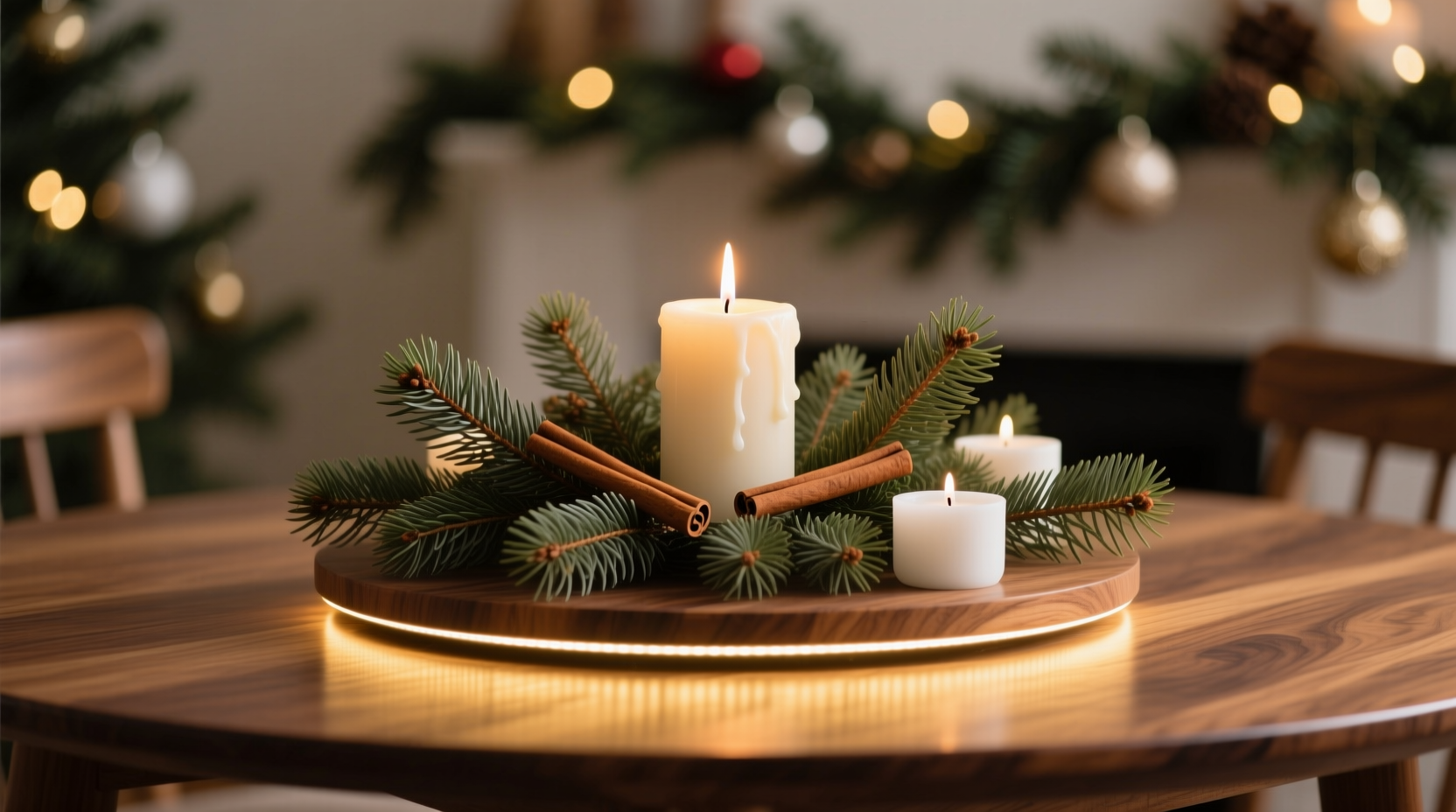
Glare occurs when light reflects directly off a surface into the viewer’s eye. On a centerpiece, this commonly happens on glazed ceramic bases, polished brass candle holders, lacquered wooden trays, or even the waxy cuticle of holly leaves. The result is visual noise: a bright, uninformative patch that competes with texture, shape, and color. More insidiously, glare triggers pupil constriction, reducing overall visual acuity and making surrounding details appear duller by comparison.
“Subtle lighting” is not low lighting. It’s controlled lighting—light that reveals rather than conceals. It emphasizes contour (the curve of a cinnamon stick), suggests translucency (the delicate veins in a magnolia leaf), and deepens warmth (amber tones in dried orange slices) without washing them out. Subtlety relies on three interlocking principles: diffusion (softening light sources), direction (angling light to graze—not hit—surfaces), and color temperature (using 2200K–2700K for authentic candle-like warmth). When executed well, it feels instinctive—like the glow from embers in a hearth, not the buzz of an overhead fixture.
Five proven techniques to eliminate glare while enhancing dimension
1. Diffuse before you direct: Layer your light sources
Never place a bare bulb or LED chip near reflective elements. Instead, build a diffusion stack: light source → diffuser → directional modifier. Start with warm-white micro-LEDs (not cool white—they introduce clinical glare). Wrap them loosely in matte-white silk organza (not polyester, which can shimmer) or layer behind frosted acrylic tubing. Then, position the diffused bundle so light grazes—not strikes—the centerpiece at a 15°–30° angle. This low-angle “raking light” accentuates texture while minimizing reflection on glossy surfaces. For tabletop use, secure the diffused strand inside a shallow, matte-black ceramic dish placed just outside the centerpiece’s footprint—its rim blocks stray light while its dark interior absorbs spill.
2. Use reflected light—not direct light—as your primary source
Mount a small, warm-toned LED puck light (2700K, 50–80 lumens) on the underside of the shelf or mantel *above* your centerpiece. Aim it not at the arrangement, but at a matte-white or pale-cream wall or ceiling panel positioned 12–18 inches behind it. The light bounces softly forward, wrapping around branches and candles with zero specular highlights. This mimics how natural light enters a room through a north-facing window—diffuse, consistent, and inherently shadow-softening. Stylist Maya Rostova, who designs centerpieces for The New York Times’ holiday features, confirms: “I’ve never had a client complain about glare when I use bounce lighting. It’s forgiving, dimensional, and makes greenery look alive—not lit up.”
“The most elegant lighting doesn’t announce itself—it simply makes everything else look better.” — Lena Choi, Lighting Designer, Studio Lumina Collective
3. Embrace “negative space lighting”
Instead of illuminating the centerpiece itself, light the space *around* it. Place two identical, dimmable warm-white LED tea lights (battery-operated, flame-flicker mode off) in clear glass votives—position one 8 inches to the left rear, one 8 inches to the right rear of the arrangement. Keep their flames at table height or slightly lower. Their glow creates a luminous halo that lifts the centerpiece visually without touching its surfaces. Because the light originates from outside the composition’s perimeter, it casts soft, open shadows that define form without creating hotspots. Crucially, this technique works equally well on mirrored trays, marble slabs, and high-gloss lacquer surfaces—none of which reflect the light sources themselves.
4. Choose materials that absorb, not reflect, light
Your lighting success hinges as much on material selection as placement. Replace glossy brass rings with antiqued copper or brushed nickel (matte finishes scatter light). Swap clear glass hurricanes for ribbed or sandblasted glass—micro-texture diffuses light at the surface level. If using candles, select beeswax over paraffin: its naturally cloudy, uneven surface scatters flame light gently, whereas paraffin’s smooth finish acts like a tiny mirror. Even botanical choices matter: opt for matte-textured eucalyptus over glossy salal, dried lavender over shiny hypericum berries. These aren’t compromises—they’re strategic enhancements that reduce glare at the source.
5. Control intensity with analog dimming—not digital
Digital PWM (pulse-width modulation) dimmers—common in budget LED strings—cause rapid on/off cycling invisible to the eye but perceptible as flicker and harshness in reflections. Analog dimming (via variable resistors or magnetic transformers) delivers smooth, continuous current reduction. For tabletop use, this means choosing battery-powered LED strings with physical rotary dials (not app-controlled ones) or using a simple $12 analog LED dimmer module wired inline to a USB-powered light strip. Set brightness so the light enhances—not competes with—the ambient room light. A useful benchmark: if the centerpiece looks brighter than the faces of guests seated nearby, it’s too intense.
A real-world example: The walnut tray centerpiece in Portland
In December 2023, Portland-based interior stylist Aris Thorne was commissioned to create a centerpiece for a historic Craftsman dining room. The brief specified a live-edge walnut tray, white dried pampas grass, preserved eucalyptus, and vintage mercury-glass votives—materials notoriously prone to glare. Initial tests with standard fairy lights created blinding reflections on the glass and washed-out grain in the wood. Thorne’s solution combined three techniques: First, she embedded a 24-inch warm-white LED strip inside a custom-cut channel beneath the tray’s lip, covered with frosted silicone diffuser tape. Second, she mounted two 3-watt warm-white LEDs on the underside of the built-in china cabinet above, angled toward a matte-eggshell-painted panel mounted on the wall behind the table. Third, she replaced the mercury-glass votives with hand-blown, ribbed glass cylinders filled with unscented soy wax candles. The result? A centerpiece where light seemed to emanate *from within* the wood grain and *through* the pampas plumes—no hotspots, no reflections, and guests consistently remarked on the “warmth” and “depth” of the arrangement, not the lighting itself.
Do’s and Don’ts: A quick-reference table
| Action | Do | Don’t |
|---|---|---|
| Diffusion | Use matte silk organza, frosted acrylic, or handmade rice paper sleeves | Use plastic wrap, glossy gift wrap, or clear cellophane |
| Placement | Position lights 12–18 inches away, angled at 15°–30° to graze surfaces | Place lights directly above or within 4 inches of reflective elements |
| Color Temp | Stick to 2200K–2700K (candlelight range); avoid anything above 3000K | Use “daylight” (5000K+) or cool white (4000K) LEDs |
| Brightness Control | Use analog dimmers or physical dials; aim for 20–40 lumens per light point | Rely on smartphone apps or remote controls with digital PWM dimming |
| Material Choice | Select ribbed glass, brushed metal, matte ceramics, and beeswax candles | Use mirrored surfaces, high-gloss lacquer, polished chrome, or paraffin candles |
Step-by-step: Setting up glare-free lighting in under 20 minutes
- Assess your surface materials: Run your fingers over every element—glass, metal, wood, botanicals. Note which feel smooth, glossy, or highly reflective. Flag these for special handling.
- Select your light source: Choose warm-white (2700K), low-lumen LEDs—preferably with analog dimming. Avoid any labeled “cool white,” “bright white,” or “daylight.”
- Build your diffuser: Cut a 4-inch square of matte-white silk organza. Fold it twice into a smaller square. Secure it over the LED with a rubber band—tight enough to hold, loose enough to allow heat dissipation.
- Position for grazing light: Place the diffused light source 12 inches from the centerpiece’s outer edge. Angle it so light skims across the tallest element (e.g., a pinecone or candle) at roughly 25°—not hitting it head-on.
- Add bounce light: Mount a second warm LED (same specs) on the underside of your shelf or mantel, aimed at a matte wall or ceiling panel 15 inches behind the arrangement.
- Test and refine: Turn off all other lights. Observe from three seating positions: directly opposite, left side, right side. Adjust angles until no surface shows a bright, unbroken highlight. Dim further if needed—subtlety wins over brightness.
FAQ
Can I use fairy lights safely with glass ornaments?
Yes—but only if they’re fully diffused and positioned *outside* the ornament’s line of sight. Wrap the strand in organza, then tuck it beneath a moss base or inside a woven basket placed beside—not under—the centerpiece. Never thread bare fairy lights through glass ornaments; their pinpoint brightness will reflect sharply.
What’s the safest way to light candles near dried botanicals?
Avoid open flames entirely near dried materials. Instead, use high-fidelity LED pillar candles with built-in timers and realistic flicker algorithms. Place them inside ribbed or sandblasted glass vessels to diffuse the light source. Ensure the LED unit has a certified UL/ETL safety rating and uses low-voltage DC power (not mains voltage).
Will dimming my lights affect battery life significantly?
Yes—dimming analog LEDs extends battery life considerably. At 50% brightness, most quality battery-operated LED strings last 2–3× longer than at full output. Digital-dimming strings often draw near-full power even when dimmed, so prioritize analog control for efficiency and safety.
Conclusion: Light as quiet intention
Subtle lighting for a Christmas centerpiece isn’t about hiding the light—it’s about refining its purpose. It asks you to slow down, observe how light interacts with each surface, and intervene with precision rather than power. When you replace glare with gentle gradation, you don’t just illuminate a table—you invite presence. You make space for conversation instead of distraction, for warmth instead of dazzle, for reverence instead of spectacle. The techniques here require no specialized tools, no electrician, and no large investment—just attention, a few thoughtful materials, and willingness to test and adjust. Your centerpiece already holds meaning: the scent of pine, the weight of tradition, the quiet joy of gathering. Let your lighting honor that—not compete with it.




 浙公网安备
33010002000092号
浙公网安备
33010002000092号 浙B2-20120091-4
Comments
No comments yet. Why don't you start the discussion?