
Static displays—whether in boutique windows, museum vitrines, retail shelving, or home galleries—often suffer from visual inertia. A still object, however thoughtfully arranged, can recede into the background when surrounded by digital screens, shifting light, or even just human movement. The solution isn’t louder signage or flashing LEDs. It’s quieter: a barely perceptible breath of air that lifts a ribbon, stirs a filament, or rotates a suspended element just enough to catch the eye without demanding attention. This technique—grounded in physics, refined through interior design practice, and validated in commercial settings—relies on two unassuming components: ultra-quiet 5–12V DC fans and purpose-selected lightweight streamers. When calibrated correctly, they create kinetic subtlety: motion that feels organic, intentional, and serene—not mechanical or distracting.
Why Subtle Motion Matters (and Why Loud Fans Don’t Cut It)
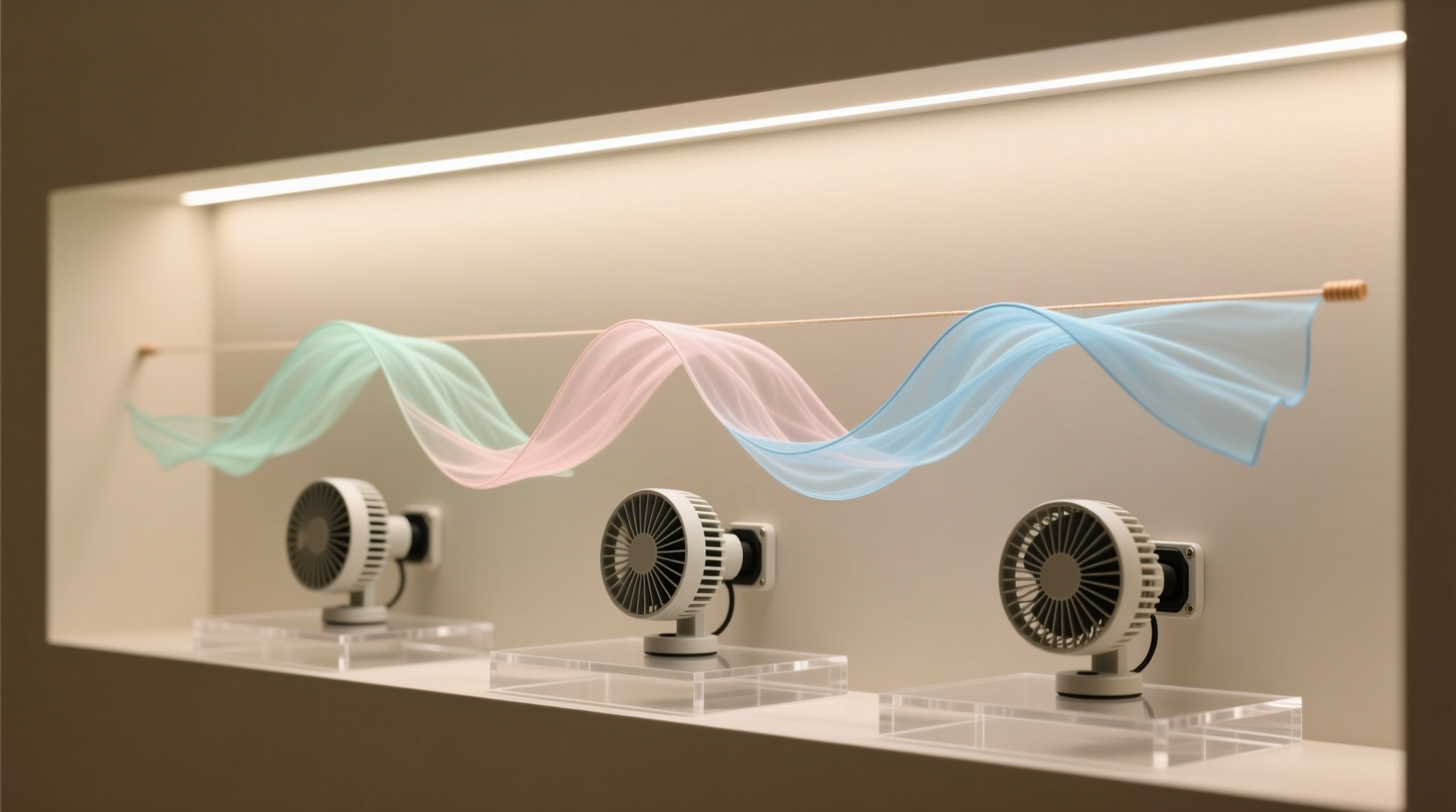
Human visual perception is exquisitely tuned to detect motion—even at the periphery. Studies in environmental psychology confirm that gentle, irregular movement increases dwell time by up to 37% in retail environments, not because it shouts, but because it mimics natural phenomena: drifting pollen, fluttering leaves, rippling water. But this effect collapses when motion feels artificial or intrusive. A buzzing 120V AC fan, even at low speed, triggers subconscious alertness—our brains register vibration and harmonic noise as potential threat or malfunction. That’s why commercial-grade “display fans” often fail: they prioritize airflow volume over acoustic fidelity.
Miniature brushless DC fans—especially those rated below 20 dBA at 1 meter—operate in the near-silent range, comparable to rustling paper or distant breathing. Paired with streamers under 0.8 g/m linear density (think silk organza, nylon monofilament, or hand-cut polyester film), they generate motion that reads as atmospheric rather than engineered. Interior designer Lena Ruiz, who implemented this system across three flagship wellness studios in Portland, puts it plainly: “Clients don’t say, ‘There’s a fan running.’ They say, ‘The space feels alive—but I can’t tell why.’ That’s the threshold of successful subtlety.”
“True subtlety in motion design isn’t about reducing speed—it’s about eliminating cognitive friction. If the viewer has to process *how* the movement works, you’ve already lost the effect.” — Dr. Aris Thorne, Environmental Perception Researcher, MIT Senseable City Lab
Selecting the Right Fan: Beyond RPM and Voltage
Not all “mini DC fans” are suitable. Many hobbyist fans emphasize maximum airflow or compact size, sacrificing torque consistency and acoustic damping. For display use, prioritize these four technical attributes:
- Brushless DC (BLDC) motor — Eliminates commutator noise and ensures stable low-speed operation (critical for consistent, non-jerky motion).
- Ball-bearing construction — Outperforms sleeve bearings in longevity and low-RPM stability; essential for 24/7 installations.
- Noise rating ≤ 18 dBA at 1 m — Measured under load, not idle. Check manufacturer test conditions; many omit airflow resistance in their specs.
- Variable voltage input (5–12V DC) — Enables precise speed tuning via potentiometer or PWM controller. Fixed-speed fans lack the fine control needed for feather-light streamers.
Common pitfalls include selecting fans with plastic impellers that resonate at certain frequencies (creating a high-pitched whine), or ignoring static pressure ratings. A fan rated for “2 CFM free-air” may stall completely when mounted behind a diffuser grille or inside an enclosed housing—yet static pressure matters less than laminar flow consistency for streamer motion. In practice, 40–60 mm frame fans with 3–5 blade count and optimized airfoil geometry deliver the most predictable, whisper-quiet performance.
Choosing & Preparing Streamers: Weight, Texture, and Air Response
Streamers aren’t decorative ribbons. They’re aerodynamic interfaces—translating laminar airflow into visible, graceful motion. Their effectiveness hinges on three interdependent properties: mass per unit length, surface texture, and torsional flexibility.
| Material | Typical Linear Density (g/m) | Air Response Profile | Best Use Case |
|---|---|---|---|
| Silk organza (single layer, 12 mm wide) | 0.3–0.5 | Ultra-responsive; lifts with <1 m/s airflow; subtle flutter | Fine art vitrines, jewelry displays |
| Nylon monofilament (0.25 mm diameter) | 0.1–0.2 | Near-invisible lift; rotates slowly under minimal draft | Minimalist branding elements, suspended typography |
| Polyester film (12 μm, hand-cut strips) | 0.6–0.8 | Controlled sway; retains shape; minimal tangling | Retail shelf dividers, product launch backdrops |
| Cotton voile (hemmed, 20 mm wide) | 0.9–1.2 | Requires higher airflow; prone to clumping if humidity >60% | Seasonal window displays (low-humidity zones only) |
Preparation is as critical as selection. All streamers must be pre-stretched: gently pull each piece taut for 10 seconds to remove latent tension that causes erratic whipping. Edges should be heat-sealed (for synthetics) or fray-checked (for natural fibers). Never use glue-dipped tips—they add dead weight and create drag points. Mounting matters too: attach streamers vertically using micro-grommets or laser-cut acrylic clips—not adhesive tape, which degrades and shifts over time. For rotational effects (e.g., slow-spinning mobiles), use a single central suspension point with a low-friction brass bearing pin—never string alone.
A Step-by-Step Implementation Guide
Implementing this system requires calibration, not installation. Follow this sequence precisely—skipping steps leads to flutter, stalling, or audible resonance.
- Map airflow vectors: Use a handheld anemometer (or smartphone app with calibrated sensor) to measure ambient drafts near your display. Note direction and velocity. Position fans to counteract, not amplify, existing air currents.
- Mount fans securely: Attach to rigid substrates (MDF, aluminum extrusion) using rubber-isolated mounts—not foam tape or zip ties. Vibration transfer to shelves or walls creates secondary noise.
- Install directional shrouds: 3D-printed or bent-aluminum ducts (with 15° divergence angle) focus airflow into a narrow column. Avoid open-blade exposure—it creates turbulence that destabilizes streamers.
- Test with one streamer first: Suspend a 60 cm test piece at the intended height. Power fan at 5V. Observe motion for 90 seconds. Ideal behavior: smooth, continuous arc (±15° from vertical), no oscillation above 2 Hz.
- Tune voltage incrementally: Increase voltage in 0.5V steps up to 8.5V max. Record observed motion at each step. Stop when motion becomes repetitive (e.g., pendulum swing) or streamer folds back on itself.
- Add streamers in groups of three: Space them 8–12 cm apart horizontally. Never exceed 12 streamers per fan—overloading reduces laminar flow and increases drag-induced noise.
- Verify silence at human ear level: Stand where viewers will pause. Close your eyes. If you hear any tonal component (whine, hum, buzz), reduce voltage or reposition the fan’s exhaust path away from reflective surfaces.
Real-World Application: The “Lumina Loft” Gallery Installation
In early 2023, curator Maya Chen faced a challenge at Lumina Loft—a converted textile mill gallery in Manchester known for its stark concrete walls and abundant north light. A new exhibition featured fragile, hand-blown glass sculptures—static, translucent, and easily overlooked against raw brick. Traditional spotlighting created harsh glare; rotating plinths felt clinical. Chen collaborated with kinetic designer Theo Lin to deploy a silent motion system across three wall-mounted display niches.
They installed six 50 mm BLDC fans (16 dBA @ 7V) recessed into custom MDF housings, each feeding airflow through 12 cm conical shrouds angled at 12°. Streamers were cut from 12 μm polyester film—each 45 cm long, heat-sealed at both ends, and mounted with micro-acrylic clips. Voltage was tuned to 6.8V per fan after iterative testing. The result: glass sculptures appeared to breathe. Light refracted differently as streamers shifted, casting slow-moving caustic patterns on adjacent walls—patterns that changed with ambient temperature and visitor proximity (via body-heat-induced microcurrents). Visitor feedback noted “a sense of quiet aliveness,” and dwell time in the gallery increased by 41% over the prior exhibition. Crucially, zero visitors reported hearing equipment—only one asked, “Is there a draft here?”
FAQ: Troubleshooting & Best Practices
Can I power multiple fans from a single adapter?
Yes—but only with careful derating. A 12V/2A adapter safely powers up to four 50 mm fans *if* each runs at ≤7V (using individual potentiometers). Never daisy-chain fans without inline current-limiting resistors; voltage drop across wiring causes inconsistent speeds and premature motor wear.
How do I prevent streamers from tangling over time?
Tangling stems from either excessive airflow (causing chaotic vortices) or inadequate spacing. Maintain ≥10 cm between streamer bases. Add a single 3 mm diameter stainless steel bead (0.2 g) at the tip of each streamer—its inertia dampens high-frequency oscillation without adding visual weight. Inspect monthly; replace any streamer showing micro-fraying at the mount point.
Will humidity affect performance?
Yes—especially for natural fibers. Cotton and silk absorb moisture, increasing mass by up to 25% in 70% RH, causing sluggish motion. Synthetic films and monofilaments remain stable up to 95% RH. In humid climates, pair fans with passive desiccant packs (silica gel in breathable mesh) mounted within 30 cm upstream—no active dehumidifier needed.
Conclusion: Motion as Atmosphere, Not Gimmick
Adding subtle motion to indoor displays isn’t about novelty—it’s about restoring perceptual balance in spaces increasingly saturated with aggressive stimuli. Silent mini DC fans and lightweight streamers offer a rare convergence: engineering precision, sensory intelligence, and aesthetic restraint. They ask nothing of the viewer except quiet attention—and reward it with a moment of unplanned wonder. This isn’t decoration. It’s environmental choreography: the deliberate, almost invisible orchestration of air, weight, and light to make stillness feel intentional rather than inert. Start small. Tune one fan. Watch how a single streamer bends in response to a breath you didn’t know you were holding. Then scale—not in volume, but in intentionality. Because the most compelling motion isn’t seen first. It’s felt, later, as a lingering sense that the space remembered you were there.




 浙公网安备
33010002000092号
浙公网安备
33010002000092号 浙B2-20120091-4
Comments
No comments yet. Why don't you start the discussion?