
Feng Shui is not merely about interior layout or furniture placement—it extends meaningfully into the landscape. Trees, as living anchors of qi (vital energy), serve as dynamic conduits between earth and sky, season and spirit. When arranged intentionally according to classical Feng Shui principles—not as decorative afterthoughts but as energetic partners—they deepen seasonal resonance: supporting spring’s renewal, summer’s expansion, autumn’s release, and winter’s stillness. This alignment isn’t symbolic; it reflects observable ecological patterns that mirror internal human rhythms. A well-placed tree doesn’t just look harmonious—it breathes with the land, buffers wind, filters light, cools microclimates, and subtly directs the flow of chi across property lines. This article details how to select, position, prune, and steward a tree so its presence strengthens seasonal balance—not just aesthetically, but energetically and ecologically.
Understanding the Five Elements and Seasonal Correspondences
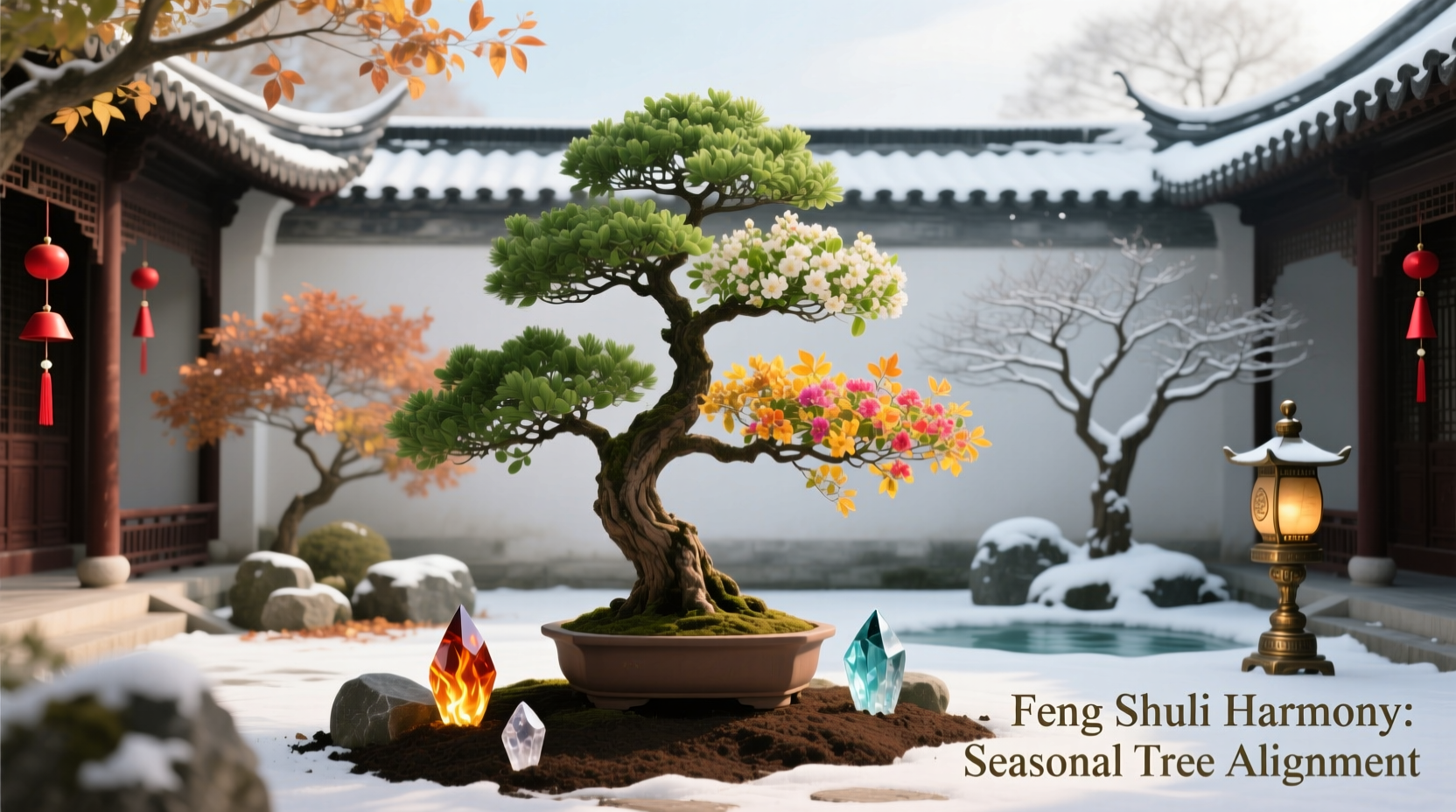
In Feng Shui, the Five Elements—Wood, Fire, Earth, Metal, and Water—are not static substances but interdependent phases of transformation. Each governs a season, direction, color, and energetic quality. Trees belong primarily to the Wood element, yet their expression shifts across seasons, interacting dynamically with the others. For example, a maple’s fiery red leaves in autumn embody the Fire element’s transformative release, while its deep roots draw on Earth and Water energies. Ignoring this fluidity leads to rigid, ineffective placements—like planting a vigorous, upward-growing willow (Wood) directly south (Fire sector), where its rapid growth may overstimulate an already yang-dominant area.
The seasonal cycle follows a generative (sheng) and controlling (ke) sequence: Wood feeds Fire (spring fuels summer’s intensity); Fire creates Earth (ash becomes soil); Earth bears Metal (minerals form in bedrock); Metal enriches Water (condensation, mineral springs); Water nourishes Wood (roots drink deeply). A tree arranged with awareness of these cycles becomes a living regulator—not fighting seasonal change, but participating in it.
Strategic Placement by Direction and Sector
Classical Feng Shui divides space using the Bagua map—a nine-section grid aligned with compass directions. Each section corresponds to a life area (e.g., Wealth, Health, Relationships) and a season. Trees influence these areas not through symbolism alone, but through tangible effects: shade temperature, wind deflection, visual framing, and root-zone moisture retention. Placement must therefore reconcile elemental affinity, directional energy, and functional impact.
| Direction | Season | Element | Recommended Tree Qualities | Avoid |
|---|---|---|---|---|
| East | Spring | Wood | Upright, fast-sprouting species (e.g., cherry, dogwood, young bamboo grove). Prioritize new growth, soft bark, rounded canopy. | Thorny, brittle, or invasive species (e.g., black locust, Russian olive). |
| Southeast | Late Spring | Wood | Graceful, spreading forms with layered foliage (e.g., redbud, Japanese maple). Supports abundance and flexibility. | Monocultural stands; trees that cast dense, unbroken shade year-round. |
| South | Summer | Fire | Flowering, sun-loving, medium-height trees with warm-toned blooms (e.g., crape myrtle, pomegranate, flame tree). Enhances recognition and visibility. | Tall evergreens blocking southern light; species prone to sudden dieback (e.g., Bradford pear). |
| North | Winter | Water | Evergreen conifers with strong vertical form and deep green needles (e.g., white pine, hemlock, yew). Stabilizes, protects, and conserves moisture. | Bare-branched deciduous trees that amplify cold winds; shallow-rooted species vulnerable to ice heave. |
| West & Northwest | Autumn | Metal | Structural, sculptural trees with clean lines, silver-gray bark, or golden fall color (e.g., ginkgo, birch, honey locust). Supports letting go and clarity. | Vigorous climbers or vines that obscure western windows at sunset; weak-wooded trees dropping heavy limbs. |
Note: The center (Earth) sector should remain open and unobstructed—no large trees here. Their roots would disrupt the grounding stability essential to this area. Instead, use low, spreading groundcovers or stone pathways.
Step-by-Step: Selecting and Planting with Seasonal Intent
- Define Your Primary Seasonal Goal: Is your priority spring vitality (East), summer warmth (South), autumn reflection (West), or winter resilience (North)? Let this guide species selection—not aesthetics alone.
- Assess Soil and Microclimate: Test drainage (dig a 12-inch hole, fill with water; if it drains in under 4 hours, drainage is good). Match tree tolerance: willow thrives in wet soil (Water affinity), while lavender oak prefers dry, sandy loam (Metal affinity).
- Choose Native or Adapted Species: Native trees carry local qi memory—they’re already tuned to regional weather cycles, pollinators, and soil chemistry. Examples: Eastern redbud (Cercis canadensis) for East/Southeast; American holly (Ilex opaca) for North; serviceberry (Amelanchier) for West.
- Time Planting by Seasonal Qi: Plant deciduous trees in late fall (after leaf drop but before hard freeze) or early spring (just before bud swell)—when Wood energy is gathering, not dispersing. Evergreens do best in early fall, allowing roots to establish before winter dormancy.
- Prepare the Hole Mindfully: Dig twice as wide as the root ball but no deeper. Loosen compacted sides. At the bottom, place a small mound of native soil mixed with composted leaf litter (Earth + Wood synergy). Position the tree so the root flare sits level with or slightly above grade—never buried.
- Water with Intention: After backfilling, water slowly and deeply—not just at the trunk, but in a ring matching the future drip line. As you water, visualize steady, nourishing Water energy flowing into the roots, supporting future Wood growth.
Mini Case Study: Restoring Balance in a Suburban Backyard
Maya, a landscape architect in Portland, Oregon, inherited a backyard dominated by a massive, aging silver maple planted dead-center in the northwest corner—directly opposing her home’s front door. By summer, its dense canopy blocked evening light; by autumn, brittle branches dropped onto gutters; by winter, exposed roots cracked her patio. Feng Shui assessment revealed two imbalances: first, the tree’s aggressive Wood energy overwhelmed the Metal sector (West/Northwest), disrupting clarity and decision-making; second, its central placement violated the Bagua’s center (Earth), scattering household stability.
Rather than remove it outright, Maya followed a phased seasonal approach. In late autumn (Metal season), she pruned 30% of the canopy—focusing on crossing, inward-growing, and weak-wooded limbs—to restore structural integrity and allow light penetration. She planted three dwarf Korean hornbeams (Carpinus coreana) in a gentle arc along the west fence—species chosen for their fine-textured, metallic-gray bark and compact, controllable form. In spring, she added a cluster of native osoberry (Oemleria cerasiformis) beneath them—small, early-blooming shrubs that support pollinators and signal spring’s arrival without competing for dominance. By the second autumn, wind flow improved, light returned, and the yard felt grounded—not because the maple vanished, but because its energy was now *in dialogue* with the seasonally attuned plantings around it.
Pruning, Care, and Seasonal Rituals
Pruning in Feng Shui is never merely horticultural—it’s energetic editing. Every cut redirects qi. Timing matters profoundly: pruning during Wood season (spring) encourages vigorous growth; pruning in Metal season (autumn) refines structure and releases excess. Avoid heavy pruning in midsummer (Fire peak), when plants are most vulnerable to stress and sap loss.
Seasonal care rituals deepen intentionality:
- Spring (East): Clean debris from base; apply light mulch of shredded bark (Wood feeding Earth); tie ribbons of green or teal silk to new branches as a blessing for growth.
- Summer (South): Ensure adequate water during heat waves; hang wind chimes made of copper or brass (Metal) near the tree to gently disperse stagnant Fire energy.
- Autumn (West): Collect fallen leaves mindfully—compost for next spring’s planting; leave some intact under the canopy to feed roots and insulate soil (Water + Earth synergy).
- Winter (North): Inspect for cracks, cavities, or pest entry points; wrap tender trunks with burlap (Earth material) if extreme cold threatens; avoid salt-laden de-icers near roots.
“Trees are the original acupuncturists of the land. Their roots needle the earth’s meridians; their crowns regulate the breath of the sky. To prune without reverence is to sever a vital artery.” — Dr. Li Wei, Professor of Traditional Chinese Landscape Medicine, Beijing Forestry University
Common Pitfalls and Energetic Corrections
Even well-intentioned placements can misfire. Here’s how to diagnose and adjust:
Three frequent errors and their remedies:
- The “One-Size-Fits-All” Oak: Planting a large, long-lived oak in every sector ignores directional nuance. An oak in the South may overheat the area; in the North, its broad canopy may block vital winter sun. Correction: Choose scale-appropriate species—dwarf fruit trees for Southeast, columnar evergreens for North, weeping forms for West.
- Ignoring Root Energy: Surface roots lifting walkways or invading foundations aren’t just physical hazards—they indicate Wood energy pushing chaotically, ungrounded by Earth or Water. Correction: Install permeable root barriers lined with gravel (Earth + Metal) and plant deep-rooted companion perennials (e.g., comfrey) to draw energy downward.
- Forgetting the “Empty Space” Principle: Overplanting—especially with fast-growing exotics—creates cluttered qi, stifling clarity and airflow. Correction: Apply the 30/40/30 rule: 30% canopy cover, 40% open space (lawn, patio, meadow), 30% understory (shrubs, groundcover). This mirrors natural forest edge ecology—and Feng Shui’s emphasis on balanced yin-yang flow.
FAQ
Can I use non-native trees effectively in Feng Shui landscaping?
Yes—if they’re ecologically adapted to your region and serve a clear seasonal purpose. A Japanese maple in the Southeast corner of a Seattle garden works because it thrives in cool, moist summers and offers delicate spring foliage and fiery autumn color—aligning with both Wood and Fire seasons. However, planting a desert mesquite in a humid coastal zone violates elemental logic: its drought-adapted nature conflicts with abundant Water energy, causing chronic stress and weak qi. Prioritize function and resilience over origin.
What if my property has limited space—like a city courtyard or balcony?
Scale down, not out. Use container-grown dwarf varieties: dwarf citrus (Fire/South), bonsai juniper (Water/North), or espaliered apple (Wood/East). Even a single potted tree, placed deliberately on a stand at waist height (Earth level), activates seasonal qi. Orient the pot so its strongest branch faces the corresponding direction, and refresh soil annually with composted leaves (Wood + Earth).
How does tree arrangement affect indoor Feng Shui?
Directly. A healthy, well-placed tree outside acts as a qi filter: buffering harsh winds (protecting Health sector), softening sharp angles (reducing Sha Qi), and framing views that enter windows (influencing the Mind and Career guas). Conversely, a dying or poorly positioned tree transmits stagnant or aggressive energy indoors—often manifesting as fatigue, irritability, or recurring minor illnesses. Always assess exterior trees when diagnosing interior imbalances.
Conclusion
A tree arranged with Feng Shui awareness for seasonal harmony is more than a plant—it’s a living calendar, a breathing compass, and a quiet teacher of rhythm. It reminds us that growth is not constant, but cyclical; that strength lies in flexibility, not rigidity; that rest is not absence, but preparation. You don’t need vast acreage or decades of study to begin. Start with one observation: watch how light moves across your yard this week. Notice which corner warms first in morning sun, where shadows pool longest at dusk, where wind hums through branches or falls silent. Then choose one action—prune a crossing limb in autumn, plant a native shrub in the west, mulch mindfully in spring. These small, seasonally grounded choices accumulate into profound shifts: cooler summers, gentler winters, clearer thinking, deeper rest. Your landscape is already speaking. Listen—not with your ears alone, but with your feet on the soil, your eyes on the canopy, and your breath syncing with the turning year.




 浙公网安备
33010002000092号
浙公网安备
33010002000092号 浙B2-20120091-4
Comments
No comments yet. Why don't you start the discussion?