
Investing in the stock market requires more than hope or intuition. To identify stocks with strong upside potential, investors must analyze a combination of financial health, market positioning, growth trends, and valuation signals. While no method guarantees success, using time-tested indicators and strategic frameworks significantly improves the odds of making informed decisions. This guide breaks down the essential tools and approaches for evaluating whether a stock is poised for growth.
1. Understand the Company’s Financial Health
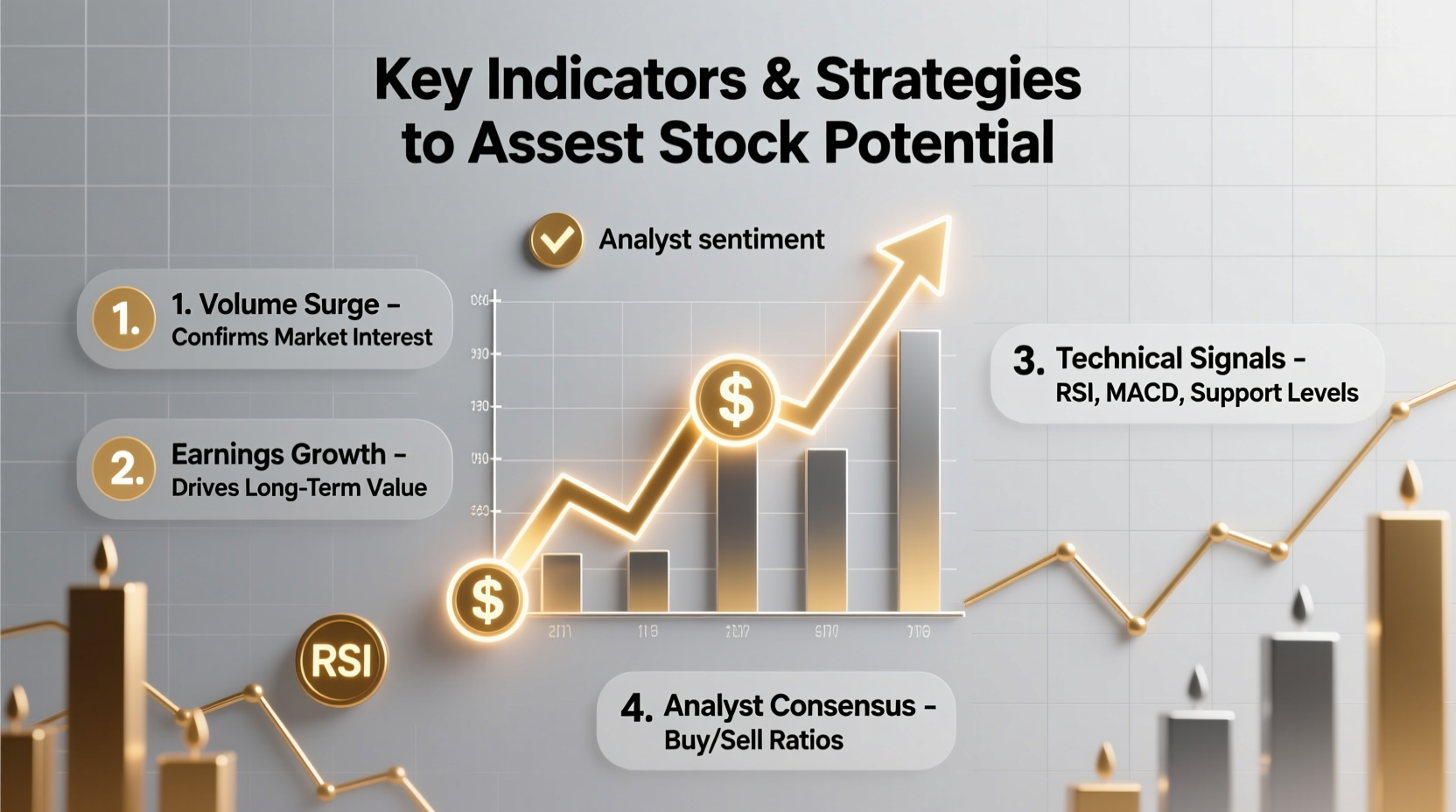
A company's financial statements provide the foundation for any sound investment decision. These documents reveal profitability, debt levels, cash flow stability, and operational efficiency. Key reports include the income statement, balance sheet, and cash flow statement—all accessible through quarterly earnings releases and annual filings (10-K and 10-Q).
Start by examining revenue growth over the past three to five years. Consistent year-over-year increases suggest market demand and effective management. Equally important is net income: growing profits indicate scalability and pricing power. However, be cautious if earnings rise while free cash flow stagnates—this may signal aggressive accounting rather than real business strength.
Key Metrics to Evaluate Financial Strength
| Metric | What It Measures | Healthy Benchmark |
|---|---|---|
| Debt-to-Equity Ratio | Leverage risk | Below 1.0 (varies by sector) |
| Current Ratio | Short-term liquidity | Above 1.5 |
| Return on Equity (ROE) | Profitability relative to shareholder equity | 15% or higher |
| Operating Margin | Pricing power and cost control | Trending upward |
2. Analyze Valuation Using Fundamental Ratios
Even a great company can be a poor investment if bought at too high a price. Valuation ratios help determine whether a stock is underpriced, fairly valued, or overvalued relative to its fundamentals.
The Price-to-Earnings (P/E) ratio remains one of the most widely used metrics. It compares a company’s share price to its earnings per share (EPS). A lower P/E might suggest undervaluation, but context matters: high-growth tech firms often carry elevated P/Es due to future earnings expectations.
For companies with limited earnings, consider the Price-to-Sales (P/S) ratio. It’s particularly useful when analyzing early-stage growth stocks. Meanwhile, the Price-to-Book (P/B) ratio helps assess asset-heavy businesses like banks or manufacturers.
“Price is what you pay. Value is what you get.” — Warren Buffett
To gain deeper insight, use the PEG ratio (P/E divided by earnings growth rate). A PEG below 1.0 often indicates that a stock is undervalued relative to its growth trajectory.
3. Assess Growth Potential and Competitive Advantage
A company’s ability to grow sustainably depends on both internal innovation and external market dynamics. Look for evidence of durable competitive advantages—often referred to as an \"economic moat.\" These include brand strength (e.g., Apple), network effects (e.g., Meta), cost leadership (e.g., Walmart), or regulatory protection (e.g., utilities).
Market position also plays a crucial role. Is the company gaining market share? Are competitors struggling to replicate its offerings? Review industry reports and analyst commentary to gauge long-term demand trends. For example, renewable energy, AI infrastructure, and healthcare innovation are sectors projected to expand significantly over the next decade.
Additionally, examine management quality. Strong leadership executes strategy effectively, allocates capital wisely, and communicates transparently with shareholders. CEO track records and insider ownership can offer clues about alignment with investor interests.
Mini Case Study: Tesla’s Rise from 2019–2021
In late 2019, Tesla traded around $45 per share. Skeptics questioned its profitability and production capacity. However, forward-looking investors noted several bullish signals: accelerating vehicle deliveries, expanding Gigafactories, growing software revenue (Autopilot), and inclusion in the S&P 500. By mid-2021, the stock surpassed $800. Those who assessed Tesla’s technological edge, first-mover advantage in EVs, and Elon Musk’s execution capability recognized its upside before mainstream consensus caught up.
4. Use Technical Analysis to Time Entry Points
Fundamentals tell you *what* to buy; technical analysis helps decide *when*. While not predictive, chart patterns and momentum indicators can highlight shifts in investor sentiment and emerging trends.
Track key moving averages, such as the 50-day and 200-day simple moving averages (SMA). When the 50-day crosses above the 200-day—a \"golden cross\"—it often signals the start of an uptrend. Conversely, a \"death cross\" may warn of bearish momentum.
Relative Strength Index (RSI) measures whether a stock is overbought (above 70) or oversold (below 30). An RSI dip below 30 during a broader uptrend could present a buying opportunity, especially if supported by positive fundamentals.
Volume analysis adds confirmation. Rising volume on upward price moves suggests institutional interest and stronger conviction behind the rally.
5. Follow a Structured Evaluation Checklist
To streamline your stock assessment process, adopt a repeatable framework. This checklist ensures consistency and reduces emotional bias:
- ✅ Revenue has grown consistently over the last 3–5 years
- ✅ Net income and free cash flow are positive and trending upward
- ✅ Debt-to-equity ratio is within industry norms
- ✅ ROE exceeds 15%, indicating efficient use of capital
- ✅ P/E ratio is reasonable compared to growth rate (PEG ≤ 1 preferred)
- ✅ Company holds a clear competitive advantage or moat
- ✅ Operating in a growing or resilient industry
- ✅ Management has a proven track record and skin in the game (insider ownership)
- ✅ Stock shows positive technical indicators (e.g., golden cross, rising volume)
- ✅ Analyst estimates show upward revisions in earnings forecasts
Frequently Asked Questions
How do I know if a stock is undervalued?
A stock may be undervalued if its valuation multiples (like P/E, P/S, or PEG) are lower than historical averages, peer companies, or justified by strong future growth prospects. Always cross-check with qualitative factors such as industry tailwinds and management quality.
Can a profitable company still be a bad investment?
Yes. Profitability alone doesn’t guarantee returns. If a stock is overpriced (high P/E relative to growth), faces declining industry demand, or lacks competitive differentiation, its price may stagnate or fall despite current earnings.
Should I rely more on fundamentals or technicals?
Long-term investors should prioritize fundamentals. Technicals are best used as timing tools. The strongest opportunities often arise when solid fundamentals align with favorable technical entry points.
Conclusion: Turn Insight Into Action
Assessing a stock’s potential isn’t about finding magic formulas—it’s about disciplined analysis, patience, and continuous learning. By combining financial rigor, valuation awareness, and strategic timing, you position yourself to identify opportunities before they become obvious to the crowd. Markets reward those who do their homework.




 浙公网安备
33010002000092号
浙公网安备
33010002000092号 浙B2-20120091-4
Comments
No comments yet. Why don't you start the discussion?