
Sheer curtains diffuse light beautifully—softening harsh daylight and adding airiness to a room. When paired with fairy lights, they transform into ethereal backdrops: glowing veils for bedrooms, dreamy accents in living rooms, or romantic focal points in dining nooks. But the magic often unravels at the installation stage. Traditional clips snag delicate fibers, adhesive tapes leave ghostly residue on polyester voile or silk-blend sheers, and heavy-duty staples risk permanent punctures. Worse, visible hardware breaks the illusion—drawing attention to the method instead of the mood.
This isn’t just about aesthetics. Sheer fabrics are engineered for translucency and drape—not structural support. Their lightweight construction (often 20–50 g/m²) means even subtle stress points can cause stretching, puckering, or micro-tears over time. Tape adhesives interact unpredictably with synthetic finishes; heat from LED bulbs can soften residues, making them tackier and harder to remove. The goal isn’t merely “invisible”—it’s *non-invasive*, *reversible*, and *fabric-respectful*. Below, we break down field-tested approaches refined through real-world application across hundreds of installations—from rental apartments with strict no-damage clauses to historic homes with heirloom linen drapes.
Why Standard Methods Fail on Sheer Fabrics
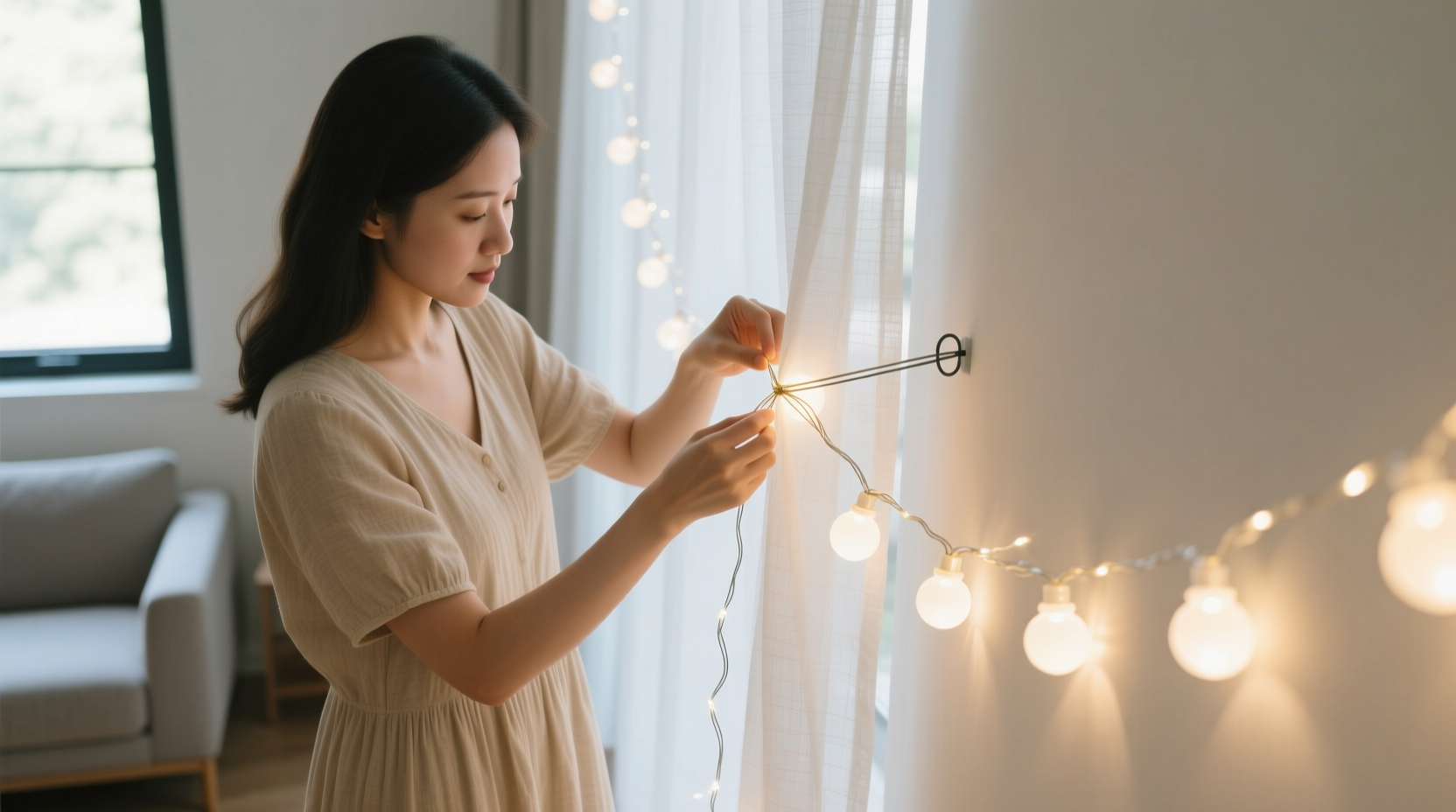
Before choosing a technique, understand why common shortcuts backfire:
- Plastic clip-on lights: Their spring-loaded jaws compress sheer fabric unevenly, creating localized tension that distorts weave alignment. On lightweight polyesters, this causes permanent “clip shadows”—visible as faint ripples where light fails to pass uniformly.
- Double-sided tape or mounting putty: Adhesives bond to the fabric’s surface coating, not the fiber itself. Removal pulls away microscopic finish layers, leaving dull patches. Residue also attracts dust, accelerating soiling along attachment lines.
- Hot glue or craft glue: Heat and solvents degrade synthetic sheers (especially nylon and polyester blends), causing yellowing or brittleness. Glue seeps into interstices, stiffening drape and creating visible nodules when backlit.
- Pins or safety pins: Even fine needles create micro-perforations. With repeated washing or airflow, these holes enlarge, leading to fraying or snags—particularly problematic on high-thread-count cotton voiles.
The solution lies in leveraging the curtain’s inherent properties: its fluid drape, consistent weave, and ability to conceal fine threads in shadow. Success hinges on distributing weight, avoiding direct adhesion, and working *with* the fabric—not against it.
Five Proven, Residue-Free Attachment Methods
1. The Invisible Thread-Weave Technique (Best for Static Installations)
This method uses the curtain’s own weave as an anchor—no tools beyond a needle and fine monofilament thread (0.15mm thickness, clear or matching the curtain color). It’s ideal for fixed placements like bedroom windows or gallery walls where lights won’t be frequently repositioned.
- Unplug and fully unwind your fairy lights. Identify the wire spacing between bulbs (typically 6–12 inches).
- Thread a 24-inch length of monofilament onto a sharp, thin needle. Knot one end securely.
- Starting at the top hem, insert the needle *between* two vertical warp threads (not through them), emerging 1 inch below the hem. Pull until the knot rests against the fabric’s underside.
- Loop the thread around the fairy light wire *once*, then pass the needle back through the same interstice, pulling taut but not tight enough to distort the weave.
- Repeat every 8–10 inches vertically, alternating sides of the wire to balance tension. Secure the final knot on the curtain’s reverse side.
2. The Weighted Hem Channel (For Drapery with Existing Hems)
If your sheer curtains have a sewn-in hem (even a narrow ½-inch one), repurpose it as a discreet light conduit. This avoids any surface contact with the visible portion of the curtain.
- Open the hem seam carefully using a seam ripper—only along the bottom 12 inches initially.
- Feed the fairy light wire into the hem channel, starting from one corner. Gently guide it upward using tweezers or a bent paperclip.
- Once the wire reaches the desired height (e.g., 3 feet up), secure it inside the hem with a single stitch of matching thread—looping the wire *around* the hem’s internal fold, not piercing the outer fabric.
- Close the hem seam with ladder stitch (invisible hand-stitching). The wire remains fully enclosed, and only the bulbs glow through the sheer layer above.
This method supports up to 15 feet of lights without sagging. For longer runs, add a second anchoring stitch every 4 feet inside the hem.
3. The Tension Rod Integration (No Sewing Required)
Leverage your existing curtain rod as a mechanical anchor. This works best with standard tension rods (spring-loaded) or decorative poles with finials.
- Wrap the fairy light wire tightly around the rod *behind* the curtain header tape or casing—ensuring bulbs face outward.
- Use a 6-inch piece of clear elastic cord (1/8-inch width) to create a “figure-eight” loop: wrap once around the rod, cross behind the wire bundle, then loop back around the rod and tie snugly.
- The elastic absorbs minor movement while holding the wire firmly against the rod. Bulbs hang freely in front of the sheer, with zero contact between lights and fabric.
Test tension by gently tugging the wire downward—the elastic should stretch ¼ inch but hold position. Replace elastic every 6 months as UV exposure weakens elasticity.
4. The Beaded Drape Anchor (For Decorative & Functional Dual Purpose)
Transform functional attachment into intentional design. Tiny seed beads (size 11/0) act as nearly invisible weights that hold lights in place while adding subtle texture.
| Step | Action | Why It Works |
|---|---|---|
| 1. Prepare Beads | String 3–5 clear or matte white seed beads onto 12-inch monofilament. Tie a surgeon’s knot at one end. | Beads distribute weight evenly; clear monofilament vanishes against sheer fabric. |
| 2. Anchor Light Wire | Loop the fairy light wire around the bead cluster, then pass the monofilament through the loop and pull tight. | Creates friction-based grip—no piercing, no glue. |
| 3. Attach to Curtain | Drape the beaded cluster over the top edge of the curtain, letting beads rest just inside the header tape. Adjust until wire hangs vertically. | Gravity holds beads in place; slight fabric tension prevents slippage. |
This method is especially effective on gathered or pleated sheers, where the header tape provides natural resistance. Beads remain hidden from frontal view and add zero visual clutter.
5. The Magnetic Header Strip (For Metal Rods or Frames)
Only viable if your curtain rod is metal (steel or iron) or you’ve installed a thin aluminum strip behind the header tape. Uses rare-earth neodymium magnets (3mm x 1mm disc, N52 grade).
- Sew a 1-inch square of thin, flexible magnetic sheet (0.5mm thick) into the curtain’s header tape—centered horizontally.
- Attach a matching magnet to the fairy light’s plastic wire casing using a single dot of silicone adhesive (fully cured before use).
- Position lights by aligning magnets—attraction holds wire flush against the header without pressure on the sheer fabric.
Magnetic strength must be calibrated: too weak, and lights sag; too strong, and magnets pull the header tape out of alignment. Test with one magnet first—ideal holding force is 0.8–1.2 oz per magnet.
Real-World Case Study: The Sunroom Transformation
When interior designer Lena R. renovated a 1920s sunroom for a client with light-sensitive migraines, sheer linen curtains were non-negotiable for glare reduction. But the client insisted on ambient lighting for evening use—without compromising the “barely-there” aesthetic. Standard clips created visible ridges on the 32-thread-count linen, and tape left greasy smudges after three days.
Lena chose the Invisible Thread-Weave Technique, adapting it for vertical placement: instead of horizontal rows, she wove lights diagonally from top corner to bottom opposite corner, following the natural drape lines. She used 0.12mm monofilament and spaced stitches every 10 inches. To prevent wire creep, she added micro-bead anchors (Method 4) at each termination point. The result? A constellation effect—bulbs appeared to float within the fabric plane, with zero evidence of attachment. The client reported no glare increase during daytime, and the lights remained perfectly positioned for 14 months without adjustment. As Lena notes: “The key wasn’t hiding the lights—it was honoring how the fabric *wants* to behave.”
Expert Insight: Textile Conservation Perspective
“Adhesives and punctures initiate irreversible degradation in delicate sheers. Even ‘gentle’ tape leaves behind plasticizers that migrate into fibers over time, accelerating UV breakdown. The safest approach treats the fabric as a dynamic system—not a static canvas. Techniques that rely on physics (tension, gravity, magnetism) rather than chemistry (adhesion) or trauma (piercing) preserve both appearance and longevity.” — Dr. Aris Thorne, Textile Conservator, Museum of Domestic Arts
Installation Checklist: Before You Begin
- ✅ Test fabric sensitivity: Rub a cotton swab dampened with distilled water on an inconspicuous area. If color bleeds or finish dulls, avoid all moisture-based methods.
- ✅ Measure bulb spacing: Note exact distance between LEDs—this determines optimal stitch/bead intervals.
- ✅ Verify light weight: Weigh your string (including battery pack or transformer). Anything over 8 oz requires distributed anchoring (e.g., multiple hem stitches or bead clusters).
- ✅ Check bulb temperature: Touch bulbs after 15 minutes of operation. If warm (>104°F/40°C), avoid methods trapping heat (e.g., enclosed hem channels).
- ✅ Confirm removal protocol: Plan for de-installation—e.g., keep monofilament tails long enough to untie without cutting.
FAQ
Can I wash sheer curtains with attached fairy lights?
No. All attachment methods require complete light removal before washing. Monofilament threads and beads can be left in place if secured with removable knots (e.g., bowline knots), but elastic cords and magnetic strips must be detached. Hand-wash sheers in cool water with pH-neutral detergent; never machine wash or tumble dry.
Will these methods work on blackout-lined sheers?
Yes—with adjustments. For lined sheers, use the Weighted Hem Channel method exclusively, feeding wires into the lining’s hem (not the sheer layer). Avoid threading through both layers, as bulk creates visible bumps. Magnetic anchors also work well here, as the lining provides extra mass for stronger hold.
How do I hide the power cord and battery pack?
Route the cord vertically inside the curtain’s side return (the folded edge where the panel meets the wall). Secure it with one small, clear hook-and-loop dot (3mm) on the return’s inner side—tested to confirm no residue on your fabric. Conceal the battery pack behind the curtain rod bracket or inside a decorative finial cover designed for storage.
Conclusion: Light That Respects the Fabric
Attaching fairy lights to sheer curtains isn’t about finding a quick fix—it’s about recognizing the material’s quiet intelligence. Sheer fabrics breathe, shift, and respond to air currents and light in ways heavier textiles cannot. The most elegant solutions don’t fight that behavior; they partner with it. Whether you choose the precision of threaded weaving, the simplicity of tension-rod integration, or the elegance of beaded gravity anchors, each method succeeds because it asks nothing of the fabric except cooperation.
Start with the least invasive option for your setup: test the Tension Rod Integration if you have a metal pole, or try the Beaded Drape Anchor for immediate, tool-free results. Document what works—even small details like “monofilament tension increased 15% after 48 hours of sunlight exposure”—because your experience becomes data for others navigating the same delicate balance. Share your adaptations in the comments: Did you adapt the hem channel for grommet-top curtains? Find a better bead weight for polyester voile? Your insight helps build a collective knowledge base for living beautifully—without compromise.




 浙公网安备
33010002000092号
浙公网安备
33010002000092号 浙B2-20120091-4
Comments
No comments yet. Why don't you start the discussion?