
Displaying anime keychains on a decorated tree has become a popular way for fans to personalize seasonal decor while celebrating their favorite characters. However, integrating small collectibles into an already intricate setup—especially one with delicate lighting and fragile ornaments—requires careful planning. The challenge lies in maintaining visual appeal without compromising the tree’s structure or creating a tangled mess. Done poorly, added weight can bend branches, and careless placement can disrupt light patterns or even create electrical hazards.
The solution is not just about where to hang the keychains, but how to do so with minimal impact. Lightweight attachments, strategic spacing, and non-invasive methods ensure your tree remains balanced, functional, and beautiful. Whether you’re decorating a real pine, artificial evergreen, or indoor bonsai-style display, these techniques preserve both aesthetics and safety.
Selecting the Right Attachment Method
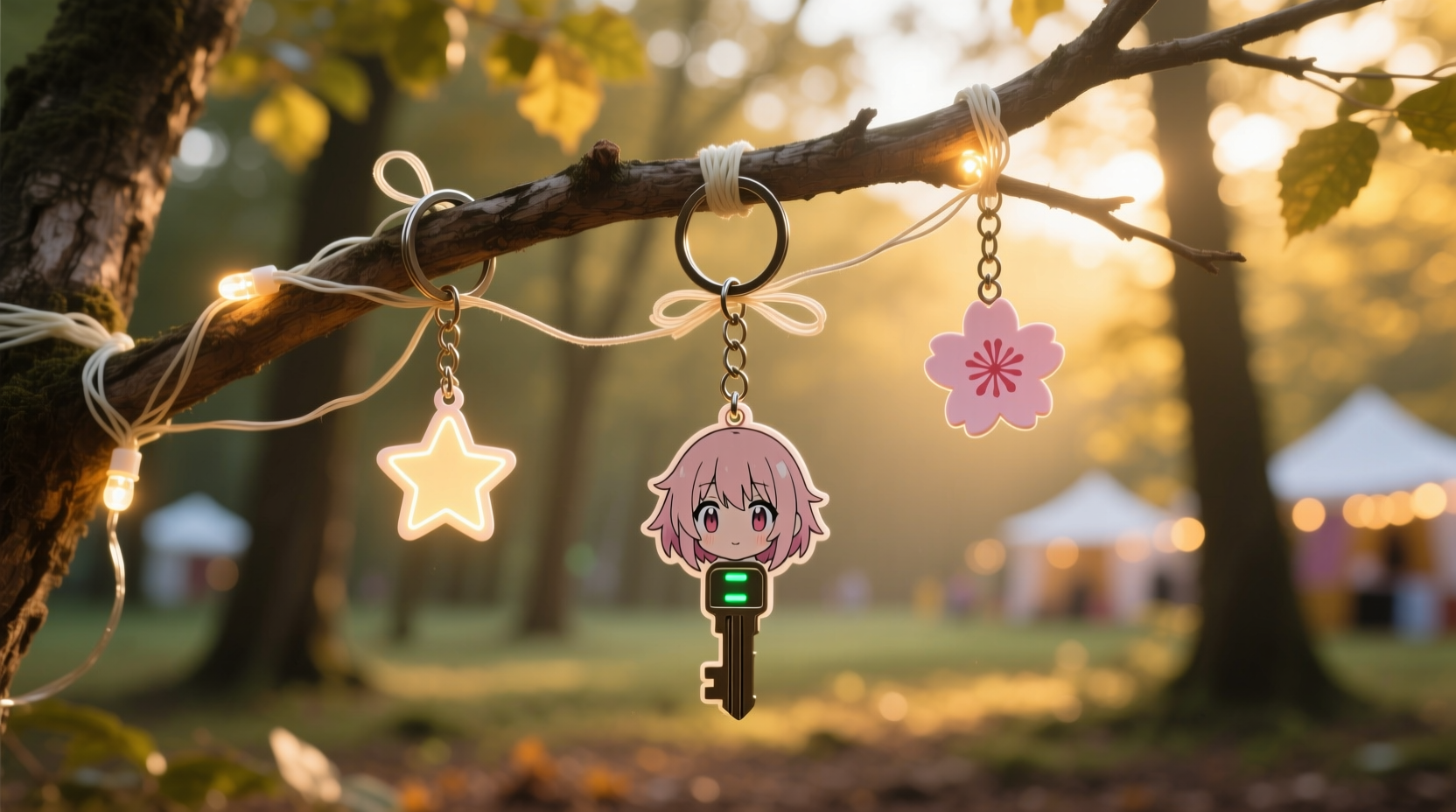
The first step in securing anime keychains to tree branches is choosing a hanging mechanism that adds no measurable weight and avoids contact with existing decorations. Traditional ornament hooks are too bulky and may scratch or displace nearby items. Instead, focus on nearly invisible, ultra-light connectors that distribute tension evenly.
Fishing line is a top choice due to its tensile strength and transparency. A 2–4 lb test monofilament is strong enough to hold lightweight PVC or acrylic keychains (typically under 0.5 oz) while remaining nearly undetectable from a few feet away. Cut 6–8 inch segments and tie one end in a loop around the keychain’s ring using a double overhand knot. Leave the other end free for attachment to the branch.
Alternatively, micro velcro dots (reusable adhesive-backed patches) offer a no-tie solution. One half adheres gently to the back of the keychain; the other attaches to a stable part of the branch or trunk. These are especially useful for trees with dense foliage where threading line is difficult.
Strategic Placement to Avoid Light Interference
One of the most common issues when adding custom elements to a lit tree is entanglement. Lights are often pre-wired and tightly wound, making it easy to snag wires when reaching into deeper layers. To prevent this, adopt a “top-down, outer-in” placement strategy.
Begin by identifying clusters where lights naturally form open loops or gaps between strands. These spaces—often near the outer third of a branch—are ideal for inserting keychains without disturbing wiring. Use a long-handled tweezer or plastic hemostat to guide the fishing line or keychain into position without manually pushing through wires.
For trees with uniformly spaced lights, consider installing keychains only on branches that don’t carry primary light runs. Focus on secondary or shorter limbs closer to the trunk, which tend to be less illuminated and more structurally supportive. This maintains visual balance while reducing risk.
“Integrating personal items into holiday displays should enhance, not complicate, the experience. Strategic zoning keeps everything functional.” — Laura Nguyen, Interior Stylist & Seasonal Decor Consultant
Step-by-Step Guide: Hanging Keychains Safely
Follow this sequence to add anime keychains efficiently and safely, minimizing disruption to lights and tree shape.
- Assess the tree’s layout: Note where lights are thickest and identify structural branches capable of supporting minor additions.
- Prepare materials: Cut fishing lines or prepare micro velcro dots. Label keychains if organizing by character or series.
- Start high and sparse: Place the first keychain near the upper third of the tree on an outward-facing branch with natural clearance.
- Thread carefully: Use a thin tool to guide the fishing line around a sturdy twig or branch fork. Tie a secure slip knot or use a drop of clear nail polish to seal the end.
- Check clearance: Gently shake the branch to simulate movement. Ensure the keychain doesn’t swing into lights or other ornaments.
- Distribute evenly: Limit to one keychain per major branch. Avoid clustering on one side to maintain visual and physical balance.
- Final inspection: Walk around the tree at eye level and from a distance to confirm visibility and safety.
Do’s and Don’ts: Best Practices Summary
| Do | Don’t |
|---|---|
| Use transparent fishing line or micro fasteners | Use metal clips or heavy ribbons |
| Place keychains on stable, forked branches | Hang from thin, flexible tips |
| Limit to 3–5 keychains on a standard 6-foot tree | Overcrowd branches for symmetry |
| Test adhesives on a hidden spot first | Apply glue or tape directly to painted or textured surfaces |
| Check for wire proximity before finalizing | Force placement if it requires moving light strands |
Real Example: A Fan’s Holiday Tree Transformation
Maria, a longtime anime collector from Portland, wanted to showcase her growing keychain collection during her apartment’s annual holiday open house. Her 5.5-foot pre-lit artificial tree was already densely decorated with glass orbs and warm white LEDs. Rather than risk tangling or overloading, she spent two evenings planning a minimalist integration.
She selected seven keychains featuring characters from Studio Ghibli films—lightweight, thematically appropriate, and visually soft against green foliage. Using 4 lb test fishing line, she attached each to secondary branches near the top and midsection, always choosing spots where lights curved away. She avoided the lower third entirely to preserve the tree’s illuminated base effect.
The result was subtle yet meaningful: guests noticed the charming details without seeing clutter. More importantly, after three weeks of daily lighting, none of the keychains shifted or caused strain. Maria reported that the method saved time during setup and takedown, proving that thoughtful execution beats quantity every time.
Alternative Display Ideas for High-Risk Trees
Not all trees are suitable for direct attachment—even lightweight additions can be risky on older artificial models with weak branch joints or real trees with brittle limbs. In such cases, consider indirect display methods that still achieve the desired aesthetic.
- Base Display: Arrange keychains on a decorative tray or miniature easel beneath the tree. Use small stands or acrylic holders to keep them upright and visible.
- Hanging Canopy: Suspend keychains from a ceiling-mounted garland or clear wire above the tree, creating a “halo” effect that mimics integration without physical contact.
- Branch Proxies: Attach keychains to faux vine wreaths or wire frames shaped like tree silhouettes, then place these behind or beside the main tree as companion decor.
These alternatives eliminate weight concerns entirely and allow for easier rearrangement. They also protect limited-edition or fragile keychains from accidental bumps or falls.
Frequently Asked Questions
Can I use tape to attach anime keychains to branches?
Only if it's removable adhesive like poster putty or blue painter’s tape—and even then, sparingly. Regular tape can leave residue or pull off paint from artificial trees. For long-term setups, fishing line or micro hooks are safer and more reliable.
Will lightweight keychains damage real tree branches?
Purely weight-wise, no—most anime keychains weigh less than a pinecone. However, repeated friction or improper knots can strip bark or weaken young twigs. Always loop around thicker sections and avoid tight bindings that restrict growth or circulation in live plants.
How many keychains can I safely add to a 6-foot tree?
As a general rule, limit direct attachments to 5–7 lightweight keychains on a standard pre-lit tree. Exceeding this increases the risk of imbalance, especially if clustered on one side. If you have more to display, rotate them weekly or use supplemental display methods.
Checklist: Safe Keychain Integration
- ☐ Assess tree structure and light layout
- ☐ Choose ultra-light attachment method (fishing line, micro velcro)
- ☐ Select keychains under 0.5 oz each
- ☐ Identify safe anchor points away from wiring
- ☐ Test connections with gentle tugs
- ☐ Distribute evenly across quadrants
- ☐ Inspect for movement and clearance
- ☐ Have backup display options ready
Conclusion: Celebrate Your Fandom Thoughtfully
Displaying anime keychains on a decorated tree is more than decoration—it’s a personal statement. When done with care, it blends fandom pride with seasonal elegance without sacrificing safety or design integrity. The key is restraint: choosing the right tools, respecting the tree’s existing structure, and prioritizing long-term enjoyment over temporary spectacle.
By following these methods, you protect both your collectibles and your decor, ensuring everything looks great today and remains intact for seasons to come. Whether you're a casual fan or a dedicated collector, your tree can reflect your passions—without a single tangle or bent branch.




 浙公网安备
33010002000092号
浙公网安备
33010002000092号 浙B2-20120091-4
Comments
No comments yet. Why don't you start the discussion?