
Flocked Christmas trees bring a magical winter wonderland feel to any home, with their soft, snow-dusted appearance mimicking freshly fallen snow on pine branches. However, this delicate aesthetic comes with a challenge: the flocking—typically a cellulose or paper-based material sprayed onto the branches—is fragile and prone to flaking or cracking when mishandled. One of the most common issues during decorating is damaging the flocking while attaching ornaments, especially when using traditional metal hooks. The pressure from bending wires or sharp edges can scrape off the white coating, leaving bare patches that ruin the illusion of a naturally frosted tree.
The key to preserving your flocked tree’s beauty lies not in avoiding decoration altogether, but in adopting smarter, gentler techniques. With the right tools, materials, and approach, you can fully adorn your tree with festive ornaments while keeping the flocking intact. This guide covers proven methods, expert-backed strategies, and real-world tested solutions for hanging lightweight ornaments safely and beautifully.
Why Flocking Is So Delicate—and Why It Matters
Flocking is created by applying tiny fibers to an adhesive-coated surface, then curing it to form a soft, textured finish. On artificial trees, this process gives branches a snowy, matte appearance that enhances realism. But because the bond between the flocking material and the PVC or PE branch is not as strong as the plastic itself, any mechanical stress—like pinching, scraping, or twisting—can cause microfractures or delamination.
This fragility becomes especially apparent when hanging ornaments. Traditional ornament hooks are designed for sturdy, non-flocked trees and often require bending a wire around a branch. That motion creates pressure points where the hook contacts the branch, easily dislodging the flocking. Over time, repeated use—even gentle—can degrade the surface, leading to uneven wear and visible damage.
“Flocked trees are more about visual impact than durability. The moment you treat them like a standard artificial tree, you risk compromising their charm.” — Daniel Reeves, Artificial Holiday Decor Specialist
Preserving the flocking isn’t just about aesthetics—it extends the usable life of your tree. A well-maintained flocked tree can last 10–15 years with minimal touch-ups, whereas one subjected to rough handling may need replacement in half that time.
Choosing the Right Tools: What to Use (and What to Avoid)
The foundation of safe ornament hanging starts with selecting the correct attachment method. Not all ornament hangers are created equal, and some should be avoided entirely when dealing with flocked surfaces.
| Tool | Safe for Flocking? | Reason |
|---|---|---|
| Plastic-coated wire hooks | No | Metal core still applies pressure; coating wears off over time |
| Standard metal ornament hooks | No | Sharp bends scratch and chip flocking immediately |
| Fabric ribbon or satin cord | Yes | Distributes weight evenly; no pressure points |
| Velcro® mini straps (soft loop side only) | Yes | Adheres gently; no piercing or clamping force |
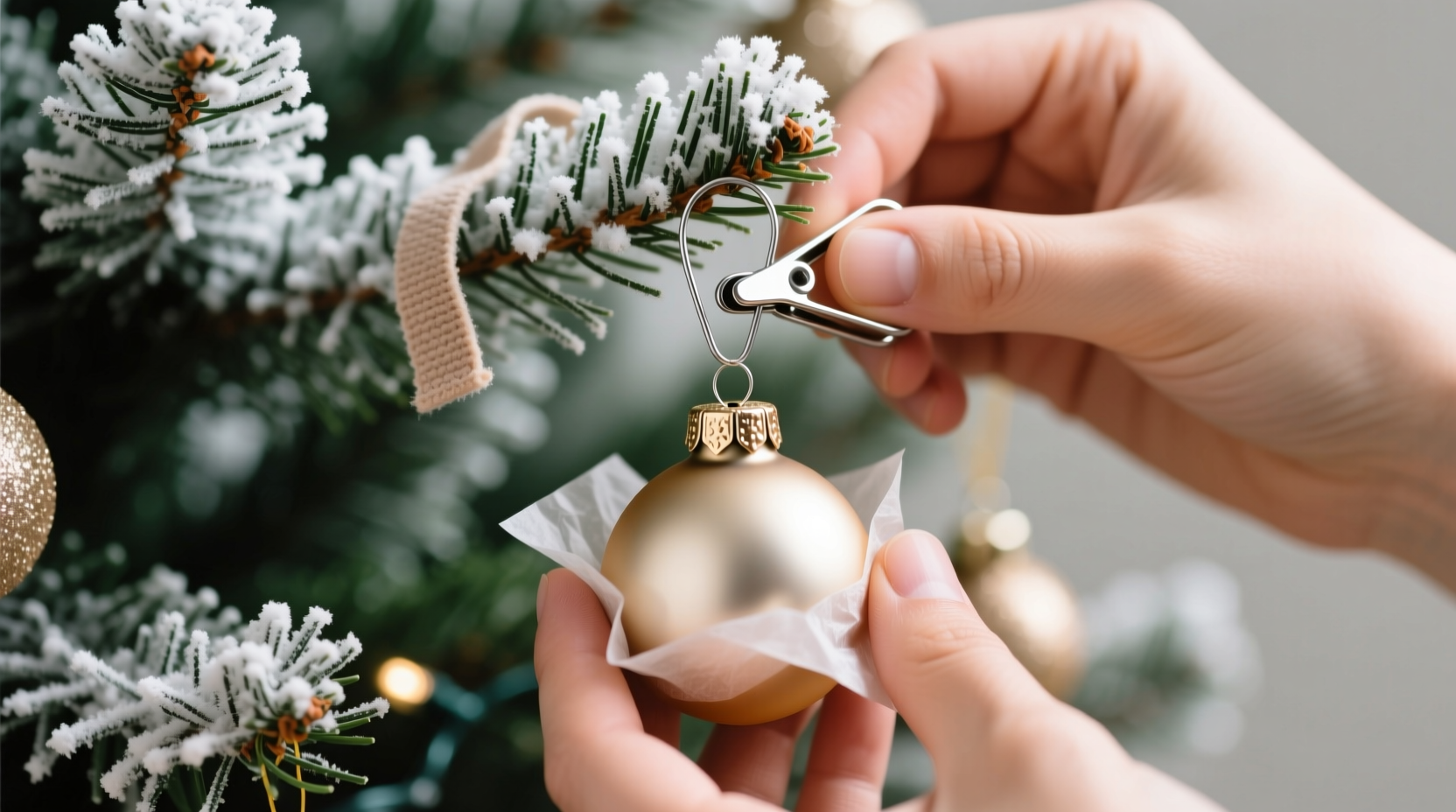
| Mini clothespins (plastic, smooth-edged) | Yes | Clips onto branch without crushing; easy to remove |
Step-by-Step: How to Hang Ornaments Without Damaging Flocking
Following a structured approach ensures consistency and minimizes risk. Use this timeline to decorate your tree efficiently and safely.
- Inspect the tree under bright light: Before hanging anything, examine each branch for weak spots or pre-existing flaking. Avoid placing heavy ornaments on thin or damaged sections.
- Prepare your hangers in advance: Cut 6–8 inch lengths of satin ribbon, or pre-tie small loops. If using mini clothespins, ensure they’re clean and free of grit that could scratch.
- Start from the inside out: Begin with inner branches, working toward the outer tips. This prevents you from leaning on decorated areas and reduces accidental bumps.
- Use the “drape-and-loop” method for ribbons: Gently drape the ribbon over the branch, center the ornament, and tie a loose knot underneath. Do not pull tightly—just enough to prevent sliding.
- Clip with care using clothespins: Open the pin gently and place it on the underside of a sturdier branch. Attach the ornament’s hook to the pin’s edge. Avoid over-tightening.
- Secure with Velcro® for heavier lightweight ornaments: For items approaching 3–4 ounces (like glass balls with wide bases), apply a small piece of soft-loop Velcro® to the branch and hook the ornament through the strap.
- Test stability gently: Lightly nudge each ornament to ensure it won’t fall, but avoid shaking or jostling the branch.
Remember: “Lightweight” generally means under 4 ounces. Anything heavier—such as large blown-glass ornaments or ceramic figures—should be reserved for the sturdiest lower branches and secured with wider support (e.g., double ribbon).
Real Example: A Home Decorator’s Experience
Sarah Lin, a holiday stylist from Portland, Oregon, has maintained the same flocked tree for nine years. Her secret? She stopped using metal hooks entirely after the first season, when she noticed white powder accumulating on her gloves during decorating.
“I thought it was dust at first,” she said. “But after seeing bare green branches peeking through, I realized I was damaging the tree every single year.”
She switched to a system of color-coded satin ribbons: gold for family heirlooms, red for themed ornaments, and silver for newer additions. Each ribbon is pre-cut and stored in labeled envelopes with the ornaments. Not only has her tree remained pristine, but the decorating process is now faster and more organized.
“The ribbons add a subtle elegance too,” she added. “They look like part of the design, not just a fix.”
Alternative Methods for Problem Areas
Some branches—especially thin, flexible tips—are too delicate even for gentle clips. In these cases, consider indirect hanging techniques:
- Overhead fishing line suspension: Tie a nearly invisible monofilament line across two stable upper branches. Hang ornaments from the line using small hooks or tied loops. This keeps weight off fragile limbs entirely.
- Bunch-wrapping with floral wire: For clusters of small ornaments (like berries or mini presents), wrap several together with thin, coated floral wire and drape the bundle over a thick central branch. The weight is distributed, and contact is minimal.
- Magnetic holders (for metal-trimmed ornaments): Use rare-earth magnets placed on either side of a branch to hold ornaments with metallic caps. Ensure the magnet is covered with a soft fabric sleeve to prevent abrasion.
Checklist: Safe Ornament Hanging on Flocked Trees
Before you begin decorating, run through this checklist to ensure you're fully prepared:
- ✅ Replace all metal hooks with ribbon, soft ties, or plastic clips
- ✅ Pre-cut and organize hanging materials by ornament type
- ✅ Inspect tree for weak or flaking branches
- ✅ Use only lightweight ornaments (under 4 oz)
- ✅ Keep a soft brush handy to gently remove stray flocking fibers
- ✅ Work in sections, starting from the top and moving down
- ✅ Avoid overcrowding—maintain space between ornaments for airflow and branch flexibility
Frequently Asked Questions
Can I repair flocking that’s already cracked?
Minor flocking damage can be touched up. Purchase matching flocking material (available in craft stores or online) and a small applicator brush. Clean the area, apply a thin layer of adhesive spray, then lightly sprinkle or roll on the flocking. Let dry completely before handling. Note: Touch-ups are best for hidden areas, as perfect color matching is difficult.
Are there commercial products made specifically for flocked trees?
Yes. Brands like Kurt S. Adler and National Tree Company offer “flocked tree care kits” that include soft hangers, touch-up flocking, and protective storage bags. While not essential, they simplify maintenance for long-term owners.
Can I use glue dots to secure ornament hooks?
No. Adhesives—even temporary ones—can pull off flocking when removed and may discolor the surface. They also make future adjustments difficult. Stick to mechanical, non-adhesive solutions like ribbons or clips.
Conclusion: Preserve the Magic, One Ornament at a Time
A flocked Christmas tree is more than a decoration—it’s a centerpiece of seasonal nostalgia, evoking quiet snowfalls and cozy evenings. Protecting its delicate finish isn’t about limitation, but about intention. By switching to gentler hanging methods, organizing your materials, and treating each branch with care, you preserve not just the tree’s appearance, but the tradition it represents.
The small effort invested in using ribbons instead of hooks, or taking an extra minute to drape rather than clip, pays off in longevity and beauty. Your tree will remain a stunning focal point for years, looking as fresh on December 25th as it did on the 1st.




 浙公网安备
33010002000092号
浙公网安备
33010002000092号 浙B2-20120091-4
Comments
No comments yet. Why don't you start the discussion?