
A freshly cut fir tree brings unmatched fragrance and charm to the holiday season. Its soft needles, rich green hue, and natural shape create a living centerpiece in any home. But with beauty comes fragility—especially when it comes to decorating. Fir boughs are delicate, and traditional ornament hooks or aggressive hanging methods can snap branches, cause needle loss, or compromise the tree’s structure. The key lies in using thoughtful, low-impact techniques that honor the tree’s organic nature while still allowing for festive expression.
Attaching ornaments without damage isn’t just about preserving aesthetics—it also extends the life of your tree. A well-decorated fir sheds less, stays hydrated longer, and maintains its fullness throughout the season. This guide explores proven methods, tools, and strategies for safely adorning your real fir tree with lightweight ornaments, ensuring both elegance and longevity.
Understanding Fir Tree Fragility
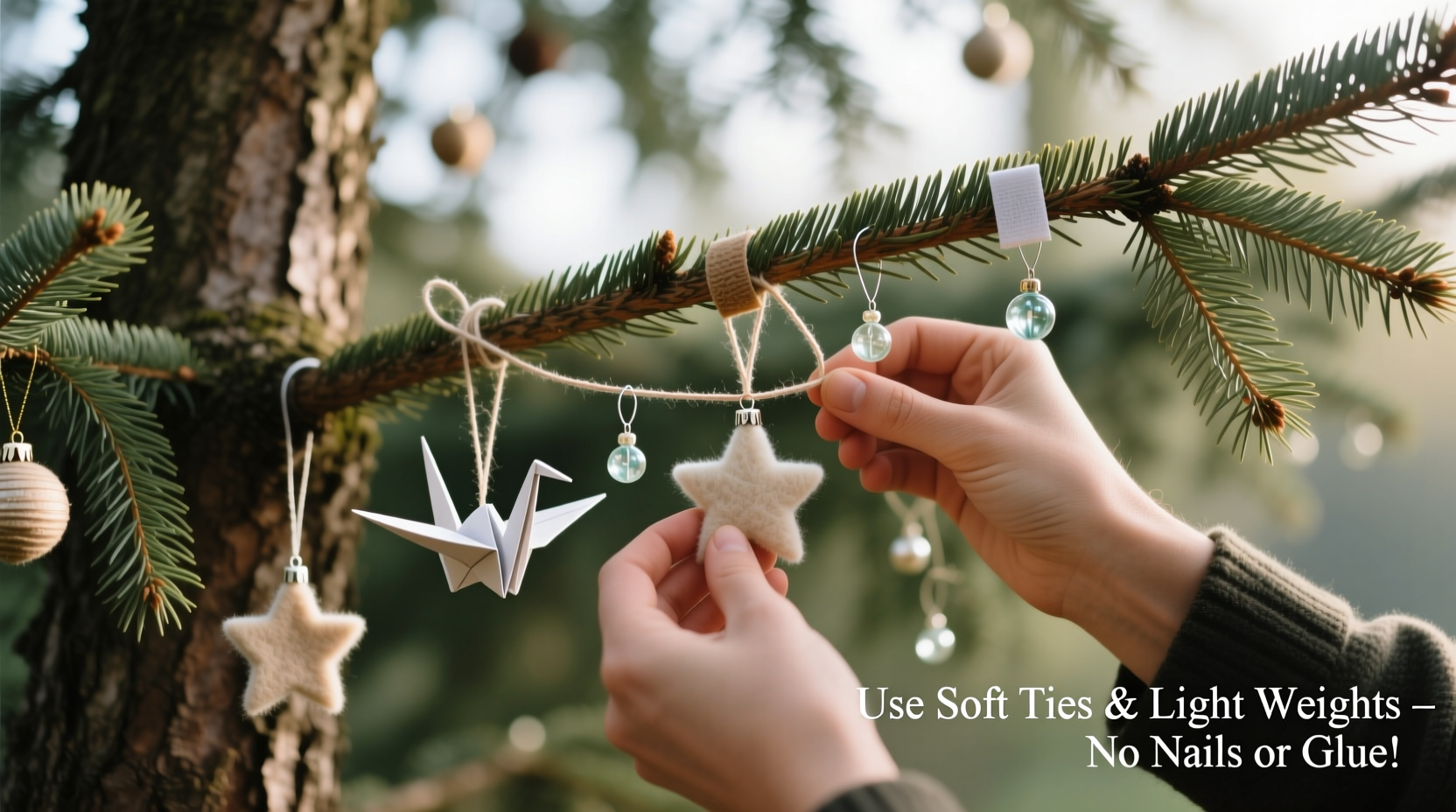
Fir trees, including popular varieties like Fraser, Balsam, and Noble firs, are prized for their strong scent, excellent needle retention, and symmetrical shape. However, their branches are more pliable and less rigid than those of spruce or pine. The outer twigs—where most ornaments are placed—are especially tender. These secondary growths support new needles but aren't designed to bear weight. Even small ornaments (3–6 ounces) can stress thin limbs if improperly attached.
The primary risks of careless decoration include:
- Branch snapping: Sudden pressure from hooks or overloading weak limbs.
- Needle bruising: Friction from rough ties or sharp edges damages foliage.
- Moisture disruption: Wounds from punctures or deep cuts accelerate drying.
- Structural imbalance: Concentrating ornaments on one side stresses the trunk.
To minimize harm, focus on distributing weight evenly, using flexible attachment points, and avoiding direct pressure on vulnerable branch tips.
Gentle Attachment Methods That Work
The goal is secure ornament placement without mechanical stress. Avoid metal hooks, tight knots, or piercing methods. Instead, use soft materials and indirect support techniques that leverage the tree’s natural form.
1. Ribbon Loops and Fabric Ties
Satin, grosgrain, or velvet ribbon can be tied gently around thicker inner branches. Cut an 8–10 inch piece, loop it through the ornament’s hanger, and loosely knot it around a sturdy limb—never pull tight. The ribbon acts as a suspension system, transferring weight to stronger wood while leaving the outer bough untouched.
For extra security, double-loop the ribbon: tie one end around the branch, thread the ornament, then bring the loose end back under the first loop and tie again. This creates a cradle effect.
2. Fishing Line Suspension
Clear monofilament fishing line (4–6 lb test) is nearly invisible and highly effective. Cut a 12-inch length, thread one end through the ornament cap, and tie a small loop. Use tweezers or a bent paperclip to drape the other end over a high, thick branch. Let the ornament hang freely below the canopy. Because the line doesn’t wrap or bind, there’s no abrasion.
“Using fishing line mimics how birds nest—minimal contact, maximum stability. It’s one of the least invasive ways to decorate a live tree.” — Dr. Lydia Chen, Arborist & Holiday Horticulturist, Pacific Northwest Botanical Society
3. Nesting Ornaments in Foliage
Some lightweight ornaments—especially round glass balls under 3 oz or fabric stars—can be nestled directly into dense clusters of needles. Gently part the boughs and place the ornament where surrounding branches naturally cup and support it. This method works best on mature firs with thick lower tiers.
Test stability by lightly tapping the branch. If the ornament shifts more than half an inch, add a hidden support: tuck a short pipe cleaner beneath it, bent into a U-shape and anchored to adjacent stems.
4. Decorative Branch Wraps
Use wide, soft cords like raffia, yarn, or braided cotton to wrap groups of ornaments onto sturdier limbs. Wrap once around the base of a cluster of boughs, lay the ornaments across the span, then complete a second wrap to hold them in place. This distributes weight across multiple points and doubles as rustic décor.
Step-by-Step: Safe Ornament Hanging Timeline
Follow this sequence to ensure balanced, damage-free decoration over one to two days (allowing time for hydration breaks):
- Day 1 – Morning: Hydrate the tree. Let it sit in water for at least 4 hours before decorating. Well-hydrated branches are more flexible and resilient.
- Day 1 – Afternoon: Assess structure. Identify strong anchor branches (near trunk, diameter > pencil width) and map out ornament zones.
- Day 1 – Evening: Hang heaviest items first. Use fishing line or wide ribbon on upper/mid-level thick limbs to establish visual balance.
- Day 2 – Morning: Add medium ornaments. Use nesting or soft ties on mid-tier boughs. Rotate tree frequently to check symmetry.
- Day 2 – Afternoon: Finish with lights and delicate pieces. Weave string lights loosely before placing final lightweight ornaments in gaps.
- Ongoing: Monitor daily. Check for sagging lines, shifting ornaments, or dry spots. Re-tie or reposition as needed.
Do’s and Don’ts: Ornament Attachment Guide
| Do | Don’t |
|---|---|
| Use soft ribbons or fabric ties | Use metal ornament hooks |
| Distribute weight evenly across quadrants | Cluster heavy ornaments on one side |
| Nest ornaments in dense foliage | Force ornaments into sparse or brittle areas |
| Check branch flexibility before tying | Tie directly onto thin, drooping tips |
| Use fishing line for overhead hangs | Puncture branches with wires or pins |
Real Example: Decorating a Fraser Fir in a Historic Home
In Portland, Oregon, interior designer Mara Ellison decorates a 7-foot Fraser fir annually in her 1910 Craftsman home. The tree sits in a sunroom with fluctuating temperatures, making preservation critical. In past years, she lost entire sections of boughs due to snapped limbs from standard hooks.
Last season, she switched to a hybrid method: clear fishing line for glass orbs above eye level, ivory satin ribbon loops for mid-level vintage ornaments, and hand-felted wool stars nestled into lower clusters. She avoided the topmost 18 inches (too fragile) and used only battery-powered LED lights to reduce heat exposure.
The result? The tree remained intact and lush for 28 days—10 days longer than average—with zero broken branches. “It looked like the ornaments were floating,” she said. “And my kids could walk by without knocking anything down.”
Essential Checklist for Safe Decoration
Before you begin, gather these supplies and follow this checklist:
- ☐ Freshly cut fir tree, standing in water
- ☐ Lightweight ornaments (under 6 oz each)
- ☐ Satin or grosgrain ribbon (½”–1” width)
- ☐ Clear fishing line (4–6 lb test)
- ☐ Scissors, tweezers, and small clamps (for holding line)
- ☐ Soft-bristle brush (to remove debris before decorating)
- ☐ Spray bottle with water (to mist branches during process)
- ☐ Plan for even ornament distribution (use mental grid: top/middle/bottom, front/sides/back)
- ☐ Designate a “no-touch” zone: outermost 6 inches of delicate tips
- ☐ Final inspection: circle tree at eye level to check balance and security
Frequently Asked Questions
Can I use tape to attach ornaments?
No—tape (including masking, painter’s, or duct tape) leaves residue, traps moisture, and can strip bark when removed. It also fails in temperature changes. Stick to non-adhesive methods like looping or suspending.
What if an ornament has no hook or loop?
Create one using a small piece of fishing line. Tie a secure knot around the ornament’s neck or base (e.g., just below a glass ball’s cap). Test the knot with light tension before hanging. For flat ornaments like wooden stars, glue a tiny loop of ribbon to the back with craft adhesive—apply only to the ornament, never the tree.
How many ornaments can I safely hang on a medium-sized fir?
As a rule, limit to 1 ornament per 1.5 to 2 feet of branch length. For a 6-foot tree, that’s roughly 30–50 lightweight ornaments total. Focus density toward the trunk and reduce quantity toward the tips. Overcrowding increases friction and wind-load stress, even with gentle methods.
Conclusion: Preserve Beauty, Honor Nature
Decorating a real fir tree should be a ritual of care, not conquest. By choosing methods that respect the tree’s delicate architecture, you enhance its natural elegance instead of compromising it. The most memorable holiday trees aren’t the fullest or flashiest—they’re the ones that feel alive, balanced, and thoughtfully adorned.
Start with hydration, proceed with patience, and prioritize gentle materials over convenience. Whether you use silk ribbons, invisible line, or artful nesting, each choice contributes to a longer-lasting display and a more sustainable tradition. A well-treated fir can remain vibrant for four weeks or more, bringing joy without sacrifice.




 浙公网安备
33010002000092号
浙公网安备
33010002000092号 浙B2-20120091-4
Comments
No comments yet. Why don't you start the discussion?