
Maximalism isn’t about excess for its own sake—it’s a celebration of personality, memory, texture, and meaning. Yet when applied to compact apartments, studio lofts, or petite bedrooms, the same exuberant principles that energize large homes can quickly tip into visual fatigue: cramped sightlines, diminished light, lost floor space, and a sense of constant busyness. The real artistry lies not in restraint, but in *intentional abundance*—curating density with discipline, layering with logic, and editing with empathy for how people actually live in tight quarters. This isn’t minimalism in disguise; it’s maximalism recalibrated for intimacy, scale, and daily comfort.
1. Anchor with Scale-Conscious Structure
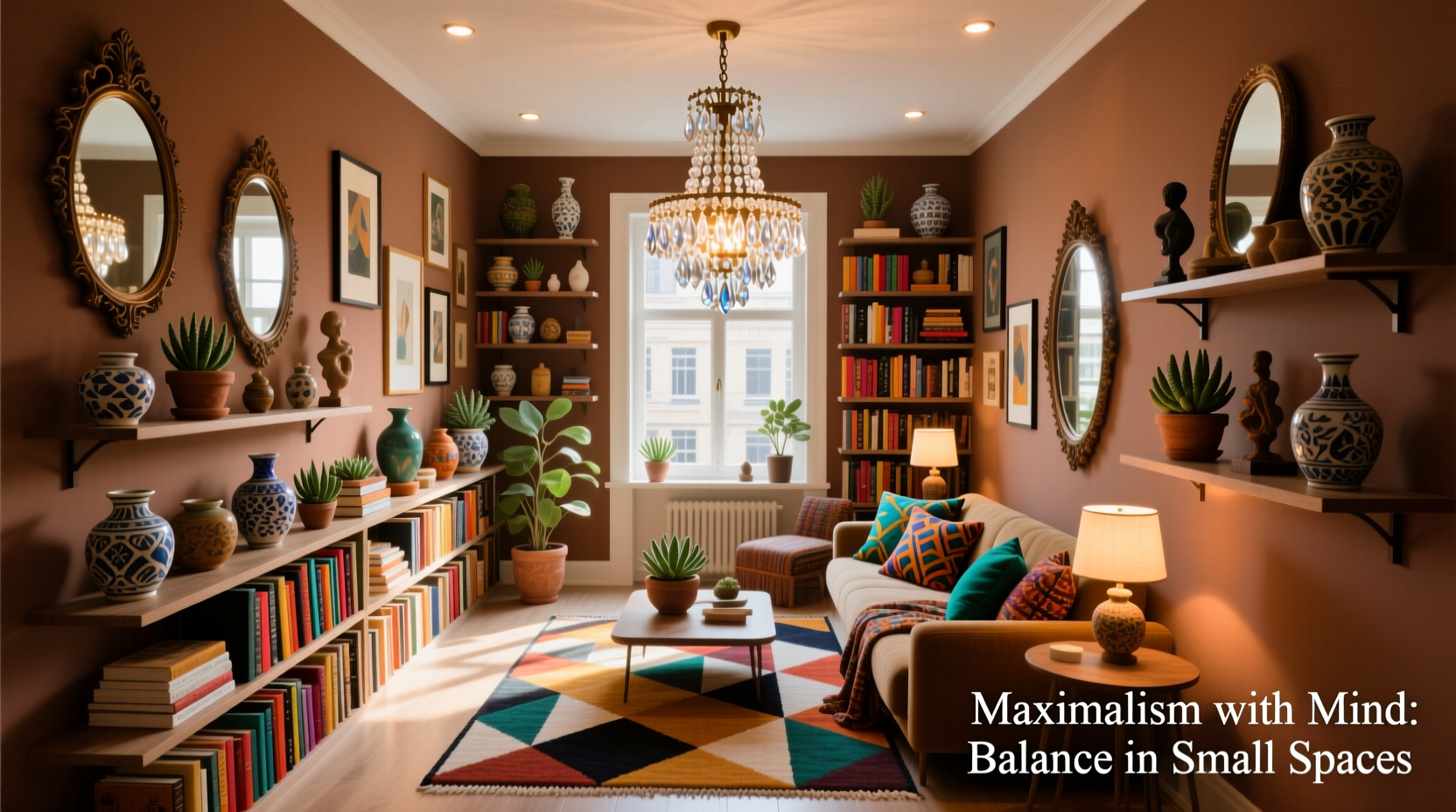
Before adding pattern, color, or collectibles, establish a spatial framework that supports—not fights—small dimensions. Maximalism thrives on contrast, but in confined areas, contrast must be architectural first, decorative second. Prioritize clean lines in built-in elements and key furniture: a streamlined platform bed, a wall-mounted desk with open shelving, or recessed cabinetry with flush handles. These structural anchors provide visual “breathing room” amid richer surface treatments.
Height is your most underutilized ally. Instead of filling floor space with low-slung ottomans or clustered side tables, go vertical: floor-to-ceiling bookshelves styled with alternating rhythm (books spine-out, objects grouped in threes, negative space as punctuation), or a single oversized mirror framed in gilded metal to reflect light and double perceived depth. Avoid bulky baseboards or crown molding that visually lowers ceilings—opt instead for subtle shadow-line reveals or painted trim that recedes rather than projects.
2. Curate Color & Pattern Using the 70-20-10 Rule (Reimagined)
The classic 70-20-10 color rule (70% dominant, 20% secondary, 10% accent) needs adaptation for maximalist small spaces. Here, it becomes a *layering ratio*, not a paint-by-numbers formula:
- 70% = Unifying Ground: Not necessarily neutral—but consistent in tone, temperature, or material. Think warm-toned plaster walls, matte black steel window frames, or wide-plank oak flooring stained deep walnut. This base doesn’t have to be “quiet”; it just needs continuity across surfaces to prevent fragmentation.
- 20% = Textural Contrast: Where maximalism begins to sing. Velvet sofa in burnt sienna, hand-thrown ceramic vases glazed in cobalt and ochre, a vintage kilim rug layered over sisal. These elements introduce richness *without* competing chromatically—because they share the same underlying warmth or coolness as the 70% ground.
- 10% = Focal Energy: One intentional “pop”: a neon-pink art print in a black floating frame, brass cabinet hardware shaped like abstract birds, or a single shelf lit with warm LED strip lighting. This is where surprise lives—but it appears only once, deliberately placed at eye level or along a natural sightline.
This approach prevents color collision while preserving vibrancy. In a 12’x10’ living area, for example, painting walls, ceiling, and trim the same deep olive-green (70%) allows a mustard-yellow velvet loveseat (20%) and a single framed vintage travel poster in electric teal (10%) to feel cohesive—not chaotic.
3. Layer Light, Not Just Objects
Overcrowding isn’t always about physical items—it’s often about *light deprivation*. In small maximalist spaces, illumination strategy is as critical as object curation. Relying solely on one overhead fixture guarantees shadows, glare, and a flattened sense of volume. Instead, deploy light in three distinct tiers:
- Ambient: Diffused, indirect sources—wall sconces with fabric shades aimed upward, LED strips behind floating shelves, or a pendant with a frosted glass globe hung slightly lower than standard (to avoid headroom conflict).
- Task: Focused and functional—a brass swing-arm lamp over a reading chair, an adjustable LED desk lamp with a narrow beam, or under-cabinet lighting in a compact kitchen nook.
- Accent: Purposeful drama—a single spotlight on a sculptural vase, a string of vintage-style Edison bulbs draped along a narrow gallery wall, or a backlit alcove showcasing a collection of blue-and-white porcelain.
Each tier serves a different physiological need: ambient light reduces eye strain and expands perception of space; task light enables activity without cluttering surfaces; accent light creates hierarchy and draws attention *away* from potential congestion zones (like a crowded entryway bench). Crucially, all fixtures should share a common finish (e.g., unlacquered brass or matte black) to unify the layering.
4. Edit Through Narrative, Not Quantity
Maximalism in tight spaces fails when editing is based on “less is more.” It succeeds when editing is based on “what tells the story?” Every object should earn its place by answering one or more of these questions: Does it hold personal significance? Does it serve a daily function? Does it contribute to a deliberate textural or tonal progression? If not, it’s noise—not narrative.
| Editing Principle | What It Looks Like in Practice | Why It Works in Small Spaces |
|---|---|---|
| Thematic Grouping | Displaying only mid-century ceramics collected during travels to Mexico City, Oaxaca, and Guadalajara—no unrelated pottery. | Creates visual cohesion and reduces cognitive load; the brain reads “one collection,” not “ten random bowls.” |
| Functional Layering | A vintage trunk serving as coffee table + storage + display surface for stacked art books and a single potted fiddle-leaf fig. | Eliminates need for separate side tables, storage bins, and plant stands—freeing floor space and sightlines. |
| Rhythm Over Repetition | Three framed botanical prints in varying sizes and frames, spaced evenly along a narrow hallway wall—no two identical. | Creates movement and interest without monotony; avoids the “gallery wall fatigue” that overwhelms narrow corridors. |
This method transforms editing from subtraction into curation. You’re not removing things—you’re clarifying intent. As interior designer Tanya Rai observes:
“In a 400-square-foot apartment, every square inch carries emotional weight. Maximalism here isn’t about accumulation—it’s about amplifying meaning. One perfectly chosen textile tells more than ten generic ones.”
5. Mini Case Study: The 320-Sq-Ft Studio Apartment in Brooklyn
When Maya, a textile artist and vintage book collector, moved into her 320-square-foot Williamsburg studio, she refused to sacrifice her love of bold color, layered textiles, and tactile variety—even though the space featured a galley kitchen, a Murphy bed, and only one true window. Her solution wasn’t downsizing her aesthetic, but rethinking its grammar.
She began by painting all walls, ceiling, and trim in Benjamin Moore’s “Wrought Iron”—a deep, warm charcoal that absorbed harsh afternoon light while reflecting soft ambient glow. She installed floor-to-ceiling, open-backed shelving along the longest wall (anchoring the space vertically), then curated it in strict rhythm: three rows of hardcover art books (spines facing out, color-blocked by hue), interspersed with ceramic vessels, woven baskets, and framed textile swatches from her own dye experiments. Nothing was hidden; everything had context.
For seating, she chose a compact, high-back velvet sofa in rust-orange—its height creating a visual “wall” that defined the living zone without blocking light. Beneath it, a narrow, hand-knotted rug in indigo and saffron tied the palette together. Lighting came from three sources: a brass wall sconce above the sofa (ambient), a swing-arm lamp clipped to the Murphy bed frame (task), and a single adjustable track light focused on her drafting table (accent). Storage lived inside the sofa’s lift-up base, beneath the bed, and within the shelving—no standalone cabinets or boxes cluttering the floor.
The result? A space that feels rich, deeply personal, and surprisingly airy. Visitors consistently comment on how “calm” it feels—despite the density of objects. Maya’s secret: “I ask myself before adding anything: Does this deepen the story of who I am *here*, right now? If it’s just ‘pretty,’ it stays in the closet.”
6. Step-by-Step: Maximalist Refresh for Small Spaces (Under 2 Hours)
Not ready for a full overhaul? Use this actionable sequence to test maximalist principles in your own compact room—no renovation required.
- Clear & Assess (15 min): Remove every non-essential item from surfaces and floors. Stand in the doorway and note where your eye lands first—and where it gets stuck or confused.
- Define Zones (10 min): Use painter’s tape to mark invisible boundaries: “reading nook,” “work corner,” “entry transition.” Even in studios, psychological zoning reduces visual competition.
- Select Your 70% Base (10 min): Choose one unifying element already present—wall color, flooring, or primary furniture finish. If none exists, commit to repainting one wall or refinishing a tabletop to anchor the palette.
- Choose One 20% Texture (15 min): Pull out one textile or object that embodies richness—velvet pillow, hammered copper tray, embossed wallpaper sample—and place it where it naturally draws attention.
- Add One 10% Focal Point (10 min): Introduce a single unexpected element: a vibrant postcard taped to a mirror, a cluster of mismatched earrings pinned to a corkboard, or a single dried palm frond leaning in a corner.
- Light Check (10 min): Turn off overhead light. Walk around using only your new layers of lighting. Adjust placement until every zone feels illuminated—not spotlighted.
7. FAQ
Won’t bold patterns make my small room feel smaller?
Only if they lack hierarchy. Large-scale patterns (like oversized florals or geometric repeats) can actually expand perception when used on a single wall or as a focal textile—because they create a strong visual “destination.” The problem arises with competing small-scale patterns (tiny polka dots on curtains + micro-check on throw pillows + busy wallpaper), which fracture the eye. Choose one dominant pattern, then support it with solids or textures in the same tonal family.
How do I store collections without making shelves look cluttered?
Group by attribute—not type. Instead of “all mugs” or “all postcards,” group by color, era, or material: “1970s ceramic vessels in earth tones,” “black-and-white travel photos from 1950–1980,” or “brass objects with patina.” This creates rhythm and intentionality. Leave 30% of shelf space empty—use those gaps as visual pauses, not wasted real estate.
Can I mix maximalism with smart home tech in a small space?
Absolutely—and it enhances the experience. Conceal wires with cord covers painted to match walls; choose minimalist smart switches (like Lutron Caseta) in matte black or brass to blend with décor; use voice-controlled lighting to shift ambiance without adding physical controls. Technology should disappear into the maximalist narrative—not interrupt it.
Conclusion
Maximalism in small spaces isn’t a compromise—it’s a refinement. It asks you to move beyond decoration as ornamentation and into decoration as autobiography: every color, texture, and object a deliberate syllable in the sentence of your home. When grounded in scale-aware structure, guided by intentional layering, and edited through narrative clarity, maximalism becomes deeply humane. It honors the reality of limited square footage while refusing to dilute the richness of lived experience. You don’t need more space to express more of yourself—you need sharper focus, deeper curation, and bolder confidence in what truly matters.




 浙公网安备
33010002000092号
浙公网安备
33010002000092号 浙B2-20120091-4
Comments
No comments yet. Why don't you start the discussion?