
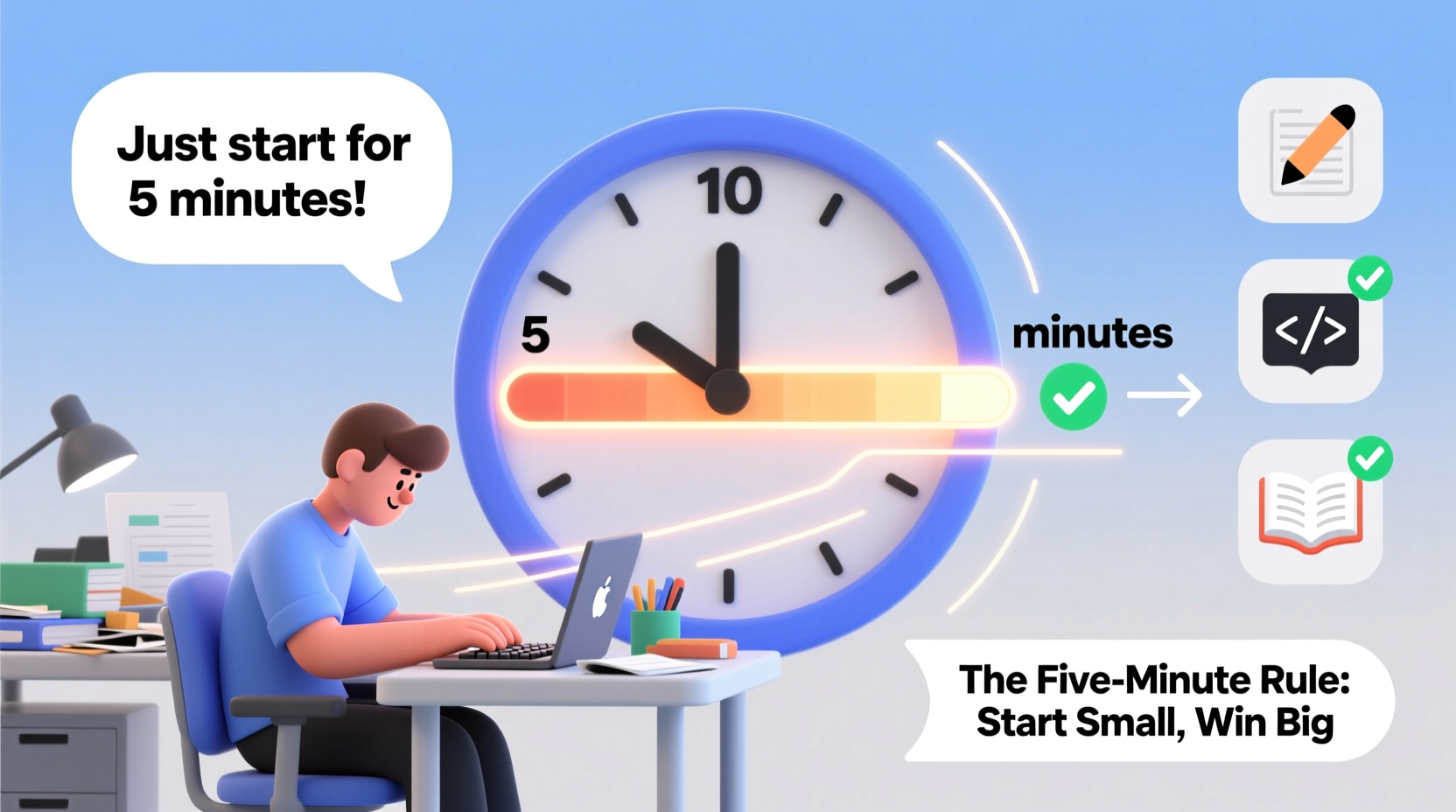
Procrastination isn’t a character flaw. It’s a response—an emotional reflex triggered by discomfort, uncertainty, or perceived effort. The moment you think about starting a task, your brain calculates the cost of action: energy, focus, risk of failure. If that cost feels too high, it pushes back with resistance. That’s when procrastination sets in. But there’s a remarkably simple strategy that bypasses this mental blockade: the five-minute rule. This isn’t another motivational gimmick. It’s a behavioral psychology hack grounded in real neuroscience and practical application. By committing to just five minutes of work, you disarm the resistance, create momentum, and often end up doing far more than you planned.
The Psychology Behind Procrastination
At its core, procrastination is not about laziness—it’s about emotion regulation. Research from Dr. Piers Steel, author of The Procrastination Equation, shows that people delay tasks not because they lack discipline, but because they’re trying to avoid negative feelings associated with them: boredom, anxiety, insecurity, or fear of imperfection. The brain defaults to short-term mood repair, choosing immediate relief over long-term gain.
This emotional avoidance creates a cycle: the longer you delay, the higher the stress builds, which in turn makes starting even harder. Tasks grow in perceived size and difficulty, feeding into perfectionism and self-doubt. What was once a manageable report becomes an overwhelming burden simply because it wasn’t started yesterday.
The key to breaking this loop isn’t willpower. It’s lowering the barrier to entry. That’s where the five-minute rule comes in.
“Motivation follows action, not the other way around.” — James Clear, author of Atomic Habits
What Is the Five-Minute Rule?
The five-minute rule is deceptively simple: commit to working on a task for just five minutes. No more, no less. You don’t have to finish it. You don’t have to do it perfectly. You just have to start.
Invented by productivity expert David Allen and popularized through various behavioral frameworks, the rule leverages the psychological principle of inertia. Once you begin moving—even slightly—your brain shifts from resistance to engagement. Starting is the hardest part; continuing is significantly easier.
Here’s why it works:
- Reduces decision fatigue: Instead of asking “Should I do this now?” you only ask, “Can I do this for five minutes?” The answer is almost always yes.
- Tricks the brain: Your mind resists large commitments but accepts small ones. Five minutes feels safe, non-threatening, and manageable.
- Builds momentum: Action generates motivation. After five minutes, you’re already engaged—and more likely to keep going.
- Breaks perfectionism: Since you’re only doing it for five minutes, there’s no pressure to get it right. This removes the paralysis of needing to be perfect.
How to Apply the Five-Minute Rule: A Step-by-Step Guide
The power of the five-minute rule lies in consistent application. Follow this structured approach to make it a reliable tool in your productivity arsenal.
- Identify the task you’re avoiding. Be specific. Instead of “work on project,” say “write the introduction to my presentation” or “respond to three client emails.” Vague goals trigger resistance; clear ones reduce friction.
- Commit out loud (or in writing). Say, “I’m going to work on X for five minutes starting now.” Writing it down reinforces commitment. This small act increases accountability and primes your brain for action.
- Eliminate distractions. Close unnecessary browser tabs, silence notifications, and create a clean workspace. You don’t need total silence, but minimize interruptions that could break your brief window of focus.
- Start the timer and begin. Don’t wait for inspiration. Use the first minute to write one sentence, open a document, or sketch an outline. Action precedes clarity.
- After five minutes, decide. When the timer ends, ask yourself: “Do I want to continue?” Most of the time, you’ll find you’ve built enough momentum to keep going. If not, stop guilt-free. You’ve already succeeded by starting.
The goal isn’t always completion—it’s consistency. Even if you stop after five minutes, you’ve made progress, reduced the task’s psychological weight, and trained your brain to respond differently next time.
Real-Life Example: From Paralysis to Progress
Sarah, a freelance writer, had been putting off updating her portfolio for months. Every time she sat down, she felt overwhelmed by the thought of redesigning pages, rewriting bios, and selecting new samples. The task felt massive, and she kept telling herself she’d “do it when she had a full day free”—which never came.
One morning, frustrated and behind on client applications, she decided to try the five-minute rule. She told herself: “I’ll just open the website editor and look at the homepage for five minutes.”
She set a timer, opened her site, and began tweaking the headline. The changes were minor, but she noticed something: she wasn’t dreading it anymore. When the timer went off, she realized she’d already made visible progress. So she continued—for 25 more minutes. The next day, she returned for another five-minute session. Within a week, her portfolio was updated and live.
What changed? Not her workload or schedule. It was the shift from “I have to finish this” to “I just need to start.” The five-minute rule removed the pressure and unlocked forward motion.
Common Pitfalls and How to Avoid Them
The five-minute rule is powerful, but it can fail if misapplied. Here are common mistakes and how to fix them:
| Mistake | Why It Fails | Solution |
|---|---|---|
| Vague task definition | “Work on taxes” feels overwhelming even for five minutes. | Be specific: “Open tax software and enter January expenses.” |
| No timer | Without a clear end, the brain resists starting. | Always use a physical or digital timer. |
| Trying to go longer immediately | Forcing 30 minutes breaks the trust in the “just five” promise. | Honor the five-minute limit. Let continuation be optional. |
| Using it only for big tasks | Small tasks pile up and cause hidden stress. | Apply it to emails, calls, chores—anything you’re delaying. |
When the Five-Minute Rule Isn’t Enough: Combining Strategies
While highly effective, the five-minute rule works best when integrated with other systems. Consider these complementary techniques:
- Two-Minute Rule (David Allen): If a task takes less than two minutes, do it immediately. This clears micro-tasks that clutter your mental space.
- Time Blocking: Schedule five-minute sessions in your calendar. Treat them like appointments to increase follow-through.
- Environment Design: Prepare your workspace the night before. Open the document, lay out materials—reduce friction so starting feels effortless.
- Accountability Partners: Tell someone you’ll complete a five-minute session. Social commitment boosts follow-through.
For chronic procrastinators, pairing the rule with cognitive-behavioral strategies can deepen impact. Ask: “What am I afraid will happen if I start?” Often, the answer reveals irrational fears—like “I’ll realize I’m not good enough”—that can be challenged and reframed.
“The secret of getting ahead is getting started. The secret of getting started is breaking your complex overwhelming tasks into small, manageable tasks, and then starting on the first one.” — Mark Twain
Five-Minute Rule Checklist
Use this checklist every time you’re tempted to delay:
- ☐ Identify the exact next action (not the whole project)
- ☐ Say or write: “I will do this for five minutes”
- ☐ Remove distractions (phone, notifications, clutter)
- ☐ Set a timer for 5:00
- ☐ Begin immediately—no waiting for focus
- ☐ When timer ends, decide: continue or stop
- ☐ Celebrate starting, regardless of duration
Frequently Asked Questions
Does the five-minute rule work for creative blocks?
Yes. Creativity thrives on action, not waiting for inspiration. Write one paragraph, sketch one idea, or play one musical phrase. Often, the act of beginning unlocks flow. The rule helps bypass the myth that you need to “feel ready” before creating.
What if I still don’t start after promising five minutes?
If even five minutes feels impossible, scale down further. Try the “one-minute rule”: open the file, write one word, or stand at your desk. Sometimes, reducing the commitment even more breaks the freeze. Alternatively, examine deeper blockers—fear of judgment, burnout, or unclear goals—that may need separate attention.
Can this help with long-term projects?
Absolutely. Long projects fail not from lack of time, but from inconsistent starts. Applying the five-minute rule daily builds compound progress. Writing a book? Write one paragraph. Building a business? Send one outreach email. Small actions, repeated, create results.
Make It a Habit: Turning Five Minutes Into Lasting Change
The true power of the five-minute rule isn’t in isolated wins—it’s in rewiring your relationship with work. Each time you start, you reinforce a new identity: “I’m someone who begins.” Over weeks, this erodes the self-image of being a procrastinator.
To make it stick:
- Track your starts: Keep a log of every five-minute session. Seeing a streak builds motivation.
- Reflect weekly: Note which tasks were easier after starting. Awareness strengthens the pattern.
- Pair with rewards: After a session, enjoy a short walk, a favorite drink, or a few minutes of music. Link starting with positive outcomes.
Progress isn’t measured in hours worked, but in moments of courage—the decision to begin despite resistance. The five-minute rule gives you a tool to act before doubt takes over.
Take Action Today
You don’t need more motivation. You don’t need a perfect plan. You need one decision: to start for five minutes. Pick one task you’ve been avoiding—right now. Set a timer. Begin.
Chances are, you’ll keep going. And if you don’t, you’ve still won. Because the war against procrastination isn’t fought in marathon sessions. It’s won in the quiet moments when you choose action over avoidance, one five-minute victory at a time.




 浙公网安备
33010002000092号
浙公网安备
33010002000092号 浙B2-20120091-4
Comments
No comments yet. Why don't you start the discussion?