
Negative thought loops are like mental ruts: once you fall into them, it becomes harder to climb out. They often stem from automatic thinking patterns—snap judgments about yourself, others, or the future that feel true but aren’t necessarily accurate. These cycles can fuel anxiety, depression, and chronic stress. The good news is they can be interrupted. Cognitive reframing, a core technique in cognitive behavioral therapy (CBT), offers a structured way to identify distorted thoughts and replace them with more balanced perspectives. This isn’t about forced positivity; it’s about cultivating mental clarity and emotional agility.
Understanding Negative Thought Loops
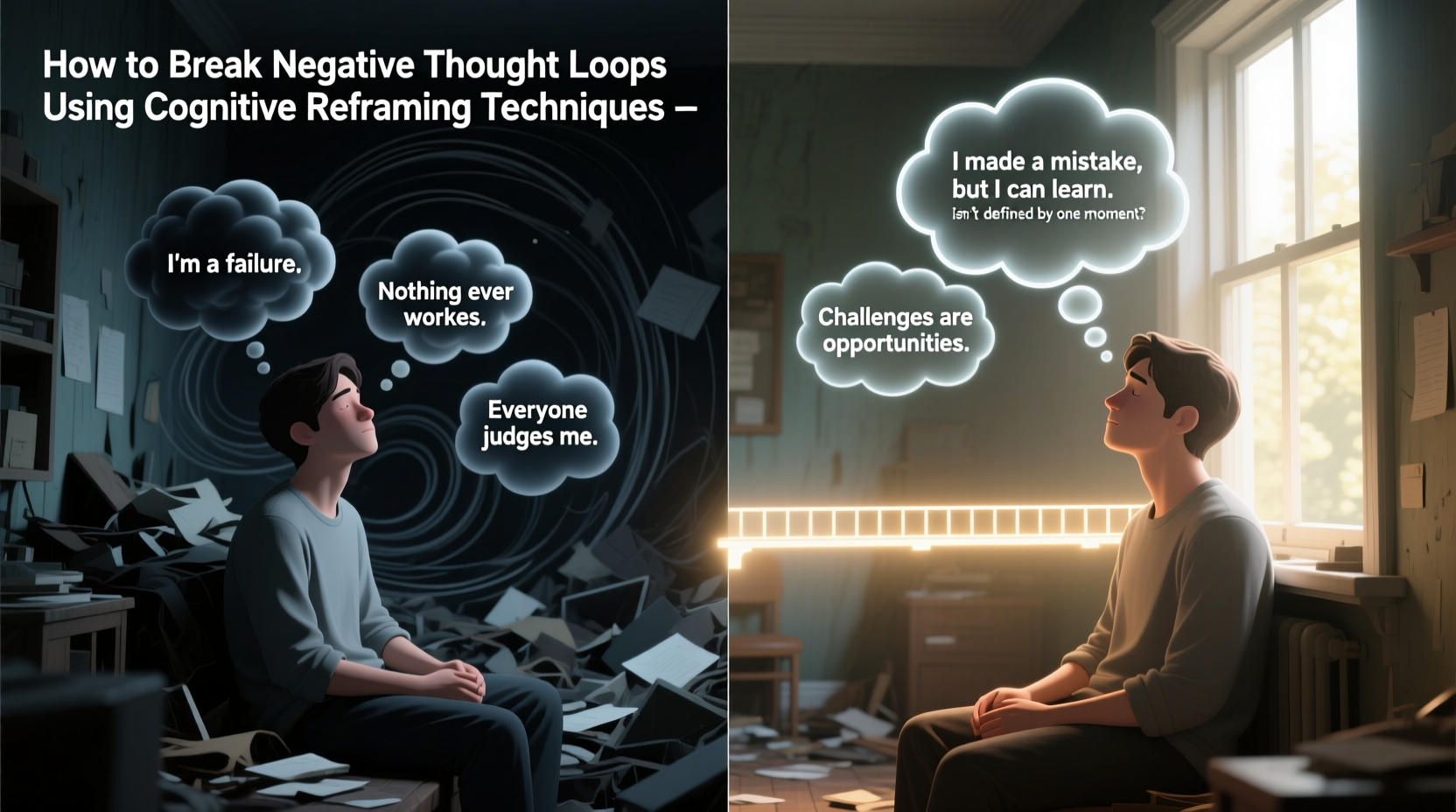
A negative thought loop begins when a triggering event activates an automatic negative belief. That belief generates emotion—often fear, shame, or sadness—which then reinforces the original thought, creating a feedback cycle. For example, missing a deadline might trigger the thought “I’m a failure,” which leads to feelings of inadequacy, making it harder to start the next task, thus reinforcing the belief.
These loops thrive on cognitive distortions—systematic errors in thinking that skew reality. Common distortions include:
- All-or-nothing thinking: Viewing situations in extremes (“If I’m not perfect, I’m a total failure”)
- Mind reading: Assuming you know what others think (“They must think I’m incompetent”)
- Catastrophizing: Predicting the worst outcome (“If I speak up, I’ll embarrass myself completely”)
- Overgeneralization: Taking one event as a never-ending pattern (“I failed once, so I’ll always fail”)
- Personalization: Blaming yourself for things outside your control (“It rained during my event—it’s my fault”)
The key to breaking free is not suppression but awareness and restructuring. You don’t need to eliminate negative thoughts entirely—you need to stop treating them as facts.
The Science Behind Cognitive Reframing
Cognitive reframing is grounded in decades of psychological research. Aaron T. Beck, the founder of CBT, discovered that people suffering from depression consistently interpreted neutral or ambiguous events through a negative lens. His work showed that changing these interpretations could significantly reduce symptoms.
Neuroscience supports this: repeated negative thinking strengthens neural pathways associated with rumination. Conversely, consciously practicing alternative interpretations builds new, healthier connections—a process known as neuroplasticity.
“We are not disturbed by things, but by the views we take of them.” — Epictetus, Stoic philosopher (a foundational insight later echoed in CBT)
Modern studies confirm that cognitive reframing reduces activity in the amygdala—the brain’s fear center—while increasing prefrontal cortex engagement, which governs rational decision-making. In practical terms, this means less reactivity and more thoughtful response.
Step-by-Step Guide to Cognitive Reframing
Breaking a negative thought loop requires deliberate practice. Follow this six-step process to reframe unhelpful thinking patterns effectively.
- Pause and recognize the loop. When you notice repetitive negative thoughts (“I’ll never get this right”), acknowledge them without reacting. Say silently: “This is a thought, not a fact.”
- Identify the trigger. What happened just before the thought arose? Was it a comment, a memory, or a physical sensation? Pinpointing the trigger helps isolate the context.
- Write down the automatic thought. Be specific. Instead of “I feel bad,” write: “I made a mistake in the report, so I’m useless at my job.”
- Challenge the thought with evidence. Ask:
- What evidence supports this thought?
- What evidence contradicts it?
- Would I say this to a friend in the same situation?
- Am I confusing a feeling with a fact?
- Generate a balanced alternative. Replace the extreme thought with a more realistic one. For example: “I made a mistake, but I’ve completed many reports correctly. One error doesn’t define my competence.”
- Reinforce the new perspective. Repeat the reframed thought several times. Write it down. Use it as a mental anchor the next time the old loop tries to restart.
This process takes time. Initially, the original thought may feel more “true” simply because it’s familiar. With repetition, the new frame gains credibility.
Real Example: Sarah’s Presentation Anxiety
Sarah, a marketing manager, dreads team meetings. Before each one, she thinks: “I’ll say something stupid and everyone will realize I don’t belong here.” This triggers anxiety, making her voice shaky when she speaks, which she interprets as confirmation of her incompetence.
Using cognitive reframing, she follows the steps:
- Trigger: Upcoming team meeting
- Automatic thought: “I’ll say something stupid and everyone will realize I don’t belong here.”
- Evidence against: She has contributed ideas in the past that were well-received. No one has ever criticized her publicly. Her promotion last year suggests recognition of her value.
- Alternative thought: “I sometimes feel nervous, but I have valuable insights to share. My colleagues respect my work. It’s okay if not every comment is brilliant.”
After two weeks of daily practice, Sarah notices her anxiety decreasing. She still feels nervous, but the catastrophic narrative no longer dominates her mind. She begins speaking earlier in meetings, reinforcing her confidence.
Do’s and Don’ts of Effective Reframing
| Do | Don’t |
|---|---|
| Be specific in identifying thoughts | Use vague labels like “I feel bad” |
| Look for nuance and exceptions | Accept black-and-white conclusions |
| Treat thoughts as hypotheses, not truths | Assume your first interpretation is correct |
| Practice regularly, even when calm | Wait until crisis hits to try reframing |
| Use kind, compassionate language | Replace one harsh thought with another (“I shouldn’t feel this way”) |
“Cognitive restructuring works best when it’s practiced like a muscle—not just in moments of distress, but as a daily mental hygiene habit.” — Dr. Lisa Feldman Barrett, Neuroscientist and psychologist
Building Long-Term Resilience with Mindful Awareness
While cognitive reframing is a powerful tool, its effectiveness increases when paired with mindfulness. Mindfulness creates space between stimulus and response, allowing you to observe thoughts without immediately believing or acting on them.
To integrate mindfulness with reframing:
- Spend five minutes daily focusing on your breath. When thoughts arise, label them (“worrying,” “planning,” “judging”) and return to breathing.
- When a negative loop starts, pause and ask: “Is this thought helpful? Is it true? Is it necessary?”
- Practice self-compassion. Replace self-criticism with statements like: “This is hard right now, and that’s okay. I’m doing my best.”
Over time, you’ll develop a meta-awareness—recognizing not just *what* you’re thinking, but *how* you’re thinking. This shift from content to process is crucial for lasting change.
FAQ: Common Questions About Cognitive Reframing
Isn’t reframing just positive thinking?
No. Positive thinking often involves denying or minimizing problems. Cognitive reframing is about accuracy and balance. It doesn’t deny difficulties but challenges exaggerated or distorted interpretations. For example, instead of saying “Everything will work out perfectly,” reframing says, “This is challenging, but I’ve handled tough situations before.”
How long does it take to see results?
Some people notice shifts within a week of consistent practice. For others, especially those with long-standing patterns, it may take several weeks. Research suggests that practicing reframing exercises for 10–15 minutes daily over four to six weeks leads to measurable improvements in mood and cognitive flexibility.
What if I can’t believe the new thought?
That’s normal. Start with a thought that’s only slightly more believable. Instead of jumping from “I’m a failure” to “I’m amazing,” try “I’ve succeeded before, so I can succeed again.” Gradually adjust the language as it feels more authentic. Believability grows with repetition.
Checklist: Your Cognitive Reframing Action Plan
Use this checklist weekly to reinforce your progress:
- ☑ Identify at least one recurring negative thought this week
- ☑ Apply the 6-step reframing process to that thought
- ☑ Write down a balanced alternative and review it daily
- ☑ Practice mindfulness for 5+ minutes on at least 5 days
- ☑ Notice when a thought loop restarts—and gently intervene
- ☑ Reflect on one situation where the reframed thought helped
Track your experiences in a journal. Over time, you’ll see patterns of growth, even on difficult days.
Conclusion: Rewire Your Mind, Reclaim Your Peace
Negative thought loops aren’t a life sentence. They are learned habits—and like all habits, they can be unlearned. Cognitive reframing equips you with a practical, evidence-based method to interrupt destructive thinking and build mental resilience. It doesn’t promise instant relief, but it offers something more valuable: agency. You begin to see that your thoughts are not commands, but suggestions—one of which you get to choose.
Start small. Pick one thought pattern that drains you. Challenge it. Reframe it. Repeat. Each time you do, you weaken the old pathway and strengthen a healthier one. Progress isn’t linear, but persistence pays off in greater emotional freedom and clarity.




 浙公网安备
33010002000092号
浙公网安备
33010002000092号 浙B2-20120091-4
Comments
No comments yet. Why don't you start the discussion?