
Small-space living doesn’t mean sacrificing holiday spirit—or functional style. In urban apartments, studio lofts, and dorm rooms, traditional floor-standing Christmas trees compete for precious square footage. The Christmas tree ladder shelf solves this elegantly: it’s a vertical, wall-mounted display that doubles as both a festive centerpiece and practical storage. Unlike freestanding alternatives, it occupies zero floor space while offering layered visual interest—perfect for ornaments, candles, greenery, books, or even wrapped gifts. More than a trend, it’s a thoughtful response to modern spatial constraints, rooted in Scandinavian minimalism and American DIY pragmatism. This guide walks you through designing, building, and styling one from scratch—no carpentry degree required, just clear instructions, smart material choices, and intentional planning.
Why This Design Works Where Others Don’t
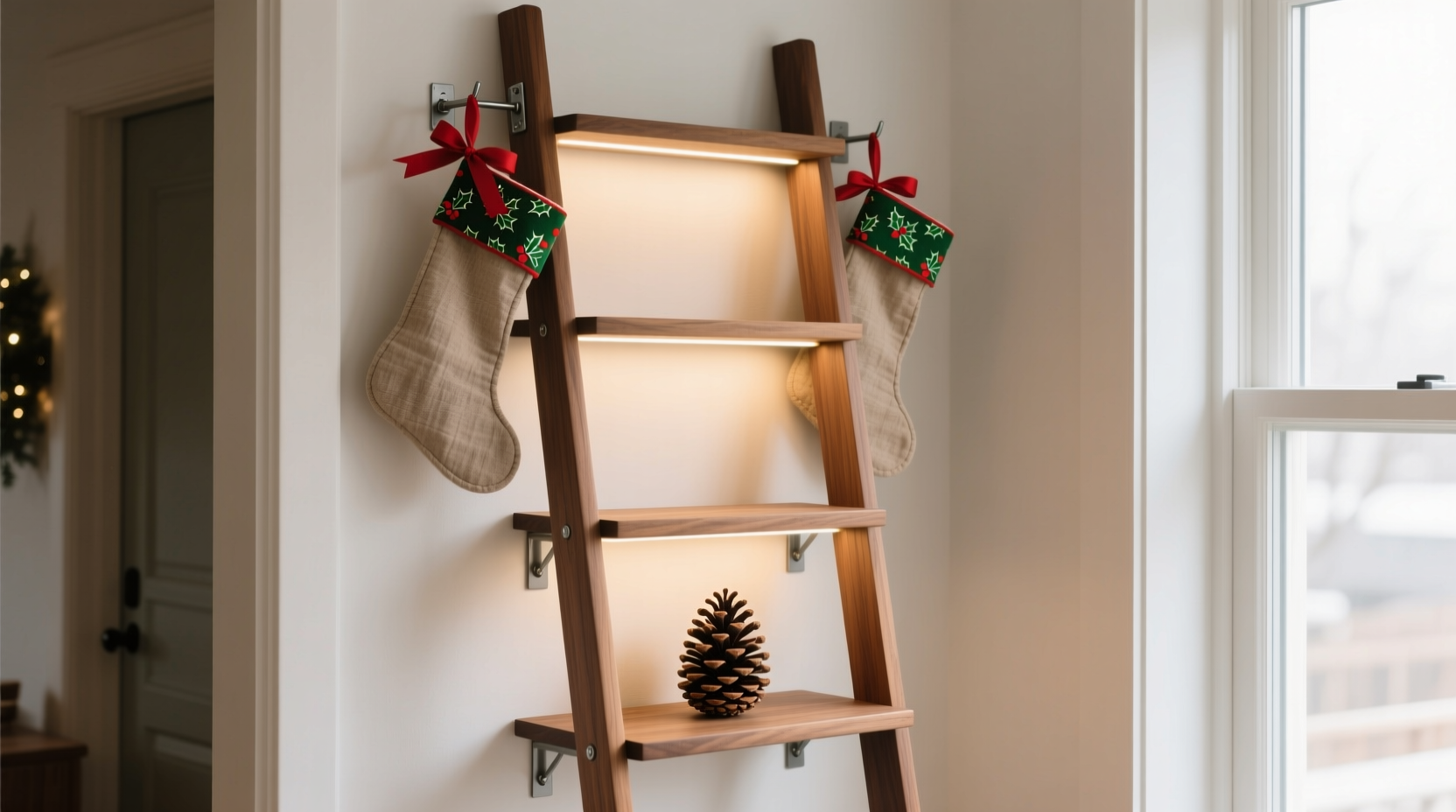
The ladder shelf isn’t merely decorative—it’s spatially intelligent. Its angled, tiered structure creates depth without projection, making it ideal for narrow hallways, beside sofas, or behind dining chairs. Unlike flat wall shelves, its open geometry invites light and air circulation, avoiding the “boxed-in” feeling common with built-ins. Structural stability comes from triangulation: each rung forms a rigid angle with the side rails, distributing weight evenly across wall anchors. When mounted correctly into studs (or using heavy-duty hollow-wall anchors), it safely supports up to 35 lbs per rung—enough for ceramic ornaments, glass globes, pinecones, and battery-operated LED string lights. Crucially, it scales gracefully: a 4-rung version fits under an 8-foot ceiling; a 6-rung version adds drama without overwhelming a 100-square-foot bedroom. Interior designers increasingly recommend it for rental-friendly holiday setups—no permanent alterations, no sawdust, and full portability between seasons.
Materials, Tools & Smart Substitutions
Cost efficiency and accessibility matter—especially when sourcing mid-December. Below is a vetted list balancing durability, aesthetics, and ease of assembly. All materials are available at major home improvement stores or online retailers with same-day local pickup options.
| Item | Specification | Why It Matters | Smart Substitution |
|---|---|---|---|
| Side rails | 2 × pine boards, 1\" × 4\" × 72\" (actual: 0.75\" × 3.5\") | Softwood is lightweight yet strong enough for vertical load; 72\" allows for 6-tier configuration with 12\" spacing | Poplar boards (smoother finish, slightly pricier) or pre-sanded MDF strips (paint-only use) |
| Rungs | 6 × hardwood dowels, 1\" diameter × 22\" | Hardwood resists dents from ornament hooks; 22\" width accommodates standard-sized decor without overhang | 1×3 pine boards cut to 22\" (sanded edges required) or repurposed reclaimed oak flooring strips |
| Mounting hardware | 4 × 3\" lag screws with washers + 4 × 200-lb-rated toggle bolts (for drywall) | Lag screws anchor into wall studs; toggles provide redundancy and distribute shear force | Heavy-duty French cleat system (requires more precision but eliminates visible hardware) |
| Finishing | Matte white water-based polyurethane or chalk-style paint | Non-yellowing, low-VOC, and scuff-resistant—critical for high-touch holiday displays | Unfinished pine with natural beeswax rub (for rustic warmth) or matte black spray enamel (for modern contrast) |
Essential tools include a drill/driver, 1/4\" and 3/8\" drill bits, level, tape measure, pencil, clamps, and sandpaper (120- and 220-grit). Skip the miter saw: all cuts are straight and can be done with a handsaw and speed square if power tools aren’t accessible.
A Real-World Build: Maya’s Studio Apartment Success
Maya, a graphic designer in Portland, lives in a 420-square-foot studio with 7.5-foot ceilings and no closet doors—every surface must multitask. Her previous “tree” was a single potted Norfolk pine she draped with lights, but ornaments kept falling off, and floor space vanished beneath gift piles. After researching compact alternatives, she built her ladder shelf in one Saturday morning using $42 in materials. She used unfinished pine rails and stained the dowels with walnut gel stain for warmth, then mounted it on the only blank wall—beside her Murphy bed. She styled tiers from bottom to top: wrapped linen boxes (gift storage), frosted glass orbs, dried eucalyptus garlands, miniature ceramic deer, and finally, a single brass star finial at the apex. “It didn’t just hold decorations—it created breathing room,” she says. “My cat stopped knocking things off the coffee table because everything had its own designated, elevated home.” Her shelf now stays up year-round—she swaps ornaments for succulents and woven baskets in January, proving the design’s lasting utility beyond December.
Step-by-Step Construction Guide
Build time: 2.5–3.5 hours (including drying time for finish). Allow 24 hours before loading with decor.
- Prepare and cut components: Sand rails and dowels thoroughly. Cut rails to final length (e.g., 72\"). Mark rung positions on rails using a level and tape measure: start 10\" from bottom, then space each subsequent mark 12\" apart (for six rungs: 10\", 22\", 34\", 46\", 58\", 70\"). Double-check symmetry with a straightedge.
- Drill pilot holes: At each marked point, drill a 3/8\" hole centered 3/4\" deep into the rail’s inside face—this prevents splitting and ensures snug dowel fit. Use a drill stop collar or wrap tape around the bit at 3/4\". Repeat identically on both rails.
- Assemble the ladder frame: Apply wood glue sparingly to each dowel end. Insert dowels firmly into corresponding holes on both rails. Clamp rails parallel using bar clamps, checking alignment with a square. Wipe excess glue immediately with a damp cloth. Let cure 2 hours minimum.
- Finish the wood: Lightly sand assembled frame with 220-grit paper. Wipe clean. Apply two thin coats of chosen finish, allowing 2 hours between coats. Do not skip this step—unfinished pine absorbs moisture from indoor heating, warping over time.
- Mount securely: Locate wall studs using a stud finder (not a magnet—many modern studs are metal). Mark stud centers. Hold ladder against wall, level horizontally and vertically. Pre-drill 1/4\" pilot holes through rail mounting points into studs. Drive 3\" lag screws with washers. For non-stud areas, install toggle bolts into drywall using manufacturer instructions. Test stability by gently rocking top rail—zero movement should occur.
“The ladder shelf’s elegance lies in its honesty: no hidden supports, no illusions. It celebrates structure as decoration—a principle that makes it timeless, not just timely.” — Lena Torres, Architectural Woodworker & Author of Compact Craft: Designing for Small Spaces
Styling Strategies That Maximize Impact
A well-built shelf falls flat without intentional styling. Avoid clutter by adhering to the “Rule of Three”: group items in odd numbers per tier (e.g., three ornaments, three pinecones, three candles). Vary heights and textures—place a tall taper candle beside low-profile ceramic bells and a trailing ivy vine. Reserve the topmost rung for one focal piece: a vintage star, a hand-blown glass orb, or a monogrammed wooden initial. For cohesion, limit your palette to three core colors (e.g., forest green, cream, and brushed brass) and repeat them across tiers. Lighting transforms the piece: weave warm-white micro-LEDs along the underside of each rung, plugging into a single outlet timer. This casts upward-facing glows that highlight texture without glare. If gifting, tuck small presents into fabric-wrapped boxes tied with twine—position them toward the back of lower rungs so ribbons cascade downward naturally.
FAQ: Practical Questions Answered
Can I mount this on tile or plaster walls?
Yes—with caveats. For tile, use carbide-tipped masonry bits and anchors rated for ceramic surfaces (e.g., plastic sleeve anchors with corrosion-resistant screws). For historic plaster, avoid toggle bolts—they can crack lath. Instead, locate wood lath behind plaster using a stud finder with deep-scan mode, then use 2.5\" screws directly into lath. If uncertain, consult a licensed contractor before drilling.
How do I keep ornaments from slipping off angled rungs?
Two proven solutions: First, add 1/8\"-deep grooves along the top edge of each dowel using a router or Dremel (test on scrap wood first). Second, line rungs with removable, non-slip shelf liner (cut to width)—available in clear or neutral tones. Both methods grip ornament hooks without damaging finishes.
Is this safe around children or pets?
When properly anchored into studs and loaded within weight limits, yes. However, avoid placing breakables or small parts on the lowest rung if toddlers or curious pets are present. Anchor the entire unit to wall studs—not just drywall—and consider adding discreet L-brackets at the top corners for extra anti-tip security. Always supervise during initial setup and decor placement.
Conclusion: Your Space, Elevated
You don’t need vaulted ceilings or a walk-in attic to host a meaningful, beautiful holiday. The Christmas tree ladder shelf proves that constraint breeds creativity—and that the most memorable seasonal moments often unfold in the smallest, most intentional spaces. It’s more than furniture; it’s a quiet act of spatial respect—honoring your home’s dimensions while expanding its emotional capacity. Every rung holds possibility: a place for memory, for ritual, for pause amid December’s rush. Build yours not as a temporary fix, but as the first piece of a curated, year-round aesthetic—one where function and festivity coexist without compromise. Gather your tools, measure twice, cut once, and let your walls tell a warmer story this season.




 浙公网安备
33010002000092号
浙公网安备
33010002000092号 浙B2-20120091-4
Comments
No comments yet. Why don't you start the discussion?