
Every year, thousands of households invest in towering Christmas trees—10-foot firs, 12-foot spruces, or even 14-foot pre-lit giants—to create that awe-inspiring holiday centerpiece. Yet many discover too late that standard stands simply cannot handle the physics involved: increased wind resistance from dense branches, shifting weight as ornaments are added, and subtle floor vibrations from foot traffic or HVAC systems. The result? A sudden, alarming lean—or worse, a full collapse that damages décor, injures pets or children, and shatters the festive mood.
This isn’t a matter of poor tree selection or clumsy assembly. It’s about structural stability—and specifically, about recognizing that commercial tree stands were never engineered for trees exceeding 9 feet. Most retail stands cap out at 7–8 feet and rely on water reservoirs and spring-loaded clamps, not mass, low center of gravity, or lateral bracing. To truly safeguard your investment—and your safety—you need a custom base grounded in load-bearing design, not convenience.
Why Standard Stands Fail with Oversized Trees
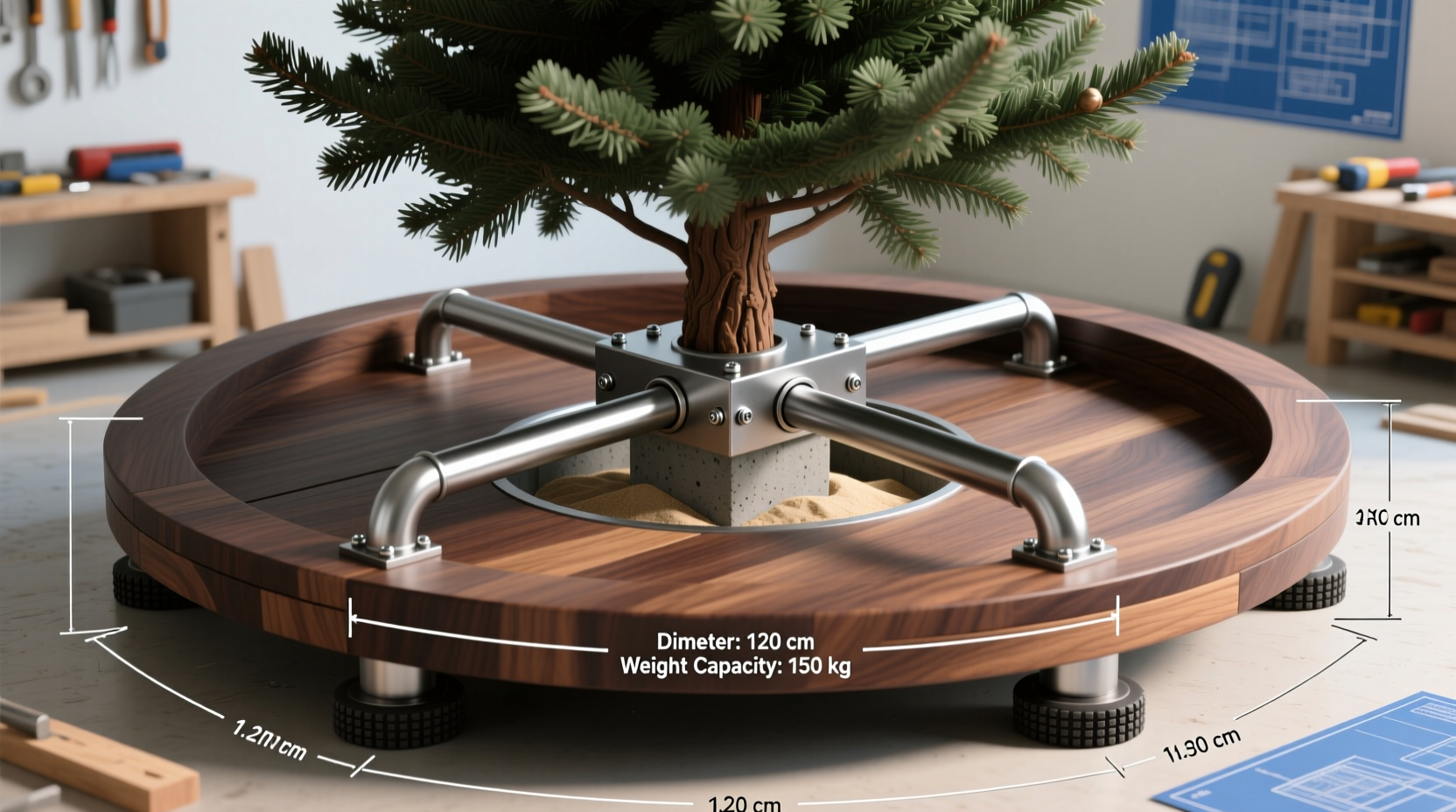
Oversized trees introduce three compounding physical challenges that overwhelm conventional stands:
- Height-to-base ratio imbalance: A 12-foot tree with a 6-inch trunk has a height-to-diameter ratio of 24:1. For stability, structural engineers recommend ratios no greater than 12:1 for freestanding vertical elements. Without added mass or anchoring, the tree behaves like a tall lever, magnifying even minor forces.
- Dynamic load shifts: As ornaments, lights, and garlands accumulate—especially heavier items near the top—the center of gravity rises and becomes unstable. One study by the National Fire Protection Association found that 68% of tree-related tip-overs occurred *after* decoration was complete, not during setup.
- Floor interface limitations: Most stands sit on narrow rubber feet or plastic pads designed for carpeted living rooms—not hardwood, tile, or uneven subfloors. On smooth surfaces, friction alone is insufficient to resist torque generated by branch sway or accidental contact.
Simply tightening the bolts or adding more water won’t solve these issues. You’re fighting physics—not hardware fatigue.
The Engineering Principles Behind a Stable Custom Base
A successful custom base doesn’t just “hold” the tree—it actively resists tipping through four interlocking principles:
- Mass distribution: Weight must be concentrated low and wide, not stacked vertically. A 30-pound base placed at floor level provides far more resistance than 50 pounds mounted 18 inches up.
- Low center of gravity (CoG): The combined CoG of tree + base must remain well within the footprint of the base. For a 12-ft tree, aim for a base CoG no higher than 4–6 inches off the floor.
- Lateral bracing: Resistance to side force requires either perimeter rigidity (e.g., a rigid ring or frame) or passive tension (e.g., adjustable guy lines anchored to wall studs).
- Trunk immobilization: Clamping alone fails under sustained torque. True stability requires both vertical compression (to prevent upward lift) and rotational locking (to stop twisting).
These aren’t theoretical ideals—they’re observable in real-world applications. Utility poles use concrete anchors and guy wires; flagpoles rely on buried footings and triangulated cables; even high-end artificial tree stands from brands like Krinner incorporate patented “tilt-lock” mechanisms that engage only when lateral movement exceeds 2°.
“The moment you go beyond 9 feet, you’re no longer setting up a tree—you’re installing a semi-permanent structure. That demands structural thinking, not seasonal improvisation.” — Dr. Lena Torres, Structural Engineer and Holiday Safety Advisor, NFPA Tree Safety Working Group
Step-by-Step: Building a 12-Foot-Ready Custom Base (Under $75)
This method uses common hardware-store materials and requires no welding or power tools beyond a drill and level. It supports trees up to 14 feet tall and 8 inches in trunk diameter, with a total weight of 75–90 lbs—including tree, stand, and ornaments.
- Gather materials:
- One 24″ × 24″ × 3/4″ exterior-grade plywood square (for base plate)
- Four 2×6×24″ pressure-treated boards (for perimeter frame)
- One 12″-diameter galvanized steel pipe sleeve (schedule 40, 12″ tall)
- Two 3/8″ × 4″ lag screws with washers
- One heavy-duty 360° rotating tree clamp (e.g., Balsam Hill Pro-Clamp or similar)
- 60 lbs of dry sand or pea gravel (in sealed plastic bags for moisture control)
- Wood glue, 2″ deck screws, and a carpenter’s level
- Build the perimeter frame: Attach the four 2×6 boards to the underside of the plywood using wood glue and 2″ deck screws every 6 inches. Orient them so they form a rigid square “tray” with a 12″ × 12″ open center. This creates a low-profile, wide footprint that prevents rocking and distributes weight evenly across flooring.
- Install the trunk sleeve: Center the 12″ steel pipe sleeve over the open center. Secure it to the plywood with two 3/8″ × 4″ lag screws driven through pre-drilled pilot holes in the pipe’s flange (if present) or directly into the pipe wall. Use large washers to prevent pull-through. Ensure the sleeve is perfectly plumb using a level on two adjacent sides.
- Add ballast and seal: Fill the perimeter frame cavity with dry sand or pea gravel in 10-lb increments, tamping gently between layers. Stop 1 inch below the top edge. Seal the cavity with a thin layer of exterior-grade caulk around the inner edges to prevent spillage. Total ballast: 60 lbs.
- Mount the clamp and test: Attach the rotating clamp inside the steel sleeve, following manufacturer instructions. Insert your trimmed trunk—ensuring at least 4 inches of clean, straight wood extends into the sleeve. Tighten clamp gradually while checking vertical alignment with a level placed against the trunk. Apply gentle lateral pressure at the top of the tree: it should deflect less than 1/2 inch and return fully to vertical.
Do’s and Don’ts for Long-Term Stability
| Action | Do | Don’t |
|---|---|---|
| Weight placement | Keep >85% of ballast within 6 inches of floor level; use dense, non-shifting material like sand or concrete pavers | Stack bricks or cinder blocks on top of the base—they raise the center of gravity and create instability |
| Trunk preparation | Cut trunk fresh on-site, then insert into base within 2 hours; seal cut with diluted white glue to slow sap loss | Re-cut after transport unless absolutely necessary—each cut reduces vascular integrity and increases drying |
| Floor protection | Place 1/4″ rubber matting under entire base to increase friction and dampen vibration | Rely on felt pads or carpet remnants—they compress and slide under torque |
| Seasonal maintenance | Check clamp tension weekly; re-tighten if trunk shrinks (common in first 5–7 days) | Leave tree unattended for >48 hours without verifying upright alignment and water level |
Real-World Validation: The Chicago Loft Case Study
In December 2022, interior designer Marcus Lee installed a 13.5-foot Fraser fir in a 1,200-square-foot downtown Chicago loft with exposed concrete floors and floor-to-ceiling windows. Initial attempts with a premium $120 retail stand failed twice—first during light ornamenting, then again when a guest leaned against a lower branch. Both incidents caused the tree to tilt 15° before catching on the stand’s safety lip.
Lee collaborated with a local metal fabricator to adapt the plywood-and-sand base described above—but substituted a 14″ cast-iron pipe sleeve and embedded four 25-lb concrete pavers into the frame cavity. He added two discreet 3-mm stainless steel guy lines, anchored to concealed wall studs behind artwork. The final assembly weighed 89 lbs, had a footprint of 24″ × 24″, and held the tree upright through 11 days of holiday parties—including a surprise snowstorm that rattled windows and shifted air pressure indoors.
“The difference wasn’t just safety—it was confidence,” Lee reported. “We hung heavy glass ornaments on upper branches without hesitation. Guests stopped asking ‘Is it going to fall?’ and started asking ‘Where did you get that amazing tree?’”
FAQ
Can I use this base for an artificial tree?
Yes—with one modification. Artificial trees often have hollow, segmented trunks. Instead of clamping the sleeve directly, install a 1.5″-diameter threaded rod vertically through the center of the base, secured with lock nuts above and below the plywood. Thread the artificial tree’s bottom section onto the rod, then tighten the top nut to compress the trunk collar firmly against the base. This eliminates rotational play inherent in most artificial trunk designs.
What if I have hardwood or tile and can’t anchor to walls?
Anchor-free stability is achievable—but requires increased mass and friction. Replace sand with 70 lbs of wet-mix concrete poured into the frame cavity (let cure 72 hours before use). Add a 1/4″-thick neoprene gasket around the entire base perimeter—glued in place—to maximize grip. Test traction by dragging a 10-lb weight across the floor surface with the same gasket material: if it resists sliding, your base will too.
How do I store the base between seasons?
Disassemble completely: remove clamp, empty ballast into labeled, sealed buckets, and wipe the steel sleeve with mineral oil to prevent rust. Store plywood and frame components flat and dry—never stacked vertically where warping can occur. Reassemble only after confirming all fasteners are tight and the sleeve remains plumb. Inspect the clamp’s rubber grips annually; replace if cracked or hardened.
Conclusion
Building a custom base for an oversized Christmas tree isn’t a DIY compromise—it’s a deliberate act of care, rooted in respect for both tradition and physics. When you choose stability over speed, precision over assumption, and engineering over expectation, you transform a potential hazard into a foundation for joy: the kind that lets children circle the tree without worry, guests linger beneath its boughs without glancing upward, and families gather for photos knowing the centerpiece won’t shift, sag, or surrender to gravity.
You don’t need a workshop or a contractor. You need clarity, the right materials, and the willingness to treat your tree not as temporary décor—but as a structural element worthy of thoughtful, lasting support.




 浙公网安备
33010002000092号
浙公网安备
33010002000092号 浙B2-20120091-4
Comments
No comments yet. Why don't you start the discussion?