
Every LEGO Christmas tree — whether it’s the iconic 10294 Christmas Tree, the compact 40530 Holiday Tree, or a custom MOC — deserves more than a flat plate. A thoughtfully engineered base transforms a seasonal centerpiece into a narrative stage: one where carolers gather, elves inspect presents, and Santa pauses mid-landing. Yet most builders settle for generic 16×16 plates or mismatched stands that wobble, obscure details, or fail to integrate minifigures meaningfully. The solution isn’t buying another set — it’s designing a purpose-built base grounded in LEGO geometry, structural integrity, and festive storytelling. This guide distills over a decade of holiday MOC development, real-world display testing, and community feedback into a practical, modular approach you can adapt to any tree set you own — no advanced tools, no glue, and no guesswork.
Why Off-the-Shelf Bases Fall Short
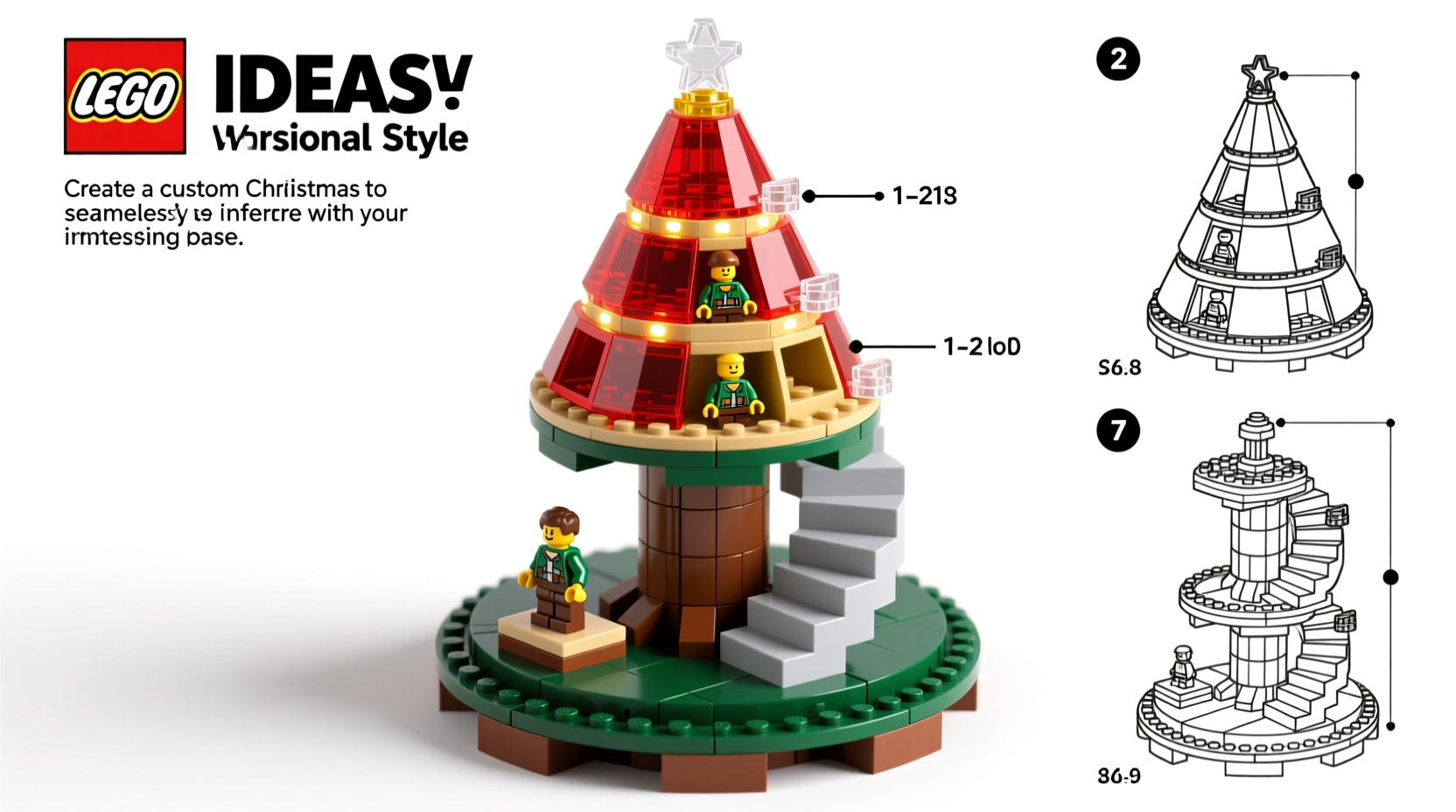
Pre-made LEGO tree bases often prioritize aesthetics over function. The official 10294 set includes a simple 8×8 green base with a single stud at the center — adequate for anchoring the trunk but useless for positioning figures or adding terrain. Third-party stands typically focus on height or rotation, neglecting three critical needs: scale consistency, minifigure accessibility, and set compatibility. A base built for a 2023 modular tree may lift the trunk too high for a 2017 version; a decorative snowbank might block access to the tree’s lower branches or interfere with hinge mechanisms. Worse, many assume all trees share the same attachment footprint — they don’t. The 10294 uses a 2×2 stud cluster at its base; the 40530 relies on a single central stud with surrounding slope pieces; smaller sets like 40478 use a 1×1 round plate. Without measuring and mapping your specific set’s connection points, even a beautifully detailed base risks instability or visual dissonance.
Measuring & Mapping Your Tree’s Footprint
Accurate measurement is non-negotiable. Start by removing the tree from its current base (if applicable) and placing it upright on a clean 32×32 baseplate. Use a fine-tip marker to trace the outline of the trunk’s contact area. Then, identify the primary attachment points — not just where studs protrude, but where weight transfers and lateral stability is maintained.
For example:
- 10294 Christmas Tree: Four 1×1 round plates arranged in a 2×2 square (centered at studs 15–16, rows 15–16 on a 32×32 plate). Total footprint: 2×2 studs, but weight is distributed across eight supporting 1×1 bricks beneath the trunk.
- 40530 Holiday Tree: Single central 1×1 round plate, surrounded by four 1×1 slope pieces forming a subtle dome. Effective footprint: 3×3 with a raised center — requiring a recessed well or elevated ring for secure fit.
- 40478 Festive Tree: One 1×1 round plate atop a 2×2 tile — best anchored with a recessed 1×1 stud surrounded by 1×1 tiles for flush alignment.
This mapping informs every subsequent decision: stud density, layer height, and terrain elevation. Skipping this step leads to bases that either float above the trunk (causing visible gaps) or compress critical joints (risking breakage).
Structural Design Principles for Stability & Scale
A stable LEGO base balances three forces: vertical load bearing, lateral resistance, and rotational inertia. Unlike static sculptures, Christmas trees sway slightly when touched or placed near foot traffic. Your base must absorb that motion without toppling or shifting minifigures.
The optimal foundation starts with a rigid core. Avoid relying solely on stacked plates — they flex under weight. Instead, anchor the entire assembly to a 16×16 or 24×24 baseplate using Technic pins or integrated clips. Then, build upward in layers:
- Base Layer (0–1 brick tall): A full 16×16 plate or tile grid, secured to your display surface. This prevents rocking and provides consistent reference points.
- Stabilization Layer (1–2 bricks tall): A frame matching your tree’s footprint exactly — e.g., a 2×2 hollow square for the 10294 — filled with internal support bricks (like 1×2 plates with clips) to lock the trunk in place.
- Terrain Layer (2–4 bricks tall): Graduated elevation using slopes, tiles, and curved pieces to create natural-looking ground cover (snow, grass, cobblestone) while keeping minifigure feet level and accessible.
- Display Layer (optional, 1–2 bricks tall): Integrated elements like benches, gift stacks, or lampposts — positioned so minifigures stand *on* the terrain, not *in front of* it.
Crucially, maintain consistent scale. Minifigures are 6 bricks tall. Their feet rest on 1 brick height (standard plate), so terrain should rise no more than 2–3 bricks to avoid awkward leg angles or visibility obstruction. A 4-brick-high snowdrift may look dramatic, but it forces figures to perch precariously — or worse, requires bending legs unnaturally.
| Design Element | Recommended Height (Bricks) | Purpose | Risk if Exceeded |
|---|---|---|---|
| Trunk Anchor Frame | 1–2 | Secures connection point without straining joints | Trunk warping or stud shearing |
| Snow Ground Cover | 1–2 | Creates texture while keeping minifigure feet visible | Figures appear “floating” or require unnatural poses |
| Gift Stack Base | 1 | Provides stable platform for 1×2 or 2×2 gift boxes | Toppling during handling or display adjustments |
| Lamppost or Signpost | 3–4 | Clears minifigure head height for readability | Obstructing view of tree or figures |
Step-by-Step Build: A Universal 16×16 Base for Most Sets
This modular base works with the 10294, 40530, and most third-party trees. It takes under 90 minutes and uses only common parts (no rare elements required).
- Prepare the Foundation: Secure a 16×16 gray or dark green baseplate to your display surface using double-sided tape or museum putty. Ensure it’s perfectly level.
- Build the Trunk Anchor: For the 10294: Place four 1×1 round plates at positions (7,7), (7,8), (8,7), (8,8) — matching the tree’s 2×2 footprint. Surround each with a 1×1 tile to prevent lateral slippage. For the 40530: Center a single 1×1 round plate at (8,8), then build a 3×3 ring of 1×1 slope pieces (inverted) around it to cradle the dome shape.
- Add Structural Reinforcement: Underneath the anchor zone, add two 1×8 Technic bricks oriented east-west and two north-south, interlocked at the center. Insert 2×2 plates with pins into their holes to lock the entire anchor grid to the baseplate.
- Create Terrain: Using white 1×1 round plates and 1×1 tiles, build a gently undulating snow field. Start at 1 brick height at the anchor edge, rise to 2 bricks at the outer perimeter (positions 1–3 and 14–16), then taper back down. Fill gaps with 1×1 cheese slopes for texture.
- Integrate Minifigure Features: At six evenly spaced points around the perimeter (e.g., positions (3,3), (3,13), (8,16), (13,13), (13,3), (8,0)), attach 1×1 plates with clips. Slide in 1×2 jumper plates to create low-profile benches. Add 1×1 round plates with printed gift patterns as floor-level presents.
- Finalize Details: Place three 1×1 translucent yellow round plates as “light reflections” on the snow. Add a 1×1 red tile with black dot (a candy cane) leaning against the trunk. Test stability by gently rocking the tree — it should hold firm with zero lateral movement.
“The strongest LEGO displays aren’t the tallest or most complex — they’re the ones where every element serves dual purpose: structure *and* storytelling. A bench isn’t just seating; it’s a brace. A snowbank isn’t just decoration; it’s a dampener for vibration.” — Lars Bjornsson, LEGO Certified Professional & Display Architect
Real-World Case Study: The Community Center Tree Project
In December 2022, the Portland LEGO Users Group built a 4-foot-tall Christmas tree display for their city’s downtown library. They used the 10294 as the centerpiece but needed to accommodate 12 unique minifigures — including a wheelchair-using elf, a toddler caroler, and a senior Santa — all interacting authentically with the tree. Initial attempts with a standard 16×16 base failed: the wheelchair figure tipped when placed near the trunk due to uneven snow elevation, and the toddler’s short legs couldn’t reach the “ground” without a step stool (not LEGO). Their solution? A revised base with three key adaptations: (1) a 1-brick-deep recessed lane running from the trunk to the outer edge, allowing the wheelchair to roll smoothly; (2) a 1×4 tile ramp with 1×1 slope transitions at both ends; and (3) a 1-brick-tall “step” embedded with 1×1 round plates at the toddler’s designated spot, enabling stable standing without bending. The result wasn’t just functional — it became a talking point for inclusive design, featured in the library’s holiday newsletter and replicated by five other regional groups.
Do’s and Don’ts for Long-Term Display Success
Even the best-built base fails without proper maintenance and placement. Here’s what separates seasonal charm from seasonal frustration:
- DO place your tree away from direct sunlight — UV exposure yellows white pieces and fades printed elements like gift patterns within 3–4 months.
- DO dust weekly with a soft, dry makeup brush — never compressed air, which can dislodge tiny parts or force dust into joints.
- DO rotate minifigures monthly to prevent stress on leg joints from static posing.
- DON’T store the base assembled year-round — humidity causes micro-warping in large plates. Disassemble and store flat in labeled bags.
- DON’T use adhesive putty or hot glue anywhere near LEGO elements — residue damages ABS plastic and voids warranty on newer sets.
- DON’T overload the base with heavy accessories (e.g., metal ornaments or ceramic figurines) — LEGO’s structural limits are precise: 10294’s trunk supports up to 1.2 kg; exceeding that stresses internal hinges.
FAQ
Can I adapt this base for a non-LEGO tree — like a wooden or ceramic one?
Yes, but with caveats. You’ll need to fabricate a custom adapter plate using a 1×1 LEGO stud glued to a wood disc or ceramic base (use epoxy rated for plastic-to-porcelain bonding). Never attach LEGO directly to heat sources or unstable surfaces. Test weight distribution thoroughly before final mounting.
What if my tree has a rotating base? Will this interfere?
Only if you build over the rotation mechanism. Identify the turntable’s diameter (usually 6×6 or 8×8) and leave that central zone completely open — no tiles, no slopes, no attachments. Build your terrain *around* it, not on top. Use 1×1 round plates with rubber grips underneath the outer ring to dampen vibration without inhibiting spin.
How do I keep minifigures from falling off during holiday gatherings?
Two proven methods: First, use 1×1 plates with clips to secure legs — slide the clip over the ankle joint for gentle retention. Second, position figures near structural elements (benches, gift stacks, lampposts) so their arms or hands can lightly grip adjacent pieces. Avoid relying on friction alone — it degrades with temperature changes and handling.
Conclusion
A custom LEGO Christmas tree base is more than engineering — it’s hospitality in brick form. It invites viewers to pause, lean in, and discover stories tucked between the branches and snow-dusted gifts. It respects the craftsmanship of your existing set while elevating its role in your home’s seasonal rhythm. You don’t need rare parts, expensive tools, or years of experience. You need precise measurement, intentional layering, and the willingness to treat minifigures not as accessories but as characters with posture, perspective, and presence. Start small: map your tree’s footprint tonight. Sketch one terrain idea on paper tomorrow. Build the anchor layer this weekend. In less than a month, you’ll have a base that doesn’t just hold a tree — it holds memories, intention, and quiet joy.




 浙公网安备
33010002000092号
浙公网安备
33010002000092号 浙B2-20120091-4
Comments
No comments yet. Why don't you start the discussion?