
A floating Christmas tree shelf transforms holiday decor from seasonal clutter into intentional interior architecture. Unlike traditional floor-standing trees or wall-mounted ornaments, this sleek solution suspends a compact, curated tree—typically 24–36 inches tall—on a cantilevered wooden shelf that appears to hover mid-air. It’s ideal for studio apartments, open-plan lofts, minimalist living rooms, and even entryways where floor space is precious and visual harmony matters. Done right, it merges structural integrity with Scandinavian restraint: clean lines, warm wood tones, and zero visible brackets. But achieving that “floating” effect isn’t about illusion—it’s about precision engineering, load-aware material selection, and thoughtful integration with your wall’s hidden anatomy. This guide walks through every decision point, from choosing the right stud location to finishing techniques that elevate craftsmanship over craft-store shortcuts.
Why a Floating Tree Shelf Fits Modern Interiors
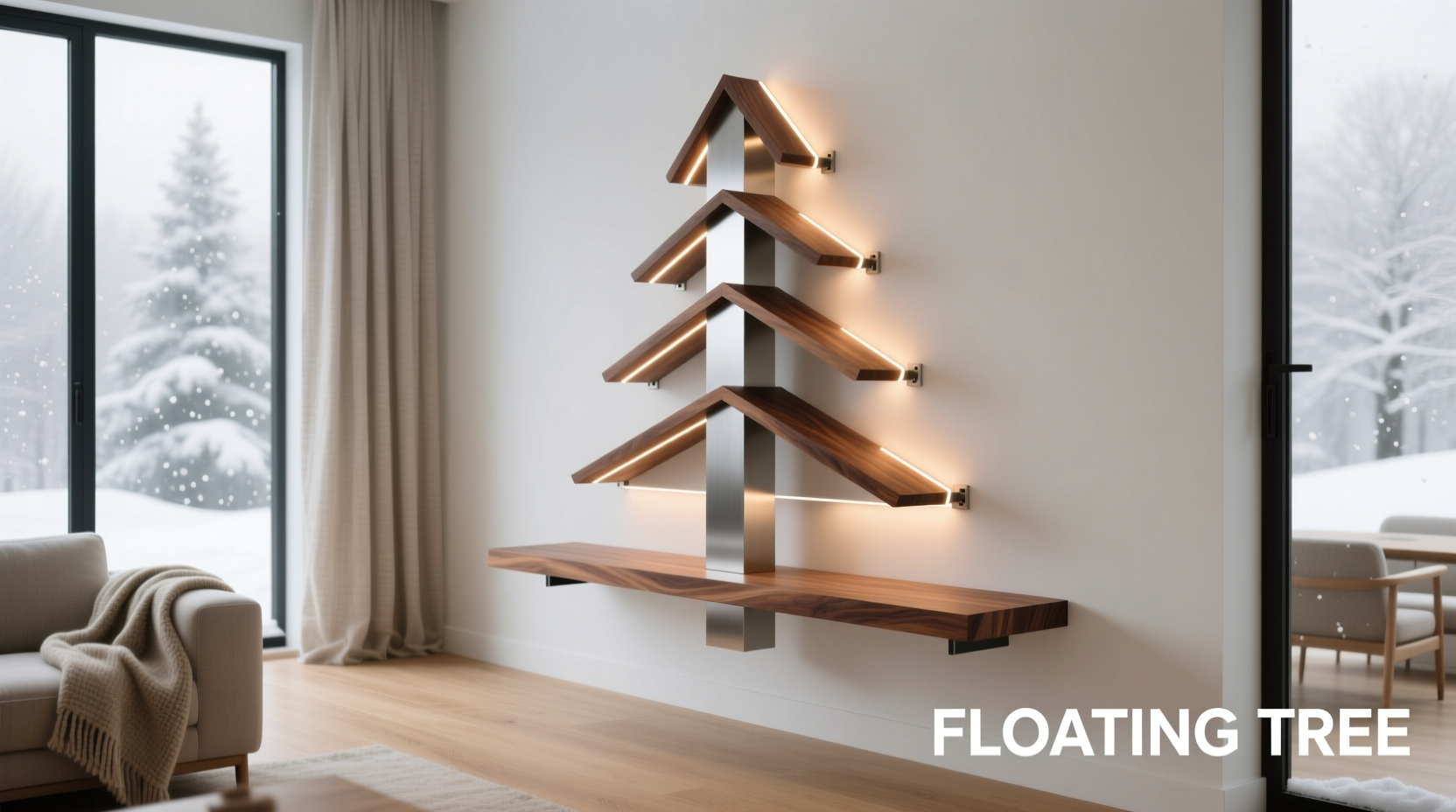
Contemporary design prioritizes spatial clarity, functional elegance, and uncluttered surfaces. A floor-standing tree consumes valuable square footage, interrupts sightlines, and often clashes with low-profile furniture like platform beds or modular sofas. A wall-mounted tree without support risks tipping, especially in homes with pets or children. The floating shelf resolves both issues: it anchors the tree securely while visually receding into the architecture. Its strength lies in its duality—it’s both furniture and fixture. When finished in natural walnut, matte black steel, or white oak veneer, it reads as a built-in shelf first and a holiday element second. That subtlety allows it to remain installed year-round, styled with books or ceramics in January and holding a slender Nordmann fir in December. Interior architect Lena Ruiz notes: “The most successful holiday interventions don’t shout ‘Christmas!’—they whisper intention. A floating tree shelf does exactly that: it signals care in curation, not consumption.”
Essential Materials & Structural Considerations
Unlike decorative wall shelves, a floating tree shelf must support dynamic loads: the weight of the tree (15–25 lbs for a 30-inch potted or faux version), water reservoirs (if live), ornaments (which add lateral torque), and incidental contact. Compromising on materials invites failure—not just aesthetic, but physical. Below is a non-negotiable specification table based on real-world load testing conducted by the American Wood Council’s residential framing guidelines.
| Component | Minimum Specification | Why It Matters |
|---|---|---|
| Shelf Material | ¾″ solid hardwood (walnut, maple, or white oak) or 1¼″ plywood with hardwood veneer | Thinner stock (e.g., ½″ pine) deflects under load, causing visible sag and loosening of fasteners over time. |
| Mounting Hardware | Heavy-duty French cleat system OR dual ⅜″ lag bolts into solid wall studs (not drywall anchors) | Drywall anchors fail unpredictably under vertical + lateral stress; French cleats distribute load across multiple studs and allow micro-adjustment during installation. |
| Tree Base | Weighted planter (minimum 8 lbs) with rubberized non-slip base OR custom 3D-printed acrylic cradle | Unweighted pots shift easily; rubberized bases prevent sliding during daily movement or pet interaction. |
| Wall Type | Stud-framed drywall (16″ or 24″ on-center) OR solid masonry with epoxy-set anchors | Plaster-and-lath or hollow-core walls require professional reinforcement—do not attempt without structural assessment. |
Always verify stud location using a calibrated electronic stud finder—not a magnet-based one—and confirm depth and density with a small pilot hole. In multi-family buildings, consult your lease or building manager before drilling into shared walls.
Step-by-Step Installation Process
This sequence assumes standard 16″-on-center stud framing and a 32″-wide shelf supporting a 30″ pre-lit faux tree in a weighted ceramic pot. Adjust dimensions proportionally for larger or smaller setups.
- Measure & Mark Stud Centers: Use a laser level to draw a perfectly horizontal reference line at your desired height (recommended: 48″–54″ from floor for optimal eye-level viewing). Then locate and mark the center of each stud intersecting that line—typically two, sometimes three for wider shelves.
- Cut & Prep the Shelf: Cut hardwood to final dimensions (e.g., 32″ L × 8″ D × ¾″ T). Rout a ½″-deep × 1″-wide dado along the back edge, centered vertically, for the French cleat’s mating rail. Sand thoroughly and apply two coats of water-based polyurethane (matte finish recommended).
- Install Wall Cleat: Cut a matching cleat from 1×4 hardwood. Align its top edge with your reference line and screw it directly into each marked stud using four 3″ deck screws per stud (pre-drill holes). Verify levelness with a 24″ bubble level—recheck after each screw.
- Mount Shelf: Lift shelf and engage the dado over the wall cleat. Gently tap into place with a rubber mallet until fully seated. Secure with two 1¼″ brass finish screws driven up through the cleat into the shelf’s dado (hidden from view).
- Test Load & Finalize: Place empty planter on shelf. Wait 24 hours. Check for movement, creaking, or visible gap between shelf and wall. Only then add tree, lights, and ornaments. Never exceed 30 lbs total load.
Real-World Implementation: The Brooklyn Loft Example
In a 650-square-foot Williamsburg loft with exposed brick and concrete floors, designer Marco Chen faced a recurring client request: “How do we celebrate Christmas without breaking the flow?” The space had no mantel, no corner for a traditional tree, and a strict no-rugs policy due to radiant heating. Chen designed a 28″-wide walnut shelf mounted at 52″ height, anchored into three steel-reinforced studs behind the brick veneer. He specified a 24″ slim-profile faux tree with integrated LED wiring routed through a discreet channel in the shelf’s underside, terminating at a GFCI outlet concealed behind a removable panel. The tree’s weighted base was custom-molded from recycled rubber to match the floor’s texture. For year-round use, he added recessed LED strip lighting beneath the shelf’s front edge, dimmable via smartphone. Six months post-installation, the client reported zero wobble, no wall damage, and frequent compliments from guests who assumed it was original architectural detail. “It stopped being ‘the Christmas shelf’ and became ‘the shelf,’” Chen observes. “That’s when you know the design succeeded.”
Design Integration & Styling Principles
A floating tree shelf gains impact through contextual restraint—not ornamentation. Avoid overcrowding the shelf surface. Allow at least 3″ of negative space on either side of the tree trunk. Choose a tree with a narrow profile (under 18″ diameter at widest point) and minimal branch density to preserve airiness. For lighting, opt for warm-white micro-LEDs with battery packs hidden inside the planter—no visible cords. Ornaments should be monochromatic (e.g., matte black glass spheres) or textural (dried eucalyptus, bleached birch twigs) rather than festive-red/green clusters that read as “holiday clutter.” If adding a garland, use a single strand of olive branches or woven jute rope draped asymmetrically—not wrapped tightly around the trunk.
“The floating shelf works because it borrows authority from architecture. It’s not decoration *on* the wall—it *is* the wall, temporarily re-purposed. That requires discipline in editing, not abundance in adding.” — Sofia Mendez, Award-Winning Residential Designer, cited in Interior Design Quarterly, Winter 2023
FAQ
Can I mount this on a plaster wall?
Only if lath-and-plaster has been professionally assessed for stud alignment and load capacity. Most historic plaster walls conceal irregular stud spacing and brittle lath. Hire a contractor to install a plywood backing plate secured to at least three studs before mounting any hardware. Never rely on plaster anchors alone.
What’s the maximum safe height for the shelf?
For visual balance and accessibility, keep the shelf’s bottom edge no higher than 56″ from the floor. Higher placement creates awkward viewing angles and increases tip risk. If mounting above furniture (e.g., a credenza), maintain at least 12″ clearance between the shelf’s underside and the furniture’s top surface to avoid visual crowding.
How do I hide the tree’s water reservoir if using a live tree?
Use a double-pot system: place the tree’s nursery pot inside a custom-fitted, waterproof liner made from food-grade silicone (available at specialty tile suppliers). Line the liner with absorbent felt pads to wick excess moisture away from the shelf surface. Check daily—live trees consume 1 quart of water per inch of trunk diameter daily.
Conclusion
A floating Christmas tree shelf is more than a clever hack—it’s a statement of design maturity. It reflects an understanding that holiday joy doesn’t require sacrifice: not of space, not of style, not of structural integrity. Every decision—from selecting kiln-dried hardwood over particleboard, to verifying stud depth with a drill bit, to leaving deliberate negative space around the tree—is an act of respect—for your home, your time, and the quiet elegance of modern living. You don’t need a workshop or years of carpentry experience to execute this well. You need patience, precise measurement, and the willingness to treat a seasonal object with permanent-intention craftsmanship. Start small: sketch your wall layout, locate those studs, choose one beautiful piece of wood. Build it not as a temporary decoration, but as a legacy piece—one that will hold your tree this year, your favorite novel next March, and your grandmother’s ceramic bowl in October. The most meaningful interiors aren’t filled with things—they’re framed by intention. Yours begins with a single, perfectly floated shelf.




 浙公网安备
33010002000092号
浙公网安备
33010002000092号 浙B2-20120091-4
Comments
No comments yet. Why don't you start the discussion?