
During the holiday season, every square inch of space counts—especially when it comes to showcasing ornaments, candles, family photos, and festive décor. If you're looking to maximize your Christmas tree’s visual impact without cluttering the floor or nearby furniture, a custom-built floating shelf wrapped around the tree offers an elegant and functional solution. Unlike traditional side tables or stands, a floating shelf adds usable surface area while maintaining an open, airy aesthetic that complements your tree rather than competes with it.
This guide walks through the entire process of designing and installing a sturdy, attractive floating shelf tailored to encircle your Christmas tree. Whether you’re working with a pre-lit artificial tree in the corner of your living room or a real fir centered in your dining area, this project can be customized to fit your space and style. From selecting the right materials to ensuring structural safety, we’ll cover everything you need to know to complete this DIY upgrade successfully—just in time for the holidays.
Why a Floating Shelf Around Your Tree Makes Sense
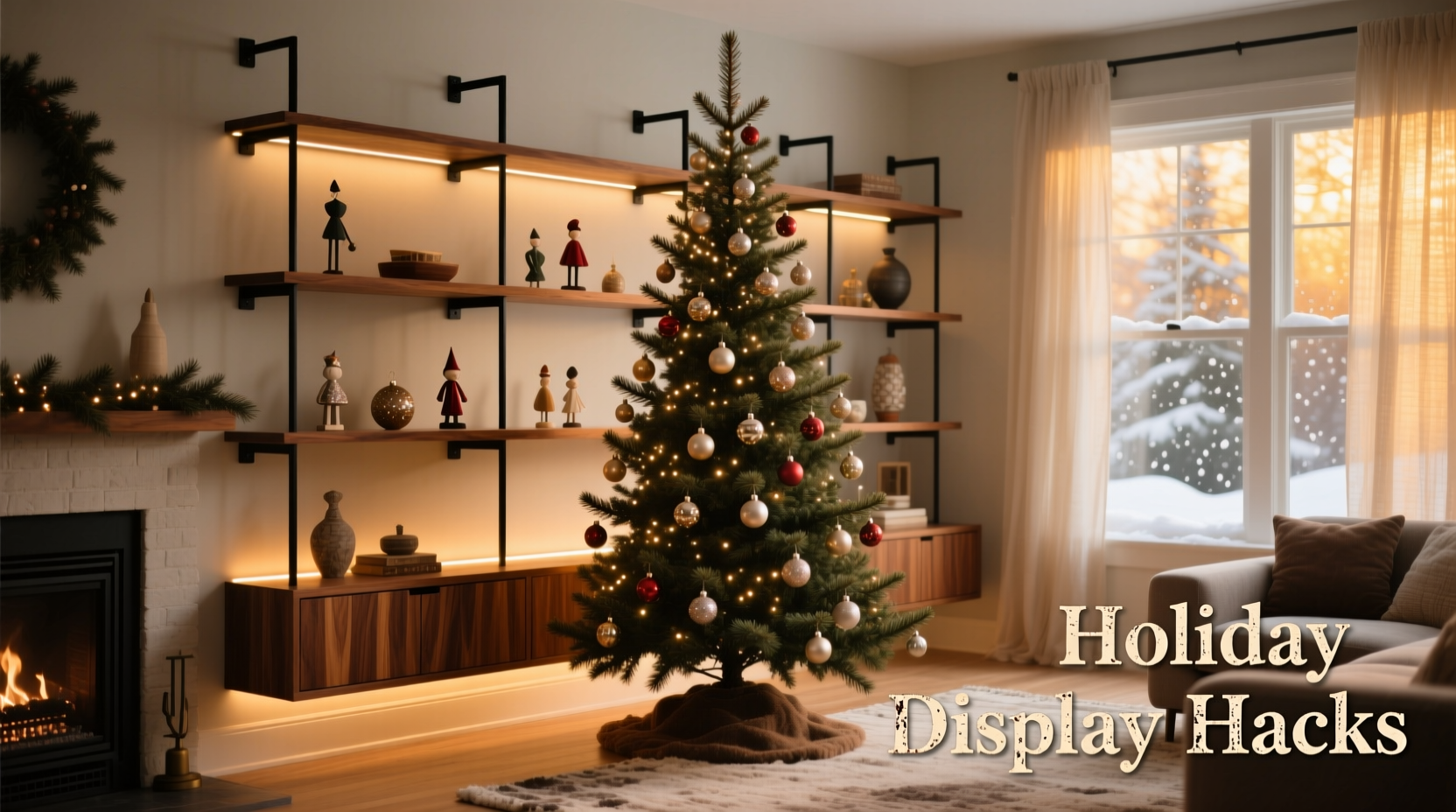
A Christmas tree is often the centerpiece of seasonal décor, but its footprint typically limits what you can place near it. A floating shelf built around the tree solves multiple problems: it prevents tripping hazards from cords and gifts on the floor, creates dedicated space for smaller decorations, and enhances the overall symmetry of your display.
The concept works best when the shelf follows the contour of the tree’s base—usually a semi-circular or quarter-round design—mounted securely to wall studs. It remains invisible until loaded with décor, at which point it becomes both practical and decorative. Think of it as architectural ornamentation that serves a purpose beyond aesthetics.
Interior designers increasingly recommend built-in solutions like this for small-space holiday styling. As Sarah Linhart, residential design consultant and author of Seasonal Spaces, explains:
“Integrating storage and display into the architecture of a room keeps holiday setups looking intentional, not temporary. A floating shelf around a tree blurs the line between decoration and design.” — Sarah Linhart, Interior Stylist & Author
Planning and Measuring for Your Custom Shelf
Before cutting any wood, precise planning ensures your shelf fits seamlessly around the tree without interfering with branches or stability. Follow these steps to map out your design accurately.
- Determine shelf height: Most people install the shelf between 18 and 30 inches above the floor. This keeps it accessible but high enough to avoid pet traffic and vacuuming issues.
- Measure tree diameter at shelf level: Use a flexible tape measure to find the widest part of the tree at the intended shelf height. Add 6–8 inches total (3–4 inches on each side) for overhang and clearance.
- Decide on shape: For trees in corners, a quarter-circle shelf works well. Trees in open spaces may benefit from a half-circle design. Full circles are rare due to access constraints.
- Locate wall studs: Use a stud finder to identify framing behind drywall. Floating shelves must anchor into studs for safe weight support.
- Sketch a rough blueprint: Draw a simple diagram showing radius, depth (typically 8–12 inches), and mounting points. Include clearance for tree stand and skirt.
Materials and Tools You’ll Need
Gathering the right supplies ahead of time streamlines construction and reduces frustration. Below is a comprehensive checklist based on a standard half-circle, 36-inch radius shelf made from pine or poplar.
Checklist: Build Materials & Equipment
- ¾-inch hardwood plywood or solid wood board (for shelf surface)
- 1x4 or 1x6 pine boards (for curved front edge/rail)
- Wall-mounted French cleat or heavy-duty floating shelf brackets (rated for 50+ lbs)
- Wood screws (2.5-inch for framing, 1.25-inch for finish work)
- Wood glue
- Sander (orbital preferred) and sandpaper (120–220 grit)
- Paint or stain + primer (optional, for finishing)
- Caulk and wood filler (for seamless joints)
- Stud finder, level, drill, jigsaw, measuring tape
- Clamps and masking tape
The choice between painted or stained finishes depends on your room’s décor. White-painted shelves blend with trim and enhance brightness, while walnut-stained wood adds warmth and richness next to green foliage.
Step-by-Step Construction Guide
With materials gathered and measurements confirmed, follow this sequence to build and install your shelf safely and professionally.
- Create the shelf template: Cut a long strip of cardboard or thin poster board to act as a compass. Fix one end at the center point of your tree’s position against the wall. Rotate the other end to trace the desired curve. Transfer this arc onto your plywood using a pencil and connect it to straight edges if needed.
- Cut the base shelf: Secure the plywood to sawhorses. Use a jigsaw with a fine-tooth blade to cut along the marked curve. Sand edges smooth after cutting.
- Build the front lip (optional): To prevent items from sliding off, attach a curved 1x4 board to the outer edge. Bendable \"kerfed\" wood or laminated strips work best for tight curves. Clamp in place, apply wood glue, and fasten with countersunk screws from underneath.
- Install mounting system: Attach a French cleat or bracket system. For a French cleat, cut two matching beveled strips—one fixed to the wall into studs, the other to the back of the shelf. When joined, they lock securely. Ensure the wall-mounted piece is perfectly level.
- Mount the shelf: With help, lift the shelf onto the wall cleat or brackets. Double-check alignment and secure additional screws through the top flange if applicable.
- Finish and seal: Fill screw holes and seams with wood filler. Sand smooth. Apply primer, then paint or stain in 2–3 thin coats. Allow full curing before loading.
Design Considerations and Safety Tips
While the shelf enhances décor, safety must remain a priority—especially in homes with children or pets. Consider the following guidelines to ensure durability and peace of mind.
| Do | Don’t |
|---|---|
| Anchor all supports directly into wall studs | Use only drywall anchors for shelf mounting |
| Limit shelf depth to 12 inches to reduce strain | Extend the shelf too far, risking leverage failure |
| Load no more than 20–30 pounds evenly distributed | Place heavy electronics or liquids on the shelf |
| Leave 3–4 inches between tree trunk and shelf inner edge | Allow branches to press against the shelf during setup |
| Use LED battery-powered candles instead of real flames | Place open flames or hot devices near tree branches |
Also consider accessibility. If you change your tree annually, design the shelf so it doesn’t interfere with assembly. Some homeowners leave the shelf installed year-round, repurposing it for books, plants, or photo frames once the holidays pass—a smart dual-use strategy that justifies the effort.
Real Example: The Thompson Family Living Room Upgrade
The Thompsons, a family of four in Portland, Oregon, struggled each year with limited space around their 7-foot pre-lit tree. Gifts piled up underfoot, and delicate snow globes had nowhere safe to go. After researching compact holiday hacks, they decided to build a half-circle floating shelf anchored to two studs behind the tree.
Using poplar wood and a French cleat system, they crafted a 10-inch deep shelf with a gently curved front rail. Painted matte white to match their crown molding, the shelf now holds miniature reindeer figurines, a vintage nutcracker, and a string of warm-white fairy lights. “It looks like it was always meant to be there,” says homeowner Lisa Thompson. “And we finally have a spot for Grandma’s heirloom ornaments without worrying about the dog knocking them over.”
The entire project took one weekend and cost under $80 in materials. They plan to use the same shelf for Easter bunnies and fall pumpkins with simple décor swaps.
Frequently Asked Questions
Can I build this shelf if my tree is in the middle of the room?
A fully circular floating shelf isn’t feasible without central support, which would obstruct the tree stand. However, if your tree is near a wall—even slightly—you can still install a C-shaped or U-shaped shelf attached to that wall segment. The key is having at least one solid anchoring surface.
What if I can’t find studs where I want the shelf?
Studs are non-negotiable for load-bearing safety. If placement conflicts arise, adjust the shelf radius or height to align with available framing. Most walls have studs spaced 16 inches apart; slight repositioning usually resolves alignment issues. Never rely solely on drywall anchors for this type of installation.
Will the shelf damage my wall when removed?
If you ever decide to remove it, patching is straightforward. Screw holes in studs can be filled with spackle or wood plugs. The shelf itself can be sanded and repurposed elsewhere—on a patio, in a closet, or as a plant ledge. Using removable caulk instead of permanent adhesive also simplifies future removal.
Final Thoughts and Next Steps
Building a floating shelf around your Christmas tree is more than a clever storage hack—it’s a way to elevate your holiday presentation with thoughtful craftsmanship. By integrating function and form, you create a lasting feature that brings joy not just during December, but potentially throughout the year. The project challenges basic woodworking skills, encourages precision, and rewards patience with visible, meaningful results.
Now that you have a clear roadmap—from measurement to mounting—gather your tools and start planning your design. Even if you’ve never used a jigsaw before, this is an achievable beginner-to-intermediate project with immense payoff. Imagine turning heads at your next holiday gathering as guests admire both your beautifully decorated tree and the elegant shelf that seems to float around it like magic.




 浙公网安备
33010002000092号
浙公网安备
33010002000092号 浙B2-20120091-4
Comments
No comments yet. Why don't you start the discussion?