
For urban dwellers, micro-apartment residents, and anyone living in under-400-square-foot spaces, the traditional Christmas tree presents a logistical puzzle: where do you put a six-foot evergreen when your living room doubles as a bedroom and your hallway is narrower than a coat closet? The answer isn’t downsizing to a tabletop sprig or skipping the tradition altogether—it’s reimagining the tree entirely. A floating shelf Christmas tree display transforms vertical wall space into festive real estate, delivering visual impact without sacrificing square footage. This approach isn’t just clever; it’s structurally sound, customizable, and surprisingly easy to execute with basic tools and thoughtful planning. Unlike freestanding trees that compete for precious floor area, this solution anchors holiday spirit to the wall—elevating both decor and spatial intelligence.
Why Floating Shelf Trees Work in Tiny Spaces
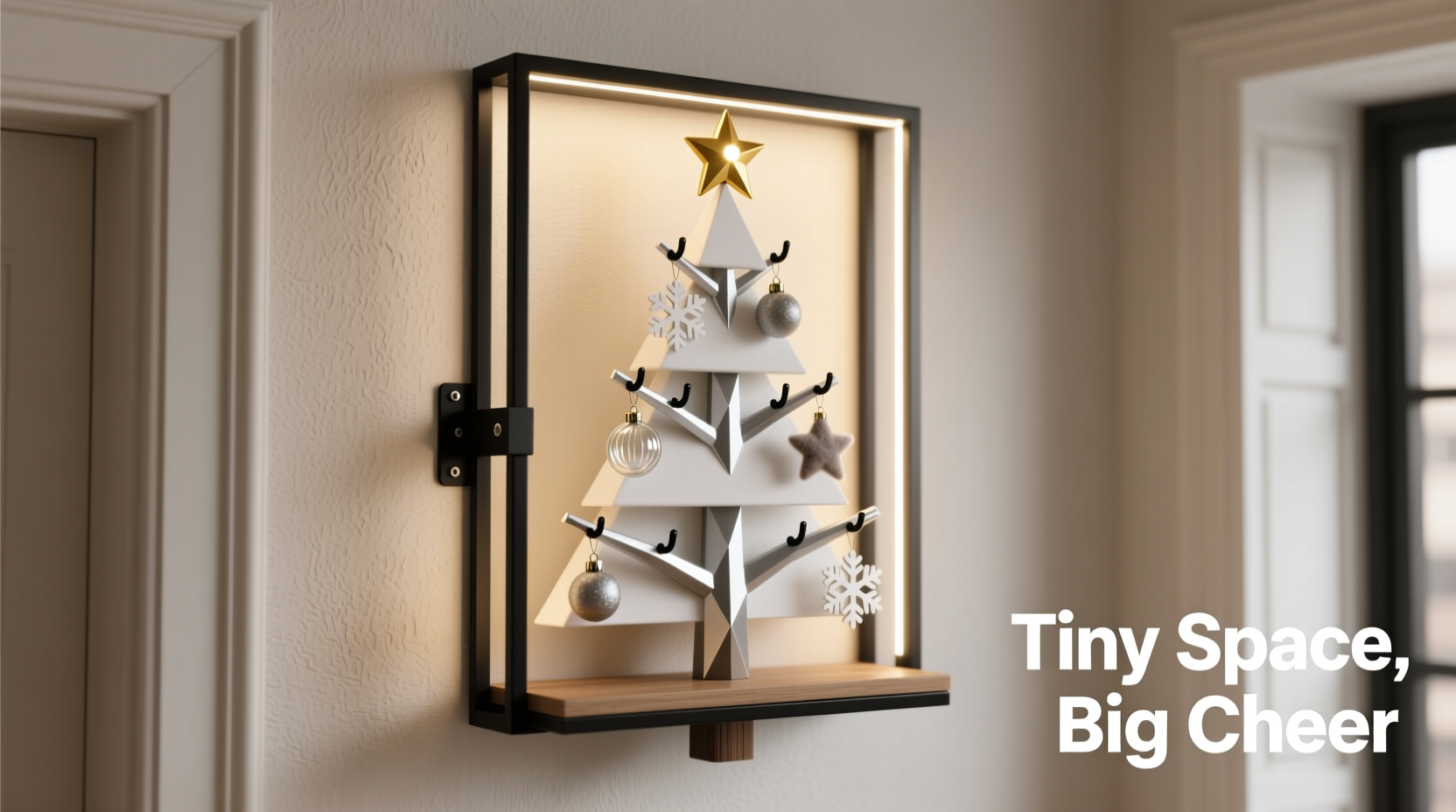
Verticality is the defining advantage of small-space living—and the floating shelf tree leverages it precisely. Rather than fighting for horizontal territory, it claims unused wall height: above doorways, beside narrow windows, or along the long blank stretch of a studio’s single exterior wall. Structural engineers confirm that properly anchored floating shelves can support 35–75 pounds depending on bracket type, material, and stud placement—more than enough for a lightweight, intentionally scaled tree (typically 24–42 inches tall). Interior designers specializing in compact homes report a consistent trend: clients who adopt wall-mounted displays report higher satisfaction with holiday aesthetics *and* year-round spatial flow. As Maya Lin, architect and spatial strategist, observes: “In constrained environments, the most generous design decisions aren’t about adding more—but about revealing what’s already there. A well-placed shelf tree doesn’t fill space; it frames it.”
Materials & Tools: What You Actually Need
Success hinges less on specialty items and more on precision execution. Below is a curated list—no over-engineering, no unnecessary purchases. All components are widely available at hardware stores or online, with total material cost ranging from $45–$95 depending on wood grade and finish.
| Item | Purpose | Key Specifications |
|---|---|---|
| Floating shelf (1x6 or 1x8 pine or poplar) | Base for tree mounting and ornament display | Minimum 36\" long; 1.5\" thick; pre-sanded preferred |
| Heavy-duty floating shelf brackets (2–3) | Secure load-bearing support | Rated for ≥50 lbs each; steel construction; include lag screws |
| Christmas tree (artificial, slim-profile) | Focal point | 24–42\" tall; 12–18\" base width; metal pole stem (not plastic) |
| Tree mounting plate | Stabilizes tree to shelf | 1/4\" plywood or hardwood, 6\"x6\"; pre-drilled for tree pole and shelf screws |
| Wall anchors & stud finder | Safe, permanent installation | Must locate studs; toggle bolts only if mounting between studs (not recommended for primary load) |
| Level, drill, screwdriver, measuring tape | Installation essentials | Digital level preferred; drill with torque control prevents wood splitting |
Avoid common pitfalls: Do not use particleboard shelves—they sag under weight and won’t hold screws reliably over time. Never mount brackets solely into drywall without hitting studs; the dynamic weight of ornaments, lights, and accidental bumps creates shear stress that drywall alone cannot withstand. And resist the urge to buy an ultra-slim “pencil tree”—its narrow profile often sacrifices stability and makes mounting wobbly.
Step-by-Step Installation Guide
This sequence prioritizes safety, alignment, and longevity—not speed. Allow 2.5–3.5 hours for full assembly, including drying time for optional stain or paint.
- Map Your Wall: Use a stud finder to locate and mark all studs within your intended shelf span. Mark their centers with light pencil lines. Note any electrical outlets, HVAC vents, or window casings that affect bracket placement.
- Design the Layout: Decide on shelf height (ideally 60–66\" from floor for eye-level viewing) and orientation (horizontal or angled at 10–15° for dynamic interest). Sketch the plan on paper, noting exact distances between brackets (maximum 24\" apart for rigidity).
- Prep the Shelf: Sand edges smooth. Apply stain or matte white paint if desired—let dry fully (overnight recommended). Pre-drill pilot holes for bracket screws and tree-mounting plate (two 1/4\" holes centered 3\" apart near shelf front edge).
- Mount Brackets Securely: Drill pilot holes into stud centers using a level as guide. Insert lag screws hand-tight first, then torque to manufacturer specs (usually 35–45 ft-lbs). Verify level across all brackets before final tightening.
- Attach Shelf & Mounting Plate: Lift shelf onto brackets. Secure with provided screws through shelf underside into bracket flanges. Affix mounting plate to shelf front using 1.5\" wood screws—ensure it sits flush and centered.
- Install Tree: Insert tree’s metal pole stem into mounting plate’s pre-drilled hole. Tighten the included set screw (or add a 1/4\"-20 hex bolt with lock washer) until tree stands rigid with zero lateral movement. Test by gently rocking trunk—no flex should occur.
- Style Thoughtfully: Hang lightweight ornaments (wood, felt, acrylic) on lower branches only. Use battery-operated LED string lights with adhesive clips—not nails or tacks—to avoid damaging branches or shelf surface.
Real Example: The Brooklyn Studio Transformation
When Lena R., a graphic designer living in a 320-square-foot Williamsburg studio, faced her third Christmas without a tree, she refused to settle for a 12-inch desk version. Her space had one unbroken 8-foot wall beside a sliding glass door—ideal for vertical use but previously ignored due to fear of damage. Using the method outlined here, she installed a 42\" reclaimed oak shelf anchored to three studs with industrial-grade brackets. She selected a 36\" frosted artificial tree with a slender 14\" base and mounted it using a custom-cut walnut plate stained to match the shelf. For styling, she added minimalist white ceramic ornaments and warm-white micro-LEDs clipped discreetly to inner branches. The result? A cohesive, gallery-like focal point that drew compliments from every guest—and freed up her entire floor for yoga mats and folding chairs. “It stopped being ‘the wall I ignore’ and became ‘the place people pause to admire,’” she says. “And I gained back 4.2 square feet of walkable space.”
Optimizing Safety, Style, and Longevity
A floating shelf tree must be safe first, beautiful second. Here’s how to ensure both:
- Weight Distribution: Keep total loaded weight (tree + ornaments + lights) under 60% of the shelf’s rated capacity. A 36\" pine shelf with two 50-lb brackets has a safe working load of ~75 lbs—so aim for ≤45 lbs total. Weigh your tree before mounting; most slim-profile artificial trees weigh 4–8 lbs empty.
- Ornament Strategy: Prioritize lightweight materials. Avoid glass, heavy metals, or oversized baubles on outer branches. Instead, cluster 3–5 small ornaments per branch tip using thin ribbon loops—not hooks that pull downward on fragile tips.
- Lighting Logic: Use only UL-listed battery-operated lights. Plug-in cords create tripping hazards and violate fire code in rental units. Opt for warm-white (2700K) LEDs—they render better on walls than cool tones and reduce glare against light-colored walls.
- Seasonal Maintenance: Check bracket tightness every 7–10 days during the season. Wood expands slightly in heated indoor air; a quarter-turn snug on lag screws prevents gradual loosening. After the holidays, disassemble completely: remove tree, wipe shelf with damp microfiber cloth, store mounting plate separately.
“Wall-mounted trees succeed when they’re treated like built-in architecture—not temporary decor. That means engineering integrity first, aesthetics second. If it wobbles, it fails—even if it looks perfect.” — Carlos Mendez, Certified Residential Remodeler & ADA Accessibility Consultant
FAQ
Can I mount this on plaster or brick walls?
Yes—with modifications. Plaster requires masonry anchors rated for the shelf’s load, and drilling must be done slowly with a hammer drill to prevent cracking. Brick demands carbide-tipped masonry bits and sleeve anchors; never use plastic anchors. In both cases, consult a qualified contractor if you lack experience drilling into these substrates—structural integrity is non-negotiable.
How do I hide the tree’s pole and mounting hardware?
Wrap the lower 4–6 inches of the metal pole with matching fabric or faux-fur trim secured with hot glue. Conceal the mounting plate behind a narrow strip of decorative wood molding (1/2\" x 1/2\") attached directly to the shelf front. Alternatively, choose a tree with a “hidden stem” design—where the pole tucks inside a hollow wooden base that rests atop the shelf.
Will this work for renters who can’t drill into walls?
Not safely or effectively. Adhesive-based “no-drill” brackets lack the tensile strength needed for even a lightweight tree and risk sudden failure. If lease restrictions prohibit drilling, pursue landlord approval first—frame it as a minor, reversible improvement (bracket holes are easily spackled and painted). Most landlords approve when presented with engineered plans and a commitment to professional restoration.
Conclusion
A floating shelf Christmas tree display is more than a space-saving hack—it’s a declaration that constraints inspire creativity, not compromise. It proves that holiday warmth doesn’t require sprawling floorspace, that tradition can evolve without losing meaning, and that thoughtful design turns limitations into opportunities for elegance. Every measurement taken, every stud located, every ornament carefully placed becomes part of a quiet act of intentionality—transforming a wall from blank surface to beloved landmark. You don’t need a mansion to host joy. You need clarity of purpose, respect for structure, and the willingness to look up instead of out. So gather your tools, measure twice, anchor firmly, and build something that lifts your spirits—and your space—this season.




 浙公网安备
33010002000092号
浙公网安备
33010002000092号 浙B2-20120091-4
Comments
No comments yet. Why don't you start the discussion?