
Miniature Christmas villages have long held a special place in holiday traditions—evoking nostalgia, craftsmanship, and quiet wonder. What once required hours of hand-carving wood or assembling delicate ceramic kits is now accessible to hobbyists, educators, and families through affordable 3D printing and intelligent LED technology. This isn’t about mass-produced decor; it’s about curating a personalized, tactile celebration of light and detail. Whether you’re a first-time maker or an experienced tinkerer, this guide walks through every practical decision: selecting the right print files, optimizing for structural integrity and aesthetics, wiring low-voltage LEDs safely and invisibly, and designing a cohesive landscape that tells a story—not just displays objects. The result is more than decoration. It’s a conversation piece, a seasonal ritual, and a demonstration of how modern tools can deepen traditional joy.
Choosing & Preparing Your 3D Printed Houses
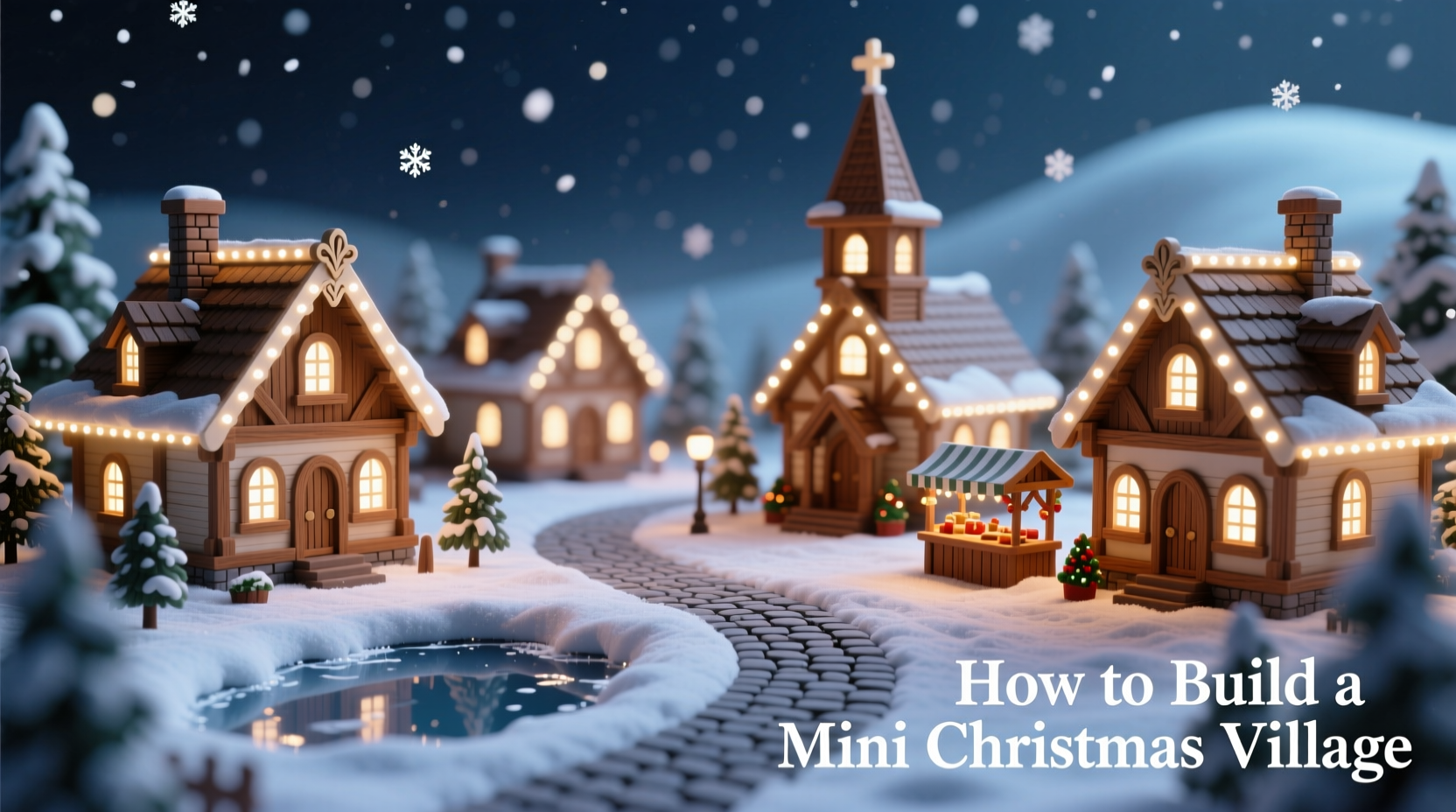
Selecting appropriate house models is foundational—not all “Christmas village” STL files are created equal. Many free downloads prioritize visual appeal over printability: thin chimneys snap mid-print, unsupported eaves sag, and tiny windows lack clearance for internal lighting. Prioritize models labeled “village-ready,” “lighting-friendly,” or “multi-part” (separate roof, base, and chimney). Look for designs with wall thicknesses ≥1.6 mm, roof overhangs ≤1.2 mm, and interior cavities at least 8 mm tall to accommodate micro-LEDs or flexible strips.
Print settings matter as much as model choice. Use PLA filament—it’s dimensionally stable, easy to sand, and holds paint well. Avoid PETG for exterior walls unless you’re sealing against humidity; its slight flexibility can cause warping under ambient heat from LEDs. Print at 0.2 mm layer height for balance between resolution and speed. Enable “ironing” on top surfaces to smooth roofs and eliminate visible layer lines. Always print roofs separately and upside-down (so the cleanest surface faces up), then glue with cyanoacrylate (super glue) mixed with baking soda for instant, gap-filling bonds.
Post-processing transforms raw prints into convincing architecture. Sand walls progressively (220 → 400 → 600 grit), then wipe with isopropyl alcohol to remove dust and oils. Prime with acrylic gesso—matte white works best for even paint adhesion and light reflection. Paint interiors first using a fine brush and watered-down acrylics (e.g., warm yellow for living rooms, soft blue for bedrooms); let dry fully before painting exteriors. For snow-draped roofs, apply a thin coat of white PVA glue, then sprinkle coarse sea salt while wet—it dries into organic, crystalline texture that catches light beautifully.
LED Lighting Strategy: Safety, Aesthetics & Control
Lighting makes or breaks a village. Harsh, uniform brightness flattens depth; inconsistent color temperature creates visual dissonance; exposed wires destroy immersion. The solution lies in layered, purpose-driven illumination: ambient base lighting, targeted interior glows, and subtle accent highlights.
Use only 12V DC LED systems—never mains voltage. They’re safer, cooler, and compatible with common controllers. Choose warm-white (2700K–3000K) LEDs exclusively. Cool whites (>4000K) read as clinical or sterile next to candlelit nostalgia. For interiors, 2 mm diameter “grain-of-wheat” LEDs (2.5 V, 20 mA) are ideal: small enough to hide behind window frames, bright enough to suggest warmth, and dimmable via PWM. For base lighting, 3528 or 2835 SMD LED strips (60 LEDs/meter, 12V) provide even, shadow-free ground illumination when mounted beneath the display platform.
| Lighting Type | Best Use Case | Wiring Tip | Power Draw (per unit) |
|---|---|---|---|
| Grain-of-wheat LEDs | Individual windows & fireplaces | Solder 30 AWG stranded wire; route through pre-drilled 1.5 mm holes | ~0.05 W |
| Flexible LED strip | Base/platform glow & path lighting | Mount with double-sided tape; cut only at marked segments | 4.8 W/meter |
| Micro LED modules (5 mm) | Streetlamps & signage | Use resistors (220 Ω) for each; secure with hot glue | 0.08 W |
Routing wires invisibly is non-negotiable. Drill discreet 1.5 mm entry points at house bases, feed wires upward through hollow walls (design houses with 3 mm vertical channels if printing custom models), and exit behind window frames. Never run wires across visible surfaces—even under snow. Conceal junctions inside a false floor or behind a decorative fence panel. For control, use a simple 12V PWM dimmer module ($6–$10) paired with a momentary switch: one press for 30% brightness (twilight ambiance), two presses for 70% (festive glow), three for 100% (full sparkle).
Building the Landscape Base & Structural Layout
A compelling village feels grounded—not floating on a blank table. The base must support weight, conceal wiring, manage light diffusion, and evoke setting: a snowy hillside, a lakeside hamlet, or a forest clearing. Start with a rigid substrate: ½-inch birch plywood (for stability) or ¾-inch MDF (for easy carving and paint adhesion). Cut to your desired footprint—common sizes are 24″ × 36″ or 30″ × 48″. Seal all edges with wood filler and sand smooth.
Create topography using sculpted foam board or carved MDF. Hot-wire foam cutters allow gentle, organic slopes; hand-carve MDF with chisels and rasps for rocky outcrops or frozen ponds. Layer materials: MDF base → carved foam hills → plaster cloth (applied like gauze, then sanded) → final texture coat. For snow, mix 2 parts white joint compound + 1 part PVA glue + 1 part coarse salt. Apply with a stiff brush, stippling for depth, then lightly spray with matte sealant to lock texture.
Plan layout using the “rule of threes”: group houses in clusters of three (a focal point, a supporting structure, and a visual anchor), stagger heights, and vary roof pitches. Leave clear sightlines between structures—no house should block the view of another’s lit windows. Position tallest buildings toward the back center, stepping down toward foreground corners. Reserve the front 6 inches for interactive elements: a miniature train track (with battery-powered locomotive), a skating pond made from mirrored acrylic, or a tiny sleigh with removable reindeer.
“Great miniature lighting doesn’t illuminate objects—it suggests life behind closed doors. A single warm window in a darkened house tells a richer story than ten blazing lights.” — Lars Bjornsson, Architectural Model Maker & Lighting Consultant, Oslo Miniature Atelier
Step-by-Step Assembly Timeline
Build your village in logical phases—not all at once. This prevents rework, ensures electrical safety, and allows for iterative refinement.
- Week 1: Design & Prep — Select 5–7 house models; verify print dimensions and interior cavity height; sketch base layout on graph paper; order filament, LEDs, wire, and controller.
- Week 2: Printing & Finishing — Print all houses, roofs, and accessories; sand, prime, and paint interiors; assemble roofs with reinforced glue; paint exteriors and add snow details.
- Week 3: Base Construction — Build and seal substrate; carve topography; apply plaster cloth; texture and seal snow surface; mount LED strips beneath base edge and along pathways.
- Week 4: Wiring & Integration — Drill house entry points; solder grain-of-wheat LEDs to wires; test each light before insertion; route wires through walls; connect all to controller and power supply; verify no shorts or flickering.
- Week 5: Final Composition & Refinement — Arrange houses on base; add terrain details (miniature trees, fences, lampposts); adjust LED brightness levels per zone; photograph under room lighting to identify glare or dark spots; make final tweaks.
This timeline assumes 5–8 hours per week. If accelerating, compress Weeks 2 and 3—but never skip testing individual LEDs before final installation. A single faulty connection can require dismantling multiple houses.
Real-World Example: The Maple Street Village
When teacher Maria Chen wanted to engage her 5th-grade STEM class in applied design, she built a 30-inch-wide village centered on accessibility and storytelling. She chose open-source STL files from the “Village Commons” library—models with removable roofs and standardized 10 mm interior cavities. Students printed houses in teams, then wired them using pre-cut 30 AWG wire kits with color-coded leads (red = power, black = ground, yellow = signal). Each house told a story: the bakery had amber LEDs behind frosted acetate “windows” to mimic oven glow; the library used cool-white micro-LEDs in bookshelf recesses; the clinic featured a red LED above its door.
Maria mounted everything on a curved MDF base painted deep navy, with cotton batting “snowdrifts” glued at varying densities. She hid the 12V power supply inside a hollowed-out wooden log at the rear, routing wires through drilled channels in the base. The final touch? A programmable controller that cycled through three scenes: “Twilight” (all lights at 40%), “Caroling Hour” (interior lights bright, path lights pulsing gently), and “Midnight” (only streetlamps and one glowing window per house). Parents reported children spent evenings identifying which house was “awake”—proving that thoughtful lighting transforms static objects into narrative spaces.
FAQ
Can I use battery-powered LEDs instead of a wired power supply?
Yes—for small villages (under 12 houses)—but with caveats. CR2032 coin cells work for single grain-of-wheat LEDs but last only 20–40 hours. AA/AAA battery packs with on/off switches are better for short-term displays (e.g., school fairs), but voltage drops as batteries deplete, causing dimming. For permanent or multi-week displays, a regulated 12V DC wall adapter is safer, more consistent, and eliminates battery waste.
How do I prevent LED heat from warping PLA houses?
Properly sized LEDs generate negligible heat. A 2.5 V grain-of-wheat LED draws only 20 mA—producing less than 0.05 watts. PLA’s glass transition temperature is ~60°C; these LEDs reach ~35°C at most. The real risk comes from poor ventilation in enclosed spaces or using high-power LEDs (e.g., 5 mm white LEDs without current-limiting resistors). Always verify LED specs and use appropriate resistors.
What’s the best way to attach houses to the base permanently?
For display longevity, use two-part epoxy (e.g., J-B Weld Plastic Bonder) applied to the underside of each house base—not glue dots or hot glue. Epoxy fills minor surface gaps, bonds securely to both PLA and wood/MDF, and remains flexible enough to absorb minor vibration. Let cure fully (24 hours) before handling or adding terrain details.
Conclusion
A mini Christmas village built with 3D printed houses and LED lighting is more than seasonal decor—it’s a synthesis of patience, precision, and personal meaning. Every soldered joint, every hand-textured snowdrift, every calibrated LED glow reflects intention. You’re not replicating a store-bought scene; you’re constructing memory infrastructure—spaces where family stories gather, where children pause to trace window light with their fingers, where quiet moments feel larger because they’re framed by care. The tools have never been more accessible, but the value remains in the doing: the rhythm of the printer, the focus of wiring, the satisfaction of seeing light bloom exactly where you planned it. Don’t wait for perfection. Print one house this weekend. Wire its windows. Place it on a simple board with a strip of warm LED light beneath. See how it changes the room. Then build the next. And the next. Because the magic isn’t in the finished display—it’s in the making.




 浙公网安备
33010002000092号
浙公网安备
33010002000092号 浙B2-20120091-4
Comments
No comments yet. Why don't you start the discussion?