
Minimalist design isn’t about subtraction for its own sake—it’s about precision, intention, and the quiet power of form. When applied to holiday traditions, it transforms the familiar into something contemplative and deeply personal. A geometric Christmas tree strips away decades of accumulated ornamentation and commercial expectation, revealing structure as symbolism: the triangle as aspiration, the circle as continuity, the cube as grounded presence. This approach appeals not only to designers and architects but to anyone seeking calm amid seasonal intensity—those who find joy in symmetry, clarity in simplicity, and meaning in repetition. Building such a tree requires no special tools, no inherited heirlooms, and no budget for glittering baubles. What it does require is attention: to proportion, material integrity, spatial rhythm, and the quiet confidence that less, when chosen deliberately, speaks louder than more ever could.
The Philosophy Behind Geometric Minimalism
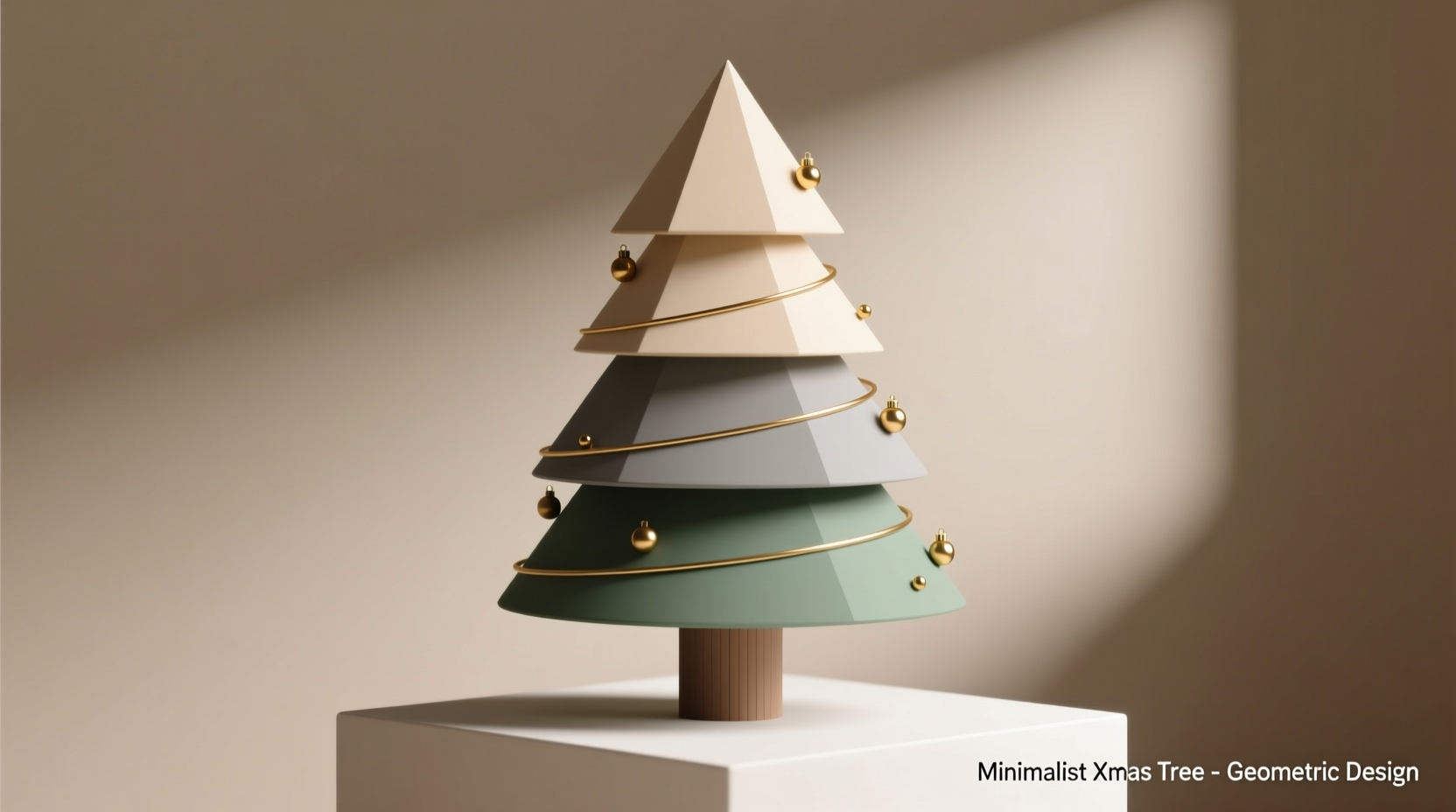
Minimalist trees rooted in geometry reject decorative excess not out of austerity, but out of respect—for space, for time, for the viewer’s emotional bandwidth. In Scandinavian design tradition, the phrase “form follows function” extends beyond utility to include psychological resonance: a sharp equilateral triangle evokes stability and upward motion; a stacked series of concentric circles suggests cyclical renewal; intersecting tetrahedrons embody lightness and structural honesty. Architect Tadao Ando once observed, “The important thing is not what you look at—but how you look.” A geometric tree invites that kind of looking: slow, unhurried, tactile. It doesn’t shout for attention—it waits for engagement. This mindset shifts the focus from consumption to curation, from tradition-as-obligation to tradition-as-choice. You’re not rejecting Christmas; you’re redefining its visual language to align with your values—clarity over clutter, balance over busyness, silence over spectacle.
Core Geometric Elements & Their Symbolic Roles
A successful minimalist tree relies on three foundational shapes—each serving both structural and conceptual functions. These aren’t arbitrary choices; they’re selected for inherent visual stability, cultural resonance, and ease of replication across materials.
| Shape | Primary Role | Material Recommendations | Proportional Guidance |
|---|---|---|---|
| Equilateral Triangle | Vertical framework (the “tree” silhouette) | Matte-finish plywood (3–6 mm), brushed aluminum sheet, reclaimed oak veneer | Base width = 70% of total height; apex angle = exactly 60° |
| Circle / Ring | Horizontal rhythm & grounding element | Blackened steel wire (4–6 mm diameter), matte ceramic, frosted acrylic | Diameter decreases by 15% per ascending ring; spacing = 12–18 cm between centers |
| Cube / Tetrahedron | Textural counterpoint & focal anchor | White Carrara marble offcuts, matte concrete blocks, anodized aluminum cubes | Base cube: 10 × 10 × 10 cm; tetrahedron edge length = 12 cm (for visual weight balance) |
Note: Avoid right triangles, irregular polygons, or asymmetrical forms unless part of a deliberate, documented concept. Minimalism thrives on predictability—not randomness masquerading as spontaneity.
A Step-by-Step Assembly Process
Building this tree is iterative, not linear. Each stage builds on the last, but allows for refinement before commitment. The process takes approximately 3–4 hours for first-time builders—including drying, sanding, and alignment checks. Precision matters more than speed.
- Select and prepare your base material. Cut a 45 × 45 cm square of 18 mm birch plywood. Sand all edges to 220-grit smoothness. Stain with water-based walnut dye (not pigment-heavy paint) to preserve wood grain texture. Let dry 24 hours.
- Mark and cut the primary triangle. Using a metal ruler and fine-tip pencil, draw an equilateral triangle centered on the base—height 90 cm, base 63 cm. Cut with a jigsaw fitted with a fine-tooth blade (80 TPI). Sand all three edges until uniformly matte—no shine, no gloss, no visible tool marks.
- Drill mounting points for rings. At 15 cm, 33 cm, 51 cm, and 69 cm up the central vertical axis (measured from base), drill 4 mm pilot holes through the triangle. These will hold brass dowel pins (4 mm × 25 mm) that support the rings. Ensure holes are perfectly perpendicular—use a drilling jig if needed.
- Form and finish the rings. Bend 5 mm blackened steel wire into four perfect circles: diameters 48 cm, 40.8 cm, 34.7 cm, and 29.5 cm (15% reduction each time). Solder joints with silver solder, then file flush. Dip in matte black patina solution for 90 seconds, rinse, and air-dry.
- Assemble the structure. Insert brass dowels into pilot holes. Slide rings onto dowels, starting with largest at bottom. Adjust until all rings sit level and parallel to base. Tighten with micro-drop of clear epoxy at each dowel base (prevents wobble without visible adhesive).
- Add the grounding element. Place a single 10 × 10 × 10 cm matte white concrete cube directly beneath the lowest ring’s center point—touching neither base nor ring. Its weight anchors the composition visually and physically.
This sequence prioritizes structural integrity first, then visual harmony. Skipping the sanding, skipping the patina dip, or forcing rings onto misaligned dowels will compromise the entire effect. Minimalism exposes every shortcut.
Real-World Application: The Oslo Apartment Project
In late November 2023, interior architect Linnea Voss redesigned her 32 m² Oslo studio apartment for a client seeking “a Christmas that didn’t feel like an invasion.” With only 1.8 meters of floor-to-ceiling height and no traditional mantel or corner, she rejected conventional trees entirely. Instead, she built a wall-mounted variant: a 75 cm tall equilateral triangle cut from powder-coated steel, mounted vertically on a pale ash panel. Four laser-cut brass rings—diameters 32 cm down to 23 cm—were suspended from concealed magnetic mounts, allowing subtle rotation. At the triangle’s apex, a single 4 cm brass tetrahedron hung on a nearly invisible monofilament. No lights. No color variation. Just warm indirect lighting from recessed ceiling spots angled precisely to graze the steel’s edge, casting long, clean shadows on the white wall.
The result? Visitors consistently described it as “calming,” “unexpectedly festive,” and “like breathing in cold air.” Linnea reported zero requests for “more” — no tinsel, no red accents, no scent diffusers. The client kept it displayed through January, citing its “quiet authority.” This wasn’t minimalism as compromise—it was minimalism as full expression.
Expert Insight: Form as Emotional Architecture
“Geometry in ritual objects operates at a pre-verbal level. A triangle doesn’t ‘represent’ growth—it is growth made visible through angle and ascent. When we limit our palette to three shapes, we’re not restricting creativity—we’re concentrating it. That concentration creates resonance. People don’t remember the absence of ornaments; they remember the feeling of stillness the shape gave them.” — Dr. Aris Thorne, Professor of Design Psychology, Royal College of Art
Essential Tips for Material Integrity & Longevity
Geometric minimalism fails when materials degrade visibly. Unlike traditional trees where fading ornaments go unnoticed, flaws in a single steel ring or warped plywood triangle dominate the entire composition. These tips ensure your tree remains pristine across seasons:
- Avoid direct sunlight exposure. UV radiation dulls matte finishes and causes subtle warping in thin plywood—even behind glass. Position away from south-facing windows.
- Never use spray cleaners. Residue attracts dust and breaks down matte coatings. Wipe steel or concrete elements weekly with a microfiber cloth dampened only with distilled water.
- Store flat, not folded. Disassemble rings and store stacked with acid-free tissue between layers. Never hang rings by wire—they’ll deform under their own weight over time.
- Re-level annually. Use a digital inclinometer app (free on iOS/Android) to verify ring alignment before display. Even 0.5° tilt disrupts perceived symmetry.
Frequently Asked Questions
Can I use cardboard or paper for a temporary version?
Yes—but only if you commit to its material honesty. Uncoated kraft cardboard, cut with a craft knife (not scissors), sanded smooth, and left raw conveys intentionality. Glossy cardstock or printed patterns break the covenant of purity. For true minimalism, temporary doesn’t mean disposable—it means respectfully provisional.
What if I don’t have power tools?
You can achieve precision with hand tools: a Japanese pull-saw for clean plywood cuts, a ring-bending jig made from hardwood scraps and nails, and careful filing with a needle file set. The key isn’t speed—it’s patience. Hand-cut edges often read as more human and considered than machine-perfect ones, provided they’re consistent.
Do I need to light it?
No. Light is optional—and often counterproductive. If used, it must be directional, cool-white (4000K), and cast from a single source positioned 120 cm to the side at 45° elevation. No fairy lights, no LED strips, no colored gels. Light here serves only to reveal form—not to decorate it.
Why This Approach Matters Beyond Decoration
A geometric Christmas tree is never just decor. It’s a daily reminder that meaning resides in structure, not surface. In a season saturated with noise—marketing slogans, social obligations, sensory overload—choosing three shapes and committing to their honest execution becomes an act of resistance. It asks: What do I truly value? What forms bring me peace? What can I remove without loss—only gain? This practice extends far beyond December. Once you’ve trained your eye to see the elegance in a 60° angle or the gravity in a 10 cm cube, you begin noticing similar harmonies elsewhere—in architecture, typography, even conversation rhythms. You stop accepting visual clutter as inevitable. You start editing—not just your tree, but your environment, your commitments, your attention.
That’s the quiet power of geometry: it doesn’t ask for interpretation. It offers clarity—and clarity, once experienced, is impossible to un-know.




 浙公网安备
33010002000092号
浙公网安备
33010002000092号 浙B2-20120091-4
Comments
No comments yet. Why don't you start the discussion?