
A minimalist Christmas tree isn’t just a design choice—it’s a deliberate act of intentionality. In an era saturated with ornament overload and synthetic extravagance, the geometric metal tree offers quiet authority: clean lines, enduring materials, and sculptural presence without clutter. Unlike traditional evergreens or plastic alternatives, these frames are designed for longevity, reusability, and architectural harmony. They’re not meant to mimic nature; they reinterpret tradition through form, function, and restraint. This approach resonates with designers, urban dwellers, sustainability advocates, and anyone who values objects that earn their place in the home—not just during December, but year after year.
Why Geometric Metal Frames Are Reshaping Holiday Design
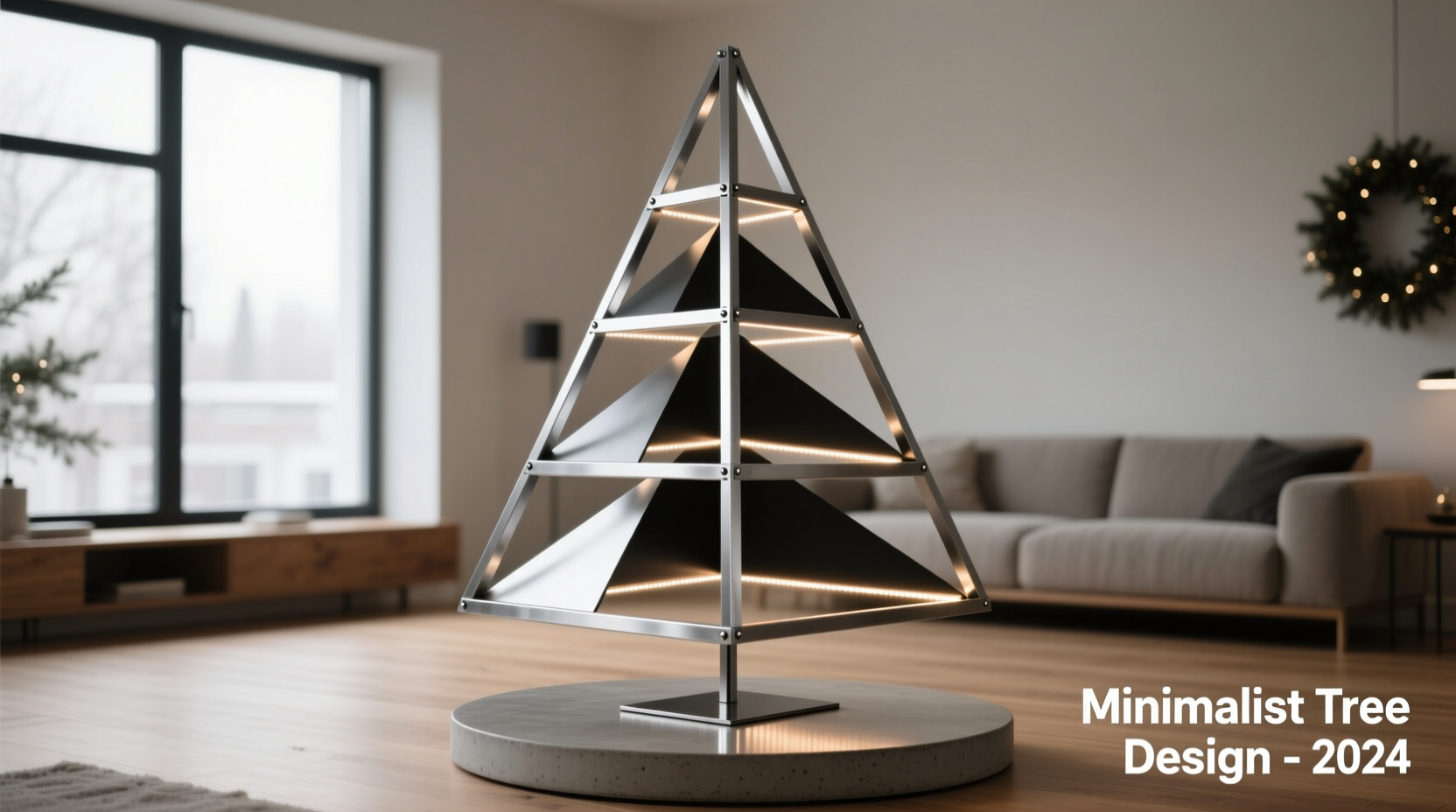
Geometric metal trees emerged from studio workshops and Scandinavian design studios in the early 2010s—not as novelty items, but as responses to three converging needs: space efficiency in compact living environments, growing environmental awareness around single-use holiday decor, and a cultural shift toward heirloom-quality objects. Unlike mass-produced plastic trees, these frames are typically fabricated from powder-coated steel, brushed aluminum, or recycled stainless steel—materials chosen for tensile strength, corrosion resistance, and tactile warmth.
What distinguishes them from generic “modern” trees is precision engineering. Each frame is calculated: angles calibrated for visual balance, joints reinforced for stability, base diameters sized to support proportional height-to-width ratios (commonly 3:2 or 5:3). A well-designed octahedral frame, for example, distributes weight evenly across eight triangular facets—creating inherent rigidity without internal bracing. This structural intelligence means no wobbling, no sagging branches, and no need for hidden stands or wall anchors in most residential settings.
“Minimalism in holiday design isn’t about subtraction—it’s about amplification through reduction. When you remove visual noise, the ritual itself becomes more legible, more meaningful.” — Lena Voss, Industrial Designer & Co-Founder of Form & Fir Studio
Core Materials and What to Look For (or Build)
Selecting or fabricating a geometric frame requires understanding material properties beyond aesthetics. Not all metals perform equally under seasonal conditions—or daily handling.
| Material | Key Advantages | Practical Considerations | Typical Finish Options |
|---|---|---|---|
| Powder-Coated Steel | High load capacity, affordable fabrication, magnetic surface for metal ornaments | Heavier than aluminum; requires rust-inhibiting coating on cut edges | Matte black, warm bronze, soft white, charcoal gray |
| Brushed Aluminum | Lightweight, naturally corrosion-resistant, non-magnetic (ideal for delicate glass ornaments) | Lower tensile strength than steel—requires thicker gauge (≥2.5mm) for heights over 6 feet | Natural silver, satin gold, oxidized copper tone |
| Recycled Stainless Steel | Zero maintenance, food-grade safety, 100% recyclable at end-of-life | Higher cost; limited color options without PVD coating | Raw mill finish, brushed nickel, matte titanium |
When purchasing commercially, verify weld integrity—look for continuous, smooth fillet welds rather than spot welds. If sourcing custom work, request a load test report: reputable fabricators will confirm the frame withstands ≥1.5x its intended ornament weight (e.g., 45 lbs for a 6-foot tree).
A Step-by-Step Assembly & Styling Protocol
Building a geometric metal tree is less about construction and more about choreography—balancing physics, proportion, and personal expression. Follow this field-tested sequence:
- Prep Your Space: Clear a 4' x 4' area with a level, hard-surface floor. Lay down a felt or rubber mat to protect flooring and dampen vibration from ornaments.
- Assemble the Base First: Most frames use a three- or four-point star base. Tighten all bolts to manufacturer torque specs (usually 8–12 Nm). Do not overtighten—aluminum threads strip easily.
- Attach Vertical Supports Gradually: Insert each upright into designated base sockets. Alternate sides while tightening—never fully secure one side before balancing the opposite.
- Install Facets Systematically: Begin at the lowest tier. Connect triangles or diamonds in clockwise order, checking alignment with a laser level every two connections. Misalignment compounds upward.
- Final Structural Check: Gently apply lateral pressure at mid-height. A stable frame should deflect ≤¼ inch and return instantly to true vertical.
- Style with Intention: Hang ornaments only on outer vertices—not along struts—to preserve negative space. Use 3–5 ornament types max, varying only in texture (e.g., matte ceramic + faceted crystal + raw wood), not color or shape.
This process takes 25–45 minutes for first-time builders—and under 12 minutes once familiar. The discipline pays off: no tangled lights, no bent branches, no annual replacement anxiety.
Real-World Application: The Oslo Apartment Case Study
In a 420-square-foot apartment overlooking Oslo’s Akerselva River, architect Sofia Lin adopted a 72-inch tetrahedral steel frame for her holiday display. Her constraints were strict: no ceiling anchors (rental agreement), floor space limited to 2.5 feet diameter, and a desire to avoid seasonal storage clutter. She chose a matte black powder-coated frame with integrated LED wire channels routed inside the tubing—eliminating visible cords entirely.
Sofia styled it with 19 hand-thrown ceramic orbs (each 2.5\" diameter, glazed in tonal grays), 7 brass wire stars (suspended from ceiling hooks at varying heights to create layered depth), and a single strand of warm-white micro-LEDs woven through the apex vertex. No tinsel, no garlands, no tree skirt. For her, the tree wasn’t decoration—it was spatial punctuation: a focal point that anchored the room’s asymmetry without competing with her Mies van der Rohe daybed or Eames lounge.
Post-holiday, she disassembled the frame in 8 minutes, wiped it with a dry microfiber cloth, and stored components flat in a custom plywood crate (designed to fit under her bed). She estimates the frame will remain in active use for 15+ years—far exceeding the 3–5 year lifespan of even premium artificial trees.
Ornament Strategy: Less Is Structurally Sound
With geometric frames, ornament placement directly affects stability. Hanging heavy objects on unsupported strut ends creates torque that warps joints over time. The solution lies in physics-aware curation:
- Weight Distribution Rule: Place heaviest ornaments (ceramic, stone, cast metal) only at vertex points where ≥3 struts converge—these are natural load-bearing nodes.
- Vertical Zoning: Reserve the bottom third for tactile elements (raw wood slices, linen-wrapped stones); middle third for reflective surfaces (crystal, polished brass); top third for light sources (mini LEDs, fiber optics) to draw the eye upward without visual heaviness.
- The 3-Color Discipline: Choose one dominant hue (e.g., deep indigo), one neutral (oatmeal linen, unbleached cotton), and one accent (oxidized copper). This prevents chromatic fatigue while reinforcing architectural cohesion.
- Attachment Integrity: Use museum wax or silicone-tipped ornament hangers—not string or wire—to prevent slippage and eliminate micro-scratches on powder coatings.
Frequently Asked Questions
Can I use fairy lights with a metal frame?
Yes—but only low-voltage (≤24V) LED strings rated for indoor use. Avoid incandescent or high-wattage bulbs: heat buildup can degrade powder coatings over time. Route wires through pre-drilled conduit holes (if available) or use adhesive-backed cable clips to secure lights flush against struts—never wrap tightly, which creates stress points.
How do I clean a metal tree without damaging the finish?
For routine maintenance: wipe with a dry, lint-free microfiber cloth. For smudges or fingerprints, dampen the cloth with distilled water only—never vinegar, alcohol, or commercial cleaners. Powder-coated surfaces react poorly to solvents; aluminum finishes can oxidize if exposed to salt air or chlorine residue. Never use abrasive pads or steel wool.
Is it safe around children and pets?
Geometric frames are inherently safer than traditional trees: no shedding needles, no tipping risk (base weight is typically 2–3x frame weight), and no accessible electrical outlets near ground level. However, ensure all ornament hangers are securely fastened and avoid sharp-edged decorative elements. The open structure also eliminates climbing hazards—there are no horizontal “branches” to grip.
Conclusion: Building Legacy, Not Just Decor
A geometric metal Christmas tree is more than an aesthetic statement. It’s a rejection of disposability, a commitment to craftsmanship, and a subtle act of resistance against the relentless pace of seasonal consumption. Every time you assemble its precise angles, hang ornaments with measured intention, or store it thoughtfully for next year, you participate in a quieter, more grounded kind of celebration—one rooted in durability, clarity, and care.
These trees don’t ask you to decorate around them. They invite you to design with them—to treat December not as an explosion of excess, but as a curated pause. Whether you commission a custom piece from a local metalworker, adapt a modular kit, or begin sketching your own isomorphic design, remember: minimalism isn’t defined by what you omit. It’s revealed in what remains—strong, silent, and utterly certain of its place.




 浙公网安备
33010002000092号
浙公网安备
33010002000092号 浙B2-20120091-4
Comments
No comments yet. Why don't you start the discussion?