
Creating a holiday centerpiece that adapts to your space, mood, and occasion is no longer limited to professional decorators. A modular Christmas tree with adjustable height and segmented lighting zones brings flexibility, energy efficiency, and visual drama into your home. Unlike traditional trees, this design allows you to modify its size for different rooms or events and control lighting effects independently—ideal for everything from intimate gatherings to festive parties.
This approach merges smart technology, structural engineering, and seasonal creativity. Whether you're working with a small apartment or a sprawling living room, a modular system ensures your tree fits perfectly each year. Plus, with dedicated lighting circuits, you can illuminate only the sections in use, saving power and reducing heat output.
Why Go Modular?
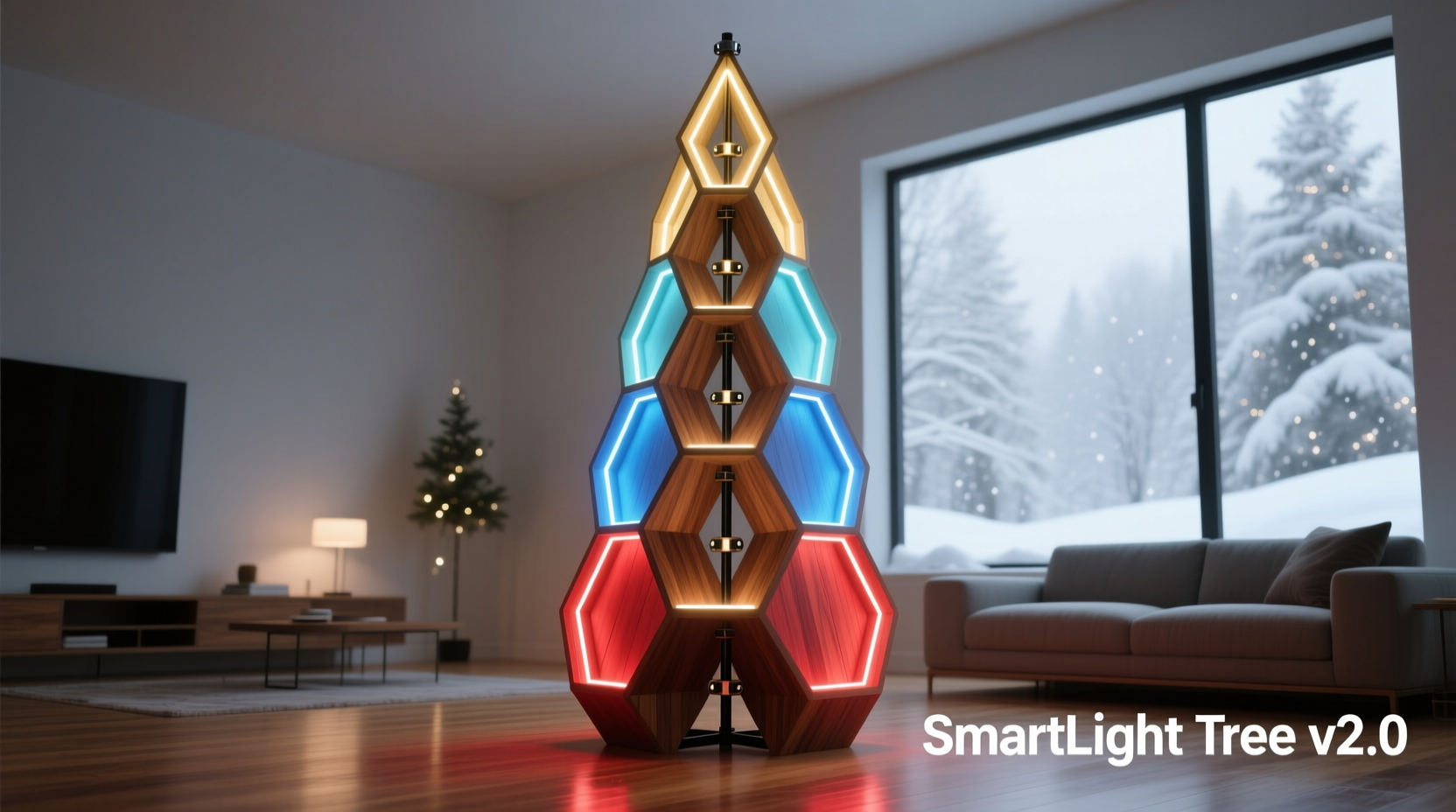
A standard pre-lit tree offers convenience but lacks adaptability. Once assembled, its height and light patterns are fixed. A modular alternative changes that. You gain control over form and function: expand vertically during holidays with guests, shorten it for daily enjoyment, or even repurpose segments as standalone decorations.
Modularity also enhances longevity. Instead of replacing an entire tree due to one faulty section, you can repair or upgrade individual modules. This reduces waste and long-term costs. According to interior designer Marcus Lin, “The future of holiday decor lies in reusable, reconfigurable systems. Families want traditions that evolve without excess.”
“The ability to scale your tree’s presence based on space and occasion transforms it from static decoration into an interactive experience.” — Elena Ruiz, Sustainable Holiday Design Consultant
Core Components of a Modular Tree System
To build a functional and visually appealing modular tree, focus on four foundational elements: frame structure, branch modules, electrical zoning, and control interface.
1. Adjustable Frame Structure
The backbone of your tree must support variable heights while remaining stable. Use telescoping aluminum poles or interlocking PVC pipes with locking collars. These materials are lightweight, corrosion-resistant, and easy to store.
- Telescoping metal poles: Ideal for heavier branches and taller configurations. Secure each extension with set screws.
- PVC pipe joints: Cost-effective and simple to assemble using T-joints and end caps. Best for indoor use with artificial foliage.
- Base plate: Attach the central pole to a weighted platform (e.g., wooden disc with sandbags) to prevent tipping at full height.
2. Interchangeable Branch Modules
Design branch tiers as removable rings or spoke-style arms that attach at designated levels. Each module should clip or screw onto the central pole securely. Use flexible wire frames covered with greenery sleeves for realism and durability.
Recommended features:
- Uniform attachment points (e.g., threaded inserts or quick-release pins)
- Standardized diameter per tier (e.g., 18\", 24\", 30\") for balanced proportions
- Storage-friendly nesting design when disassembled
3. Segmented Lighting Zones
This is where customization shines. Divide lights into independent circuits aligned with physical tiers. For example:
- Zone 1: Bottom tier – warm white steady
- Zone 2: Middle tier – cool white pulse
- Zone 3: Top tier – multicolor fade
Use LED string lights rated for indoor use with separate controllers or a central smart hub. Waterproof ratings aren’t necessary unless used near windows or doors.
4. Control Interface
For seamless operation, integrate a control method that matches your tech comfort level:
| Control Type | Best For | Limitations |
|---|---|---|
| Remote controls (per zone) | Simple setups; non-tech users | Limited automation; multiple remotes |
| Wi-Fi smart plugs + app | Scheduling, voice control | Requires stable network |
| Arduino/Raspberry Pi controller | Custom animations, sensors | Advanced setup needed |
Step-by-Step Assembly Guide
Follow this sequence to construct your modular tree safely and efficiently.
- Prepare the base and pole: Assemble the bottom pole segment and mount it securely to the base plate. Ensure it stands vertically using a bubble level.
- Install first branch module: Slide the lowest branch ring onto the pole and lock it at the desired height (typically 18–24 inches above the floor).
- Route initial lighting: Feed the first zone’s light string down through the pole or alongside it, securing with zip ties every 6 inches.
- Add subsequent tiers: Continue stacking pole extensions and attaching branch modules, spacing them 12–18 inches apart depending on desired density.
- Connect lighting circuits: Link each zone’s power cord to its respective controller or smart plug. Avoid daisy-chaining across zones to prevent overload.
- Test all connections: Power on each zone individually to confirm functionality before full illumination.
- Apply finishing touches: Add ornaments, tinsel, and a tree topper. Conceal wires with garland or fabric wraps if desired.
Disassembly follows the reverse order. Store each component in labeled bins: poles, branch rings, lights by zone, and controllers. This organization saves time next season and prevents mix-ups.
Real-World Example: The Urban Loft Transformation
In a 700-square-foot Brooklyn loft, resident Sofia Chen faced a recurring challenge: her 7.5-foot tree overwhelmed the space after New Year’s. She wanted to keep a festive touch without sacrificing living area.
She built a three-tier modular tree using black powder-coated steel tubing and magnetic branch connectors. Each tier had 24-inch diameter wire frames wrapped in faux pine sprigs. Lighting was divided into three zones controlled via a Wi-Fi hub.
During peak holiday weeks, she ran all zones with animated color cycles. After guests left, she removed the top two tiers, shortened the pole, and kept only the bottom zone lit with soft amber glow—a compact \"after-holiday mode.\" The change reduced energy use by 60% and freed up 40% more floor space.
“It felt like having two trees in one,” she said. “One for celebration, one for calm.”
Do’s and Don’ts of Modular Tree Building
| Do | Don't |
|---|---|
| Use UL-certified LED lights to reduce fire risk | Overload circuits by connecting too many strings per zone |
| Label all parts during disassembly | Store components in damp basements or attics |
| Plan for cable management from the start | Run exposed wires across walkways without protection |
| Balance weight distribution across tiers | Place heavy ornaments only on upper levels |
| Test stability at maximum height before decorating | Ignore wobbling or leaning after assembly |
Smart Integration and Automation Ideas
Take your tree beyond manual control with automation. Using smart outlets or microcontrollers, you can program lighting behavior based on time, sound, or environment.
- Scheduled dimming: Lights gently brighten at dusk and fade out at bedtime.
- Music sync: Middle zone pulses to holiday music beats detected by a microphone sensor.
- Presence detection: Tree illuminates only when motion is sensed nearby, conserving energy when unobserved.
- Voice activation: “Alexa, turn on the Christmas tree” triggers all zones or specific colors.
For DIY enthusiasts, platforms like Node-RED or Home Assistant allow complex routines—such as activating snowfall-themed lighting when weather apps report local snow.
Frequently Asked Questions
Can I use real branches with a modular frame?
Possibly, but not recommended for repeated use. Fresh evergreen boughs dry out within days, increasing fire hazard and shedding debris. If used, limit to short-term displays and never leave lights on unattended. Artificial foliage is safer and reusable.
How many lighting zones should I create?
Three to four zones offer optimal flexibility without excessive complexity. One zone per major third of the tree (bottom, lower-middle, upper-middle, top) allows layered effects. More zones increase wiring difficulty and cost.
Is it safe to mix different brands of LED lights?
Yes, as long as all lights are low-voltage, UL-listed, and operated within their rated amperage. However, mixing brands may result in slight color temperature differences (e.g., warm vs. cool white), which can affect aesthetic cohesion.
Essential Build Checklist
Before starting construction, verify you have these items:
- Telescoping pole or segmented pipe (minimum 6 ft extended)
- Sturdy base plate with weight capacity (≥15 lbs)
- 3–4 interchangeable branch modules (wire frames with foliage)
- LED string lights (separate sets for each zone)
- Zip ties, adhesive clips, or conduit for wire management
- Smart plugs or remote controllers (one per zone)
- Power strip with surge protection
- Labels and storage bins for off-season organization
- Level, screwdriver, measuring tape
Conclusion: A Tradition That Grows With You
A modular Christmas tree with adjustable height and lighting zones isn’t just a decoration—it’s an investment in smarter, more meaningful holiday traditions. It accommodates changing homes, growing families, and evolving tastes without demanding new purchases every year. By designing for reuse, personalization, and safety, you create something far more valuable than sparkle: sustainability wrapped in joy.
Start small if needed—a two-tier prototype with basic controls—but build with intention. Document your process, refine each season, and share what works. Others will be inspired not just by how your tree looks, but by how thoughtfully it was made.




 浙公网安备
33010002000092号
浙公网安备
33010002000092号 浙B2-20120091-4
Comments
No comments yet. Why don't you start the discussion?