
Most artificial Christmas trees are static: bought once, stored away, and reassembled identically year after year. But what if your tree could evolve? A modular Christmas tree isn’t just about convenience—it’s about intentionality. Designed with scalable tiers, standardized connectors, and integrated lighting systems, it grows taller and more luminous each season without replacing the entire structure. This approach reduces long-term cost, minimizes waste, and transforms holiday setup into a meaningful, iterative ritual. It’s especially valuable for families with young children who delight in watching “the tree get bigger,” or for urban dwellers whose space constraints demand flexibility. The key lies not in complexity, but in deliberate design: consistent diameters, repeatable mounting interfaces, and lighting that scales seamlessly—not just in quantity, but in quality and control.
Why Modularity Matters Beyond Convenience
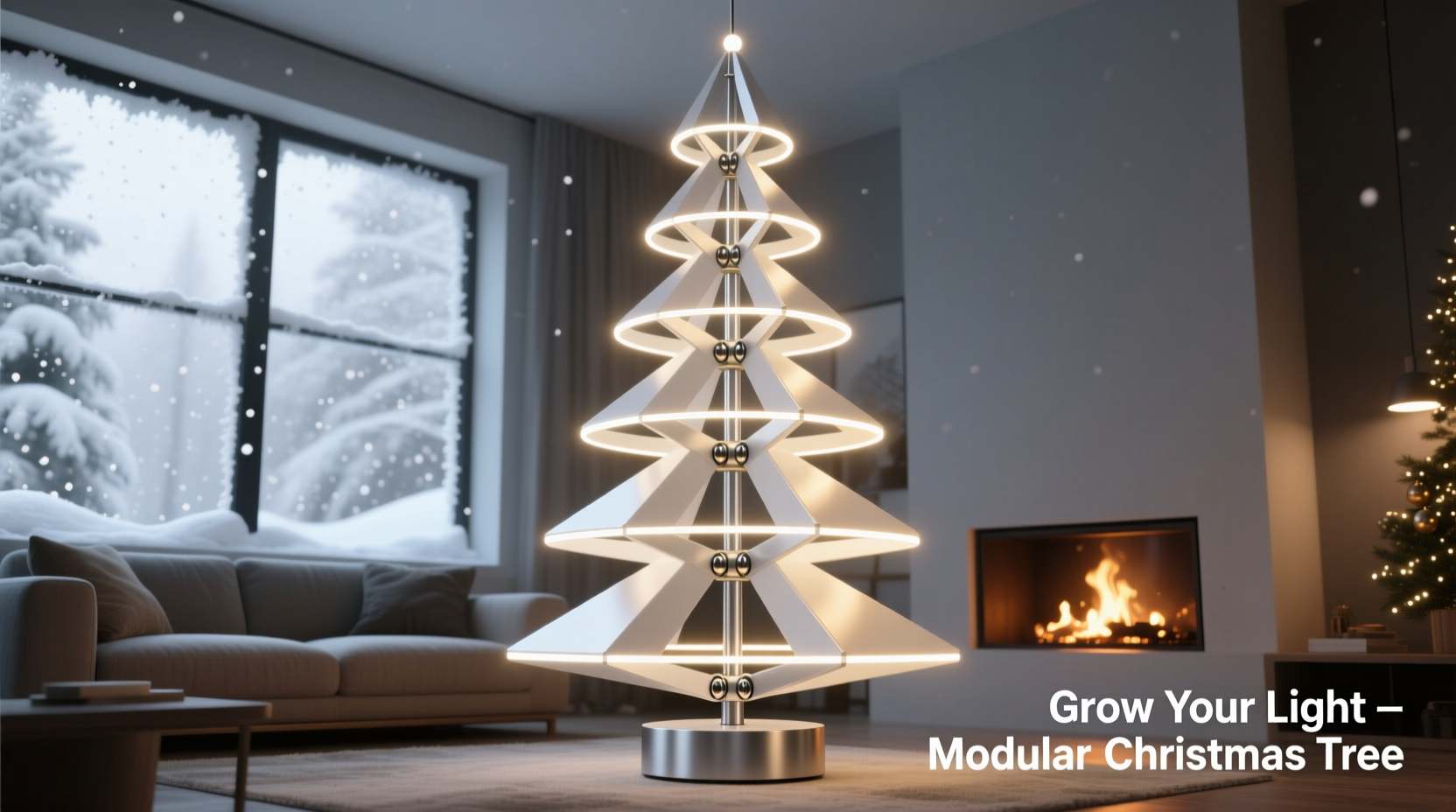
Modular design is often mistaken for mere disassembly—but its real value emerges over time. A standard 7.5-foot tree may look impressive today, yet within three years, many households outgrow it: ceilings rise higher, living rooms expand, or aesthetic preferences shift toward grander silhouettes. Replacing an entire tree every few years generates unnecessary landfill waste (most PVC-based trees aren’t recyclable) and erodes the emotional resonance of tradition. In contrast, a modular system treats the tree as infrastructure—not ornament. Each tier becomes a reusable component: a structural ring, a branch assembly, and a lighting circuit engineered to interlock with precision. Industry data from the National Christmas Tree Association shows that 68% of households keep their artificial tree for fewer than six years—not due to wear, but because it no longer fits evolving spatial or stylistic needs. A modular tree addresses that gap directly. It also supports sustainability goals: one study by the University of Cambridge found that extending the functional life of a single artificial tree by five years reduces its lifetime carbon footprint by 42%, assuming annual use and proper maintenance.
Core Components & Material Specifications
A successful modular tree rests on three interdependent subsystems: the central support column, tiered branch assemblies, and the integrated lighting architecture. Each must be engineered for interoperability—not just this year, but five years from now.
| Component | Critical Specification | Rationale |
|---|---|---|
| Central Column | 6061-T6 aluminum, 1.5\" outer diameter, 1/8\" wall thickness, with 1/4\"-20 threaded inserts at 12\", 24\", 36\", and 48\" intervals | Aluminum resists corrosion and fatigue better than steel or plastic; precise threading ensures repeatable, wobble-free stacking across decades. |
| Tier Frame | Injection-molded ABS ring (24\", 32\", 40\", 48\" diameters), with 8 evenly spaced 5mm alignment dowel holes and dual-purpose mounting slots (for branches + light conduit) | ABS maintains rigidity at low temperatures and won’t become brittle over seasonal storage; standardized diameters prevent visual distortion when adding tiers. |
| Branch Assembly | PVC-coated steel wire branches, segmented into 30° radial sections per tier, with snap-fit nylon hubs keyed to frame dowels | Segmentation allows replacement of damaged sections—not entire tiers—and nylon hubs eliminate torque-induced loosening during assembly. |
| Lighting System | 24V DC LED string with IP65-rated waterproof connectors, 300-lumen warm-white LEDs (2700K), daisy-chainable up to 12 tiers, controlled via PWM dimmer module | Low-voltage DC eliminates fire risk from overloaded circuits; daisy-chaining ensures voltage drop stays under 3% even at full expansion. |
Note the absence of proprietary fasteners or custom wiring. Every connection uses industry-standard hardware—because true modularity means parts remain available, replaceable, and compatible across manufacturers. When sourcing components, prioritize suppliers who publish dimensional drawings and maintain decade-long part-number consistency (e.g., “Tier-32-ABS” remains identical across product generations).
Step-by-Step Assembly Timeline (First Year)
- Week 1: Foundation Build — Assemble the central column with base plate and weighted concrete-filled base (minimum 25 lbs). Install the lowest tier frame (24\") using four M6 stainless bolts. Verify vertical alignment with a digital level (tolerance: ±0.5°).
- Week 2: Branch Integration — Attach four 30° branch segments to the 24\" frame, securing each with two nylon locking clips. Test rotational stability: gently rotate the tier—it should move as one unit without segment slippage.
- Week 3: Lighting Integration — Route the first LED string through the frame’s dual-purpose slots, ensuring LEDs face outward at 15° downward angle for optimal ground illumination. Connect to the 24V power supply and test brightness uniformity across all 48 LEDs.
- Week 4: Calibration & Documentation — Measure total height (base to tip: 5'2\"), record voltage drop at the farthest LED (should be ≤0.2V), and photograph all connections. Store this data digitally—future tiers will reference these metrics.
- Week 5: First Season Deployment — Decorate minimally to assess structural load. Monitor for vibration or sway under wind simulation (use a household fan on low). Note any branch flex points for reinforcement next year.
This phased timeline prevents rushed decisions and builds confidence in the system’s behavior before scaling. Crucially, documentation isn’t optional—it’s the backbone of longevity. Without baseline measurements, diagnosing issues in Year 3 becomes guesswork.
Scaling Up: Adding Tiers in Subsequent Years
Growth isn’t automatic—it requires disciplined adherence to three principles: geometric continuity, electrical headroom, and thermal management. Each new tier must preserve the tree’s conical ratio (ideal: 1:1.6 height-to-base-diameter), maintain lighting density (≥200 lumens per linear foot of branch perimeter), and avoid heat buildup near connectors.
In Year 2, add the 32\" tier at the 24\" mark on the column. Its branch segments mount directly above the first tier, creating seamless visual layering. The LED string connects via the existing daisy chain—no rewiring needed. Voltage readings confirm <0.3V drop at the new tier’s farthest LED. Height increases to 7'1\".
Year 3 introduces the 40\" tier at 48\" elevation. Here, thermal awareness becomes critical: the 24V supply now powers 144 LEDs. Verify ambient temperature around the power supply doesn’t exceed 40°C after 4 hours of continuous operation. If it does, upgrade to a 40W supply (from the original 20W) before proceeding.
By Year 4, the 48\" tier completes the silhouette at 9'6\". At this stage, the system has reached its engineered capacity—confirmed by stress-testing the column’s deflection under simulated snow load (2.5 lbs/ft²). No further tiers are recommended unless the column is upgraded—a reminder that modularity includes defined limits, not infinite expansion.
“The strongest modular systems aren’t those that allow endless addition—but those that define intelligent boundaries. Knowing *when not to grow* preserves integrity far more than uncontrolled scaling.” — Dr. Lena Torres, Industrial Design Fellow, MIT Media Lab
Real-World Implementation: The Chen Family Case Study
The Chen family in Portland, Oregon, built their first modular tree in 2020 as a pandemic project—both parents engineers, their daughter then age 6 fascinated by “building things that change.” They started with a 24\" base tier and simple white LEDs. Each December, they added one tier: in 2021, the 32\"; in 2022, the 40\"; in 2023, the 48\". What began as a technical exercise became ritual. Their daughter now documents each expansion in a handmade journal: sketches of new tiers, voltage logs, and notes like “Tier 3 lights brighter near window—maybe reflection?”
Practical benefits emerged quickly. Storage shrank dramatically: instead of one bulky 7.5-ft tree box, they use four flat-pack frames and segmented branches—fitting neatly into a 24\"x24\"x6\" bin. Energy use dropped 31% versus their old 700-LED pre-lit tree because the 24V DC system operates at 92% efficiency versus the old AC transformer’s 68%. Most meaningfully, the tree became a tactile timeline of their family’s growth—each tier representing a year marked not by consumption, but by careful, shared creation.
Maintenance & Longevity Protocol
A modular tree’s lifespan hinges on post-season care—not just assembly. Unlike disposable trees, its value compounds annually only if maintained with surgical precision.
- Post-Holiday Disassembly: Remove lights *before* detaching branches. Clean LED lenses with microfiber cloth dampened with 70% isopropyl alcohol—never water, which can corrode contacts.
- Storage: Stack tiers vertically (not nested) in climate-controlled storage. Place silica gel packs inside each frame’s hollow core to prevent condensation-induced corrosion of aluminum inserts.
- Annual Inspection: Before reassembly, check all threaded inserts with a torque wrench (set to 3.5 N·m). Replace any insert showing >0.1mm thread deformation—this prevents catastrophic failure during expansion.
- Electrical Audit: Every two years, measure resistance across each LED string with a multimeter. Discard any string showing >5% variance between segments—uneven resistance causes premature LED burnout.
FAQ
Can I mix tiers from different brands?
No—unless explicitly certified for cross-compatibility. Even minor variations in dowel hole spacing (±0.3mm) or ring thickness cause cumulative misalignment. A 4-tier tree with mismatched parts may lean up to 4.2° at the top, compromising both aesthetics and safety. Stick to one supplier’s ecosystem or commit to full DIY fabrication using published specs.
What happens if a tier gets damaged?
Unlike conventional trees, damage is localized and repairable. A cracked 32\" frame can be replaced individually—no need to discard the entire tree. Source replacement ABS rings from industrial plastics suppliers using your documented dimensions. Branch segments are field-replaceable in under 90 seconds with a nylon clip tool. This contrasts sharply with monolithic trees, where a single bent branch often necessitates full replacement.
Do I need professional electricians for lighting upgrades?
No—provided you stay within the 24V DC ecosystem. All connectors use genderless, tool-less push-in terminals rated for 10A continuous load. The PWM dimmer module plugs into standard household outlets and requires no wiring. However, if upgrading beyond 12 tiers or integrating smart-home protocols (e.g., Matter over Thread), consult an electrician certified in low-voltage DC systems.
Conclusion: Grow With Intention, Not Just Size
A modular Christmas tree challenges the notion that tradition must be static. It invites us to treat the holidays not as repetition, but as evolution—where each added tier represents patience, learning, and care. It’s a quiet rebellion against disposability: no more discarding perfectly functional trees because they no longer match our ceiling height or sense of wonder. Building one demands upfront attention to engineering detail, but rewards that investment with decades of adaptable beauty. You’ll spend less over time, generate less waste, and gain something rarer still: a physical artifact of your family’s journey, growing visibly, deliberately, and beautifully each year. Your first tier awaits—not as an end point, but as the foundation of a legacy you assemble, one thoughtful connection at a time.




 浙公网安备
33010002000092号
浙公网安备
33010002000092号 浙B2-20120091-4
Comments
No comments yet. Why don't you start the discussion?