
In Minecraft, accessing the Nether is a pivotal milestone in any survival world. It unlocks access to rare resources like blaze rods, ghast tears, nether wart, and ancient debris—essential for brewing potions, enchanting gear, and crafting powerful tools such as the netherite upgrade. However, constructing a functional Nether portal requires precision, preparation, and understanding of game mechanics. This guide walks you through every necessary step to successfully build a Nether portal in survival mode, from gathering materials to activating the gateway.
Gather the Essential Materials
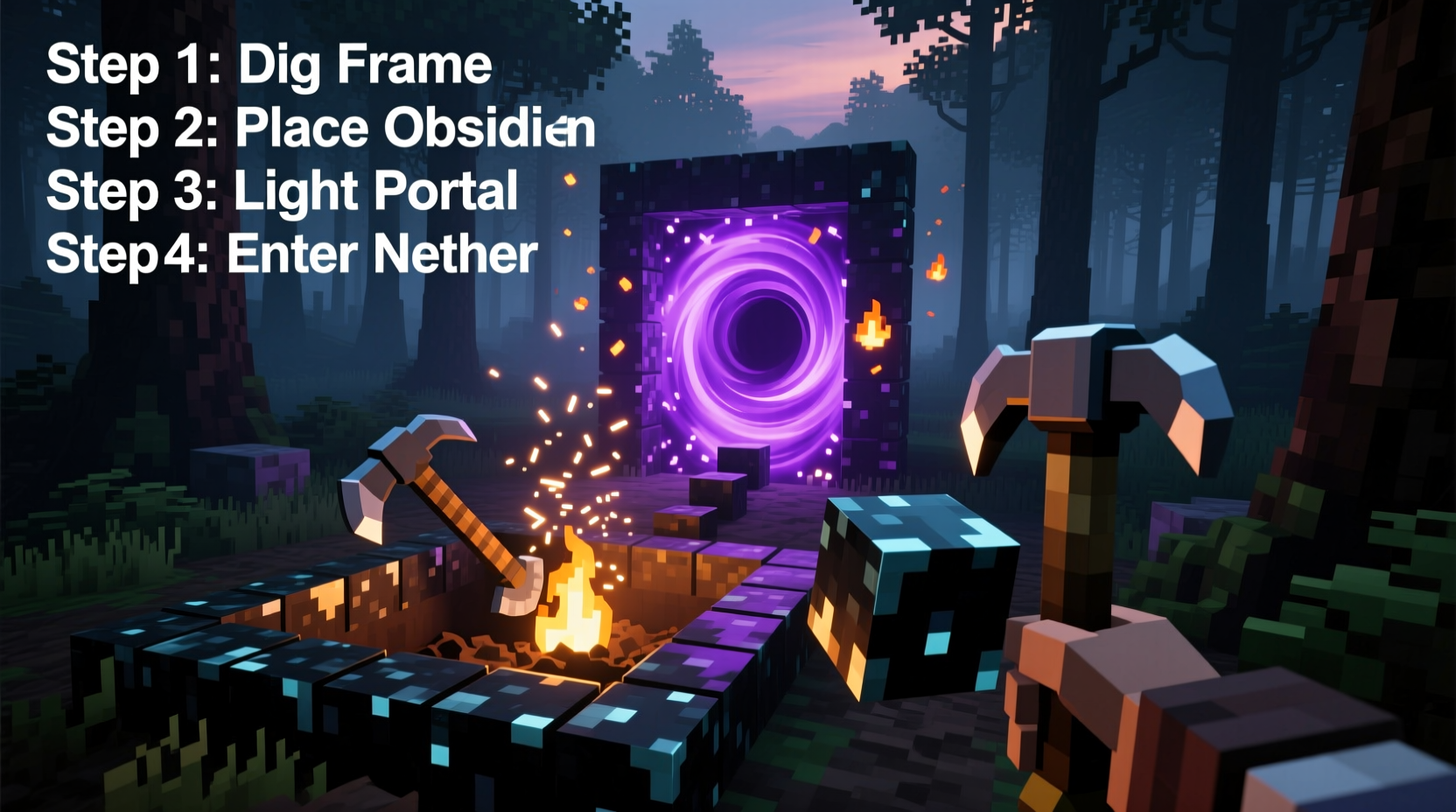
The first challenge in building a Nether portal is acquiring obsidian, the only block that can form the frame. Obsidian is one of the strongest blocks in the game and cannot be mined without a diamond or netherite pickaxe. Before beginning construction, ensure you have the following:
- 10–14 blocks of obsidian (minimum 10 for the frame; extras recommended for adjustments)
- Diamond or netherite pickaxe (to mine obsidian after placement)
- Flint and steel (to activate the portal)
- Water bucket (to create obsidian from lava)
- Lava source block (naturally found underground or in ravines)
Obsidian is formed when flowing water touches a stationary lava source block. You’ll use this interaction to generate obsidian in the Overworld. Locate a lava pool—commonly found between layers 10 and 15 underground—and bring a water bucket to initiate the reaction.
Create Obsidian Using Water and Lava
To produce obsidian, follow this precise method:
- Dig a small channel next to the lava pool, just wide enough for one block.
- Pour water into the channel so it flows toward the lava.
- When the water touches the stationary lava source, it will instantly turn into obsidian.
- Mine the newly formed obsidian using a diamond or netherite pickaxe.
- Repeat until you have at least 10 blocks.
It’s crucial to distinguish between a lava source block and flowing lava. Only a source block will generate obsidian when touched by water. Flowing lava will simply harden into cobblestone or stone, which is not useful for this purpose.
| Material | Function | Notes |
|---|---|---|
| Obsidian | Portal frame | Requires diamond/netherite pick to collect |
| Flint & Steel | Ignites portal | Durable but can break over time |
| Water Bucket | Cools lava | Must be used on source block only |
| Diamond Pickaxe | Mines obsidian | Wood/Iron picks won’t work |
Some players prefer to build an obsidian farm by creating a reusable setup where water and lava meet at a controlled point. This allows rapid generation of multiple blocks and is especially helpful if you plan to build larger portals later.
Construct the Portal Frame
The Nether portal must follow a strict size and shape to function. The frame must be a hollow rectangle made entirely of obsidian. Here are the exact dimensions:
- Minimum height: 4 blocks tall
- Minimum width: 4 blocks wide
- Maximum size: 23 blocks high and 23 blocks wide (practical builds rarely exceed 5x4)
To build a standard 4x5 portal:
- Place two vertical columns of obsidian, each 4 blocks high, four blocks apart.
- Connect the tops with a horizontal row of three obsidian blocks.
- Add a bottom base of three obsidian blocks between the lower ends of the columns.
- Ensure all corners are secure and the interior is completely empty (air blocks only).
The final structure should resemble a doorway with no cap on top—only the outer edges made of obsidian. The inside must remain open for activation.
Common Frame Mistakes
Many players fail their first attempt due to avoidable errors:
- Using fewer than 10 obsidian blocks
- Leaving the top open but forgetting the base
- Placing blocks inside the portal area
- Building too narrow (less than 4 blocks wide) or too short (less than 4 blocks tall)
If the portal doesn’t activate, recheck the structure against the official size requirements. Even one block deviation can render it non-functional.
Activate the Portal with Flint and Steel
Once the frame is complete, light the portal from within. Stand close to the inside edge of the frame and right-click with flint and steel on any inner face of an obsidian block. A purple, swirling effect will appear inside the frame, accompanied by a distinct sound. After about two seconds, the animation stabilizes into a permanent portal.
The activated portal creates a teleportation field. Walking into it transports the player to the Nether dimension after a brief transition.
“Precision matters more than speed when building a Nether portal. Rushing leads to wasted materials and failed ignitions.” — Lucas Reed, Minecraft Survival Guide Author
If the portal does not activate:
- Verify that the frame meets minimum size requirements.
- Ensure no blocks are obstructing the interior.
- Confirm you’re using flint and steel—not fire charges or other ignition sources.
- Check that your game settings allow Nether travel (e.g., cheats disabled, difficulty not set to Peaceful).
Mini Case Study: First-Time Builder’s Experience
Jamal, a new Minecraft player, spent hours digging deep into a mountain biome searching for lava. He located a lava lake at Y-level 11 but accidentally poured his water directly into the pool, turning it into stone instead of generating obsidian. After consulting a tutorial, he learned to place water adjacent to the source. By redirecting the flow with a trench, he successfully created fresh obsidian blocks. He built a 4x5 frame but forgot the base layer. When flint and steel failed to ignite it, he reviewed the structure and added the missing three obsidian blocks. On his second try, the portal activated immediately. His experience highlights the importance of understanding fluid mechanics and double-checking construction details.
Post-Activation Tips and Safety Measures
Entering the Nether without preparation is risky. The dimension is filled with hostile mobs, treacherous terrain, and environmental hazards. Before stepping through, consider the following safety steps:
- Bring armor and weapons: At minimum, iron gear and a sword.
- Carry building blocks: Cobblestone or dirt to escape danger or bridge gaps.
- Have food ready: Steak or golden carrots help sustain health during combat.
- Mark your portal location: Use torches or signs to find your way back.
- Keep inventory space: You’ll likely collect valuable drops like glowstone or soul sand.
If the portal breaks—either from explosions or accidental mining—you can relight it as long as the frame remains intact. In rare cases, if the entire structure is destroyed, you must rebuild it using stored obsidian or return via another portal linked through coordinates.
Understanding Nether Portal Mechanics
Minecraft uses a coordinate-based system to link Overworld and Nether portals. For every 8 blocks traveled in the Overworld, movement in the Nether covers 1 block. This ratio allows fast long-distance travel when portals are properly aligned. However, mismatched coordinates can result in spawning far from your original portal upon return.
Players who plan extensive exploration often build paired portals to ensure reliable往返 travel. This involves manually placing portals in both dimensions to control spawn points, avoiding random generation in dangerous areas like nether fortresses or lava oceans.
FAQ
Can I use fire charges instead of flint and steel?
No. While fire charges can ignite TNT and set fires, they cannot activate a Nether portal. Only flint and steel works for this purpose.
Why didn’t my portal light up even though the frame looks correct?
The most common reasons are incorrect dimensions (too small), internal blockage, or using a pickaxe weaker than diamond to mine the obsidian (which prevents collection). Also, ensure you're clicking on the inner side of the frame with flint and steel.
Do I need exactly 14 obsidian blocks?
A standard 4x5 frame uses 14 blocks (4 tall × 2 sides = 8, plus 3 top + 3 bottom = 6, minus 4 corners counted twice → total 10 unique placements, but physically 14 blocks placed due to overlap). However, some designs minimize overlap. Aim to have at least 10 usable blocks, but carry 14 to be safe.
Checklist: Building a Nether Portal in Survival Mode
- ✔️ Locate a lava source block (Y=10 to 15)
- ✔️ Bring a water bucket to create obsidian
- ✔️ Mine at least 10 obsidian blocks with a diamond pickaxe
- ✔️ Build a frame: 4–23 blocks high, 4–23 blocks wide, minimum 4x5 exterior
- ✔️ Ensure the interior is hollow and unobstructed
- ✔️ Use flint and steel on the inside of the frame to activate
- ✔️ Prepare gear before entering the Nether
Conclusion
Building a Nether portal in survival mode is a foundational skill that opens up vast new possibilities in Minecraft. From securing blaze rods for brewing to finding ancient debris for netherite upgrades, the rewards are immense. Success hinges on careful planning, proper material collection, and attention to structural detail. Once you’ve mastered the process, you’ll find that venturing into the Nether becomes a routine part of progression rather than a daunting challenge.




 浙公网安备
33010002000092号
浙公网安备
33010002000092号 浙B2-20120091-4
Comments
No comments yet. Why don't you start the discussion?