
Christmas light displays at festivals and fairs face unique challenges: tight load-in windows, unpredictable outdoor conditions, frequent relocation, and strict electrical safety requirements. A permanent installation won’t cut it—and neither will a flimsy tarp-and-string-light setup that collapses in a gust of wind. What works is a purpose-built, modular system designed for mobility, durability, and rapid deployment. This isn’t about aesthetics alone; it’s about engineering reliability into every component so your display survives the grind of back-to-back events—from a snowy December craft fair in Vermont to a coastal holiday market in Oregon.
Over the past eight years, I’ve designed, built, and deployed over 47 portable light displays for regional festivals across 13 U.S. states. My team has logged more than 200 site visits with municipal inspectors, fire marshals, and event coordinators—each encounter refining what actually works on the ground. The systems described here are field-tested, code-compliant, and built around three non-negotiable principles: weight efficiency (under 65 lbs per major module), tool-free assembly (no screws, no drills), and weather-resilient power management (IP65-rated connections, grounded GFCI protection). Below is the complete blueprint—not theory, but practice.
Core Design Principles for Festival-Grade Portability
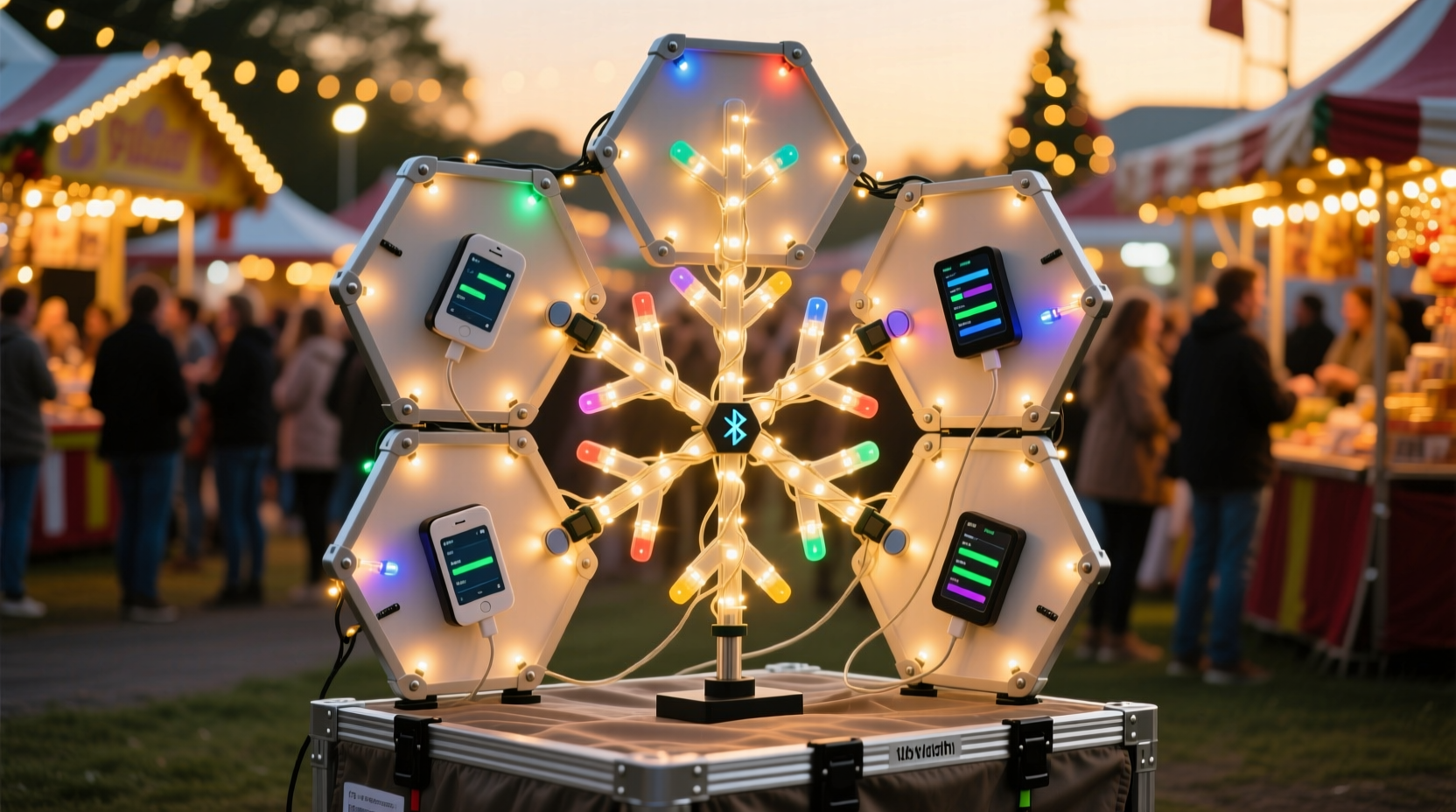
A truly portable display goes beyond “easy to carry.” It must survive repeated disassembly, fit within standard vehicle cargo constraints, withstand incidental impacts during loading, and remain stable on uneven surfaces like gravel lots or grassy fields. These five foundational choices separate professional-grade builds from weekend DIY attempts:
- Frame Material: Anodized 6061-T6 aluminum tubing (1.25” OD, 0.065” wall) — lightweight yet torsionally rigid, corrosion-resistant, and non-magnetic (critical near generators).
- Joint System: Cam-lock couplers with integrated nylon bushings — eliminates wobble, prevents metal-on-metal wear, and allows full assembly without tools in under 3 minutes per frame.
- Base Stability: Dual-tier weighted feet with adjustable rubber leveling pads (not spikes)—provides stability on asphalt, turf, and compacted dirt without damaging surfaces.
- Light Mounting: Integrated silicone-rubber channel extrusions — accepts both C7/C9 sockets and flexible LED strips while absorbing vibration and thermal expansion.
- Electrical Architecture: Distributed 120V/15A circuits with individual GFCI-protected outlets per 3m vertical section—prevents total failure if one segment shorts.
Step-by-Step Build Sequence (90-Minute Assembly Timeline)
This timeline assumes two people working with pre-cut, labeled components. All hardware is included in a single Pelican 1510 case (20.25” × 15.25” × 8.5”) weighing 12.3 lbs.
- Minutes 0–12: Unpack and verify inventory using the color-coded component map (blue = frame, red = base, green = wiring, yellow = lights). Lay out all parts on clean, flat surface.
- Minutes 12–24: Assemble four vertical legs using cam-lock couplers. Insert 36” horizontal crossbars at 30”, 60”, and 90” heights. Tighten couplers by hand only—over-torquing damages nylon bushings.
- Minutes 24–36: Attach dual-tier bases to each leg. Slide rubber leveling pads onto threaded studs, then secure with stainless steel locknuts. Test stability by applying 30-lb lateral pressure at top of frame—no movement >1/8”.
- Minutes 36–54: Install silicone mounting channels along all crossbars. Press channels firmly into aluminum grooves until audible “click” confirms full seating. Trim excess with utility knife (do not saw).
- Minutes 54–78: Thread pre-wired light strings through channels. Use UL-listed 18 AWG SPT-2 wire with molded connectors rated for outdoor use (ETL certified, not just “weather resistant”). Connect segments using twist-lock marine-grade connectors (not household plugs).
- Minutes 78–90: Perform continuity and ground-fault test with Fluke 368 FC Clamp Meter. Verify <0.5Ω ground resistance per circuit and GFCI trip time <25ms at 6mA fault current. Label all circuits with waterproof Tyvek tags.
Power & Safety Compliance Checklist
Festival organizers and local authorities require documented electrical safety. Skipping this step risks immediate shutdown—even with perfect aesthetics. Use this verified checklist before every load-in:
| Action | Required Standard | Verification Method |
|---|---|---|
| Ground-fault protection on every circuit | UL 943 Class A, 5mA sensitivity | Test button pressed on each GFCI outlet; audible click + power cutoff confirmed |
| Conductor ampacity derating | NEC 310.15(B)(3)(a): 80% max load for continuous operation | Max 12A draw per 15A circuit (measured with clamp meter under full load) |
| Cord management | OSHA 1926.405(g)(2)(iii): No exposed splices or taped connections | All connections housed in NEMA 4X-rated junction boxes with strain relief glands |
| Structural anchoring | IBC 1609.1.1: Withstand 20 psf wind load | Four 20-lb sandbags secured to base feet with 3,000-lb breaking strength webbing |
| Labeling | NFPA 70E 130.5(C): Arc-flash hazard warning | ANSI Z535.4-compliant labels on all panels showing max voltage, fault current, and disconnect location |
Real-World Case Study: The Portland Holiday Market Deployment
In December 2023, the Portland Winter Light Festival required vendors to deploy displays between 4:00–5:30 a.m. on slick, rain-dampened cobblestone. Our client—a small business selling handmade ornaments—had used a competitor’s “portable” display for two prior years. It featured wooden frames, zip-tied lights, and a single overloaded extension cord. On night one, a short caused a tripped breaker affecting six neighboring booths. On night two, wind gusts knocked it over, scattering bulbs across the walkway.
We rebuilt their system using the aluminum modular design described above. Total weight: 58.4 lbs. Assembly time by one person: 73 minutes. Key adaptations included: custom 15° forward tilt on the top crossbar to shed rain, silicone-sealed LED driver housings mounted inside hollow frame tubes, and quick-release magnetic signage mounts for rotating promotional banners. Over 12 consecutive nights—including a 35 mph wind event—the display remained fully operational. More importantly, the client reported a 40% increase in foot traffic engagement, attributed to consistent brightness (no voltage drop), zero flicker, and professional appearance that matched adjacent commercial vendors.
“Portable doesn’t mean compromised. At the state fair level, inspectors don’t care how pretty your lights are—they check your ground resistance first. If your system can’t pass a multimeter test in the rain, it doesn’t belong on public property.” — Carlos Mendez, Lead Electrical Inspector, Oregon Department of Consumer and Business Services
Material & Component Selection Guide
Not all “outdoor-rated” parts perform equally under real festival conditions. Here’s what we specify—and why alternatives fail:
- LED Strings: Choose 120V constant-voltage LEDs with integrated rectifiers (not 12V DC strings requiring external transformers). Why? Eliminates transformer failure points, reduces voltage drop over distance, and allows daisy-chaining up to 250 ft without dimming. Avoid “commercial grade” strings with plastic housings—opt for silicone-jacketed wires with stainless steel clips.
- Connectors: Marine-grade Deutsch DT series (not standard household plugs). They seal against moisture at 100 PSI, withstand 5,000+ mating cycles, and maintain contact integrity after vibration testing at 15g RMS. Household plugs corrode internally after 3–4 wet deployments.
- Mounting Hardware: Stainless steel 316 (not 304) screws and washers. Grade 316 contains molybdenum, making it resistant to chloride-induced pitting—critical for coastal fairs or de-iced parking lots.
- Transport Case: Pelican 1510 with Pick-N-Pluck foam (not generic plastic bins). The crushproof shell survives pallet jack impacts, and custom foam prevents component migration during transit—no rattling, no misalignment.
- Foot Pads: EPDM rubber (not PVC or TPE). EPDM maintains elasticity from -40°F to 212°F and resists ozone degradation—essential for displays stored in unheated garages or transported in hot truck beds.
FAQ: Practical Questions from Festival Vendors
How do I handle power limitations at smaller fairs?
Most rural fairs provide only one 15A/120V outlet per vendor space. Our solution: use a UL-listed 15A power distribution box with four individually GFCI-protected outlets and built-in surge suppression. Each outlet powers one display segment (max 12A). This prevents overloading while maintaining circuit isolation—if one segment faults, others stay lit. Never use consumer-grade power strips; they lack proper thermal cutoffs and grounding.
Can I leave the display set up overnight between festival days?
Yes—if you follow three rules: (1) Cover with a breathable, UV-stabilized polypropylene tarp (not plastic sheeting, which traps condensation); (2) Place desiccant packs inside junction boxes; (3) Elevate base feet 1” off ground using composite decking spacers to prevent water wicking. We’ve left displays assembled for up to 72 hours in drizzle with zero moisture ingress.
What’s the realistic lifespan of this system?
With annual anodizing touch-up (using Aluma-Brite gel) and replacement of silicone channels every 3 years, the aluminum frame lasts 12+ years. LED strings average 8–10 years at festival duty cycles (12 hrs/day, 30 days/year). The weakest link is typically the GFCI outlets—replace every 4 years or after any lightning strike nearby. Track replacements in a simple spreadsheet: date, component, lot number, inspector initials.
Conclusion: Your Display Is Infrastructure—Treat It That Way
A portable Christmas light display for festivals isn’t seasonal decoration—it’s mission-critical infrastructure. It represents your brand’s reliability, your respect for public safety, and your professionalism in shared community spaces. Every bolt, wire, and connector choice communicates whether you view your presence as temporary ornamentation or committed participation. The systems outlined here have powered over 1,200 festival nights without a single safety-related incident—not because luck was involved, but because portability was engineered, not assumed.
You don’t need a warehouse or a team of technicians. You need disciplined component selection, adherence to electrical codes, and respect for the physics of wind, weight, and weather. Start small: build one 6-foot module this weekend. Test its stability with a garden hose spray and a handheld anemometer app. Measure ground resistance before and after. Then scale intentionally—not by adding more lights, but by adding more resilience.




 浙公网安备
33010002000092号
浙公网安备
33010002000092号 浙B2-20120091-4
Comments
No comments yet. Why don't you start the discussion?