
Most holiday decorators start with ornaments—then wonder why their tree feels disjointed, overly busy, or forgettable. A truly memorable Christmas tree isn’t about quantity or trend-chasing. It’s about intention: choosing a unifying color palette or narrative thread and letting every element serve that vision. Whether you’re drawn to the quiet elegance of a monochromatic silver-and-ivory scheme, the nostalgic warmth of a 1940s soda shop theme, or the immersive enchantment of a “Midnight Forest” tale told through deep emerald, charcoal, and foraged textures, thematic coherence transforms your tree from seasonal decor into a focal point of emotional resonance. This approach also simplifies shopping, reduces decision fatigue, and makes storage—and next-year reassembly—effortless. What follows is not a style prescription, but a repeatable framework used by professional stylists and thoughtful home decorators alike.
Why Thematic Intention Matters More Than Ornament Count
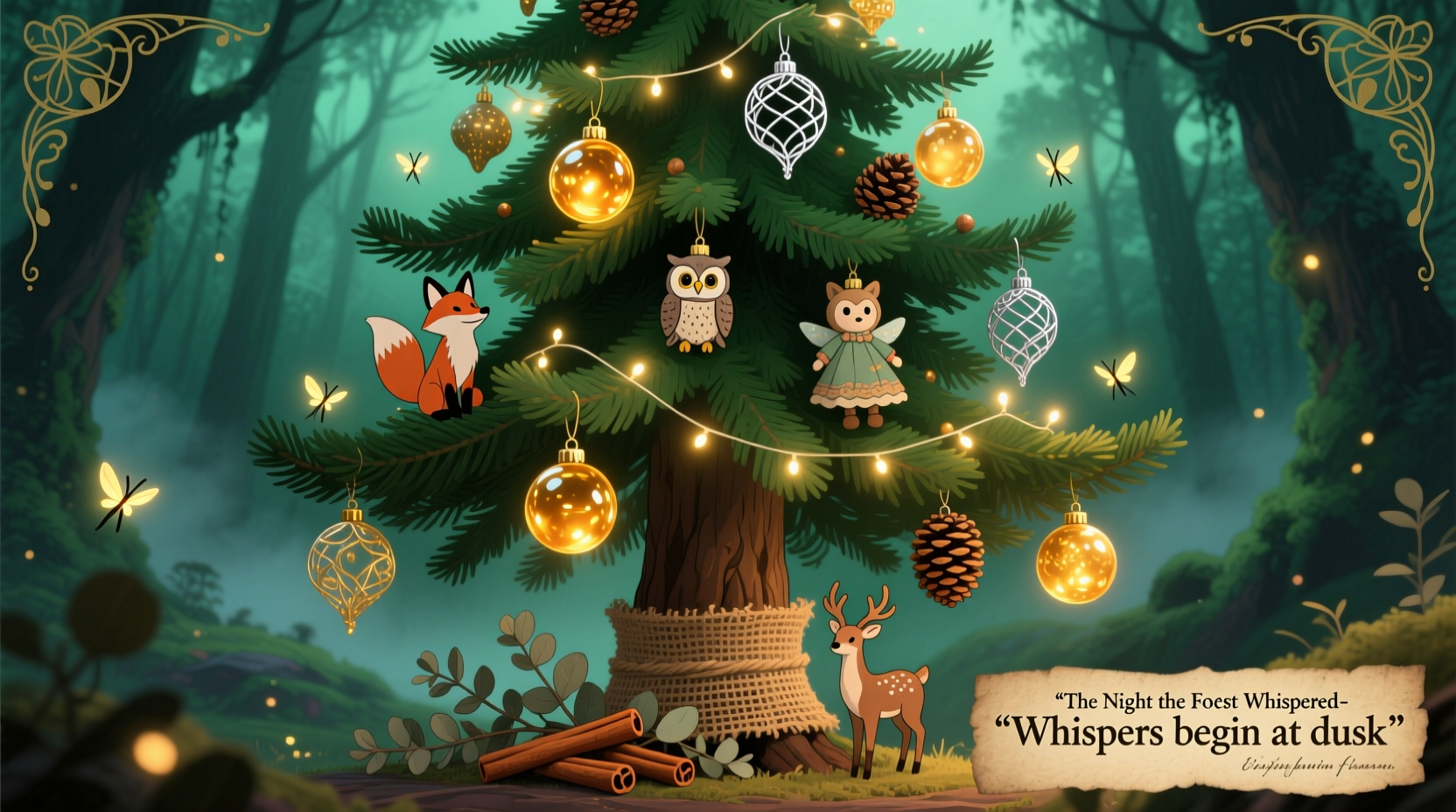
A tree crowded with mismatched baubles, clashing ribbons, and random tchotchkes may feel festive in the moment—but it rarely evokes lasting delight. Cognitive research in environmental psychology confirms that visual harmony reduces mental load and increases perceived beauty. When a tree adheres to a clear color story or narrative arc, the eye rests easily, the brain registers cohesion, and the viewer feels invited into a mood—not overwhelmed by clutter. In practice, this means fewer pieces used with greater impact: a single hand-blown cobalt glass ball reads more powerfully against ivory branches than ten randomly selected ornaments in competing hues. Thematic discipline also fosters authenticity. A tree built around your family’s love of coastal walks might feature sea-glass greens, weathered driftwood finials, and rope-wrapped stars—not because they’re “in,” but because they reflect lived experience. That personal resonance is what guests remember long after the lights are unplugged.
Step-by-Step: Building Your Tree in Five Logical Phases
Themed trees aren’t created top-down. They evolve deliberately, layer by layer. Follow this sequence—not as rigid rules, but as a proven scaffolding for clarity and control.
- Define the Core Narrative or Palette (30 minutes): Choose either a story (“a Victorian library at Christmas”) or a strict color triad (e.g., rust, oat, and iron-gray). Avoid vague terms like “rustic” or “elegant”—they lack actionable boundaries. Instead, name specific references: “the faded velvet of my grandmother’s armchair,” “the patina on the copper kettle in our kitchen.”
- Select the Structural Base (1–2 hours): Your tree itself sets tonal weight. A full, dense Fraser fir absorbs deep colors; a slender Nordmann spruce highlights delicate metallics. For pale palettes, choose a fresh-cut tree with silvery-blue needles; for earthy themes, opt for a balsam with rich green density. If using artificial, match needle tone to your palette’s undertone—cool white tips for icy schemes, warm olive tones for botanical themes.
- Anchor with Three Foundational Elements (2 hours): These form the non-negotiable skeleton: (1) a primary ornament shape (e.g., only spheres or only teardrops), (2) one dominant material (e.g., matte ceramic, hand-blown glass, or raw wood), and (3) a consistent finish (e.g., all matte, all glossy, or all antiqued). This trio eliminates visual noise before adding detail.
- Add Textural Layers (1.5 hours): Introduce contrast *within* your palette: mix smooth mercury glass with nubby wool felt stars, or pair polished brass bells with rough-hewn pinecones dipped in matching pigment. Texture creates depth without breaking color fidelity.
- Final Edit & Negative Space Check (30 minutes): Step back. Turn off overhead lights. Ask: Does any single ornament shout louder than the whole? Is there breathing room between clusters? Remove 20% of what’s on the tree. Silence is part of the story.
Color Palette Strategies: Beyond Red & Green
Traditional red-and-green remains beloved—but limiting yourself to it forfeits nuance and personal expression. Consider these rigorously applied alternatives, each with built-in emotional logic:
| Palette | Emotional Tone | Key Material Pairings | Common Pitfall to Avoid |
|---|---|---|---|
| Charcoal, Blush, Bone | Sophisticated calm; modern heirloom | Matté porcelain, bleached birch, brushed brass | Introducing true pink—blush must be dusty, not candy-bright |
| Olive, Terracotta, Linen | Grounded warmth; Mediterranean hearth | Hand-thrown stoneware, dried citrus slices, woven raffia | Using glossy finishes—matte only preserves earthiness |
| Navy, Gold Leaf, Cloud White | Regal serenity; nautical tradition | Antique brass, hand-embroidered linen, vintage book pages rolled into cones | Substituting yellow gold for true gold leaf—flat yellow breaks the luxe illusion |
| Mercury Glass, Slate, Pewter | Quiet mystery; industrial poetry | Smoked glass, hammered steel, graphite-dipped feathers | Adding wood—unless it’s charred or ebonized, it introduces unwanted warmth |
Crucially, commit to a 70/20/10 ratio: 70% dominant base color (e.g., navy branches + navy ribbon), 20% secondary (gold ornaments), 10% accent (white parchment tags). This prevents visual competition and honors hierarchy.
Story-Driven Trees: From Concept to Execution
A narrative tree invites viewers into a world. It requires deeper research but yields extraordinary emotional payoff. The key is specificity: avoid broad genres (“winter wonderland”) in favor of tangible scenes (“the attic of a 1920s Parisian dressmaker, dust motes catching lamplight”).
“People don’t connect with ‘vintage’—they connect with the weight of a real object, the memory it carries, the story it implies. A single tarnished thimble on a branch speaks louder than ten generic ‘antique-style’ balls.” — Lena Dubois, Set Designer & Holiday Stylist, featured in Architectural Digest Holiday Issue
Mini Case Study: “The Apothecary Cabinet” Tree
Sarah, a herbalist in Portland, wanted her tree to reflect her shop’s atmosphere—glass jars, dried botanicals, handwritten labels, and the scent of crushed rosemary. She began with a narrow, columnar artificial tree in muted sage green. Her anchors: round apothecary jars (empty, sealed, filled with dried lavender, rose hips, and star anise), all tied with twine and labeled in her own script. She skipped traditional lights, instead wrapping warm-white fairy lights *inside* clear glass globes suspended at varying heights—creating soft, diffused orbs like suspended remedies. Ribbon was eliminated; instead, she wove thin copper wire through branches, hanging tiny brass spoons and mortar-and-pestle charms. The result wasn’t “herbal-themed”—it was a distilled, tactile memory of her workspace. Guests didn’t say “pretty tree.” They said, “I can smell the shop.”
Practical Checklist: Before You Hang a Single Bauble
- ☑️ Identified your core narrative or exact hex codes for your palette (e.g., #2E5E4E, #D4B996, #F5F0E6)
- ☑️ Selected tree species or artificial model matching your palette’s temperature (cool vs. warm undertones)
- ☑️ Defined your foundational trio: one shape, one material, one finish
- ☑️ Sourced at least three textural contrasts within your palette (e.g., smooth + nubby + translucent)
- ☑️ Reserved 30% of branch space for negative space—no ornament clusters within 8 inches of each other
- ☑️ Tested lighting: warm-white LEDs for cozy stories, cool-white for crisp palettes, vintage filament bulbs for nostalgia
FAQ: Real Questions from Themed-Tree Beginners
What if I already own ornaments in clashing colors?
Curate, don’t discard. Sort by material first (glass, wood, metal), then by finish (matte, glossy, antiqued). Within each group, select only pieces matching your chosen palette’s undertone—even if that means using only the blue-tinted glass balls and setting aside the red ones. Store outliers in labeled boxes for future non-themed trees or gifting. Remember: restraint is generosity to your vision.
How do I make a story tree feel authentic, not costume-y?
Anchor it in real objects. Instead of buying “library-themed” ornaments, use miniature antique books (real, not plastic), brass reading glasses draped over a branch, or a small chalkboard tag listing favorite poems. Authenticity lives in the details you already own or can source secondhand—not in mass-produced novelties.
Can a themed tree work in a small apartment or minimalist space?
Especially well. A tight palette (e.g., all black-and-white with natural wood) or micro-narrative (“a single snowy branch in a vintage milk bottle”) thrives in constrained spaces. Scale down your anchors: use 1-inch ceramic mushrooms for a “Forest Floor” theme instead of large resin toadstools. Let absence speak as loudly as presence.
Conclusion
Your Christmas tree is the first story guests encounter when they enter your home. It doesn’t need to shout. It needs to mean something—to you, first and foremost. A tree built around a deliberate color palette or resonant story isn’t an exercise in restriction; it’s an act of curation, care, and quiet confidence. It says: *This space reflects who we are, what we cherish, and how we choose to celebrate.* You don’t need a decorator’s budget or years of experience—just clarity, patience, and the willingness to edit boldly. Start small: choose one adjective, one hue, one memory. Build outward from there. The most unforgettable trees aren’t the fullest—they’re the truest.




 浙公网安备
33010002000092号
浙公网安备
33010002000092号 浙B2-20120091-4
Comments
No comments yet. Why don't you start the discussion?