
Motivation is fleeting. It arrives like a spark—bright, energizing, and full of promise—but often vanishes just as quickly. You start strong: waking up early to work out, writing daily, launching a side project. Then, within days or weeks, the excitement wanes. The alarm feels heavier. The blank page more intimidating. The gym bag stays untouched in the corner. This isn’t failure. It’s human nature. The real challenge isn’t finding motivation; it’s building self discipline that persists when motivation disappears.
Self discipline isn’t about willpower alone. It’s a system of habits, environment design, mindset shifts, and consistent action—even when you don’t feel like it. Unlike motivation, which depends on emotion, self discipline thrives on structure. And while it may feel difficult at first, it can be cultivated deliberately over time. The people who achieve lasting results aren’t those with endless enthusiasm—they’re the ones who show up regardless.
The Myth of Motivation-Driven Success
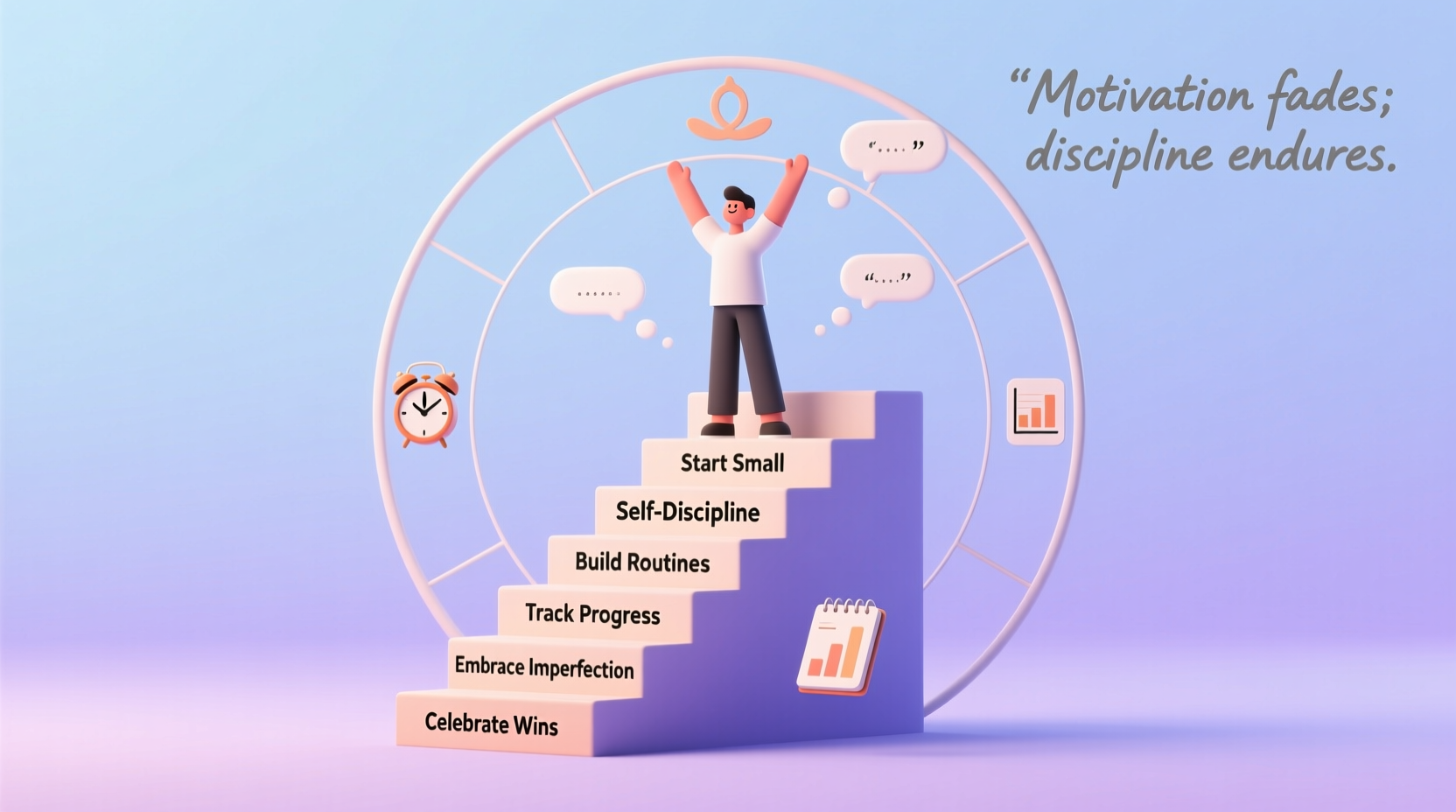
Society glorifies motivation. Inspirational quotes, viral videos, and success stories often emphasize passion and drive. But behind every sustained achievement lies something quieter: routine. Consider the writer who publishes a novel not because she feels inspired every day, but because she writes 500 words each morning before checking her phone. Or the athlete who trains in the rain, not because he loves it, but because his schedule demands it.
Motivation is unreliable. It fluctuates based on mood, energy, stress, and external circumstances. Relying on it sets you up for inconsistency. Self discipline, by contrast, operates independently of feelings. It’s the ability to act according to your values and goals, even when discomfort arises. As author James Clear puts it:
“Motivation gets you started. Habit keeps you going.” — James Clear, Author of *Atomic Habits*
The shift from motivation dependence to disciplined action is what separates short-term bursts from long-term transformation.
Design Your Environment for Discipline
Your surroundings shape your behavior more than you realize. Willpower is a limited resource. Every decision depletes it. If your environment is filled with distractions and temptations, you’ll exhaust your mental energy resisting them. Instead of fighting your surroundings, redesign them to support your goals.
Consider the example of Maria, a freelance designer struggling to meet deadlines. She’d sit down to work, only to find herself scrolling through social media an hour later. Rather than blaming herself, she analyzed her environment. Her phone was always within reach. Notifications popped up constantly. The solution wasn’t more willpower—it was change. She began using website blockers during work hours, placed her phone in another room, and created a dedicated workspace free of distractions. Within two weeks, her focus improved dramatically—not because she became more motivated, but because her environment supported discipline.
Small environmental tweaks compound over time. They reduce friction for good habits and increase it for bad ones. Over time, this makes disciplined action the default, not the exception.
A Step-by-Step Guide to Building Self Discipline
Discipline isn’t built overnight. It grows through consistent, incremental actions. Follow this six-step process to cultivate lasting self discipline:
- Clarify your “why”: Identify the deeper reason behind your goal. Is it health? Freedom? Legacy? A strong “why” provides direction when effort feels hard.
- Start small: Choose one tiny habit that aligns with your goal. Floss one tooth. Write one sentence. Walk for five minutes. Small wins build confidence and momentum.
- Create a trigger-action plan: Link your new habit to an existing routine. Example: “After I brush my teeth, I will meditate for one minute.” This builds automaticity.
- Track consistently: Use a calendar or app to mark each day you complete the habit. The visual chain creates psychological pressure to maintain it.
- Review weekly: Reflect on what worked and what didn’t. Adjust your approach without judgment. Discipline includes adaptability.
- Scale gradually: Once the habit is automatic, increase the difficulty slightly. But never sacrifice consistency for intensity.
This method works because it bypasses the need for constant motivation. By focusing on systems rather than outcomes, you create a sustainable path forward. Progress isn’t measured by inspiration, but by showing up—even when you don’t feel like it.
Common Discipline Killers (and How to Avoid Them)
Even with the best intentions, certain patterns sabotage self discipline. Recognizing these traps allows you to navigate around them.
| Trap | Why It Sabotages Discipline | Solution |
|---|---|---|
| Overcommitting | Takes focus away from core priorities, leading to burnout | Limit yourself to 1–2 key habits at a time |
| All-or-nothing thinking | One missed day feels like total failure, causing quitting | Adopt a “never miss twice” rule |
| Poor sleep or nutrition | Reduces cognitive control and impulse regulation | Protect foundational health habits first |
| Lack of feedback | Without progress markers, motivation drops | Use journals, trackers, or check-ins |
| Isolation | No accountability makes quitting easier | Share goals with a trusted friend or group |
Discipline isn’t about perfection. It’s about resilience. When you slip—which you will—the key is to respond with self-awareness, not self-judgment. Each recovery strengthens your capacity for long-term consistency.
The Role of Identity in Sustained Discipline
Most people approach self improvement from a behavioral level: “I want to run more.” But lasting change starts at the identity level: “I am someone who runs.” When your actions align with who you believe yourself to be, discipline becomes natural.
For instance, if you see yourself as a healthy person, skipping a workout feels incongruent with your identity. You don’t debate whether to eat junk food—you simply don’t do it, because it doesn’t fit who you are. This internal alignment reduces reliance on motivation.
Building identity-based discipline takes time. Start by making choices that reflect the person you want to become. Each small decision reinforces the belief. Eventually, the behavior isn’t a struggle—it’s an expression of self.
Mini Case Study: From Burnout to Breakthrough
David, a 34-year-old software developer, wanted to transition into data science. He enrolled in an online course but kept dropping off after a few weeks. Each time, he blamed his lack of motivation. “I just can’t get myself to study after work,” he said.
Instead of pushing harder, David stepped back. He realized he was trying to study for two hours nightly—a goal that required peak energy and focus after a full day of coding. Unsurprisingly, he failed repeatedly.
He revised his strategy. First, he reduced the target to 15 minutes per day, right after dinner. He prepped his laptop the night before so starting was effortless. He tracked each session on a wall calendar. After two weeks, the habit stuck. Only then did he slowly increase the duration.
Within four months, David completed the course and built a portfolio. He didn’t become more motivated—he became more strategic. His breakthrough came not from willpower, but from designing a system that made discipline inevitable.
Checklist: Building Self Discipline That Lasts
- ✅ Define your core goal and its deeper purpose
- ✅ Choose one small, specific habit to start with
- ✅ Anchor the habit to an existing daily routine
- ✅ Optimize your environment to reduce distractions
- ✅ Track your progress visibly (e.g., habit tracker)
- ✅ Review weekly and adjust as needed
- ✅ Practice self-compassion when you miss a day
- ✅ Reinforce your new identity through language and action
This checklist isn’t a one-time fix. It’s a framework to return to whenever motivation fades—which it will. The power lies in repetition, not intensity.
Frequently Asked Questions
How long does it take to build self discipline?
There’s no fixed timeline. Research suggests habits can form in 18 to 254 days, depending on complexity and individual differences. The key isn’t speed—it’s consistency. Focus on showing up daily, even in small ways, and discipline will grow naturally over time.
What should I do when I lose motivation completely?
When motivation vanishes, fall back on your smallest possible version of the habit. If you can’t run, walk. If you can’t write 500 words, write one sentence. The goal isn’t performance—it’s maintaining the thread of action. Momentum often returns once you restart.
Can self discipline be learned, or is it innate?
Self discipline is a skill, not a trait. While some people may have a genetic predisposition toward persistence, everyone can improve through practice. Like a muscle, discipline strengthens with use and weakens with neglect. The most disciplined individuals aren’t born that way—they’ve simply trained longer.
Conclusion: Discipline Is the Bridge Between Goals and Achievement
Motivation will come and go. Some days you’ll feel unstoppable. Others, you’ll barely muster the energy to begin. That’s normal. What matters isn’t how you feel—it’s what you do. Self discipline is the quiet force that carries you through doubt, fatigue, and distraction. It turns intention into action, and action into results.
You don’t need grand gestures or sudden inspiration. You need a plan, a process, and the willingness to persist when it’s hard. Start small. Design your environment. Track your progress. Reconnect with your purpose. Most importantly, keep going—even when no one is watching and nothing feels rewarding.




 浙公网安备
33010002000092号
浙公网安备
33010002000092号 浙B2-20120091-4
Comments
No comments yet. Why don't you start the discussion?